Thanx vs Punchh 2026: Which Restaurant Loyalty Platform Wins?
⚡ Expert Summary: Thanx and Punchh (now PAR Engagement) are the two dominant loyalty platforms for multi-location restaurants, and the choice comes down to philosophy. Thanx wins on card-linked auto-enrollment, AI-driven churn prediction, non-discount rewards that protect margins, and self-service customization. Punchh wins on scale (89k+ locations, 34 of top 100 brands), unified ordering+engagement ecosystem, and consulting-heavy support. For most restaurant operators who want lower effective discount rates and better data control, Thanx is the better bet in 2026. For brands that need a turnkey all-in-one suite with ordering built in, Punchh/PAR is the safer choice.
The Short Version
If you run 3+ restaurant locations and want a loyalty program that doesn’t destroy your margins with blanket discounts, go with Thanx. It captures every transaction automatically (no app download required), predicts which customers are about to churn, and sends personalized offers based on actual behavior rather than guesswork.
If you want a complete engagement ecosystem where loyalty, online ordering, kiosk, drive-thru, and marketing all live under one vendor, Punchh (now PAR Engagement) is the logical choice. It’s more established at enterprise scale, but it’s also more expensive and the features aren’t as focused on margin protection.
Both platforms are quote-based and start around $500/month for multi-location operators. Neither makes sense for a single independent restaurant.
What We’re Comparing
Both Thanx and Punchh serve the same market: restaurant chains that need a loyalty and guest engagement platform. Both connect to POS systems, send automated marketing, and track customer behavior. But they approach the problem from different angles, and those differences matter when you’re spending $500–2,000+ per month.
In the United States, where restaurant margins run 3-8% on average, a difference of 2-3% in effective discount rate isn’t theory — it’s the difference between a profitable location and a loss leader.
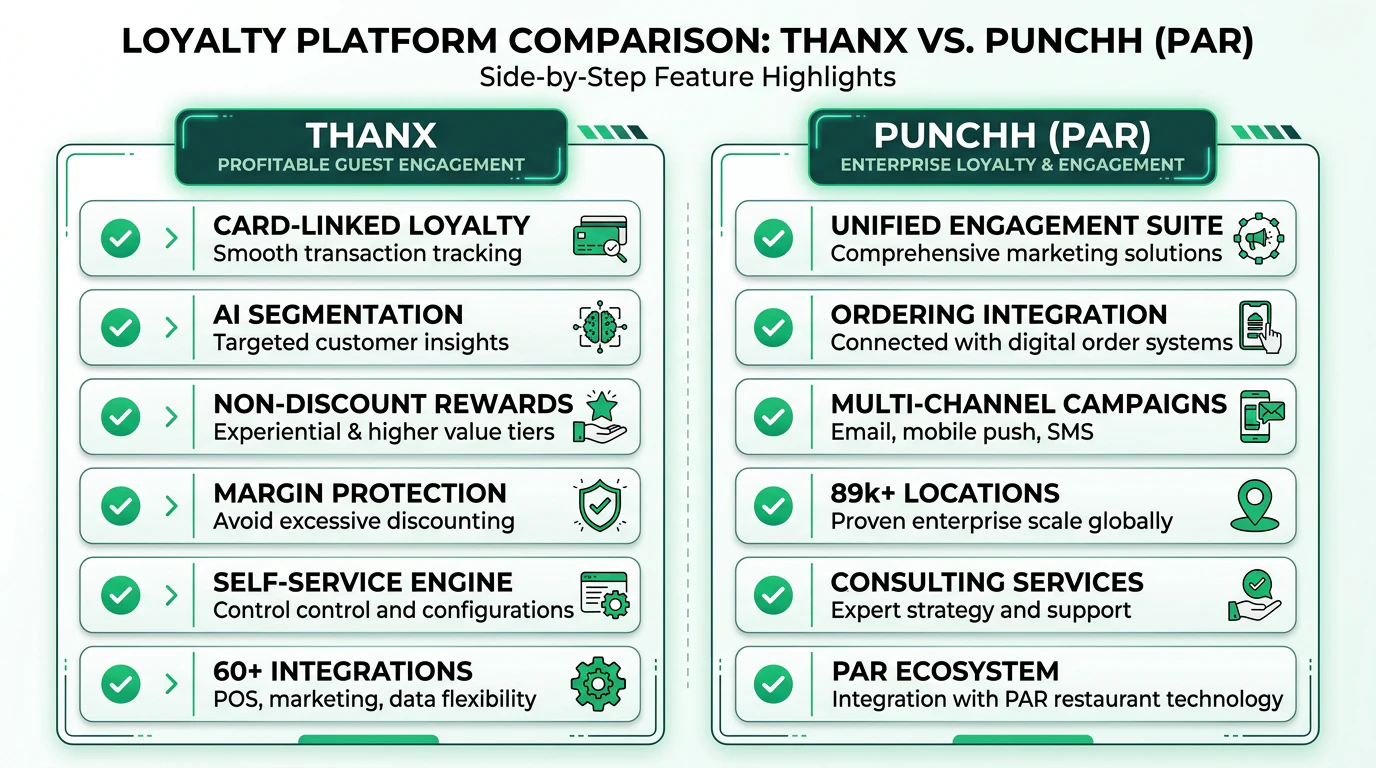
Thanx leads on card-linked loyalty and margin protection, while Punchh offers a broader unified engagement suite with ordering and kiosk integration built into the ecosystem.
Feature Comparison
| Feature | Thanx | Punchh (PAR) |
|---|---|---|
| Loyalty enrollment | Auto via payment card — no app download, no scan, no check-in | Phone number, QR scan, or app-based enrollment |
| AI churn prediction | ✅ Advanced — predicts churn and automates offers before customers leave | Basic — campaign personalization but no predictive churn engine |
| Reward types | Points + non-discount rewards (VIP access, hidden menus, experiences) | Primarily points and discount-based offers |
| Effective discount rate | ~2.4% average | ~10% average (industry standard) |
| Self-service customization | ✅ Loyalty Program Designer, real-time A/B testing | Limited — relies on PAR consulting services for custom work |
| POS integrations | 60+ (Toast, Square, Olo, Deliverect, etc.) | Major integrations within PAR ecosystem + open APIs |
| Online ordering | Third-party integrations only | ✅ Built-in PAR ordering suite (web, app, kiosk, drive-thru) |
| Mobile app | Custom branded app (high ratings, shared core platform) | Custom branded app within PAR ecosystem |
| Marketing automation | AI-powered, behavior-triggered SMS/email | Multi-channel campaigns with strategy consulting |
| Customer analytics | SegmentAI, effective discount reporting, churn dashboards | Unified data view across engagement channels |
| Scale | Mid-market to enterprise chains (Blaze Pizza, Pokeworks, Cheba Hut) | Massive enterprise scale (89k+ locations, 34 of top 100 brands) |
| Starting price | ~$500/month (Starter, quote-based) | ~$1,000+/month (Enterprise, quote-based) |
The difference in effective discount rate is the number that should grab your attention. Thanx claims an average of 2.4% — meaning the discounts they give away cost roughly 2.4% of revenue. Traditional programs (including Punchh) run around 10%. For a restaurant doing $50,000/month in loyalty-tracked revenue, that’s a difference of $3,800/month — or $45,600/year.
Where Thanx Wins
Card-Linked Enrollment Changes the Game
This is the single biggest differentiator. Thanx matches every credit or debit card transaction to a customer profile automatically. No app download. No typing a phone number into a keypad. No scanning a QR code while balancing a tray of food.
The result is dramatically higher enrollment rates. Thanx claims 223% growth in captured guests compared to legacy programs. When Blaze Pizza switched from Punchh to Thanx in 2025, they reportedly doubled their loyalty participation within months — without changing their menu, pricing, or locations.
Punchh requires the customer to actively enroll — scan a QR code, download an app, or enter a phone number. In busy QSR environments where customers are already juggling phones, bags, and kids, any friction in the enrollment process drops participation by 30-50%.
Non-Discount Rewards Protect Your Margins
Most loyalty programs are effectively coupon engines. Customers earn points, cash them in for discounts, and the restaurant eats the margin. Punchh’s model is primarily discount-driven.
Thanx offers a fundamentally different approach: non-discount rewards. Think VIP parking, early access to menu items, invite-only tasting events, secret menu access, or a dedicated service line for loyalty members. These rewards cost the restaurant almost nothing to deliver but feel valuable to the customer because they’re exclusive.
This matters because the data shows it works. Thanx’s average effective discount rate of 2.4% is roughly a quarter of what Punchh operators typically see. If you’re running 20 locations doing $40,000/month each, that 7.6% difference is $76,000/month you’re not giving away as discounts.
AI Churn Prediction Is Ahead
Thanx’s AI engine analyzes thousands of data points per customer — visit frequency, average ticket, menu preferences, time of day, recency of last visit — and flags accounts showing declining engagement before they lapse. The system then automatically sends a personalized win-back offer without anyone needing to push a button.
Punchh offers campaign personalization (segmenting customers for targeted offers) but doesn’t have the same predictive churn capability. Their strength is in breadth of campaign types across channels, not in anticipating who’s about to leave.
Where Punchh Wins
Scale and Enterprise Track Record
89,000 locations is not nothing. 34 of the top 100 restaurant brands use Punchh. If your brand operates nationally and needs a platform that’s proven at massive scale — and has the support infrastructure to handle complex rollouts — Punchh has the track record.
Thanx is growing fast but doesn’t approach that scale. It’s won mid-market chains (50-500 locations) and individual brands, but it’s not yet the default choice for the largest QSR operators.
Unified Ecosystem (If You Want It)
PAR owns the whole stack: Punchh (loyalty), PAR POS, PAR online ordering, PAR kiosk, PAR drive-thru. If you standardize on PAR infrastructure, the integration is seamless. Loyalty data flows directly into ordering, kiosk recommendations are personalized based on loyalty history, and drive-thru upsells adjust for VIP members.
Thanx integrates with everything (60+ POS systems), but it’s an integration — not a native part of the ecosystem. You’ll need to manage the connections yourself or through Thanx’s support.
Consulting and Strategy Support
Punchh provides hands-on consulting as part of their enterprise packages. Campaign strategy, segmentation advice, menu engineering for loyalty — their services team helps operationalize the platform. This is valuable for restaurant groups that don’t have a dedicated marketing person.
Thanx is more self-service. Their Loyalty Program Designer lets you customize everything yourself, and there’s support available, but the hands-on strategy service isn’t at the same level.
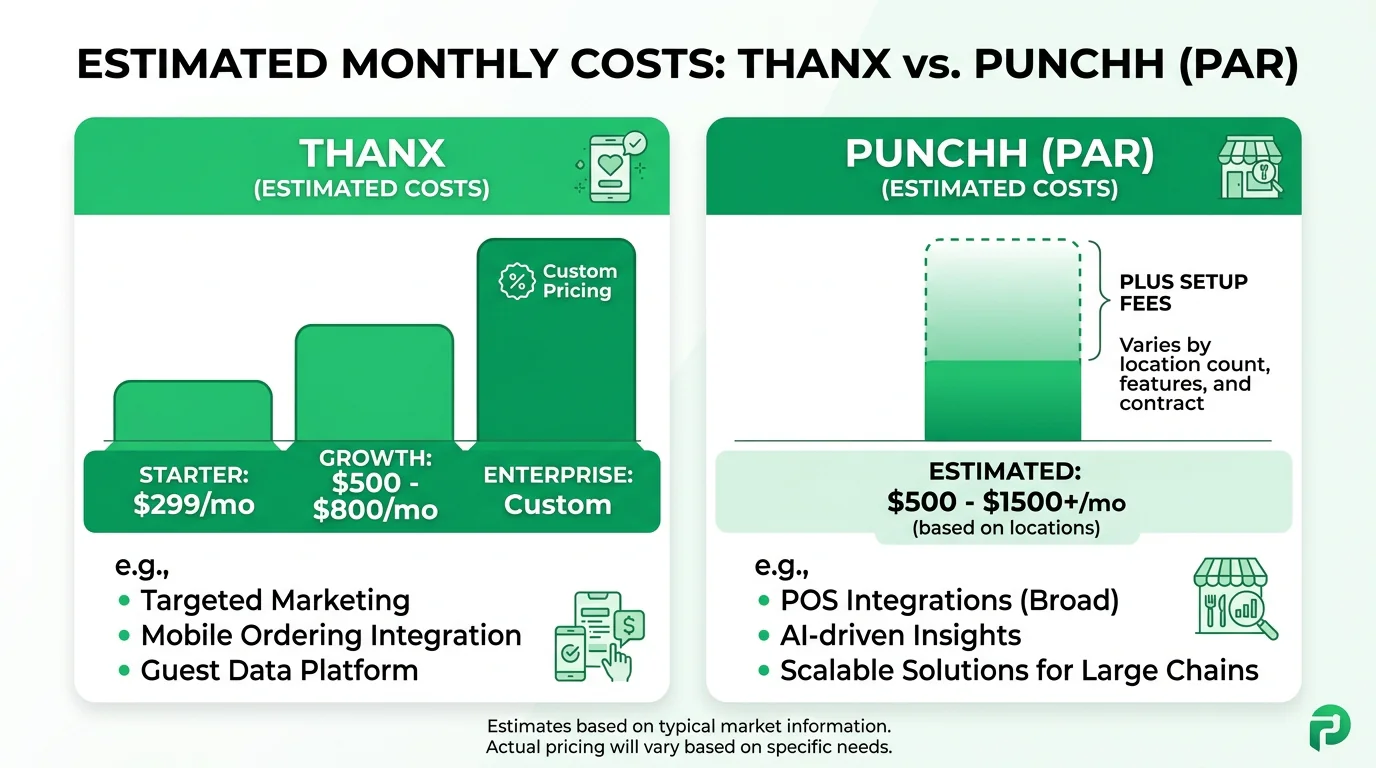
Both platforms are quote-based, but estimated pricing ranges show Thanx starting lower for mid-market operators while Punchh scales higher with enterprise-level service and ecosystem costs.
Pricing Reality Check
Neither platform publishes pricing publicly, which means you’ll need to go through a sales process to get a real quote. Based on available data and operator reports, here’s what you should expect:
| Thanx | Punchh (PAR) | |
|---|---|---|
| Entry-level estimate | ~$500/mo (3-5 locations) | ~$1,000+/mo (5+ locations) |
| Implementation fees | $1,000–3,000 (one-time) | $5,000–15,000+ (one-time) |
| Contract term | Annual (12-month minimum) | Multi-year typical (2-3 years) |
| Typical ROI timeline | 3-6 months (via discount rate reduction) | 6-12 months (via increased frequency) |
The key insight: Thanx’s ROI calculations usually center on reducing what you’re currently spending on discounts. If your existing loyalty program costs 10% of loyalty-tracked revenue in discounts, and Thanx drops that to 2.4%, the platform pays for itself before you count any revenue growth from improved retention.
Punchh’s ROI case is more about the revenue lift from a broader engagement ecosystem — ordering, kiosk upsells, drive-thru personalization — which is harder to attribute directly to the loyalty platform but potentially larger in absolute terms.
Real-World Switching Data
The most telling signal in this market is who’s switching and why. Several notable chains have moved from Punchh to Thanx in the last 18 months:
- Blaze Pizza (2025): Moved from Punchh to Thanx, doubled loyalty participation, switched to non-discount rewards model
- Cheba Hut: Reported faster enrollment and better analytics actionable data
- Hopdoddy Burger Bar: Cited better customer insights and lower effective discount rates
- Fox Restaurant Concepts (multiple brands): Consolidated on Thanx for unified data across concepts
The reverse (moving from Thanx to Punchh) is less common and typically driven by a larger enterprise consolidation where PAR is already the primary infrastructure vendor.
The Verdict
If you’re reading this and running a restaurant group, here’s the decision framework:
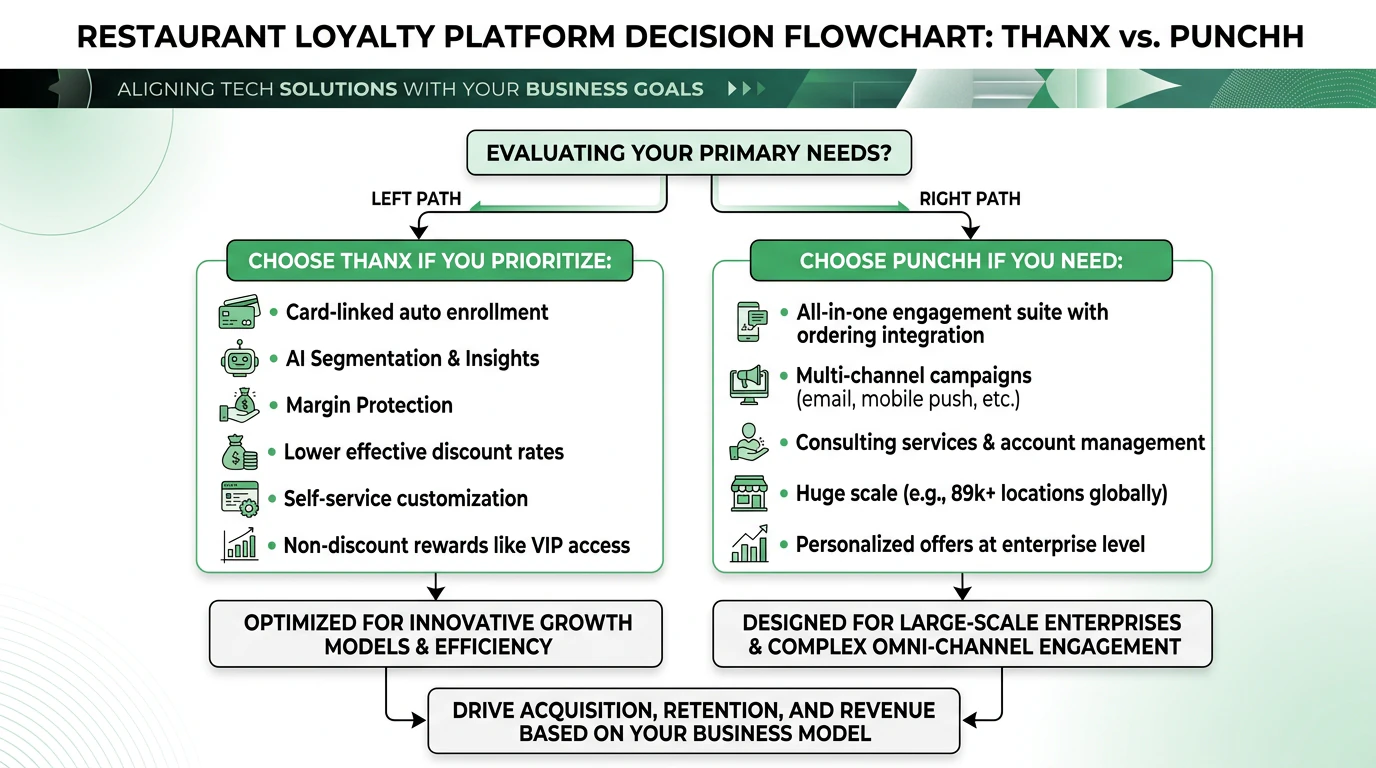
Decision framework for Thanx vs Punchh — the choice depends on whether your priority is margin protection and data control or a complete engagement ecosystem with ordering built in.
Choose Thanx if:
- You prioritize margin protection — lower effective discount rates matter more than ecosystem breadth
- You want frictionless enrollment — customers are enrolled automatically via payment cards
- You prefer self-service customization — you want to design and A/B test your own loyalty programs
- Your customers would respond to non-discount rewards (VIP access, experiences, priority service)
- You’re a 3-50 location operator looking for sophisticated analytics without enterprise-level complexity
- AI-driven churn prediction and automated retention is a priority
Choose Punchh (PAR) if:
- You want a unified engagement ecosystem — POS, ordering, kiosk, drive-thru, loyalty all from one vendor
- You need hands-on consulting and strategy support — you don’t have an internal marketing team
- You operate at enterprise scale (100+ locations) and need a platform proven at that level
- You’re already invested in the PAR ecosystem and switching loyalty vendors would mean displacing other PAR products
- You prefer multi-year contracts with a single vendor relationship for stability
Don’t choose either if:
- You run a single restaurant or fewer than 3 locations — the monthly cost is hard to justify
- You already use Toast POS and are satisfied with Toast’s free loyalty program — the value gap needs to be material
- Your customer base is primarily tourist traffic — loyalty programs work best with repeat local clientele
Frequently Asked Questions
Is Thanx better than Punchh?
For most multi-location restaurant operators, yes — Thanx offers better margin protection (2.4% vs ~10% effective discount rate), automatic card-linked enrollment that drives higher participation, and more advanced AI churn prediction. However, Punchh offers greater enterprise scale and a more complete ecosystem including built-in online ordering.
What is Punchh now called?
Punchh operates as part of PAR Technology and is marketed under the PAR Engagement umbrella. The product is often referred to as Punchh by PAR or PAR Punchh. In 2024 and 2025, PAR has been consolidating its engagement products under the unified “PAR Engagement” brand, but the Punchh name remains widely used in the industry.
Does Thanx work with Toast POS?
Yes, Thanx integrates with Toast POS along with 60+ other systems including Square, Clover, Olo, and Deliverect. However, Toast offers its own free loyalty program for Toast users, so the value proposition of Thanx depends on whether you need more sophisticated AI features and lower discount rates than the free option provides.
How much does Punchh cost?
Punchh pricing is quote-based and typically starts around $1,000/month for multi-location operators, with implementation fees ranging from $5,000 to $15,000+. Enterprise contracts are usually multi-year (2-3 years). The total cost depends on the number of locations, the scope of integrations, and whether you include PAR’s consulting services.
Can I switch from Punchh to Thanx?
Yes. Multiple notable chains have made this switch recently, including Blaze Pizza in 2025. Thanx offers migration support and data import from Punchh. The process typically takes 4-8 weeks depending on the number of locations and complexity of your current setup. Expect implementation fees of $1,000 to $3,000 for the migration.
Which platform has better AI features?
Thanx has more advanced AI features, particularly around churn prediction and automated retention campaigns. Their SegmentAI tool analyzes thousands of data points per customer and triggers personalized offers before a customer stops visiting. Punchh focuses more on campaign personalization across channels but doesn’t offer the same predictive capabilities.
Is Thanx or Punchh better for a small chain of 5 locations?
For 5 locations, Thanx is typically the better fit. It’s more affordable at the entry level (~$500/month), easier to customize without needing external consulting, and optimizes for the part of the business that matters most to small chains: protecting margins and building repeat customer relationships. Punchh is better suited for larger operations (50+ locations) where a unified vendor ecosystem drives more value.

About Barak Schurr
Barak Schurr built and exited a major ticketing platform, ran global operations at Eventbrite, and now focuses on one question: which AI tools actually help independent restaurant owners run leaner and grow faster. He writes from the operator’s perspective — no vendor spin, no theory, just what’s real in 2026.
Email: [email protected]
More Resources for Your Restaurant