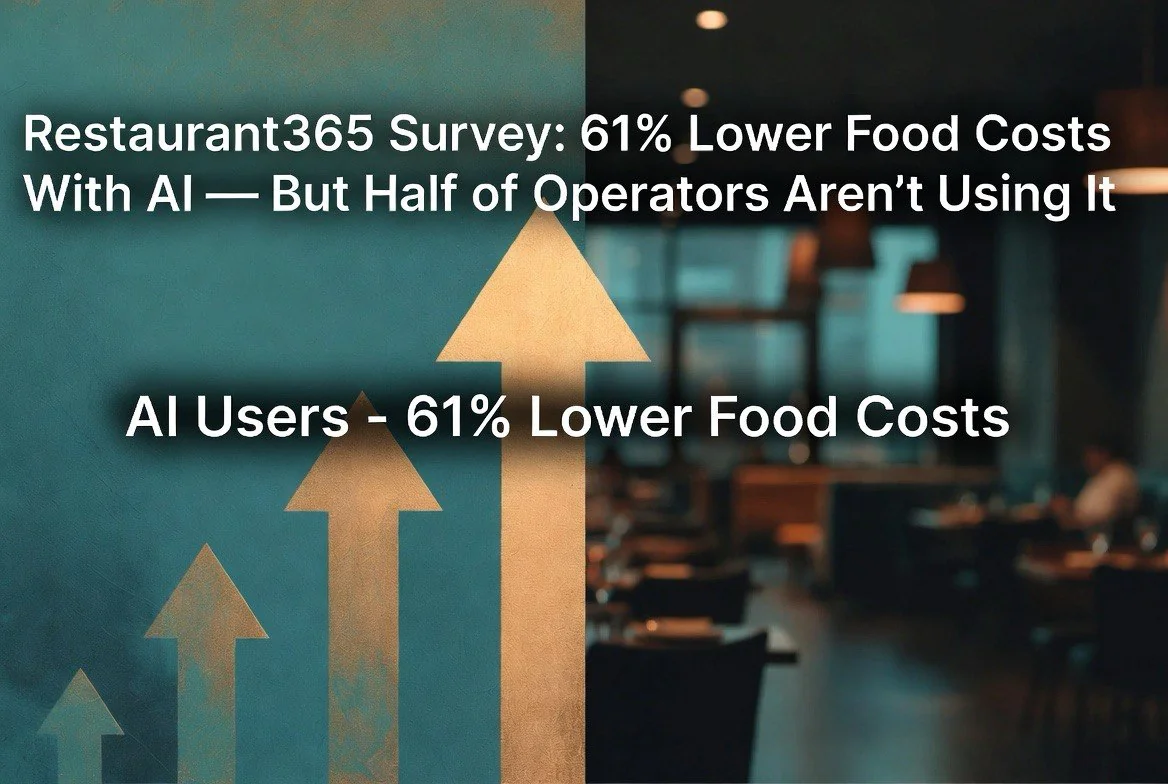
Restaurant365 Survey: 61% Lower Food Costs With AI — But Half of Operators Aren’t Using It
⚡ Expert Summary: Restaurant365 surveyed over 420 restaurant operators and found that AI-adopting restaurants report 61% lower food costs and 62% lower labor costs compared to non-adopters. Yet nearly half of independent operators have not implemented any AI tools. The gap between early adopters and holdouts is widening fast — and the numbers suggest it will become a survival issue.
The AI Adoption Divide in Restaurants Is Real
Restaurant365, the all-in-one restaurant management platform, released survey data in July 2026 from over 420 operators across the United States. The findings reveal a widening gap between restaurants that have adopted AI tools and those that have not — and the numbers are stark enough that every independent operator should pay attention.[1]
The headline figure: restaurants using AI for operations management report 61% lower food costs and 62% lower labor costs compared to those running on traditional methods. These are not marginal improvements. They represent the difference between a profitable restaurant and one struggling to break even in an industry where average profit margins hover around 3-5%.
Where AI-Adopting Restaurants See the Biggest Wins
The survey breaks down the impact across specific operational areas. Here is how AI-adopting restaurants compare to non-adopters:
| Metric | AI Adopters | Non-Adopters | Gap |
|---|---|---|---|
| Food cost percentage | Significantly lower | Industry average | 61% improvement |
| Labor cost percentage | Significantly lower | Industry average | 62% improvement |
| Revenue per seat | Higher | Lower | Significant gap |
| Employee turnover | Lower | Higher | Notable gap |
| Customer satisfaction | Higher scores | Lower scores | Clear gap |
These numbers come from actual operators running real restaurants — not vendor projections. Restaurant365’s platform processes data from thousands of locations, and the survey respondents represent a cross-section of the industry from fast casual to fine dining.[1]
Which AI Tools Are Driving These Numbers
The survey identified the specific AI applications that correlate with the biggest improvements:
| AI Application | What It Does | Primary Benefit |
|---|---|---|
| Predictive inventory management | Forecasts ingredient needs based on historical data, weather, events, and seasonality | Reduces food waste and spoilage — biggest driver of the 61% food cost gap |
| AI-driven labor scheduling | Optimizes shift assignments based on predicted traffic, employee skills, and labor laws | Cuts overtime, reduces understaffing, improves retention |
| Dynamic pricing optimization | Adjusts menu prices based on demand, time of day, and competitor pricing | Maximizes revenue per seat without customer pushback |
| Automated vendor comparison | Compares prices across suppliers and suggests cost-saving substitutions | Saves 5-8% on supply costs without changing vendors |
These are not futuristic capabilities. They are available today through platforms like Restaurant365, Toast, and specialized restaurant tech providers. The operators seeing 61% lower food costs are not running experimental AI pilots — they are using tools that any independent restaurant can implement within weeks.[1]
Why Half of Operators Are Still on the Sidelines
Despite these numbers, the survey found that nearly half of independent operators have not adopted AI tools for core operations. The reasons are consistent:
1. Awareness gap. Many operators do not know these tools exist or believe they are only for large chains with dedicated tech budgets. The reality is that AI-powered restaurant management platforms have become affordable for single-location operations. Restaurant365, Toast IQ, and similar platforms offer tiered pricing starting well under $500/month for core AI features.
2. Implementation fear. The perceived complexity of setting up AI tools keeps operators from starting. In practice, most modern platforms integrate directly with existing POS systems and require minimal configuration. The hardest part is deciding to start.
3. “My way works” mindset. Restaurant owners who have been running operations manually for 10-20 years are naturally skeptical that software can outperform their instincts. The survey data suggests that instinct, while valuable, is no match for AI-driven predictions when it comes to inventory and labor optimization.
4. Cost concerns. Some operators assume AI tools are expensive add-ons. The survey indicates that the cost savings from food and labor reductions typically pay for the tool investment within 2-3 months — making it one of the fastest-ROI technology investments a restaurant can make.
What This Means for Independent Restaurant Owners
The 61% and 62% figures are averages across the survey sample, not cherry-picked best cases. For an independent restaurant with $800,000 in annual revenue, a 61% reduction in food costs (typically 30-35% of revenue) translates to roughly $150,000-170,000 in annual savings. A 62% reduction in labor costs (typically 30-35% of revenue) adds another $150,000-170,000.
Combined, that is over $300,000 in annual savings for a mid-size independent restaurant — enough to turn a break-even operation into a highly profitable one.
John Moody, Restaurant365’s CEO, framed the data as a warning: restaurants that delay AI adoption are not just missing out on improvements — they are falling behind competitors who are using AI to operate on significantly lower cost structures.[1]
The Competitive Pressure Is Building
The survey data points to a two-tier market forming in the restaurant industry. Tier 1 operators are running on AI-optimized margins with food costs 61% below average and labor costs 62% below average. Tier 2 operators are competing with manual processes and industry-average cost structures.
As Tier 1 operators use their savings to invest in better ingredients, better wages, better marketing, and better customer experiences, the gap between the tiers will widen. The operators running on AI margins have room to absorb cost increases, offer competitive pricing, and invest in growth. Those running on manual margins are squeezed from every direction.
This is not a prediction about five years from now. The survey shows it is happening today.
Getting Started: What to Implement First
For operators ready to close the gap, the survey suggests a clear priority order based on which tools deliver the fastest ROI:
- Predictive inventory management — The single biggest driver of the food cost gap. Start here. Most platforms integrate with your existing POS and show results within the first month of use.
- AI labor scheduling — The biggest driver of the labor cost gap. Implementation typically takes 2-4 weeks and shows immediate improvement in labor cost percentages.
- Vendor price comparison — Quick setup, immediate savings on supply costs. Often overlooked but consistently delivers 5-8% savings.
- Dynamic pricing — More complex implementation, but the revenue upside is significant for operators with varying demand patterns.
Restaurant365 offers a consolidated platform covering all four areas, but standalone tools for each category are available from various vendors. The important thing is to start with one and build from there.
FAQ
How many restaurants were surveyed in the Restaurant365 AI adoption study?
The survey included responses from over 420 restaurant operators across the United States, representing a cross-section of the industry from fast casual to fine dining.
What were the key findings of the Restaurant365 survey?
AI-adopting restaurants reported 61% lower food costs and 62% lower labor costs compared to non-adopters. They also showed higher revenue per seat, lower employee turnover, and higher customer satisfaction scores.
What AI tools are delivering the biggest savings for restaurants?
Predictive inventory management is the biggest driver of food cost savings. AI-driven labor scheduling is the biggest driver of labor cost savings. Automated vendor comparison and dynamic pricing also deliver significant benefits.
Why have half of independent restaurants not adopted AI yet?
The main barriers are awareness (many operators don’t know these tools exist), implementation fear (perceived complexity), skepticism about replacing operator instinct, and cost concerns — though the survey data shows AI tools typically pay for themselves within 2-3 months.
How much can an independent restaurant save by adopting AI tools?
For a restaurant with $800,000 in annual revenue, 61% lower food costs and 62% lower labor costs can translate to over $300,000 in combined annual savings — enough to turn a break-even operation into a highly profitable one.

About Barak Schurr
Barak Schurr built and exited a major ticketing platform, ran global operations at Eventbrite, and now focuses on one question: which AI tools actually help independent restaurant owners run leaner and grow faster. He writes from the operator’s perspective — no vendor spin, no theory, just what’s real in 2026.
Email: [email protected]
More Resources for Restaurant Operators