Get the AI Restaurant Quick-Start Guide — Free
The 5 AI tools independent US restaurant owners are using right now to cut labor costs and answer every call.
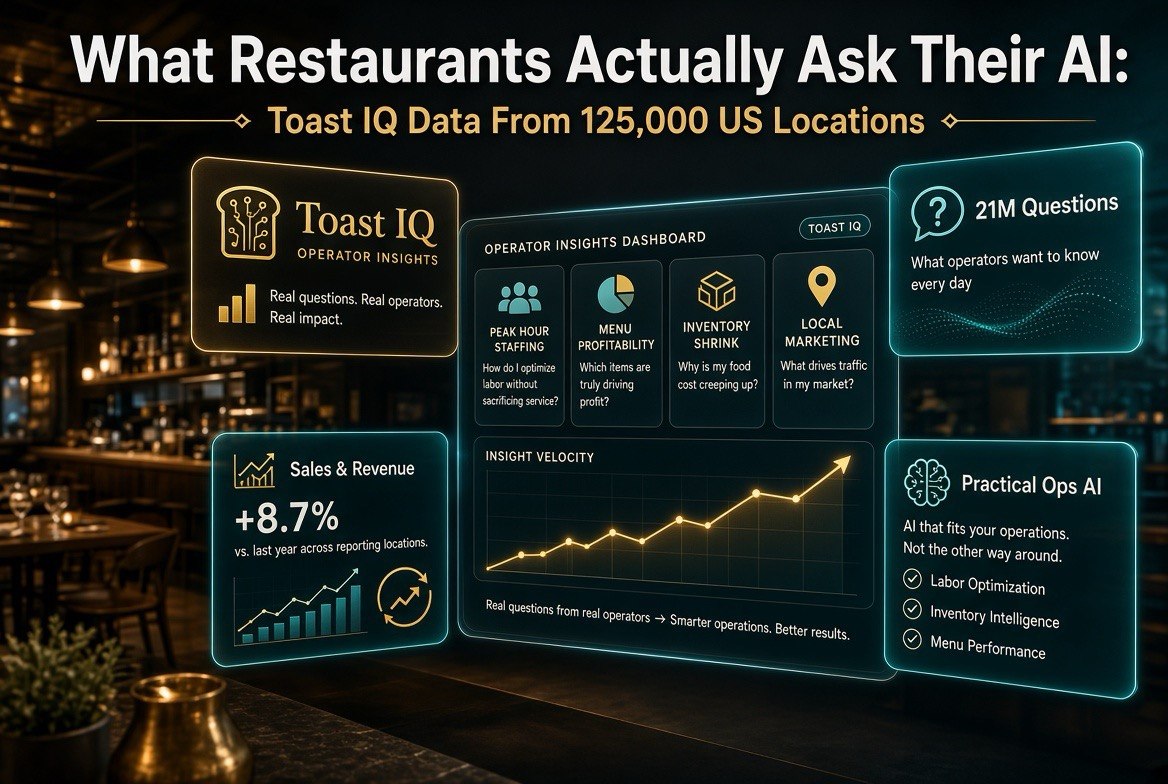
What Restaurants Actually Ask Their AI: Toast IQ Data From 125,000 US Locations
⚡ Expert Summary: In the first 90 days of 2026, operators across more than 125,000 U.S. restaurant locations sent over 21 million questions to Toast IQ, an AI assistant built into the Toast POS. The anonymous usage data reveals exactly what restaurant owners actually ask their AI — and it is not the clever stuff you might expect. Sales and revenue questions lead at 47%, menu and inventory at 34%, and guests and marketing at 32%. The single most popular prompt is “Create a short, easy-to-read daily briefing for my restaurant.” For an independent operator, this is a ready-made playbook: the questions your peers are asking are the ones where AI delivers the quickest, most measurable return.
Why What Operators Ask Matters More Than the Hype
There is no shortage of vendors telling you that AI will transform your restaurant. But there is very little real data on what independent operators actually do with the tools once the demo is over and it is eight o’clock on a Saturday night. That is precisely why the Toast IQ usage numbers matter. They are not a vendor pitch or a marketing survey. They are aggregated, anonymized records of more than 21 million real questions asked by real operators managing real restaurants across the United States in the first quarter of 2026.
Read that once more: 21 million conversations in 90 days. That is real-world usage at a scale no focus group can match. And it tells us something important — restaurant owners are not asking their AI to write poetry or generate clever slogans. They are asking it the same practical, margin-focused questions they have always cared about: what did we sell, what do we have, who is coming tonight. The AI is being used as a business intelligence assistant, not a novelty.
For you the operator, that is the signal. If your competitors are squeezing answers out of their point-of-sale data with AI, waiting means giving them a head start on the same insights you could be pulling from your own numbers.
The Numbers: What 21 Million Questions Actually Break Down Into
Let me put the query mix in front of you in a way that is easy to scan, because the proportions tell the real story about where independent restaurants feel the most pressure.
| Query Category | Share of Questions | What It Says About Operators |
|---|---|---|
| Sales and revenue | 47% | The money question dominates — operators want to know what they sold and why |
| Menu and inventory | 34% | Menu engineering and stock control are front-of-mind pressure points |
| Guests and marketing | 32% | Winning and keeping customers matters alongside day-to-day ops |
| Menu optimization opportunities | ~26% of restaurants | Owners are using AI to find underperforming items and pricing gaps |
| Labor costs and efficiency | ~13% | Scheduling and labor are real but secondary to sales and menu questions |
The pattern is unmistakable. The questions cluster around the two things that keep restaurant owners up at night: revenue and the menu. Nearly half of every question is aimed at understanding sales. That is not a coincidence — sales numbers are the most direct read on whether your operation is healthy, and operators instinctively reach for the tool that can turn raw POS data into a plain-language answer in seconds.
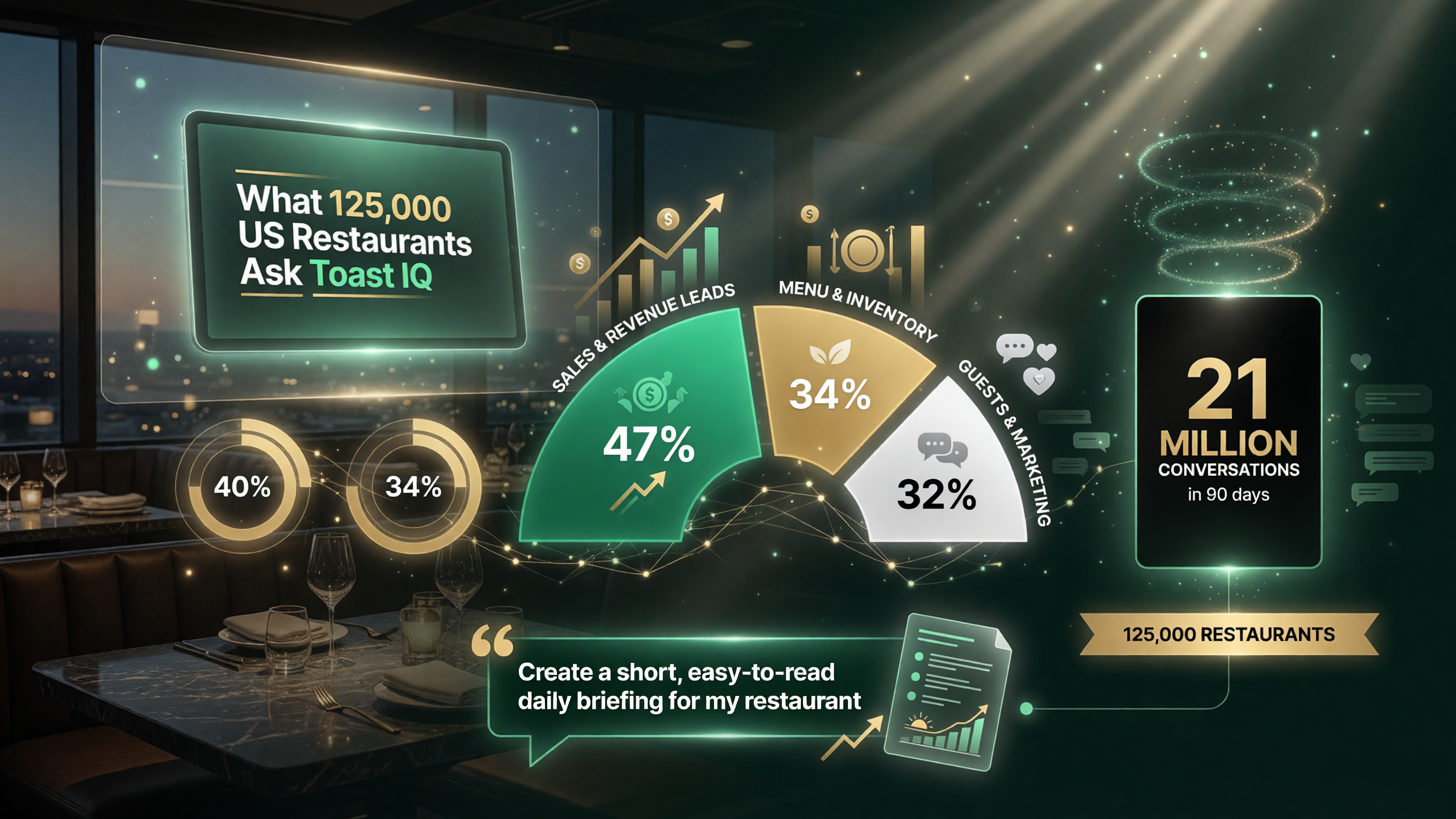
Toast IQ query mix across 125,000 U.S. locations: sales and revenue lead at 47%, menu and inventory at 34%, guests and marketing at 32% — 21 million conversations in 90 days.
The Single Most Common Question Perfectly Sums Up the Use Case
Here is the prompt operators asked more than any other: “Create a short, easy-to-read daily briefing for my restaurant.” That is the moment the whole AI story clicks into place. Restaurant owners are not asking for exotic analytics. They want the same thing they have always wanted — a quick, clear read on how the day went so they can make decisions and get on with the hundreds of other things demanding their attention.
The other popular prompts reinforce it. Operators ask their AI to “Show me my 2025 year in review,” “Refresh my menu items,” and “Show me today’s gross sales and highlight any notable variances from yesterday and from the same day last week.” These are not toy questions. They are the exact reporting tasks that, done by hand, eat up an owner’s evening — pulling reports, cross-referencing days, eyeballing trends. The AI compresses that into a conversation.
Notice what is missing from the popular list. Nobody is asking for generic marketing copy or restaurant-themed poems. The usage is overwhelmingly operational and financial. That tells you where the real value of restaurant AI sits: not in flashy tricks, but in making the boring, essential reporting work faster and clearer.
What the Data Tells an Independent Operator to Do
If you have a POS with an AI assistant, this data is effectively a list of the questions worth asking first. If you do not, it is a map of what your competitors are learning about their own business. Either way, there is a practical playbook here.
Start with the revenue question. Ask your AI for today’s gross sales, yesterday’s numbers, and the same day last week, with notable variances highlighted. That single question, asked daily, builds the habit of catching problems early — a slow Tuesday, a missing prep delivery, a price that stopped working — before they become a bad week.
Move to the menu. Ask which items are underperforming, which ingredients are eating the most cost, and where your menu has pricing or mix gaps. Menu engineering is where a lot of quiet profit hides, and it is one of the highest-value uses this data reveals.
Then turn to labor. Ask for scheduling insights, overtime trends, and labor cost as a percentage of sales across your shifts. With labor running 28–35% of revenue for most independents, even a small improvement here is meaningful money.
Finally, make the briefing a daily habit. If the most common prompt in the country is a daily briefing, there is a reason. Give yourself a two-minute morning read and let the AI surface the variances while you focus your attention on the decisions only you can make.
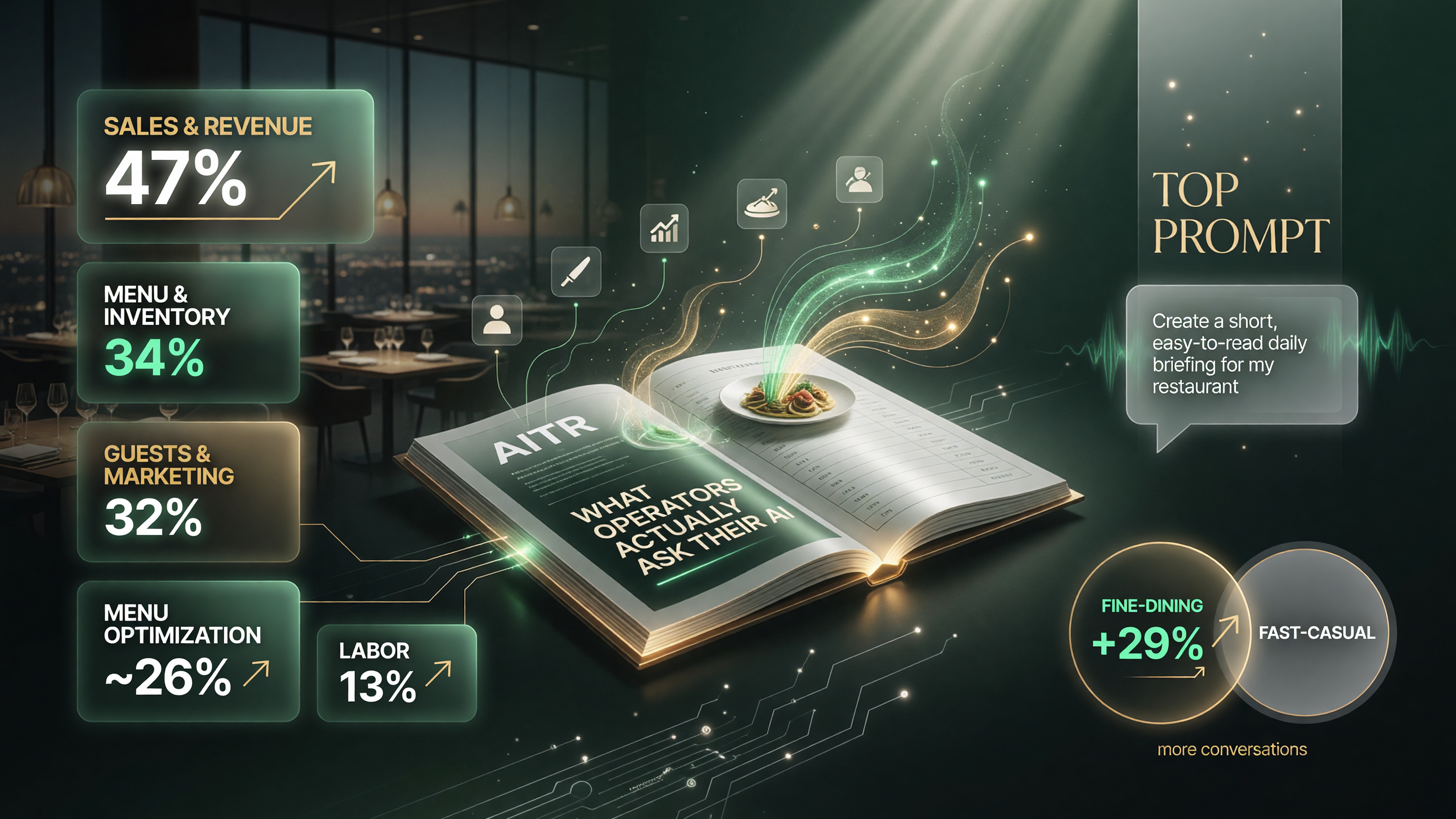
Menu optimization shows up in about 26% of questions and labor around 13%, while the single most common prompt is “Create a short, easy-to-read daily briefing for my restaurant.”
Why Fine-Dining Operators Are Asking More Than Anyone
One finding stands out: fine-dining locations generated about 29% more conversations with Toast IQ than fast-casual locations. That is a counterintuitive result that deserves real attention. You might expect high-volume quick-service operations, with their tight margins and sheer ticket count, to lean hardest on automation. The data says the opposite — the more complex, higher-ticket, service-heavy segment is engaging more.
The explanation makes sense once you think about it. Fine dining has more moving parts to manage: reservations, tasting menus, wine inventory, higher per-cover revenue, and a guest base that notices service details. The operator has more variables to track and less tolerance for guesswork. So they offload the analytics to the AI and keep their judgment on the floor. It is a reminder that AI adoption is not about the size or speed of your operation — it is about the number of decisions you have to make and how much each one is worth getting right.
For an independent owner in any segment, the lesson is the same: the more data you can pull out of your operation, and the faster you can act on it, the better you compete. The tool does not care whether you run one location or fifteen. It cares whether you ask.
The Bottom Line: Ask Better Questions, Get Better Numbers
There is nothing mysterious about restaurant AI once you see how operators actually use it. They are asking practical questions about sales, menus, guests, and labor — and getting plain-language answers that let them act. The 21 million conversations are proof that the tools deliver value when pointed at the right problems, not proof that restaurants are being taken over by robots.
Your move is simple and does not require a big budget. Start asking your own operation the high-value questions this data reveals — revenue variances, menu performance, labor cost, a daily briefing. Whether you adopt a modern POS AI assistant or you pull similar reports from the tools you already own, the discipline of asking these questions daily is what closes the gap between your numbers and your decisions.
The operators who asked first are already 21 million questions ahead. You do not need to catch that entire gap overnight. You just need to start asking — today, about one revenue question, then build from there.
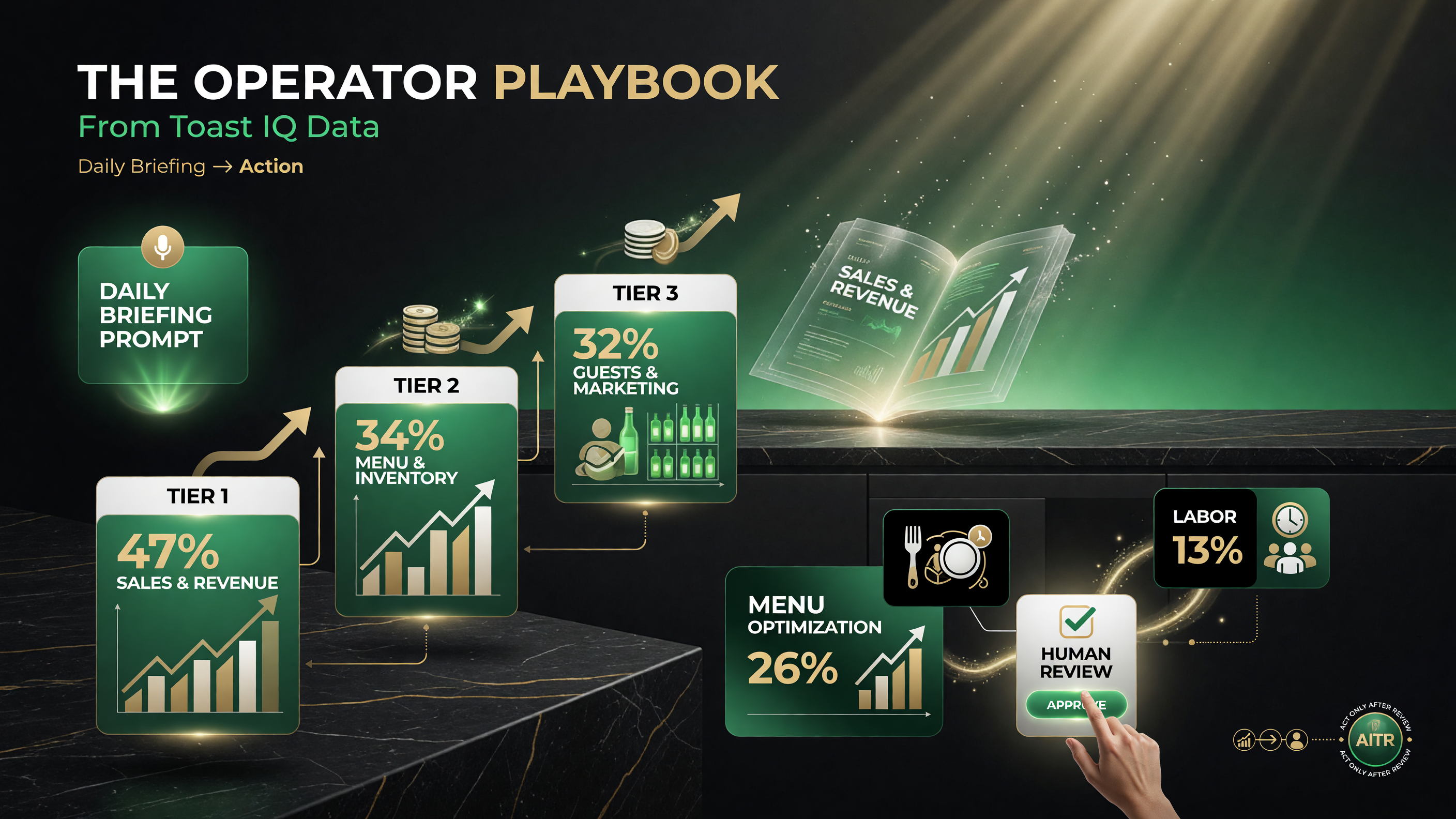
The playbook in action: start with the daily briefing, prioritise the money questions, and keep a human review step before acting on what the AI reports.
Frequently Asked Questions
What do restaurant owners actually ask AI assistants?
Real usage data from Toast IQ across 125,000+ US locations shows operators mostly ask about sales and revenue (47%), menu and inventory (34%), and guests and marketing (32%). The single most common prompt is a request for a short daily briefing.
How are restaurants using AI in 2026?
Operators are using AI assistants built into their POS to turn sales, menu, and labor data into plain-language answers — daily briefings, revenue variance checks, menu optimization, and labor cost analysis. The focus is operational and financial, not novelty.
Is AI actually worth it for independent restaurants?
Real usage suggests yes when pointed at the right questions. Operators sent over 21 million conversations to Toast IQ in Q1 2026, weighted heavily toward revenue and menu questions — the areas where quick, measurable returns live.
What should I ask my restaurant’s AI first?
Start with the revenue question: today’s gross sales versus yesterday and the same day last week, with notable variances highlighted. Then move to menu performance, labor cost as a percentage of sales, and a daily briefing.
Why is fine dining using AI more than fast casual?
Fine-dining locations generated about 29% more conversations with Toast IQ. The explanation is operational complexity — more variables like reservations, tasting menus, and wine inventory mean more decisions worth getting right.
Does this data come from a reliable source?
Yes. The figures come from Toast’s “90 Days with Toast IQ” analysis (BusinessWire, June 2026) and NRN coverage, based on aggregated anonymous usage from over 125,000 US locations in Q1 2026.

About Barak Schurr
Barak Schurr built and exited a major ticketing platform, ran global operations at Eventbrite, and now focuses on one question: which AI tools actually help independent restaurant owners run leaner and grow faster. He writes from the operator’s perspective — no vendor spin, no theory, just what’s real in 2026.
Email: [email protected]
More Resources for Restaurant Operators