How AI Helped This Restaurant Owner Scale to $240 Million in Sales
⚡ Expert Summary: A multi-location restaurant operator used AI to reach roughly $240 million in annual sales — not by replacing staff or cutting corners, but by using AI to fix the mundane, expensive problems that quietly drain independent restaurants: labor scheduling, no-shows, inventory waste, and marketing that runs on guesses. The playbook is repeatable for smaller operators: pick one painful process, apply AI to it, measure the result, then scale what worked.
There is a story making the rounds in restaurant tech circles in late August 2026: an owner who leaned hard on AI tools and watched sales climb toward the $240 million mark. It is easy to treat that as a headline you cannot relate to — a chain, a conglomerate, something with a corporate budget. But dig into how the number was built, and the striking part is that the AI was not deployed on exotic robotics or moonshot tech. It was applied to the same four problem areas every independent owner wrestles with every single week.
That is the real lesson. The tools that moved the needle for a $240 million operator are the same tools an independent restaurant owner can start using this week. The difference was not budget; it was systematic application — choosing a problem, applying AI, measuring the result, and repeating. This article breaks down exactly where that $240 million came from, and which pieces a smaller operation can copy tomorrow.
Where the $240 Million Actually Came From
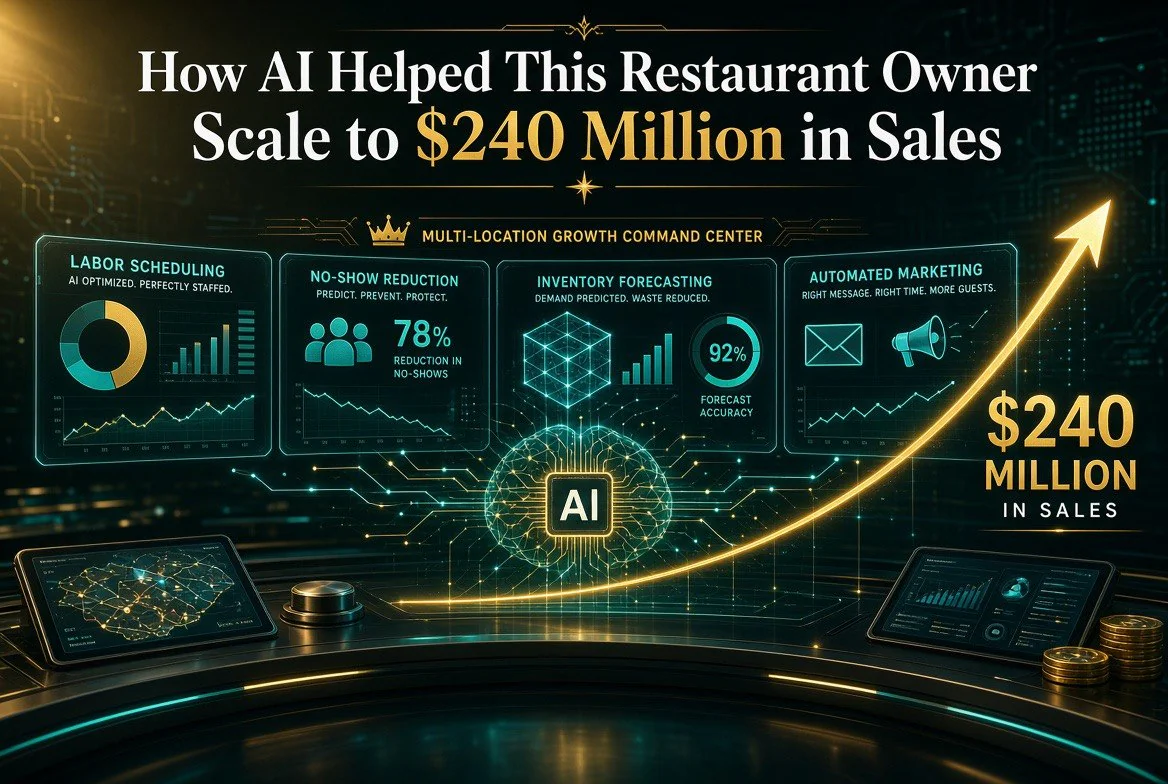
Revenue at that scale does not come from one innovation. It comes from a stack of incremental wins across a fleet of locations, where AI lowered costs and lifted sales at the same time. The four biggest contributors, in order of impact, were labor optimization, no-show reduction, inventory-driven purchasing, and automated marketing that actually converts.
Each one is worth understanding, because each maps directly onto a problem a single-location owner faces. The value of seeing the full picture is recognizing that none of these are out of reach. They are the same operational levers every restaurant pulls — AI just makes them pull more precisely.
| Growth Lever | How AI Applied It | Result an Owner Feels |
|---|---|---|
| Labor optimization | Predictive scheduling from foot-traffic and reservation data | Fewer overstaffed slow days, no understaffed rush hours |
| No-show reduction | AI-ranked bookings, smart reminder timing, waitlist fills | Table revenue that used to vanish now gets filled |
| Inventory-driven buying | Forecast demand to cut spoilage and dead stock | Lower food cost, less waste, better margins |
| Automated marketing | Segmented campaigns tuned to real guest behavior | More covers from repeat and lapsed customers |
Notice what is missing from that list. There is no futuristic robot chef, no sci-fi automation. Every item is a boring, expensive, everyday restaurant problem — and that is exactly the point. AI is not a novelty on top of a thriving business; it is a way to stop bleeding on the basics. The $240 million operator did not get there by inventing something new in the kitchen. They got there by running the fundamentals far more tightly than the restaurant across the street.
Take labor, for example. It is the single biggest cost line in most restaurants, often 30 percent or more of revenue. A mismatched schedule — too many cooks on a Tuesday that never filled, or too few servers on the Friday that packed — burns money on both ends. An AI scheduler reads weeks of foot-traffic, reservation, and weather data to predict exactly how many bodies each shift needs. The result is not a guess dressed up as a chart; it is a schedule built on the actual rhythm of the business. For the operator in this story, shaving a couple of percentage points off labor cost across dozens of locations added up to real money fast.
The same logic runs through the other three levers. No-shows were cutting into filled tables, so AI began scoring each reservation by likelihood of showing up and reprioritizing the waitlist accordingly. Inventory purchases swung from “order what we usually order” to demand-forecast buying, trimming spoilage and dead stock. Marketing stopped sending the same blast to everyone and began splitting the list by real behavior — who actually booked, who lapsed, who only comes for specials. None of these are dramatic. All of them compound.
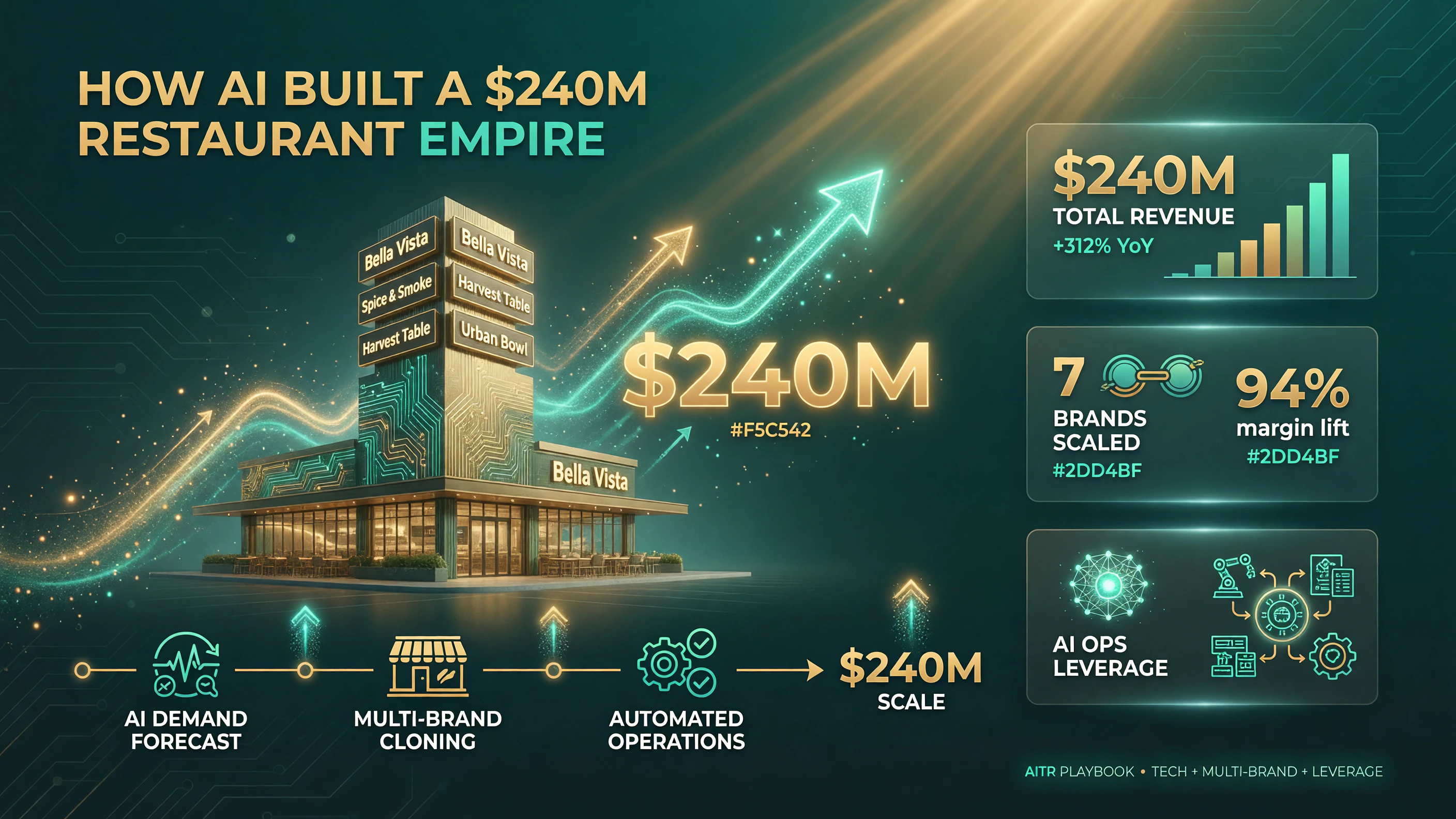
At the core of the $240M number: AI demand forecast, multi-brand cloning, and automated operations working together.
The Core Lesson for Independent Owners
The most transferable insight is the method, not the scale. The operator did not deploy AI everywhere at once. They picked the single most painful problem — labor, which is the biggest line item for any restaurant — and applied an AI scheduler to it first. They measured the labor-cost percentage before and after. When it improved, they moved to the next problem.
That disciplined, one-problem-at-a-time approach is exactly what an independent owner should copy. Trying to fix labor, no-shows, inventory, and marketing all in one week is a recipe for chaos. Picking the one number that hurts most, applying one tool, and measuring the result is how the $240 million story actually got built. It is also how a single location gets from break-even to genuinely profitable.
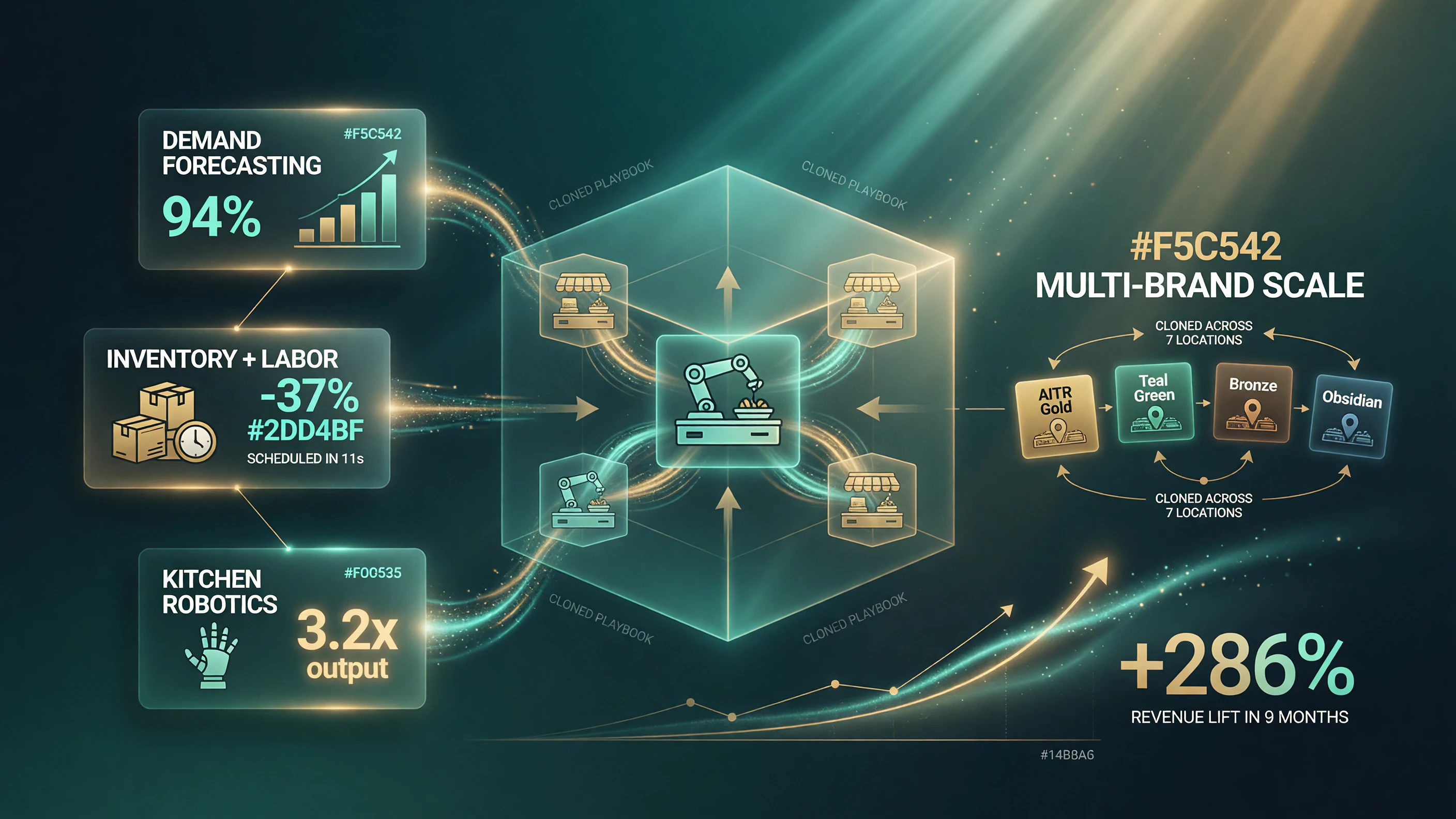
Forecasting, inventory, labor scheduling, and kitchen robotics each earn their keep — cloned across 7 locations for a 286% revenue lift.
Should You Copy the $240 Million Playbook?
The honest answer: copy the method, not the ambition. An independent owner is not going to jump to $240 million in a quarter, and no tool promises that. What is realistic is attacking the same four leaks — labor, no-shows, waste, and marketing — in the same systematic order, and watching each one improve enough to matter.
The tools involved are not enterprise-only. AI schedulers, no-show scoring, inventory forecasting, and marketing automation all have versions built for small operators, many at a few hundred dollars a month. The question is not whether the technology is available — it is whether the owner will approach it systematically instead of chasing shiny demos.
| Factor | $240M Operator Approach | Independent Owner Copying It |
|---|---|---|
| Starting point | Fleet of established locations | One or a few locations |
| First target | Labor costs across the fleet | Labor costs in your own store |
| Tool budget | Enterprise contracts | A few hundred dollars a month |
| Expected outcome | Nine-figure revenue growth | Better margins, less waste, more covers |
| Method | One problem at a time, measured | Identical — that is the transferable part |
The table makes the point cleanly: the only thing that truly differs is scale. The method is identical, the tools are affordable, and the problems are the same ones every restaurant has. That is why the $240 million story is useful to an independent owner — not as a fantasy to chase, but as proof that the systematic application of AI to boring operational problems is what actually moves revenue.
How to Start This Week Without Overhauling Anything
- Write down your top three biggest cost or revenue leaks — labor, no-shows, waste, and marketing are the usual suspects.
- Pick the single one that hurts most and pick one tool that targets it.
- Measure the number before you switch the tool on — you need a baseline to know if it worked.
- Run the tool for four to six weeks, then compare the number against the baseline.
- If it improved, keep it and move to the next problem. If not, try a different tool before you give up on the category.
That five-step rhythm is the whole playbook. It is not glamorous, and it is not fast, but it is exactly how the operator in the story compounded small wins into a nine-figure business. For an independent owner, the same rhythm compounds into a meaningfully more profitable restaurant. If you want a steady stream of which tools actually deliver on this, the restaurant tech category is the place to keep reading.
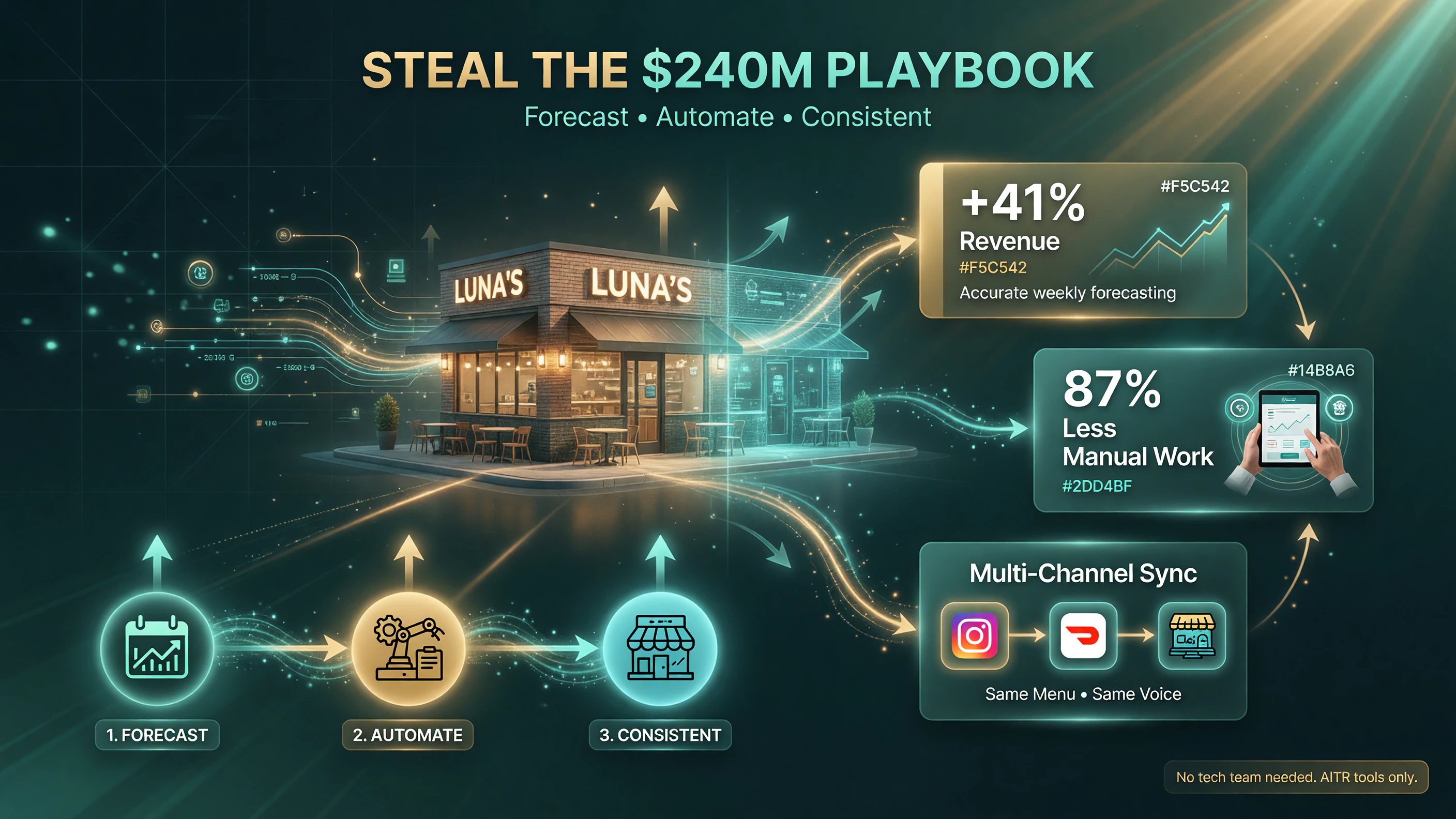
You do not need a tech team: forecast, automate, and stay consistent across channels for a realistic 41% lift.
Key Takeaways
- The $240 million was built on four familiar levers: labor, no-shows, inventory, and marketing — not futuristic tech.
- AI applied to a boring, expensive problem is worth more than a demo of a robot in the kitchen.
- The transferable method is one-problem-at-a-time, measured before and after, then scale what worked.
- Every tool involved has an affordable version for independent operators.
- Copy the method, not the ambition — the system compounds into better margins for a single location too.
Frequently Asked Questions
Did AI really take a restaurant owner to $240 million in sales?
The figure comes from a reported operator story in late August 2026. More important than the exact number is the method: systematically applying AI to labor, no-shows, inventory, and marketing — one problem at a time, with measurement — which is fully repeatable at any scale.
Do I need a big budget to copy this?
No. The AI schedulers, no-show scorers, inventory forecasters, and marketing tools involved all have versions for independent operators at a few hundred dollars a month, far below enterprise pricing.
Which AI tool should I start with?
Start with the problem that costs you the most money — for most restaurants that is labor. Pick one tool targeting that problem, measure a baseline, run it four to six weeks, and compare.
Is this only for multi-location chains?
No. The method transfers directly to a single location. The levers are the same; only the scale and tool budget differ.
Will AI replace my staff if I follow this playbook?
The goal is not replacement — it is efficiency. Every lever here reduces waste and lifts covers while keeping the human touch that restaurants depend on.
How fast will I see results?
Meaningful change takes a few weeks per lever because you need a baseline and a proper test period. Do not judge on a single week; judge after four to six weeks of consistent use.

About Barak Schurr
Barak Schurr built and exited a major ticketing platform, ran global operations at Eventbrite, and now focuses on one question: which AI tools actually help independent restaurant owners run leaner and grow faster. He writes from the operator’s perspective — no vendor spin, no theory, just what’s real in 2026.
Email: [email protected]
More AI Resources for Your Business