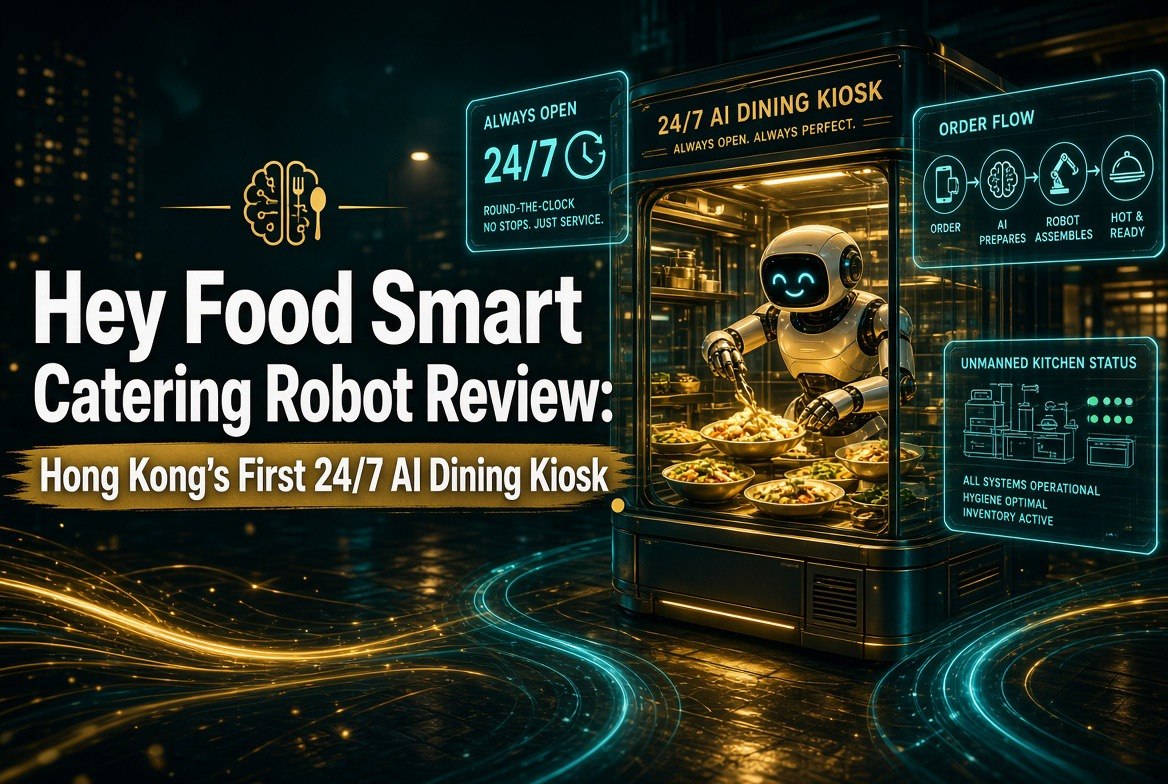
Hey Food Smart Catering Robot Review: Hong Kong’s First 24/7 AI Dining Kiosk
⚡ Expert Summary: Hong Kong has launched its first AI-powered catering robot — the “Hey Food Smart Catering Robot” — a fully automated kiosk that handles ordering, reheating, and meal dispensing to serve freshly prepared hot meals around the clock. It’s a three-way launch by InvestHK, Hong Kong’s Food and Environmental Hygiene Department (FEHD), and China Resources Enterprise Property Investment (CREP), aimed at remote areas, busy districts, and late-night hours. Customers order on-screen and pay by QR code or via the Xinghui mobile app. The bigger play: a scaled, licensed network of automated food service that keeps food-safety compliance baked in.
For most independent restaurant owners, “automation” still means a kiosk that takes orders or a robot that buses a tray. What Hong Kong just switched on is a bigger idea — an unattended kitchen that prepares, reheats, and dispenses hot meals with no staff behind the counter at all, running 24/7.
It’s called the Hey Food Smart Catering Robot, and it’s the first of its kind in Hong Kong. Whether you’re a single-location operator or someone weighing a low-labour expansion, this launch is worth understanding — because it shows exactly where automated food service is heading, and what it takes to do it legally and safely.
What the Hey Food Robot Actually Does
The system applies AI to a familiar food-and-beverage retail scenario: getting a hot meal to a customer quickly. What’s different is how much of the process is hands-off.
- Fully automated operations. The kiosk handles ordering, reheating, and meal dispensing end to end — no counter staff required.
- Hot meals around the clock. It’s designed to serve freshly prepared hot food 24 hours a day, which is a real gap in many districts.
- Multiple ordering paths. Customers order on the built-in screen and pay by QR code, or use the Xinghui (幸匯) app to complete the whole purchase on their phone.
- Deployed where service is thin. The stated targets are remote areas, busy districts, and late-night hours — the places where traditional staffing is hardest to justify.
In plain terms: a customer walks up at 2 a.m., orders a hot meal on a screen, pays, and walks away with food — with no one employed behind the machine.
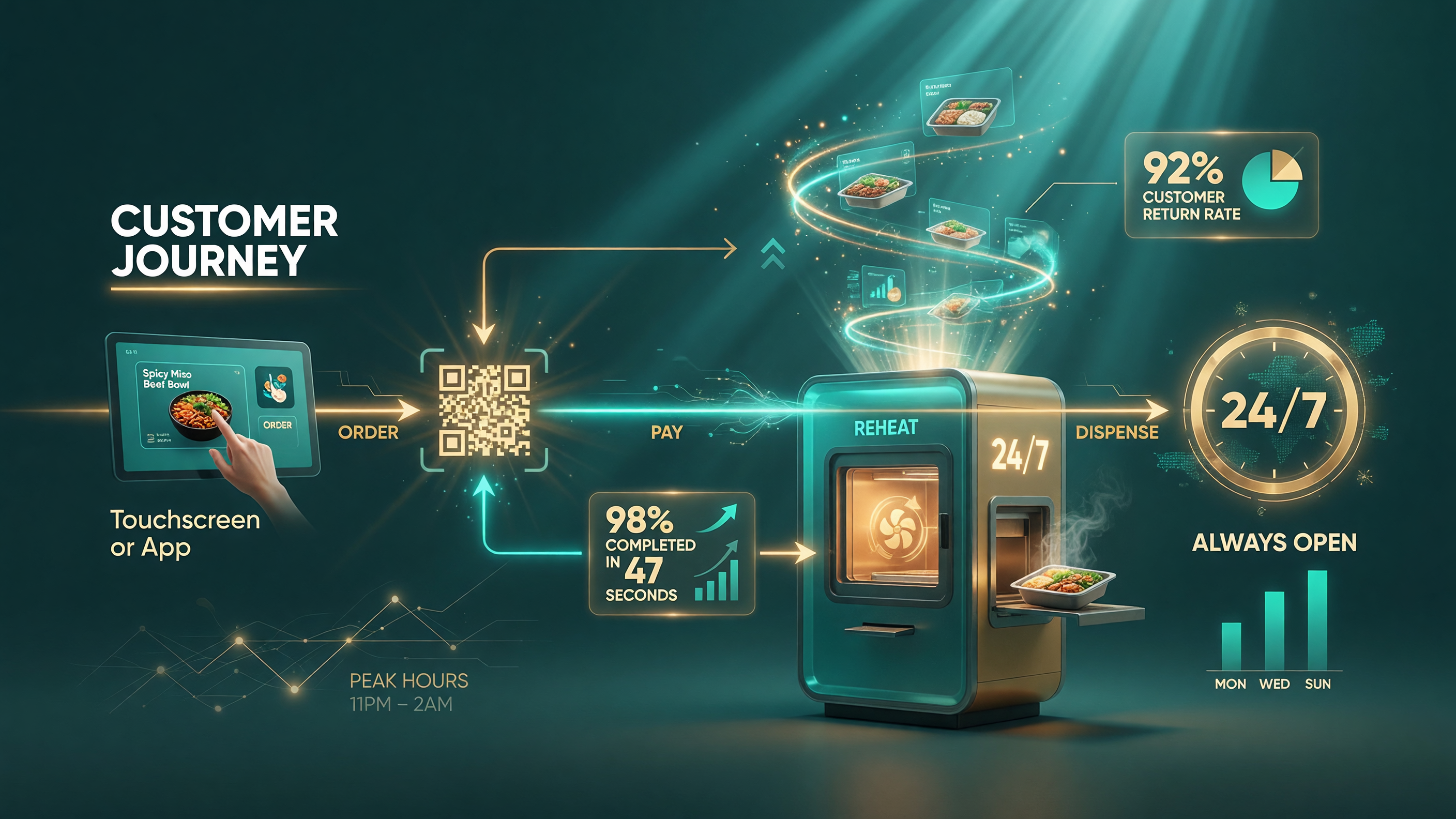
How the kiosk works end to end: a self-serve flow from order and QR payment through automated reheating and dispensing — no staff and no closing time.
Who’s Behind It — and Why That Matters
This isn’t a startup’s proof of concept. It’s a collaboration between three heavyweight organizations, which is actually the most important detail for any operator thinking about this space.
- Invest Hong Kong (InvestHK) — the government department promoting foreign investment and tech adoption in the territory.
- Food and Environmental Hygiene Department (FEHD) — the body that licenses and regulates food businesses in Hong Kong. Their involvement is the key signal: this is a government-signed path to compliance, not a grey-market machine dodging hygiene rules.
- China Resources Enterprise Property Investment (CREP) — the operating arm with two decades of commercial-market experience in Hong Kong, tasked with bringing mainland technology and local expertise together.
The FEHD’s role is the part independent owners should pay attention to. Automated food dispensing is a different licence problem than a counter-and-kitchen operation. The FEHD gave guidance on legal requirements and hygiene standards to help the companies get proper food business licences — which means there’s now a documented, repeatable compliance route for this kind of machine.
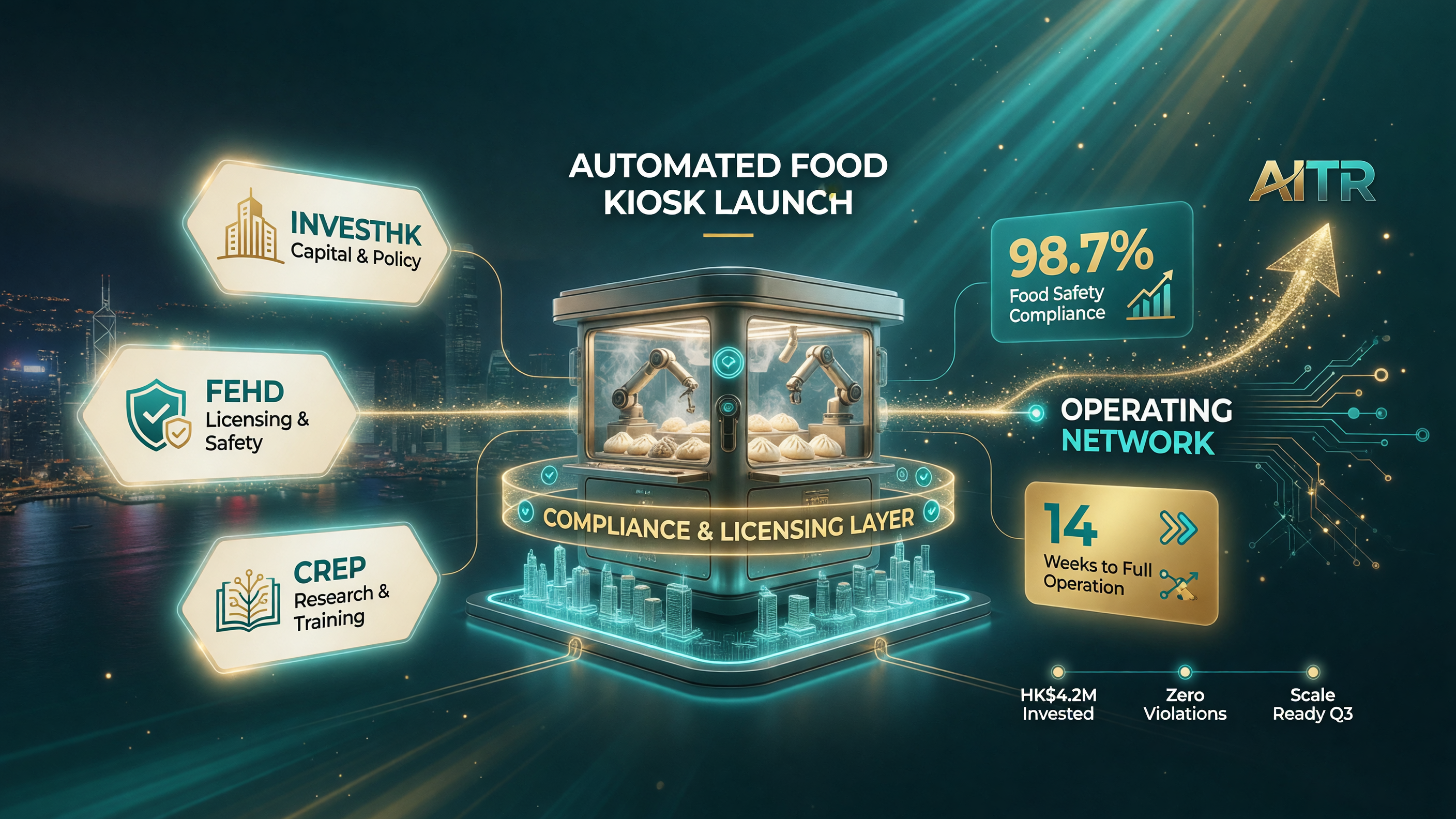
Three partners make the 24/7 model viable: government investment promotion, a food-safety licensing authority, and a research-and-training arm — with compliance wrapping the whole operating network.
Why This Is a Bigger Deal Than a Fancy Vending Machine
You could dismiss this as a premium vending machine. That would miss the strategy underneath.
CREP describes the long-term goal as building a scaled operational network of smart catering — not placing one novelty unit. The play is to reach critical mass across locations, with China Resources’ two decades of Hong Kong commercial real-estate relationships giving it access to high-footfall, underserved sites.
And there’s a cross-border angle. CREP positions this as a one-stop expansion platform to help mainland Chinese brands establish a presence in Hong Kong. The Hey Food robot isn’t just a product launch — it’s a template for how automated food concepts can enter a regulated market with compliance already handled.
Think about what that means for speed to market. A normal operator moving into a new territory has to navigate licensing, food-safety inspection, and local-commercial relationships from scratch — often a multi-quarter slog. This project bundles those into the launch itself: the regulator co-designed the path, and the operator brings the real-estate relationships and the brand. The result is a unit that can go live in the places where demand actually exists, instead of where it’s easiest to navigate red tape. That’s the quiet superpower underneath the headline — and it’s the part most press coverage misses.
Hey Food Robot vs. Traditional Restaurant Operations
To make this concrete, here’s how the automated kiosk model stacks up against a conventional shift.
| Dimension | Hey Food AI kiosk | Traditional counter operation |
|---|---|---|
| Staffing | None needed to serve | Counter, kitchen, and cleanup staff per shift |
| Hours | 24/7 with no overtime or shift loading | Limited by staff availability and shift costs |
| Ordering | On-screen or mobile app with QR payment | Face-to-face or a separate POS |
| Menu flexibility | Limited to what the machine can reheat/dispense | Full menu, live kitchen |
| Compliance | Licensed via FEHD guidance for automated food service | Standard food business liquor/hygiene licences |
| Customer experience | Fast, consistent, self-service | Human interaction, customisation, atmosphere |
The trade-off is obvious and real. You’re giving up menu breadth, human service, and the warmth of a staffed room — and gaining 24/7 availability without the labour cost that makes late-night and low-footfall service impossible for most independent places.
Where 24/7 Automated Food Service Makes Sense
The kiosk model is not a general replacement for a dining room — it’s a targeted fit for specific demand patterns. Mapping where it works versus where it doesn’t is the fastest way to judge whether a concept like this belongs in an operator’s portfolio.
| Scenario | Great fit for automation | Better served by a staffed kitchen |
|---|---|---|
| Late-night / after-hours demand | No staff overtime, 24/7 availability | Premium dining stays ambient and managed |
| Low-footfall or remote districts | Economically viable where payroll isn’t | Destination restaurants draw footfall themselves |
| Standardised grab-and-go menus | Reheat-and-dispense items done reliably | Menus built on a la minute cooking |
| Customer expectation | Fast, consistent, self-service convenience | Hospitality, customisation, atmosphere |
Read it as two different businesses, not one. An operator who understands this can use automation to capture the off-peak and remote demand that a staffed room can’t serve profitably — while protecting the full-service experience that keeps guests coming back to the dining floor.
What Independent Owners Can Take From This
You don’t need to operate in Hong Kong for this launch to be relevant. Three lessons transfer directly to any independent food business weighing automation:
- Labour is the constraint automation is actually solving. The robot’s whole value proposition is serving a hot meal when it’s not economically viable to staff. If you’ve ever turned down a profitable time slot because you can’t find or afford staff, this is the gap automation targets.
- Compliance is the moat — and the opportunity. The reason this project is notable is that the regulator was part of the launch. When a government food-safety body co-develops the licensing path, automated food service stops being a grey area. That’s precedent operators in other markets should watch closely.
- The real business model is the network, not the machine. CREP isn’t selling a kiosk — it’s building a scaled footprint. Individual owners should think the same way: one automated unit is a curiosity; a network of sites is a business.
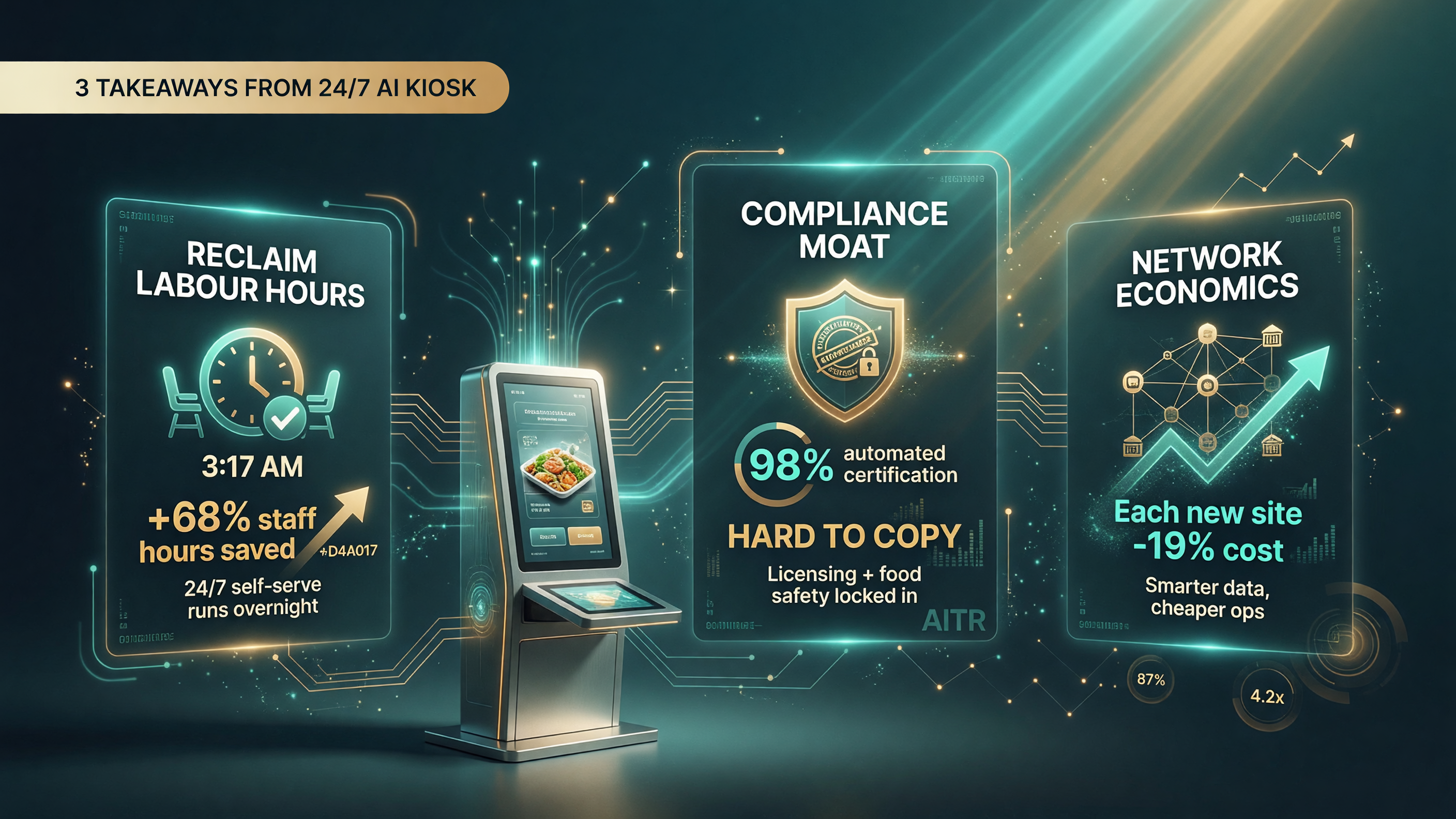
What owners can actually take from the model: reclaim overnight labour hours, build a moat in licensing and food-safety compliance, and let network economics lower costs as the footprint grows.
What Hey Food Does Not Solve
It would be a mistake to read this as the end of restaurants. The kiosk model is blunt — it serves a defined set of reheated meals reliably, and it can’t do the things that make a dining room worth visiting:
- No menu creativity. Every item must survive automated reheating and dispensing. That rules out a live kitchen’s range.
- No hospitality. There’s no one to greet you, recommend a dish, or handle a complaint with judgment.
- No atmosphere. A machine dispensing hot food isn’t a place people go to celebrate, date, or linger.
- Not a fit for every cuisine. It works for pre-prepared hot meals; it can’t do a la minute cooking.
So the realistic reading is complementary, not replacement. Automated kiosks will capture the grab-and-go, off-peak, low-footfall demand that independents currently can’t profitably serve — while human-led restaurants hold the experience business.
There’s also a lesson in how the economics shift as the network grows. A single unattended unit has to earn back its hardware and site cost from one location’s off-peak sales — a real risk if footfall is thin. But once a concept like CREP’s hits enough sites, the picture changes: menu purchasing scales, maintenance costs spread across the fleet, and the operator can negotiate sites on volume rather than betting each machine is profitable alone. That’s the difference between a novelty kiosk and a network business, and it’s the reason the scaled rollout matters more than the first machine. For an independent looking at automation, the takeaway is to model the unit economics at your actual site, not at the across-the-fleet average.
The Bottom Line
The Hey Food Smart Catering Robot is a genuine first: a government-backed, fully automated, 24/7 hot-meal machine operating inside a regulated framework. It’s a concrete example of how AI and robotics are moving past the demo stage and into licensed, everyday commerce.
For an independent operator, the value isn’t in copying the machine — it’s in seeing where the margin and the compliance structures are forming. Labour is the pressure, network economics is the payoff, and a clear licensing path is the unlock. If you’ve been watching automated food service from the sidelines, this is the launch that shows it’s no longer a novelty — it’s a real, regulated model.
Frequently Asked Questions
What is the Hey Food Smart Catering Robot?
It’s Hong Kong’s first AI-powered catering robot — a fully automated kiosk that handles ordering, reheating, and meal dispensing to serve freshly prepared hot meals 24/7. It was launched by InvestHK, the Food and Environmental Hygiene Department (FEHD), and China Resources Enterprise Property Investment (CREP).
How do customers order from the Hey Food robot?
Customers order on the built-in screen and pay by QR code, or use the Xinghui (幸匯) mobile app to complete the whole purchase on their phone. The entire process — order, reheating, and dispensing — is automated.
Where is the Hey Food robot deployed?
It targets remote areas, busy districts, and late-night hours — the scenarios where traditional staffed service is hardest to justify. CREP plans to expand the concept into a scaled operational network over time.
Why is the government involved in this launch?
The Food and Environmental Hygiene Department (FEHD) gave guidance on legal requirements and hygiene standards so the companies could obtain the proper food business licences. Its involvement establishes a documented compliance route for automated food dispensing.
Will automated robots replace restaurants?
No. Automated kiosks like Hey Food capture grab-and-go, off-peak, and low-footfall demand that independents often can’t profitably serve, while human-led restaurants retain the experience, menu creativity, and hospitality business. They’re complementary, not a replacement for full-service dining.

About Barak Schurr
Barak Schurr built and exited a major ticketing platform, ran global operations at Eventbrite, and now focuses on one question: which AI tools actually help independent restaurant owners run leaner and grow faster. He writes from the operator’s perspective — no vendor spin, no theory, just what’s real in 2026.
Email: [email protected]
More Restaurant AI Resources