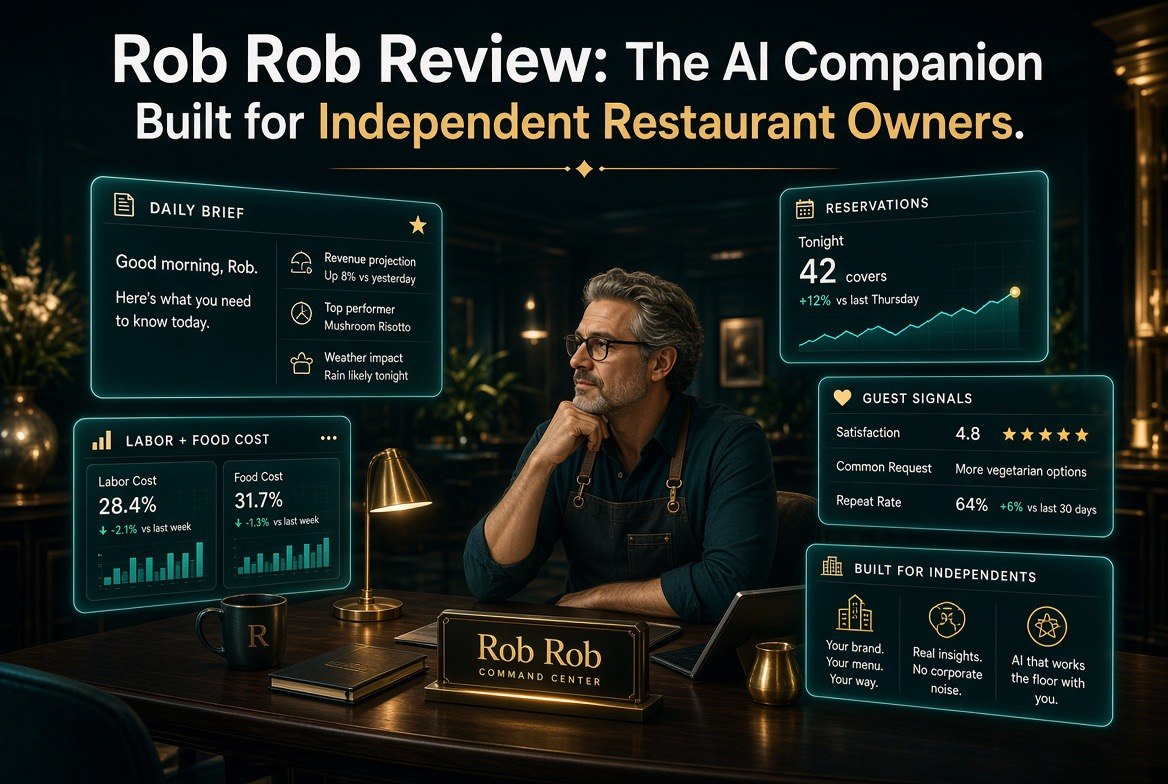
ROB “Rob” Review: The AI Companion Built for Independent Restaurant Owners
⚡ Expert Summary: ROB (Restaurant Owner Buddy) is a purpose-built AI companion for independent restaurant owners — not a generic chatbot. It remembers your restaurant’s goals, history, and past decisions, then gives grounded advice on staffing, food costs, cash flow, pricing, marketing, and growth — with follow-up questions and confidence levels instead of bossy answers. It flags when you need a real lawyer, accountant, or HR pro. Built by a hospitality operator, currently in limited early launch at restaurantownerbuddy.com.
Running an independent restaurant is a lonely job. The owner decides everything — staffing, food costs, menu pricing, cash flow, marketing, whether to expand — and most of those calls have to be made fast, with no one in the building who’s been in your shoes.
ROB is built for exactly that person. It’s not another point-of-sale add-on or a customer-service chatbot. It’s an always-available operating partner for the owner’s decision-making — designed by people who’ve actually run restaurants, not by developers who’ve never stood in a walk-in.
What Makes ROB Different From a Generic Chatbot
The restaurant-owner market is flooded with AI tools that answer customer calls, take reservations, or optimize a website. ROB isn’t any of those. It’s aimed at the owner’s own head-space — the constant, lonely stream of decisions.
Three things separate it from an off-the-shelf assistant:
- It remembers your restaurant. ROB builds and keeps private, restaurant-specific context — your goals, your history, your past decisions and their results. Conversations don’t restart from scratch every time. It learns your operation.
- It gives grounded, plainspoken advice. It states the right level of confidence for what it’s telling you, asks follow-up questions, and helps you think — rather than confidently making things up like a generic AI.
- It knows its limits. When a question crosses into licensed territory — legal, accounting, HR — it says so and points you to a real professional. That’s a big trust signal for owners who’ve been burned by overconfident software.
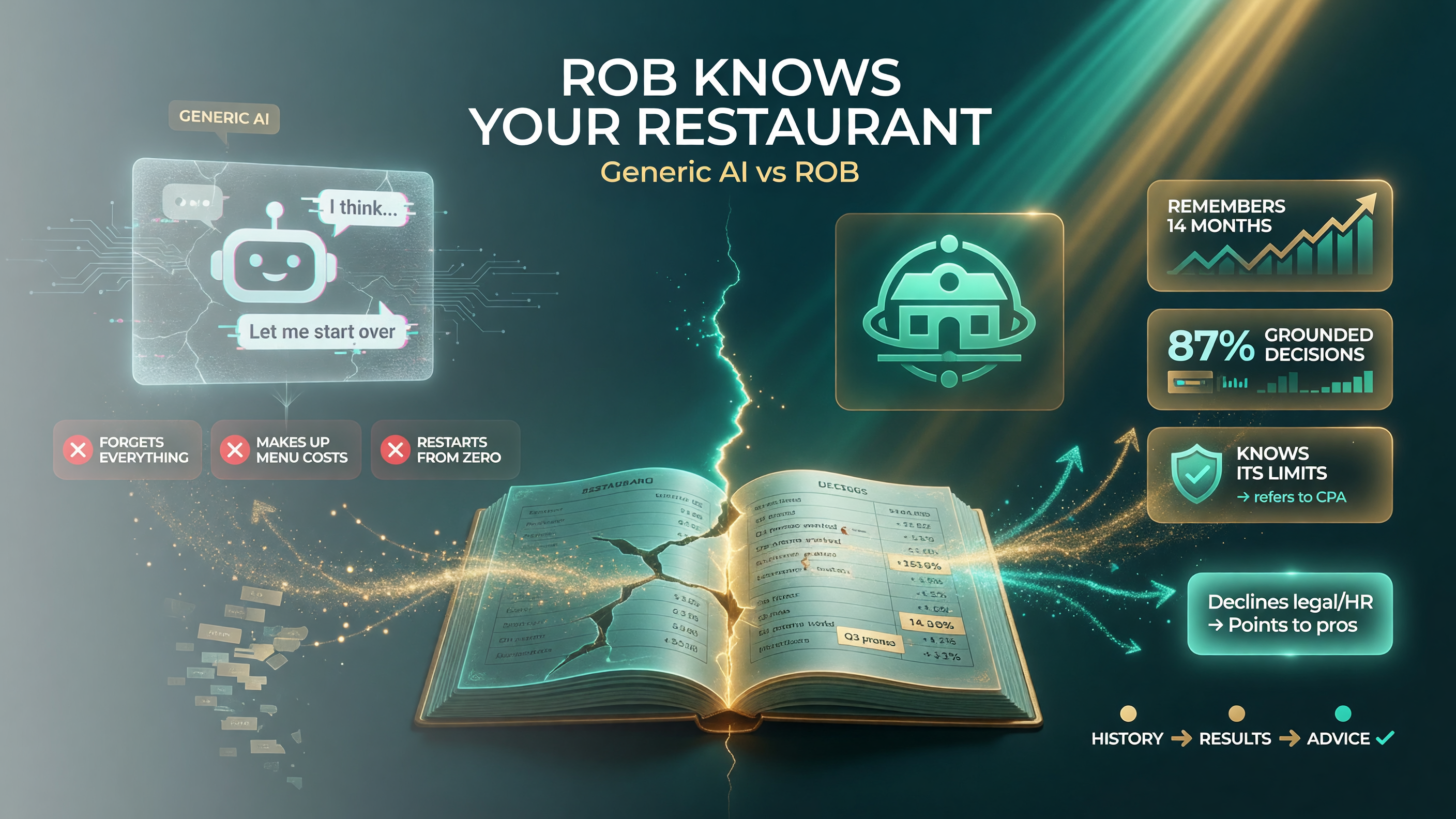
ROB keeps private, restaurant-specific context and states the right confidence level, while a generic chatbot restarts from zero and invents answers.
What ROB Can Help You With
ROB spans the full range of what an owner actually wrestles with. Here’s the practical breakdown:
- Operations. Organize your priorities, troubleshoot problems — labor and scheduling, food costs, cash flow, menu pricing, vendor issues — and move from “I’m worried about X” to the specific next step. For example, it can look at your sales trends and labor data and suggest a staffing adjustment that protects guest service.
- Growth and leadership. Practical thinking on marketing, team development, customer experience, hiring, leadership problems, and long-horizon calls like expansions or price changes.
- Continuity. It remembers shared details and decisions across sessions, so you don’t re-explain your own restaurant every time you open it.
- Owner-to-owner connection. Pathways to network, learn from peers, and build a professional community — a real, human value on top of the AI.
- Problem-solving. Help evaluating options, comparing alternatives, preparing for difficult conversations, and turning insight into clear action — without making the decision for you.
The last point matters. ROB’s design philosophy is explicitly that the AI assists — it never decides for the owner. You stay in control; it does the heavy thinking alongside you.
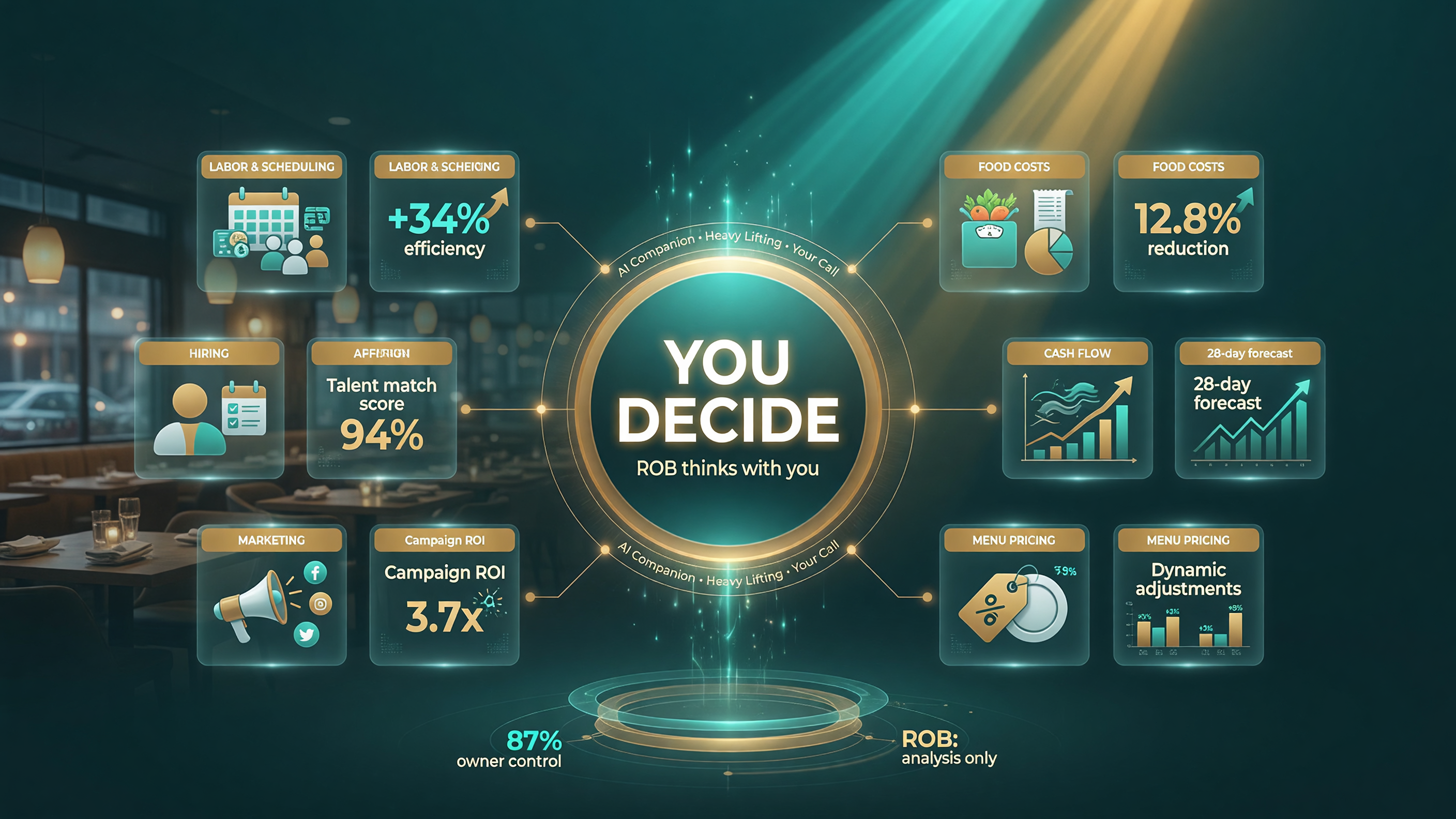
The decision dashboard: ROB helps with operations, growth, continuity, and problem-solving across every area an owner manages — but the AI assists, the owner decides.
ROB vs. A Generic AI Assistant vs. Nothing
The honest way to evaluate ROB is to stack it against what an owner actually has today: a generic AI tool, or no help at all.
| Dimension | ROB (Restaurant Owner Buddy) | Generic AI assistant |
|---|---|---|
| Built for | Independent restaurant owners specifically | Everyone, no operational depth |
| Remembers your restaurant | Yes — private context, history, past decisions | No — starts blank every session |
| Advice style | Grounded, plainspoken, with confidence levels | Polite, generic, often vague |
| Knows its limits | Flags when you need a real lawyer/accountant/HR pro | Rarely — may overstate expertise |
| Decision ownership | AI assists, owner always decides | Assumes you’ll figure it out |
| Scope today | Single-location; multi-location coming soon | Whatever you prompt it with |
The “knows its limits” row is worth pausing on. In an industry where a bad staffing call or a misplaced tax assumption can cost real money, an AI that confidently invents answers is dangerous. ROB’s willingness to say “you need your accountant for this one” is a feature, not a shortcoming — it’s how you build trust with someone whose livelihood is on the line.
How ROB Compares to Other Restaurant AI Tools
There’s a whole shelf of restaurant tech labeled “AI” — and almost none of it is for the owner’s decision-making. To keep the categories straight, here’s where ROB sits relative to the other tools you’re likely being pitched.
| Tool type | Who it serves | What it does | Does it help YOU think? |
|---|---|---|---|
| Reservation/reception chatbots | Your guests | Book tables and answer guest questions | No |
| POS / kitchen / labor tools | Your operation | Process transactions, schedule, track inventory | No — they generate data, not judgment |
| Generic AI assistant (ChatGPT etc.) | Everyone | Answers almost any question generically | Sometimes, but no restaurant memory |
| ROB (Restaurant Owner Buddy) | You, the owner | Remembers your restaurant and helps you decide | Yes — that’s the whole point |
The last column is the filter that matters. A reservation chatbot fills seats but won’t tell you whether to raise prices on your best-selling dish. Your POS tells you what sold, but not whether the new menu pricing is quietly killing your food cost. ROB is the only one aimed at the judgment layer — the decisions only you can make but don’t have to make alone.
Where the Advice Comes From
A tool is only as good as the knowledge underneath it. ROB draws on four sources:
- Proven best practices and verified facts from the restaurant industry.
- Founder experience — the team behind ROB has real operating history in hospitality, not just software.
- Continuous learning — the platform improves over time based on owner feedback and validated patterns.
- Aggregated owner insights — patterns learned across owners, while keeping each owner’s individual data private.
That last point is important for trust. ROB learns from the collective experience of many owners, but your specific operation stays yours. No one else’s staffing numbers or pricing decisions leak into your feed.
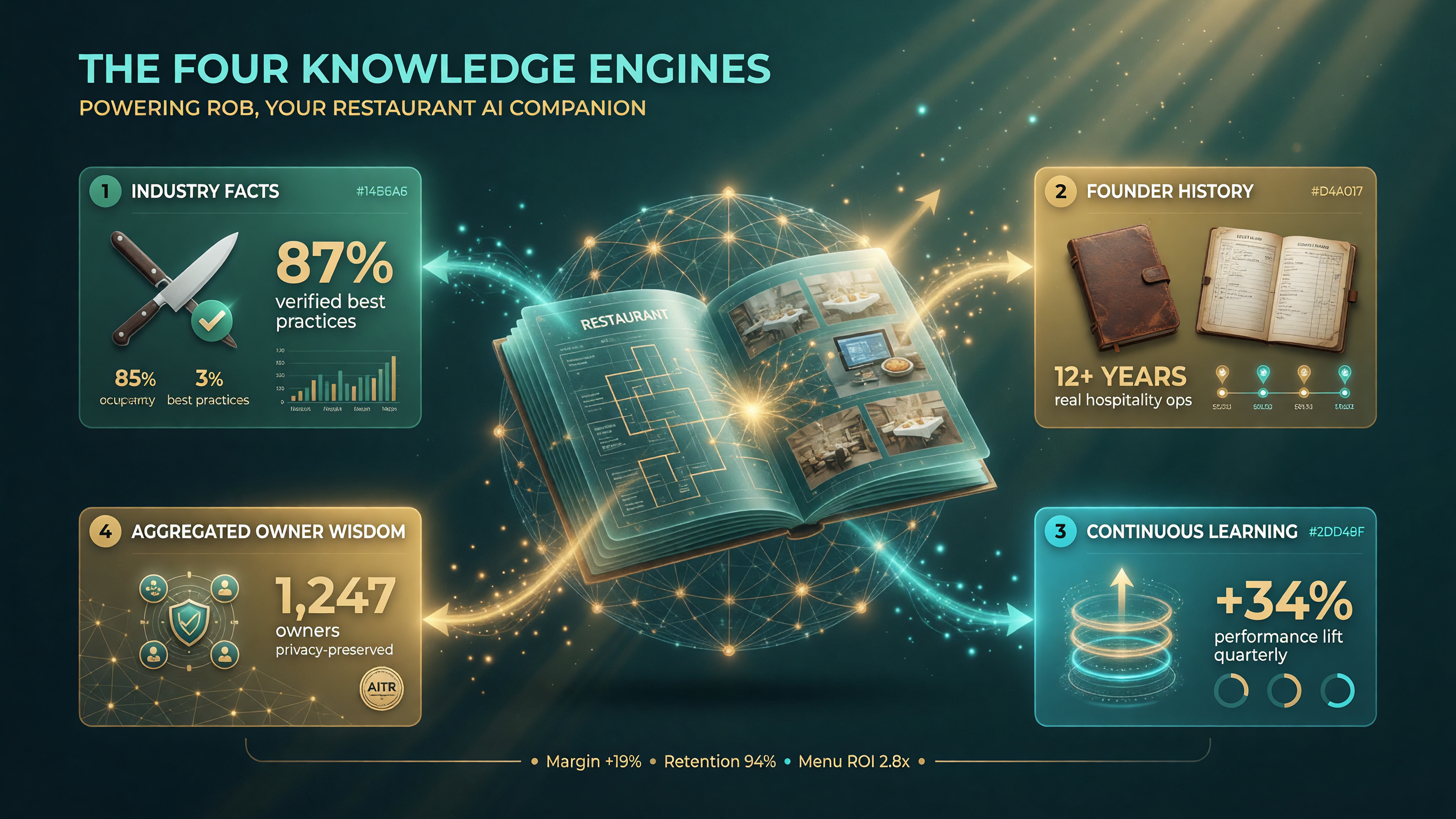
Where the advice comes from: ROB draws on verified industry practice, real hospitality operating history, continuous learning, and aggregated owner insights — while each owner’s individual data stays private.
How It Works in Practice
You talk to ROB by voice or text, like a colleague you can reach any hour. It listens, remembers the context of your operation, asks clarifying questions, gives you recommendations with alternatives, and helps you track follow-ups and results.
The goal is moving you from a vague worry — “labor’s tight but I don’t know where to cut” — to a concrete plan with a next step. Not a lecture, not a wall of theory, but a working conversation.
And it improves the more you use it. The more ROB learns about how you run your place, the better it anticipates your questions and recognizes patterns before you have to spell them out.
As a senior operator once put it to me, the hardest part of the job isn’t the work — it’s that there’s no one to think out loud with between the health inspection, the vendor call, and the Friday-night rush. Tools that track your numbers are useful, but they answer “what happened,” not “what should I do about it.” ROB is trying to be the second voice in that room: one that knows your operation, isn’t afraid to push back, and has no agenda other than helping you land on a sound decision. That’s a genuinely different value proposition from anything else in the restaurant stack — and it’s why the early-access crowd is worth watching rather than dismissing as just another chatbot launch.
Who Should Try ROB
ROB is in a limited early launch for independent restaurant owners and senior operators. That’s deliberate — the team is iterating based on real user feedback rather than shipping a half-baked product to everyone at once.
It’s best for the owner who:
- Makes most operational decisions alone, with no partner or regional manager to bounce ideas off.
- Wants a second opinion on staffing, pricing, costs, or a tricky conversation — without the cost of a consultant.
- Is skeptical of generic AI and wants something built from actual restaurant operating experience.
- Values privacy and wants an assistant that keeps their operation’s context to themselves.
If that sounds like you, request access at restaurantownerbuddy.com and try it on one real decision you’re facing this week.
What ROB Does Not Do (Be Clear About This)
ROB won’t run your restaurant for you. That’s by design, but it’s worth stating plainly:
- It doesn’t make your decisions. It helps you think; you pull the trigger.
- It’s not a customer-service chatbot or reservation system. It’s for the owner, not your guests.
- It’s not licensed legal, accounting, or HR advice. It flags when you need a real professional.
- It’s single-location for now. If you run multiple restaurants, the multi-location view is on the roadmap, not here yet.
- It’s a companion, not a replacement. It can’t stand in the kitchen or sign the checks.
Set the right expectations and ROB is genuinely useful. Expect it to run your business and you’ll be disappointed — that was never the job it was built to do.
The Bottom Line
Owning a restaurant is one of the few jobs where the person running the show often has no one to think out loud with. ROB is the first tool I’ve seen aimed squarely at that loneliness and that decision load — not at your guests, not at your website, but at you, the operator.
The combination of restaurant-specific memory, plainspoken grounded advice, and honest limits is the right recipe. If it executes well, this is the kind of tool that could quietly become part of the owner’s daily routine — less like software, more like a seasoned partner who’s been in the weeds too.
It’s early, and it’s worth kicking the tires on a real decision before you trust it with anything big. But for the owner who’s tired of making every call alone, ROB is worth a look.
Frequently Asked Questions
What is ROB Restaurant Owner Buddy?
ROB is a purpose-built AI companion for independent restaurant owners. It helps with operational decisions like staffing, food costs, cash flow, pricing, and marketing by remembering your restaurant’s specific context and offering grounded, plainspoken advice — without making decisions for you.
Who is ROB for?
Independent restaurant owners and senior operators making daily operational decisions on their own. It’s built specifically for single-location operators today, with multi-location support coming soon.
How is ROB different from other restaurant AI tools?
Most restaurant AI tools handle customer-facing jobs — answering calls, reservations, or website optimization. ROB is different: it’s an owner-facing decision-making companion. It remembers your restaurant’s history and past decisions, gives advice with appropriate confidence, and flags when you need a licensed professional.
Does ROB replace my accountant, lawyer, or HR advisor?
No. ROB explicitly acknowledges when a question needs licensed professional advice and points you to the right expert. It’s a thinking partner for operational decisions, not a substitute for legal, accounting, or HR professionals.
How much does ROB cost and where do I get it?
ROB is in a limited early launch for independent restaurant owners and senior operators. You can request access at restaurantownerbuddy.com. Pricing and availability are part of the early-access program as the platform iterates on feedback.

About Barak Schurr
Barak Schurr built and exited a major ticketing platform, ran global operations at Eventbrite, and now focuses on one question: which AI tools actually help independent restaurant owners run leaner and grow faster. He writes from the operator’s perspective — no vendor spin, no theory, just what’s real in 2026.
Email: [email protected]
More Restaurant AI Resources