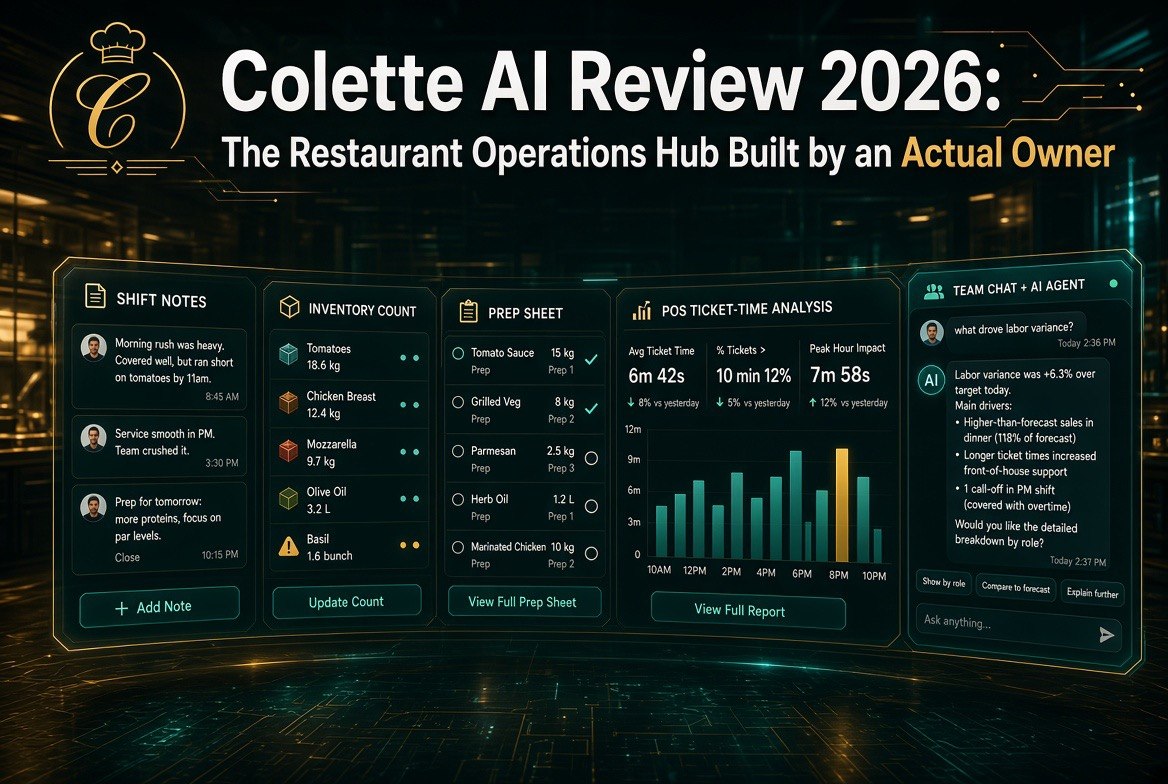
Colette AI Review 2026: The Restaurant Operations Hub Built by an Actual Owner
⚡ Expert Summary: Colette is a Y Combinator-spirit, operator-built AI “system of work” for independent restaurant groups — but it is not a phone agent. It does not answer guest calls or book reservations. Instead, Colette lives entirely on the back-of-house side: it is a shared team hub where managers and staff communicate, log shift notes, and where AI agents quietly handle the grunt work — inventory counts, prep sheets, side-work lists, tip sheets, bank reconciliations — and pull live numbers from your Toast, OpenTable, and Bill.com accounts straight into the conversation. It was created by Eli Feldman, co-owner of Boston’s Shy Bird restaurants, because he was drowning in the same 15-to-20-minute admin tasks every operator knows. At Shy Bird’s Fenway location, Colette’s analysis of POS data and kitchen footage helped cut peak brunch ticket times from over 30 minutes to roughly 9 minutes by rebalancing how the line was set up. This review breaks down what Colette actually replaces, where the numbers come from, what it costs in operator terms, and who should — and should not — sign up.
Walk into the office of almost any independent restaurant group and you will find the same quiet disaster: a GM juggling four different apps, a spiral notebook of shift notes nobody reads, a text thread where the maintenance issue from Tuesday got lost by Thursday, and a manager re-typing sales figures into a spreadsheet by hand. None of that shows up on the floor, so none of it gets prioritized. But it is where margins quietly leak, where great managers burn out, and where the chaos between shifts actually lives.
Colette is built for exactly that mess. It is an AI-native operations layer made by someone who runs restaurants — not by a SaaS company guessing what a kitchen needs — and it is one of the more genuinely interesting restaurant-tech releases of 2026 because it attacks the problem from a different angle than almost everything else on the market. Most restaurant AI this year has gone to the front of the house, teaching machines to answer the phone, take orders, and book tables. Colette went the other way and went deep into the back office, where the phone never rings but the hours still vanish.
This review is written for the independent owner and multi-unit operator who already has Toast or Square, an OpenTable or Resy account, and a stack of small tasks eating the team’s week. It covers exactly how Colette works, what it genuinely replaces, the real results posted by the restaurants using it, where it falls short, and how to decide if it earns a seat in your stack. If you are looking for an AI to answer your phones, this is not that article — Colette and the voice agents are complementary tools, and I will explain where each belongs at the end.
What Colette AI Actually Is
Colette (askcolette.ai) describes itself as a “system of work” for restaurant teams, which is marketing-speak for something genuinely useful: one shared workspace where your restaurant’s communication, task tracking, and operating data all live, with AI agents embedded throughout to do the repetitive parts.
The founding story matters here because it explains the product. Eli Feldman is a co-owner of Shy Bird, the Boston rotisserie mini-chain with locations in Kendall Square, South Boston, and Fenway. He did not start Colette as a B2B SaaS founder chasing a trend. He built it, initially with the help of AI models like Claude, to pull his own back-office operation out of the weeds — the paper trails, the endless small tasks, the knowledge that lived only in a departing manager’s head. When it worked at Shy Bird, he and a team that includes former Toast executives turned it into a product and opened it to other independent operators in spring 2026. By mid-2026, roughly three to four dozen restaurants across the United States were using it, including about seventeen in the Boston area and groups in Chicago, New York, Denver, Austin, and Portland, Maine. Boston’s Coda Restaurant Group, which runs spots like SRV, is a notable early adopter.
Despite the friendly-sounding name and the fact that it can talk and answer questions, Colette is not a customer-facing voice agent. It does not pick up inbound calls, take reservations over the phone, or act as a virtual host. That is the single most important thing to understand before you evaluate it, because it sets the whole product in the right place: Colette’s user is your team, not your guests. It is an internal tool that makes your managers and staff dramatically more effective.
What Colette Actually Does — The Core of the Review
Strip away the branding and Colette does four jobs, and it is worth understanding each because they map to different pain points you already have.
1. One place for all team communication and handoffs. Restaurants run on scraps of information — the prep note from the morning crew, the walk-in temperature check, the “call the vendor about the ice machine” reminder — and those scraps currently live in a half-dozen places: group texts, email threads, sticky notes on the pass, a floor manager’s notebook. Colette replaces that fragmentation with a shared chat and thread system where shift notes, manager logs, and files carry over from one shift to the next. When the closing manager logs a broken piece of equipment, it does not disappear into a dead text thread. It becomes a tracked item the opening manager actually sees. That continuity between shifts is one of the quiet killers of independent restaurants, and it is the first thing the product attacks.
2. AI agents that handle the small recurring tasks. This is the “get it done” layer, and it is the part that frees real hours. Colette’s agents automate the admin chores that eat a manager’s week in 15-to-20-minute slices: inventory counts, prep sheets, side-work assignments for the floor, and converting closing notes into next-shift action items. A manager at Coda Restaurant Group described Colette taking care of the daily tip sheet and bank reconciliation — the kind of task that used to mean logging into an accounting portal, pulling numbers, and re-typing them into a spreadsheet, every single day. None of these are glamorous. All of them add up to real time, and they are precisely the tasks that do not get done when a place is short-staffed.
3. Your data, pulled into the conversation. Colette connects to the systems you already run — Toast for sales and POS data, OpenTable for reservations, and Bill.com for accounting and invoicing — and brings the numbers directly into your team discussions. Instead of a manager opening three separate dashboards to answer “what drove last week’s labor variance?”, they can ask inside the flow of the conversation they are already having. This is not a new dashboard on top of your stack. It is the opposite: it pulls your existing systems into a single human conversation and makes the data answer questions in context.
4. Institutional knowledge that does not walk out the door. Every restaurant has a version of this: the general manager who just knows that the salmon sub is fine for the regular with the allergy, or that the walk-in runs colder on the left side when it is packed. When that person leaves, the knowledge leaves with them. Colette can ingest handbooks, HR materials, guest notes, recipes, and operational history into one searchable hub, so the “how we actually do things here” stops being a fragile human memory and becomes a resource the whole team can draw on. Co-founders who came out of Toast built the integrations to make this feel native rather than bolted on.
Where Do the Results Come From? Shy Bird’s Brunch Turnaround
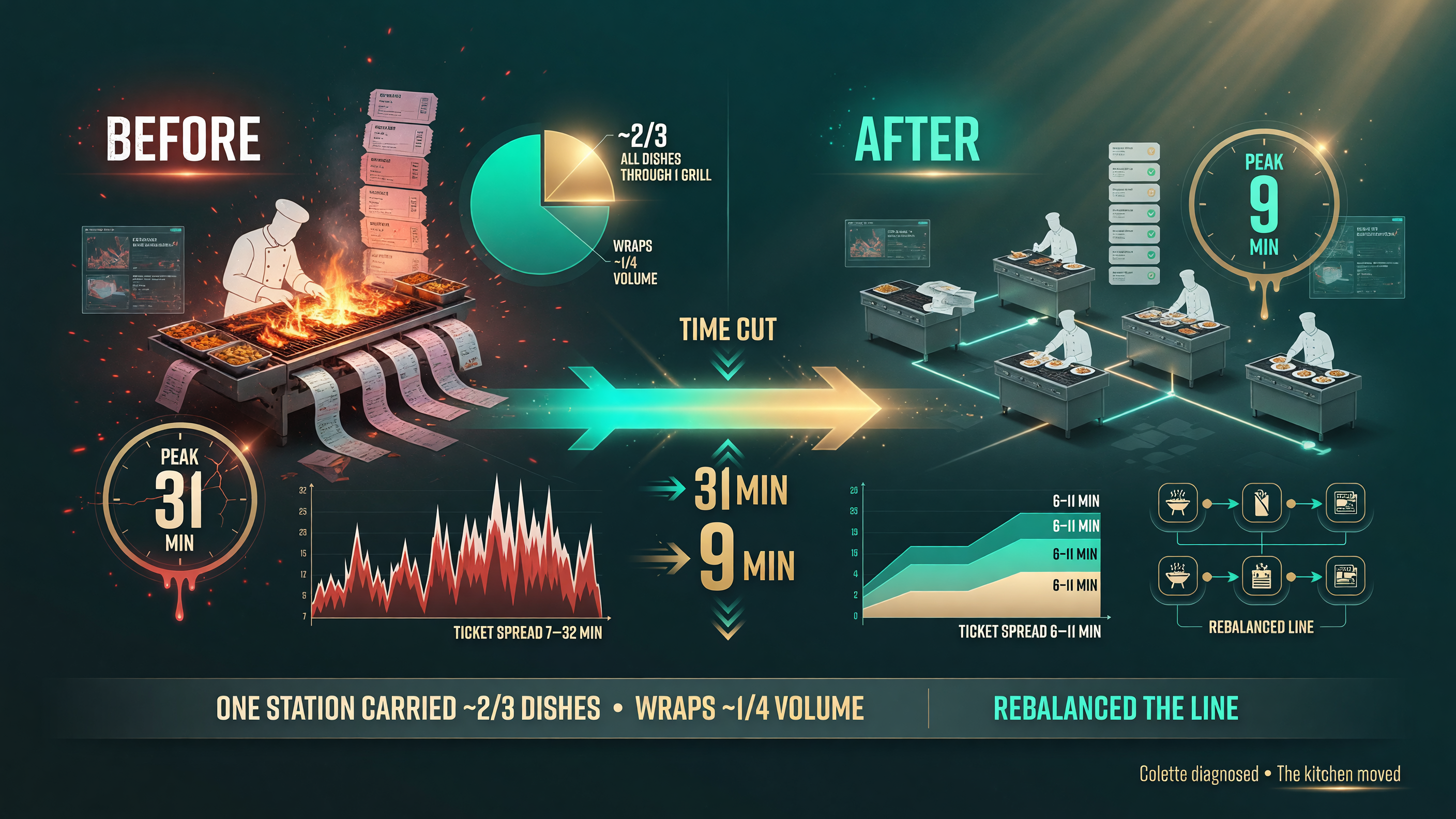
The result story is a diagnostic story: peak brunch ticket time fell from about 31 minutes to roughly 9 once the kitchen rebalanced the line – with the spread tightening from a wide 7 to 32 minutes down to a consistent 6 to 11. Colette flagged the bottleneck; the kitchen did the moving.
The most concrete public result attached to Colette comes from the founder’s own restaurant, and it is worth reading closely because it shows what the tool is actually for. At Shy Bird’s Fenway location, brunch service had a real problem: ticket times were long and wildly inconsistent, swinging between seven and over thirty minutes during peak volume. The team was not sure where the bottleneck was, and guessing was not helping.
They uploaded POS data — product mix and ticket times — along with kitchen photos and video into Colette. The analysis surfaced something specific and counterintuitive: roughly two-thirds of the dishes on the brunch line were being produced at a single grill station, and wraps alone made up about a quarter of the volume. One station was carrying the entire service. Based on that finding, the kitchen rebalanced how the line was set up and changed the mise en place for the high-volume items.
The results were dramatic. On partial implementation the next day at similar volume, peak ticket times dropped from about 31 minutes to under 25 — roughly a 20 percent cut in a single shift. When the full rebalancing was in place the following weekend at comparable volume, average peak ticket time fell from about 31 minutes to roughly nine minutes, with much tighter consistency — a six-to-eleven-minute band instead of wild seven-to-thirty-two swings.
Was that all Colette? No. Colette did not move the pans. The kitchen did. But Colette was the diagnostic that told them exactly where to look — and it replaced what would otherwise have been weeks of trial-and-error guessing with one data-driven pass. That is the honest way to understand this tool’s value: it is not a robot replacing cooks, it is a highly competent operations analyst that never sleeps and knows how to read your POS data. Feldman himself is adamant about this framing, repeatedly describing AI and the human team as outperforming either alone.
It is also worth noting where the numbers stop. There is a separate forecasting example in the coverage: Colette projected about $12,500 in daily sales for a given day, the team adjusted the figure up to around $15,500 based on local factors the AI could not see — a Fenway crowd or a big game — and actual results exceeded even the adjusted number. That is the intended division of labor. The AI provides the baseline from history and inventory; the humans add the judgment about the world the AI cannot see.
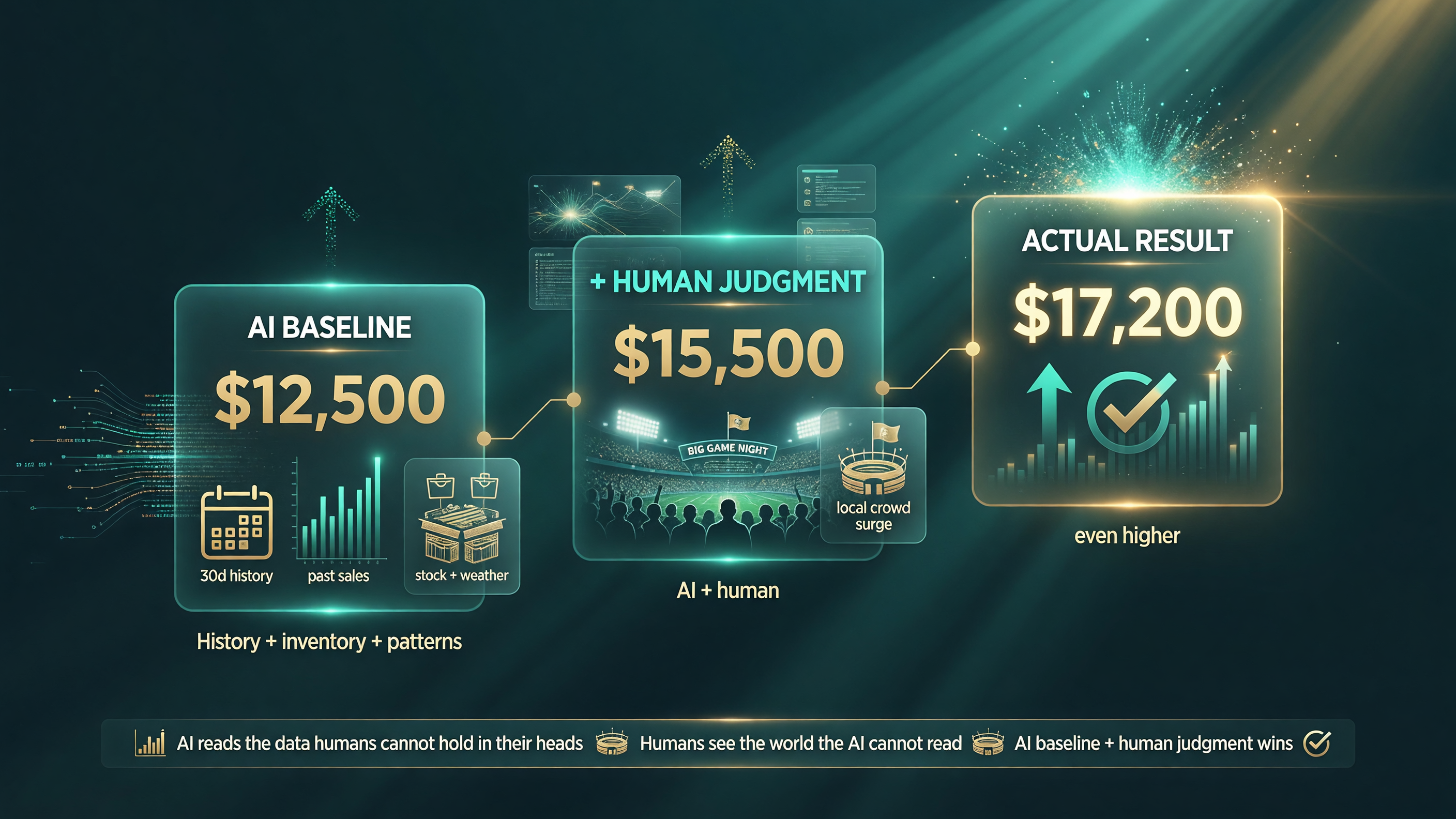
The intended division of labor: the AI sets the baseline from history and inventory, the humans bring the judgment about the world the AI cannot see, and the two together beat what either could manage alone.
How Colette Compares to a Restaurant AI Voice Agent
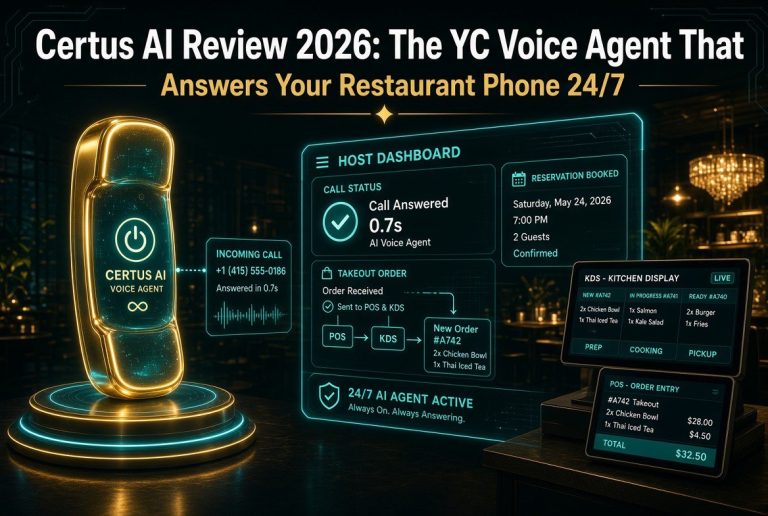
If you have been reading the restaurant-AI coverage of 2026, you have almost certainly seen the other category: AI voice agents that answer your phones, take reservations, and handle takeout orders, like Certus AI. People frequently confuse the categories, so it is worth a head-to-head, because they are not competitors — they are two halves of the same modern stack, and a growing operator will likely end up with elements of both.
| Factor | Colette (Back-of-House) | Voice Agent (e.g. Certus — Front-of-House) |
|---|---|---|
| Primary user | Your managers and staff (internal team) | Your guests (external callers) |
| What it handles | Shift notes, comms, inventory, prep, tip sheets, forecasting, data Q&A | Answers phone, takes takeout/orders, books reservations, FAQs 24/7 |
| Key integrations | Toast, OpenTable, Bill.com | Toast/Square/Clover POS, OpenTable, delivery platforms |
| Primary payoff | Saves manager hours, fixes ops bottlenecks, retains knowledge | Captures revenue from missed/after-hours calls |
| Staff training needed | Some onboarding to use the hub daily | Minimal — guests interact, staff handles handed-off orders |
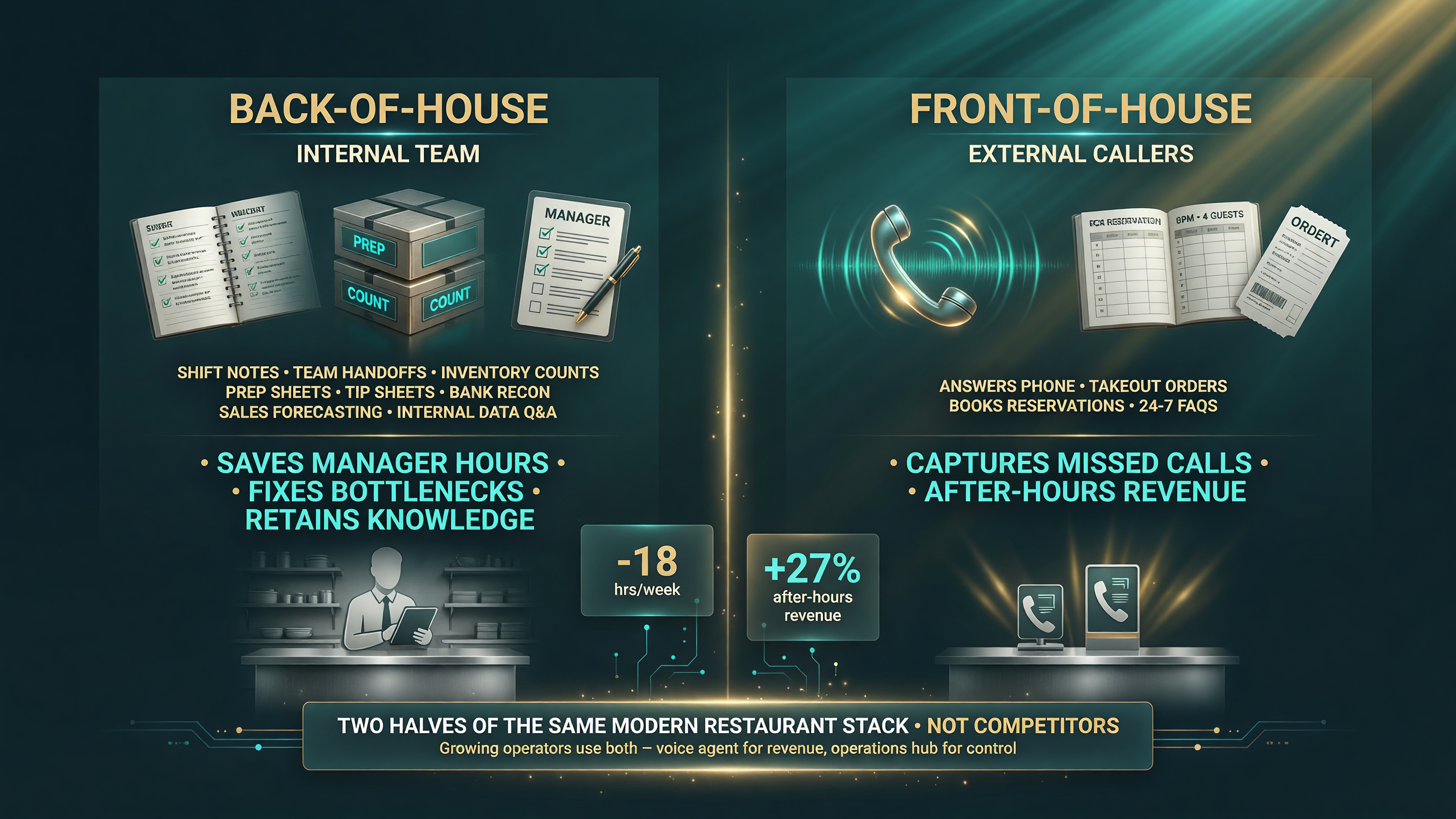
The two categories people mix up are not competitors – they are two halves of the same modern restaurant stack, and a growing operator will likely end up with elements of both. Missed calls and lost reservations point to a voice agent; managers drowning in admin and a floor running on guesswork point to a back-of-house hub.
The short version: if your pain is missed calls and lost reservations, you want a voice agent. If your pain is your managers drowning in admin and your floor running on guesswork, you want something like Colette. They sit on opposite sides of the guest experience and both add up to a leaner, more profitable restaurant.
For Whom Is Colette a Strong Fit?
Colette is not a tool for every restaurant, and it is worth being direct about who should and should not consider it so you do not waste your time.
| If this is you | Colette fit |
|---|---|
| Single-unit independent with a hands-on owner-operator | Moderate — the owner already does most tasks; value is freeing the GM’s focus for guests |
| 2-10 unit independent group | Strong — this is the sweet spot; multi-location comms/reporting pain is highest here |
| High manager turnover / knowledge walking out the door | Very strong — institutional-knowledge capture is a core feature |
| Kitchen bottleneck you cannot diagnose (long ticket times) | Strong — the POS-data analysis use case is proven at Shy Bird |
| Only need someone to answer the phone after hours | Not a fit — look at a voice agent like Certus instead |
The honest diagnosis: Colette earns its keep most reliably for the multi-location independent operator whose staff email-and-text sprawl is real and whose managers are losing hours to recurring admin. For that operator, the tool is not a luxury — it is an organizational fix.
Pricing and Where to Be Skeptical
Now the part that requires the most honesty: Colette’s pricing is not public. The company does not list rates on its site, and available coverage does not disclose them. This is normal for a young B2B product still in its early commercial rollout and is not inherently a red flag, but it is a real limitation for a buyer trying to compare it against tools with transparent per-location pricing. Colette appears to be sold on a demo-and-onboarding basis, with pricing tailored to the size and structure of the group. The practical takeaway for you: expect to book a call to get a number, and treat any quote you receive in the context of the hours it will actually save.
There are other things to weigh before you commit. First, Colette is young — it launched publicly only in spring 2026, and while it has three to four dozen restaurants on board and a founder who dogfoods it daily, it does not yet have the years-long track record or the independent case-study depth of more established restaurant software. The most compelling public numbers come from the founder’s own restaurants, which is strong evidence the product works for its creator but is not the same as third-party validation across many independent operations. Second, like any tool that ingests your handbooks, guest notes, and operational data, it is worth asking plainly about data handling and who can see what — especially since it centralizes a lot of sensitive operational detail in one place. Third, it is an internal adoption product: it only pays off if your team actually uses the hub every shift, so budget for onboarding and habit-building, not just the license.
None of these are disqualifying. But they are the questions a smart operator should bring to the demo rather than discovering later.
The Bottom Line: Who Is Colette For?
Colette is one of the more thoughtful pieces of restaurant software to come out in 2026, and its design philosophy deserves respect: it was built by an owner who understood that independent restaurants are a team sport and that the team’s biggest leak is often not the kitchen or the phone — it is the unstructured chaos between shifts. By giving that team one place to communicate and by handing the repetitive admin to AI agents, Colette attacks a problem nearly every multi-unit independent operator has and almost no other tool addresses well.
It is not a magic wand and it is not a phone agent. It will not capture a single missed call, but it can give your managers back hours of their week, surface the bottleneck bleeding your ticket times, and stop your institutional knowledge from walking out the door with your best manager. If you run a single location with a hands-on owner doing every task, you can probably skip it for now. If you run two or more locations, or your managers are drowning in admin and your shifts keep dropping the ball on handoffs, Colette is a genuinely strong candidate to put in front of your team — and a demo is worth your time.
Frequently Asked Questions
Is Colette an AI phone-answering service for restaurants?
No. Colette is a back-of-house operations platform for restaurant teams. It does not answer guest calls, take reservations over the phone, or act as a virtual host. It is an internal workspace and AI assistant for managers and staff that handles team communication, shift notes, recurring admin tasks, and data pulled from systems like Toast, OpenTable, and Bill.com.
Who created Colette and why does it matter?
Colette was created by Eli Feldman, a co-owner of Boston’s Shy Bird restaurant group, and a team that includes former Toast executives. Feldman built it to solve his own back-office overload before turning it into a product, which is why the tool focuses on practical operator pain rather than flashy features.
What restaurant systems does Colette integrate with?
Colette connects to common restaurant systems including Toast for POS and sales data, OpenTable for reservations, and Bill.com for accounting and invoicing. It also ingests internal documents like handbooks, recipes, and guest notes so the team can query institutional knowledge in one place.
What results have restaurants seen with Colette?
The most documented results come from the founder’s own restaurant, Shy Bird. After Colette analyzed POS data and kitchen footage at the Fenway location, rebalancing the brunch line based on its findings cut average peak ticket times from roughly 31 minutes to about nine minutes at similar volume. Early adopter Coda Restaurant Group in Boston also reports Colette handling daily admin like tip sheets and bank reconciliations.
How much does Colette cost?
Colette does not publish pricing. It appears to be sold on a demo-and-onboarding basis with pricing tailored to each restaurant group, so you need to book a call through askcolette.ai to get a quote.
Who should use Colette?
Colette is best suited to independent restaurant groups running two or more locations, operators whose managers are losing hours to recurring admin and fragmented communication, and teams dealing with high manager turnover. It is less relevant for single-unit owner-operators who handle every task themselves or for operators whose only need is answering the phone after hours — that is a voice-agent job.

About Barak Schurr
Barak Schurr built and exited a major ticketing platform, ran global operations at Eventbrite, and now focuses on one question: which AI tools actually help independent restaurant owners run leaner and grow faster. He writes from the operator’s perspective — no vendor spin, no theory, just what’s real in 2026.
Email: [email protected]
More Resources for Restaurant Operators