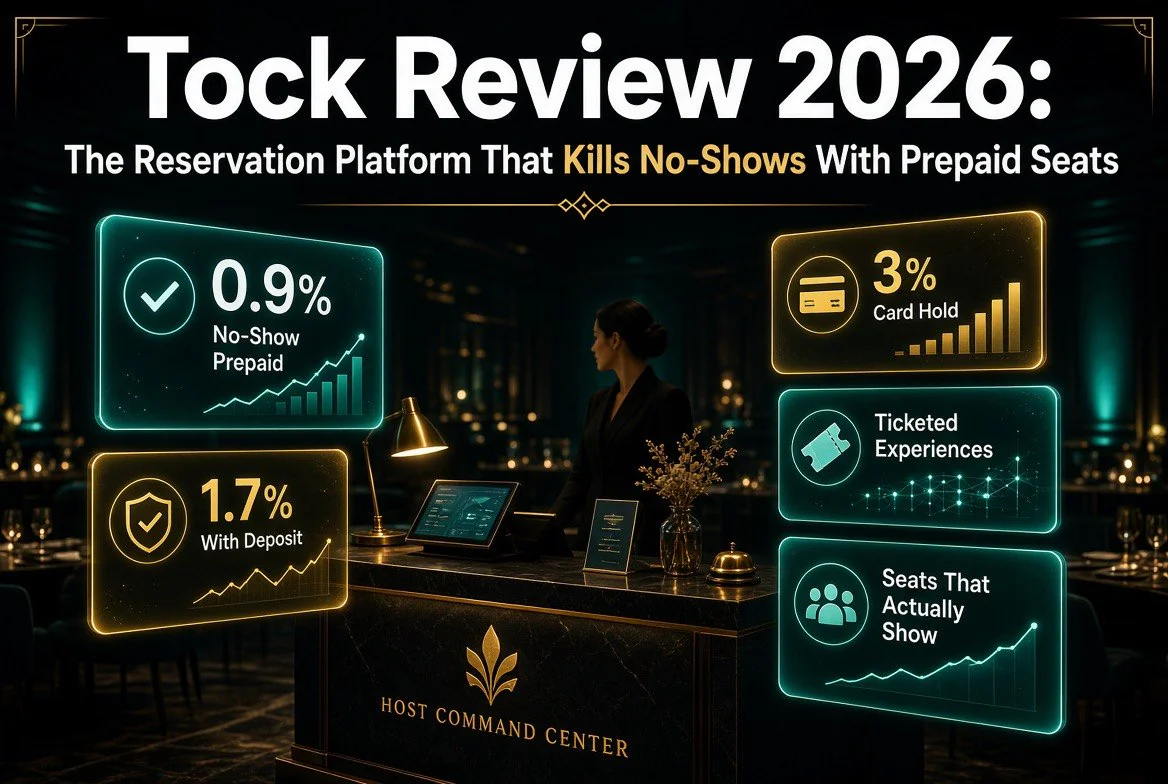
Tock Review 2026: The Reservation Platform That Kills No-Shows With Prepaid Seats
⚡ Expert Summary: Tock treats a reservation like a ticket — you take a deposit, hold a card, or collect full prepayment when the table is booked, not after a no-show costs you the seat. The data backs the model: Tock reports an average no-show rate around 0.9% for fully prepaid bookings and about 1.7% with deposits, versus the 10–20% many urban independents absorb without protection. For a tasting-menu, chef’s-counter, or event-driven restaurant where an empty seat is real revenue gone, Tock’s friction model is the single most effective no-show defense an independent can deploy.
No-shows are the silent revenue leak every independent restaurant owner knows but rarely fixes. A Friday-night no-show on a six-top at an average check of $80 a head is $480 of food cost and labor tied to a table that never shows. In a normal month that’s not an occasional annoyance — industry data puts no-show rates at 10–20% in urban areas for restaurants without protection. For a place running tasting menus or chef’s counters with fixed seating, that’s a permanent hole in the revenue line.
The standard fixes — reminders, overbooking, double-booking — manage the symptom. Tock addresses the cause: it makes the guest financially committed to the seat at the moment they book it, the same way a concert ticket commits the buyer. That model, which Tock pioneered for restaurants, is why it remains the strongest no-show defense for the independently owned restaurants whose seats are genuinely perishable.
How Tock’s No-Show Model Works
Tock’s core innovation is treating restaurant reservations like event ticketing — a model its co-founder, the Alinea team behind it, understood intimately. You choose how much friction to apply to a booking, from least to most.
Free reservation
Standard bookings with no payment, suitable for walk-in-friendly casual spots or as the lightest tier. These still get automated reminders but carry the least protection against no-shows.
Credit card hold
The guest authorizes a card at booking; it’s only charged if they no-show or late-cancel within your policy window. Tock’s data puts no-show rates at roughly 3% with this protection — a strong middle ground that protects revenue without asking guests to pay up front.
Deposit
Guests pay a deposit at booking — figures range from small per-person amounts to about 10% of the predicted check — fully refundable if they cancel within policy. Tock reports average no-show rates around 1.7% with deposits, and some operators have described cutting no-shows by half after turning them on.
Full prepayment
Guests pay for the whole experience when they book — the model for tasting menus, chef’s counters, and ticketed events. This is Tock’s strongest protection, with an average reported no-show rate of just 0.9%. When someone has already paid, they show up.
| Protection level | What guest pays at booking | Reported no-show rate |
|---|---|---|
| Full prepayment | Entire experience | ~0.9% |
| Deposit | Fixed amount or ~10% of check | ~1.7% |
| Card hold | Authorized, charged only on no-show | ~3% |
| No protection (baseline) | Nothing | 10–20% urban average |
Look at that spread. Moving from “no protection” to even a card hold cuts your no-show exposure dramatically, and full prepayment nearly eliminates it. The friction you’re comfortable asking for should track how perishable your seats are — a chef’s counter that seats 12 twice a night cannot absorb no-shows the way a 120-seat dining room can.
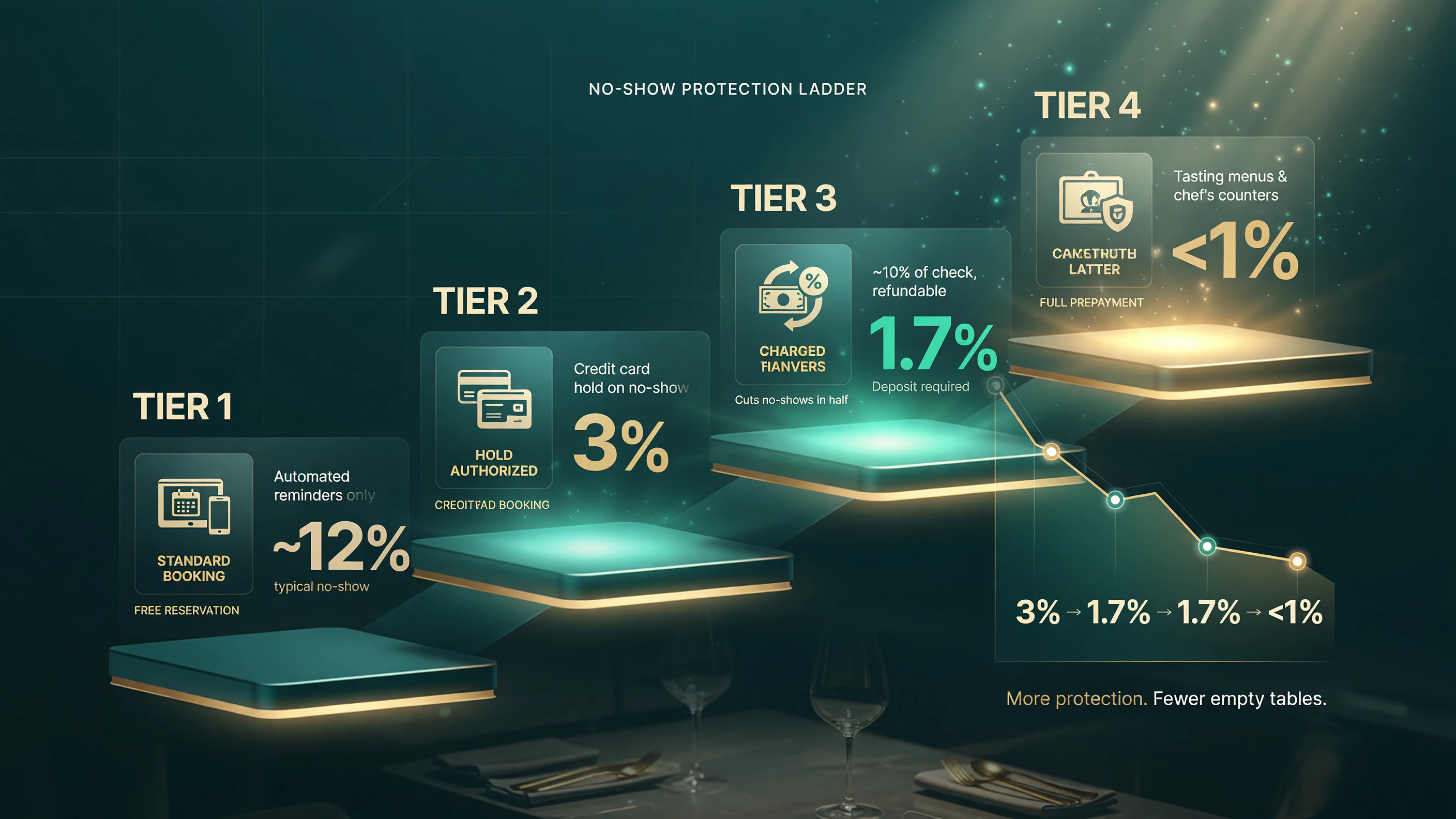
How much friction you apply decides the no-show rate you live with: a free booking leaves the typical range wide open (~12%), a card hold brings it near 3%, deposits cut it toward 1.7%, and full prepayment pushes it under 1%.
Beyond No-Shows: The Experiences Engine
No-show protection is Tock’s headline, but for independent restaurants with something special to sell, the experiences engine is arguably the bigger revenue unlock. Tock lets you list and sell ticketed items alongside standard reservations on the same page: tasting menus, chef’s counters, wine pairings and flights, holiday dinners, cooking classes, special events.
For the fixed-seating or event-driven independent, this turns a direct channel out of thin air. Instead of manually managing events over email and chasing deposits, guests book and prepay online through your Tock page, and the seats are guaranteed before the night starts. It’s the difference between hoping the room fills and selling the room in advance.
Tock also bundles table and service management around it — adjustable floor plans, walk-in waitlists, pacing controls, two-way SMS with guests, and a guest CRM where profiles, history, and notes accumulate and you keep ownership of the data. Higher tiers add automated guest insights and deeper analytics.
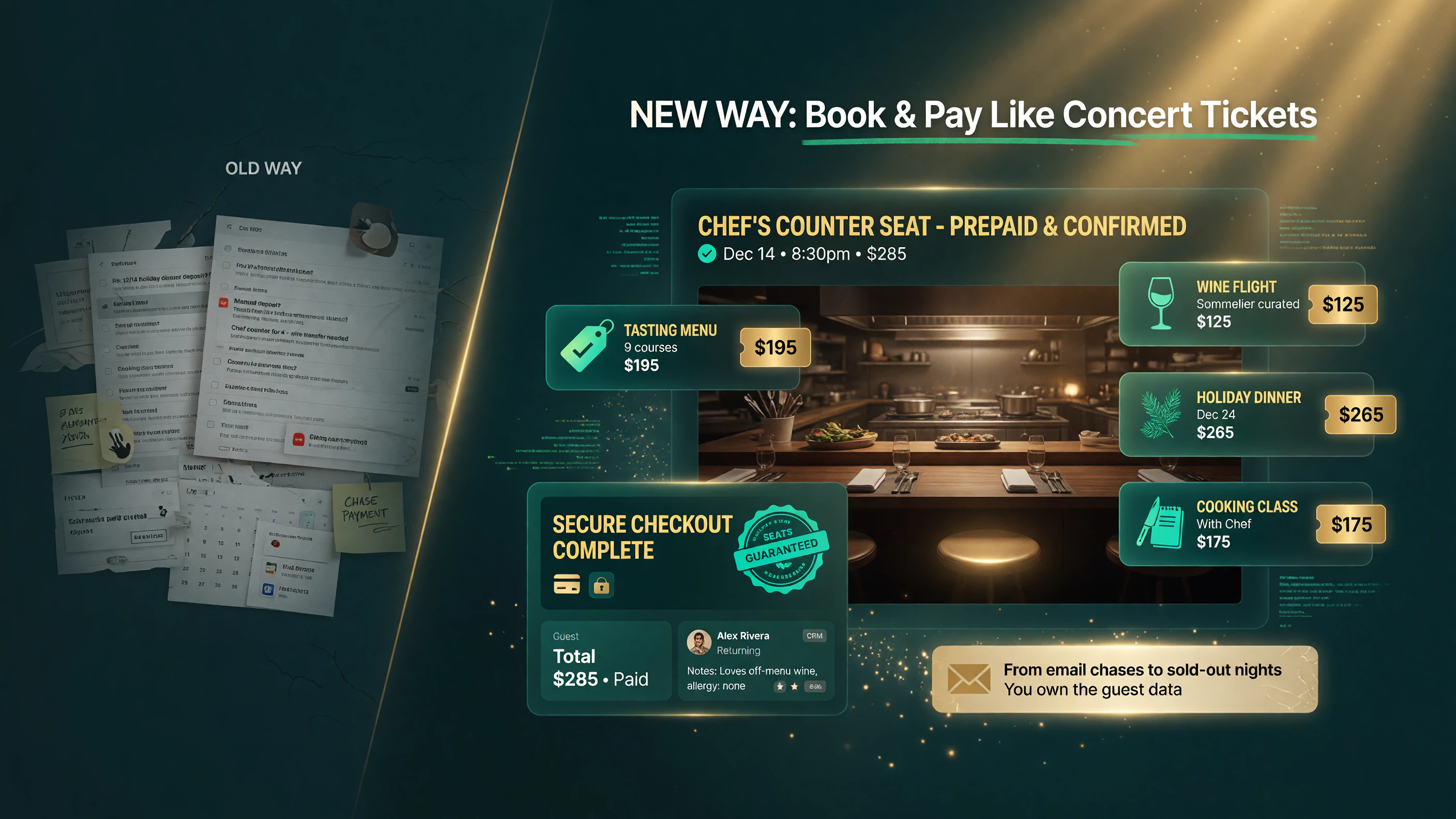
Fixed-seating and event-driven independents can stop chasing deposit emails: list the tasting menu, chef’s counter, wine flight, or cooking class, and guests prepay online so the seats are sold before the night begins.
The Integration into Resy and What It Means for You
2026 brings a real strategic consideration: American Express, which owns Resy, acquired Tock and announced the two platforms are merging — Resy as the consumer-facing brand, with Tock’s prepaid and ticketing functionality migrating over as system integration continues through the merger timeline. For an independent owner, the practical read is that the restaurant-side management tools and the prepaid no-show model are being consolidated under one roof rather than retired.
The honest implication: if you’re evaluating long-term platform risk, the ongoing merger is worth a direct question to your Tock sales contact about timeline and feature continuity before you commit. The prepaid model that matters for your no-shows isn’t going away — it’s the crown jewel of the acquisition — but platform transitions always carry some uncertainty, and a straight answer on roadmap beats a guess.
Pricing: Flat Monthly, No Per-Cover Fees
Tock’s pricing model is one of its quieter advantages for independents: a flat monthly subscription rather than per-cover fees. For a busy independent restaurant, that predictability matters a lot — your platform cost doesn’t grow linearly with every guest you seat the way percentage-of-revenue or per-cover models do. Fees only apply on prepayments and tickets, plus standard payment processing.
| Plan tier | Approximate monthly | What it adds |
|---|---|---|
| Core reservation tools | ~$249–289 | Reservations, table management, no-show tools, POS integrations |
| Essential | ~$269–289 + 3% on prepayments | Adds deeper customization and event ticketing |
| Premium | ~$399–459 + 2% on prepayments | Lower prepay fees, premium support, deeper guest insights, robust experiences |
Because pricing varies by tier, location, and current offers, confirm the exact figure with your sales rep — but the structural point holds: flat monthly, no per-cover penalty for success.
Where Tock Falls Short
Be honest about fit. Tock is not the right tool for every independent. If you run a casual, high-volume à-la-carte spot with little ticketed or prepaid business, Tock’s model can feel like overkill — you’re paying reservation-platform money and applying friction to seats that are easy to refill from walk-ins. The prepayment fees (on tiers that charge them) add up on large prepaid volumes. And some independent operators report mixed value in reviews, with the main complaints centering on fees and the pace of upsells from the platform.
There’s also the discovery question. Tock’s consumer network is smaller than OpenTable’s, the platform that dominates diner discovery — so if your primary need is filling the room with new diners searching for a table, a broader discovery platform may matter more. Tock’s strength is protecting and monetizing the demand you already have, and selling your unique ticketed offerings directly — not necessarily driving mass new-customer discovery. Integrated partners help close that gap, but it’s a real tradeoff to weigh.
Should You Put Your Reservations on Tock?
The honest decision framework:
- Are no-shows costing you real revenue? If you’re absorbing 10–20% no-shows on seats that can’t be refilled — tasting menus, chef’s counters, fixed seating, events — Tock’s prepaid model attacks the problem at its root.
- Do you sell experiences, not just meals? If you run wine dinners, holiday events, classes, or ticketed multi-course menus, the experiences engine is a direct-sales channel that funds itself through prepayment.
- Do you value predictable platform costs? Flat monthly with no per-cover fees protects your margin as you grow, versus percentage models that scale with your success.
- Is your business casual and walk-in-driven? If so, reservation friction works against your flow — Tock is the wrong tool for you, and that’s fine.
For the independent whose seats are genuinely perishable — the tasting-menu room, the chef’s counter, the event-driven dining room — Tock remains the most effective no-show defense in the market, backed by a prepaid model with reported no-show rates near zero. It’s not the platform for every restaurant, but when an empty seat is money you can never recover, it’s the difference between hoping guests show and knowing they will.
Putting Real Numbers on a No-Show Problem
Abstract talk about “losing revenue to no-shows” lands differently when you put your own seat count against it. Run this quick back-of-the-napkin check before you decide anything, because it tells you whether the reservation model is a defense you need or a friction you’re adding for no benefit.
Start with the seats you cannot refill on short notice — fixed seating, a chef’s counter, tasting-menu covers, private tables held for a specific party. Estimate that fully booked few-turn night: how many of those seats sit in parties you hold a reservation for, and what does the average party spend per seat after food and drink?
Now apply the 10–20% no-show range that operators commonly report when there’s no money attached to the booking. If you run twenty covers on a Saturday that genuinely can’t be backfilled when a reservation is a no-show, at, say, roughly eighty dollars a head in spend, losing even two of those parties near the high end of typical no-show behavior can erase several hundred dollars of impossible-to-recover revenue — before you even count the prep and product that was staged for the table. With a no-show rate closer to the 1–3% that prepaid and card-hold models report (with fully prepaid bookings effectively near zero), that exposure mostly disappears.
The numbers are why the decision framework above is really a single question wearing different clothing: do you hold seats that a no-show leaves emptiable and un-backfillable? If the honest answer is yes, then every no-show is a total loss, and a card hold, deposit, or prepaid seat is insurance you buy once a month through the platform fee and forget about. If the answer is no — your room fills from walk-ins and same-day calls within minutes — then reservation friction is a cost you don’t need, and the model isn’t for you.
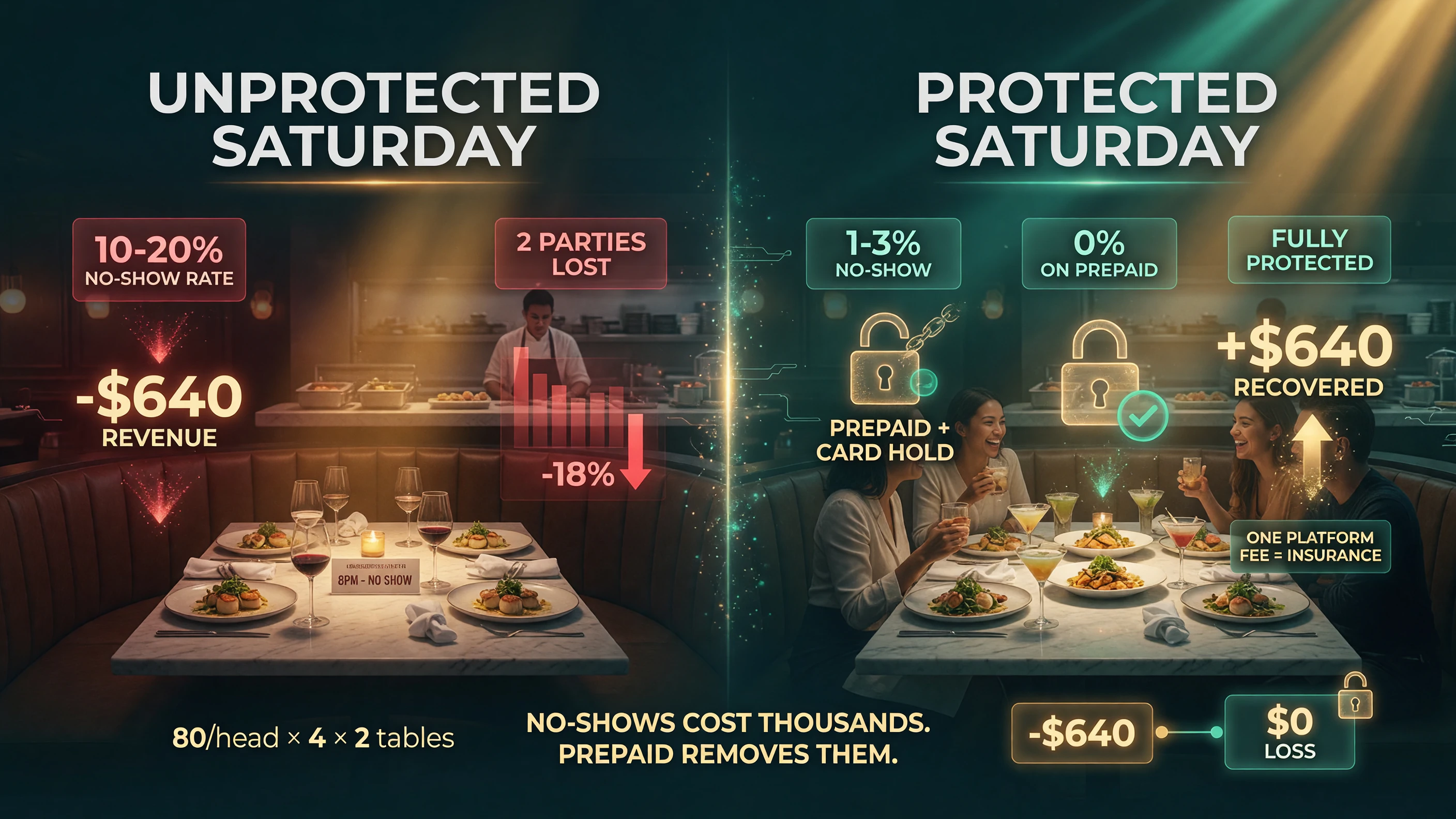
Run your own covers against the numbers: an unprotected no-show can erase hundreds of dollars of un-backfillable revenue, while prepaid and card-hold bookings push the rate toward 1–3% (and near zero fully prepaid).
Frequently Asked Questions
What is Tock?
Tock is a reservation and hospitality platform that treats restaurant bookings like event tickets. Restaurants can take card holds, deposits, or full prepayment at booking to prevent no-shows, and can sell ticketed experiences like tasting menus and events alongside standard reservations.
How much does Tock cost?
Tock uses flat monthly subscription pricing with no per-cover fees. Plans range approximately from $249–289/month for core reservation tools up to $399–459+/month for premium tiers, with fees of 2–3% applied only on prepayments and tickets. Confirm current pricing with Tock sales.
Does prepayment really stop no-shows?
Tock’s data backs it: fully prepaid bookings average about 0.9% no-show rates, deposits about 1.7%, and card holds about 3% — versus the 10–20% urban baseline without protection. Financial commitment at booking is the single strongest no-show deterrent restaurants have.
Is Tock being shut down?
No — Tock and Resy (both under American Express) are merging. Resy is becoming the consumer-facing brand while Tock’s restaurant-management tools and prepaid/ticketing model migrate over as system integration continues. The no-show protection model is central to the acquisition, not being retired.
Is Tock good for casual, walk-in restaurants?
Generally no. Tock’s strength is protecting and monetizing perishable seats and selling ticketed experiences. A casual, high-volume, walk-in-driven restaurant is often better served by a lighter or discovery-focused platform, since reservation friction can work against its flow.