Orderly AI Voice Ordering Review: Answers the Phone and Takes Orders So Your Staff Don’t
⚡ Expert Summary: Orderly is an AI voice-ordering agent that answers your restaurant’s existing phone line, takes natural-language orders around the clock, confirms details back, and sends them straight to your POS — no number change, no new hardware. For an independent shop drowning in missed peak-hour calls or paying a staffer just to answer the phone, it’s one of the fastest labor-cost wins in restaurant AI: call-capture on missed lines, consistent upsells that lift average order value, and fewer bodies needed on the phone during the rush.
Here’s the reality of the restaurant phone in 2026: it still rings, and during Friday dinner service it rings when you’re shorthanded and can’t answer. Every one of those missed calls is an order going to whoever your customer calls next. Independents lose a meaningful slice of peak-period revenue not because the food’s bad or the price is wrong, but because no one could pick up the phone in time.
Voice-AI ordering vendors have been pushing at this problem for the last couple of years, and the pitch is finally grounded in real operator numbers. AI phone ordering is hitting meaningful adoption — recent industry data puts AI phone answering at around 34% adoption among US restaurants rolling it out — because owners who deploy it see the same three outcomes: missed calls get answered, average checks tick up from consistent upsells, and staff stop juggling a phone during service. Orderly is built squarely in that lane for independent operators.
What Orderly Actually Does
The concept is simple enough to explain in one sentence — an AI answers your phone and takes the order — but the details matter for how it behaves in a real, chaotic service environment.
It uses your existing phone number
Customers call the same number they always have. Orderly sits on that line, so there’s no rebranding, no “call our other line,” no lost customer trust. You forward your current line and the AI answers.
It understands natural language, not scripts
This is where older phone-tree systems failed and modern voice agents succeed. A customer saying “large pepperoni, extra cheese, no onions, half sausage” doesn’t need to navigate a menu of button options. Orderly parses the modifiers, quantities, and special requests in plain speech, confirms the order back in plain language, and reads out what it heard so mishears get caught before the order hits the kitchen.
It handles the complexity of your actual menu
Menu rules matter. Pizza shops especially have logic — topping limits, allowed combinations, half-and-half pizzas, crust options, delivery zones. Orderly is trained on those constraints, so it won’t accept an order your kitchen can’t make. If a call goes outside what it can confidently handle, it routes to staff rather than guessing.
Orders sync straight to your POS and kitchen
Because the confirmed order flows into your existing POS — Toast, Square, Clover and the like — there’s no re-keying and no transcription errors between the phone and the ticket that prints. The AI doesn’t touch raw card data in many setups; payment is handled via a secure link sent to the customer.
Where Orderly Makes You Money
The value isn’t “cool technology,” it’s three concrete revenue and cost levers. Independent operators who deploy AI phone ordering report the pattern below.
| Lever | What happens | Why it matters to an independent |
|---|---|---|
| Missed-call capture | AI answers after hours and during the peak crush | Independents can lose 20–40%+ of peak phone calls; captured calls are orders you’d otherwise hand to a competitor |
| Average order value | Consistent, polite upsells on every call | Vendors cite 12–38% ticket lifts from reliable add-on prompts a busy human forgets |
| Labor | Fewer staff hours spent on the phone during service | Reallocates the person who used to answer toward prep and expo; directly trims the labor line |
The labor angle is the one owners feel first. Phone coverage during a rush usually means pulling whoever’s closest off a higher-value task. When the AI handles the front-of-house phone load, that person stays on the line that actually plates the food.
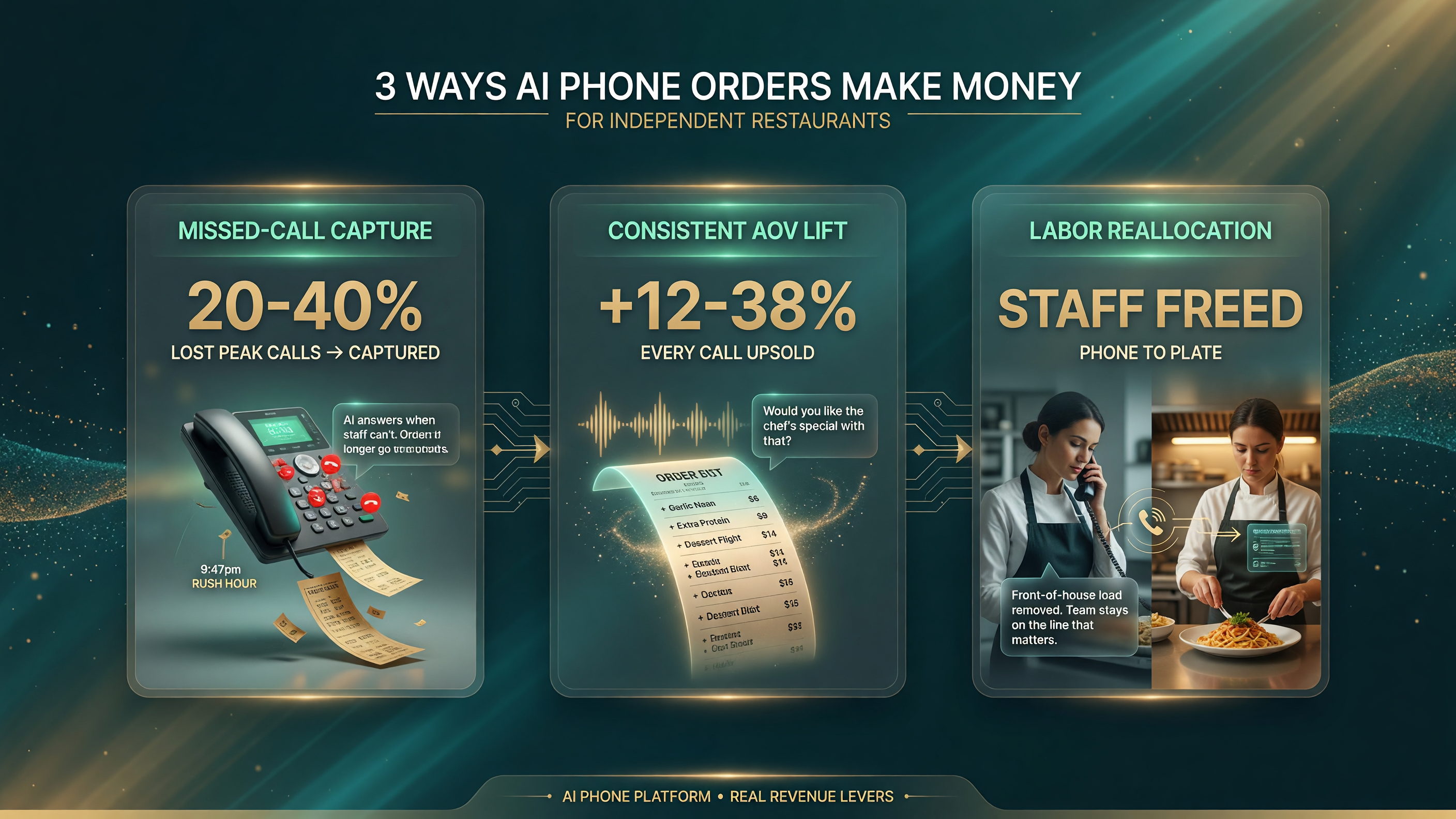
Three concrete money levers: AI captures the 20–40%+ of peak calls restaurants otherwise lose, polite upsells lift tickets ~12–38%, and staff stay on the line that plates the food instead of answering the phone.
Inside a Real Order
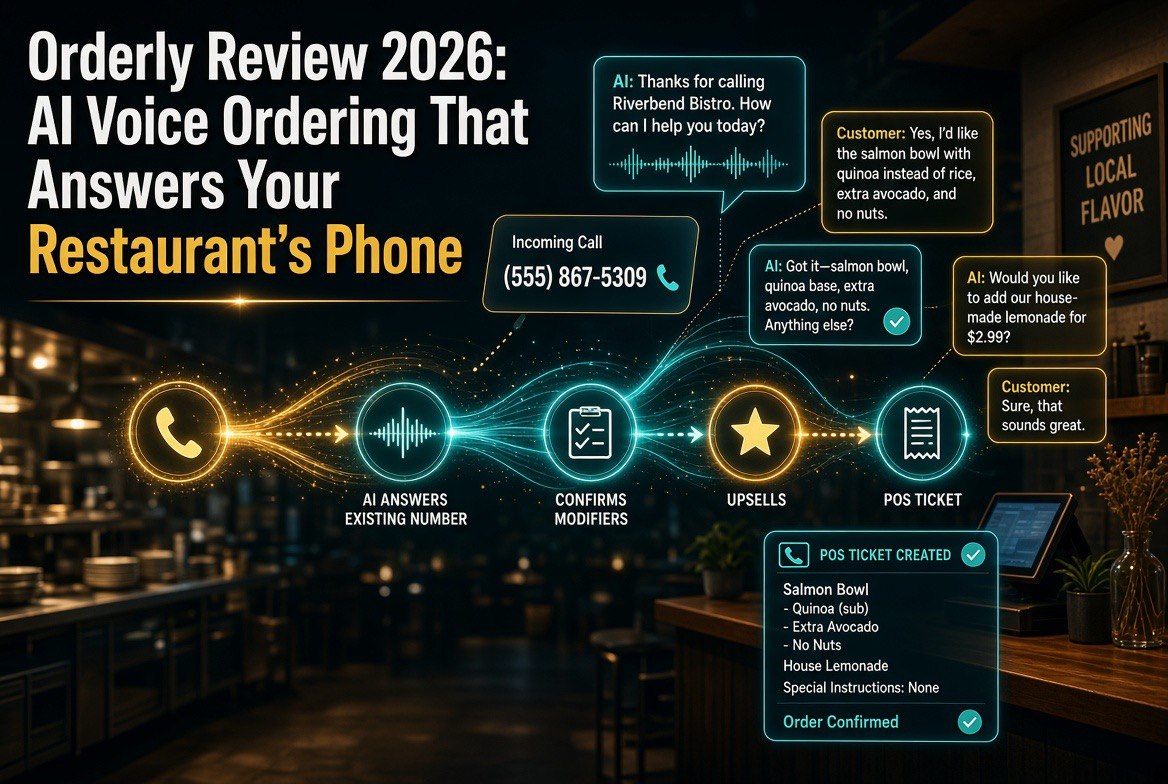
To make this concrete, here’s what a typical call looks like once Orderly is live.
- Call comes in to your existing number during the dinner crush — a customer who would previously have hit voicemail.
- AI answers with your restaurant’s greeting, no hold music, no “press 1 for pizza.”
- Customer orders naturally: “I’ll do a large pepperoni with extra cheese, no onions, and half sausage.”
- AI confirms the details back — size, crust, toppings, half-and-half split — and reads the full order for verification.
- Upsell: “Can I add a 2-liter or dessert to that order today?”
- Handles payment via secure link and gives the pickup/delivery estimate.
- Order syncs to your POS, and you clear the AI’s queue only for calls it flagged as ambiguous.
That’s the whole loop. The operator’s job shifts from answering every call to reviewing the small number the AI routes because it wasn’t confident.
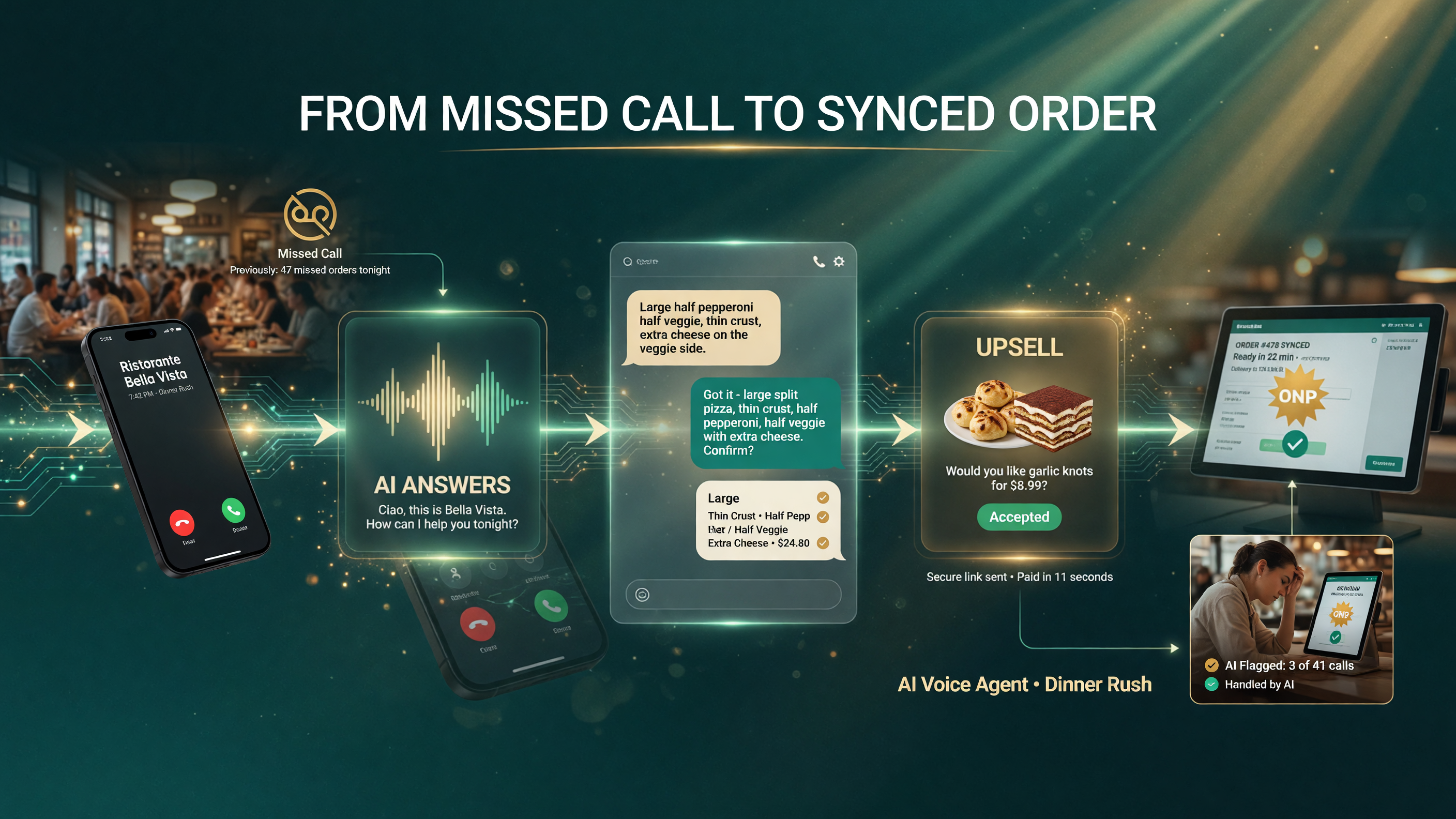
One call, end to end: the AI answers during the rush, takes a natural order, confirms the split back, offers an upsell, takes a secure payment, and syncs to the POS — the operator only reviews the handful of calls the AI flags as unsure.
Orderly vs. Answering Yourself vs. a Phone Tree
Independents realistically choose between three ways to handle the phone. Here’s the honest comparison.
| Factor | AI voice agent (Orderly) | Human answers | Old phone tree / voicemail |
|---|---|---|---|
| Peak-hour coverage | Answers every call, every time | Depends on staffing in the moment | Routes away or drops the order |
| Order accuracy | Confirms back + syncs to POS | Good but varies under pressure | Lost entirely |
| Upsells | Consistent on every call | Inconsistent, forgotten in the rush | None |
| Labor | No phone staffing needed | Full body pulled from service | n/a — you just lose the call |
| Cost profile | Flat monthly subscription | Wages + benefits | Cheap but revenue-negative |
Read that bottom row carefully. Voicemail is “free” but it costs you the order. A human is reliable but expensive and pulled off higher-value work. An AI agent is a flat monthly line that answers 100% of calls and only costs more if it genuinely earns its keep through captured orders and higher tickets.
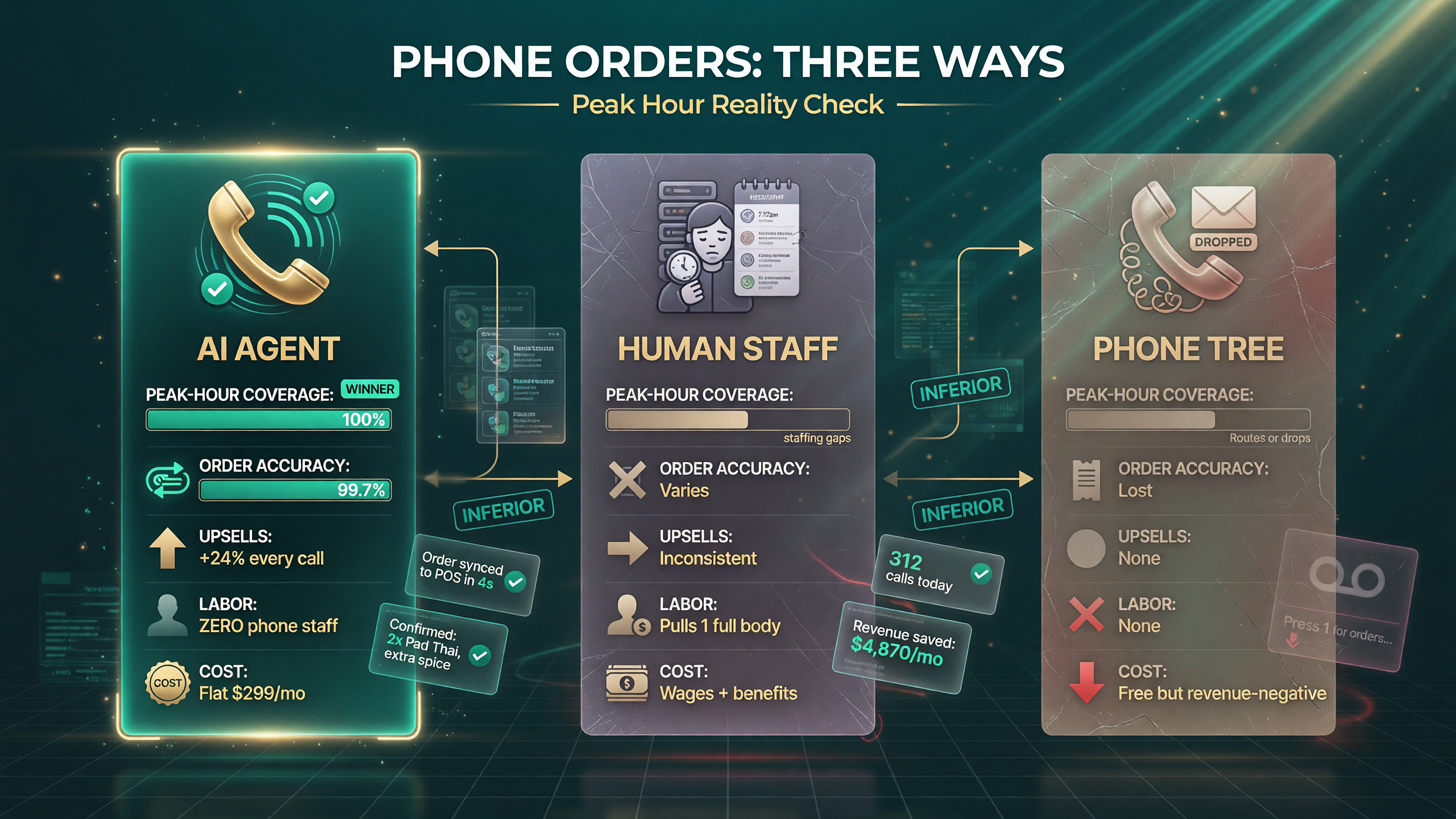
Three ways to handle the phone: an AI agent answers 100% of calls and syncs orders to the POS on a flat subscription, while a human pulls a body off service and voicemail is “free” but revenue-negative — it costs you the order.
How to Set Up Orderly at Your Restaurant
Getting a voice agent live is not a months-long project, but the setup quality decides how well it performs. Vendors in this category typically run a structured onboarding rather than handing you a config panel and walking away. A realistic rollout looks like this.
- Menu file. You start by providing your menu in structured form — every item, size, crust or configuration option, topping or ingredient with its limits, and any combo or special rules. This is the single biggest lever on accuracy, so don’t rush it.
- Delivery-zone mapping. You load where you deliver and where you don’t, so the agent doesn’t accept an order outside your range or promise a delivery time you can’t hit.
- Call forwarding. You point your existing number to the service. Customers keep calling the same digits; nothing changes on their end.
- Open hours and policy. You set when the agent answers loud and clear, whether it also handles calls after close (capturing next-day or future orders), and your cancellation constraints.
- POS connection. You authorize the integration with your point-of-sale so confirmed orders drop straight into your flow and print at the right station.
- Voice test drives. You place a handful of sample calls that mirror how your real customers really order — with slang, interruptions, and run-on sentences — and tune the agent against what it gets wrong.
- Short ramp. You go live monitoring the routed-call queue closely for the first week or two, then relax as the agent internalizes your menu and talking points.
Expect to review more flagged calls in that first fortnight than you ever will again. That’s not a defect — it’s the agent’s menu-learning period. The restaurants that see the biggest lift are the ones that invest in steps 1 and 6 rather than assuming the AI just works on day one.
Pricing and the ROI that Justifies It
Voice-ordering agents are typically sold as a flat monthly subscription per location rather than per call, which makes the economics predictable. The exact figure varies by order volume and menu complexity — expect to see a per-location monthly rate with setup, and quotes are generally customized to your volume rather than a published one-size price.
The way to evaluate the cost is against what it replaces. If the AI captures even a handful of peak-period phone orders a week that you were losing, and lifts your average ticket on the calls it handles, the subscription pays for itself quickly. Restaurant-industry ROI analyses for this category point in the same direction: the combination of recaptured calls and labor reallocation is what moves the needle, not any single metric.
Where Orderly Falls Short
Be straight about the limits. An AI voice agent is excellent on the phone line it’s trained on, but it won’t handle every edge case perfectly. Highly unusual, emotional, or escalated calls still get routed to a human — and during the busiest moments you still need someone available to take those. If your business runs almost entirely on dine-in traffic with little phone ordering, the missed-call problem it solves is smaller for you. And as with any voice AI, accuracy depends on menu setup and a short training period; you’ll review more routed calls in the first weeks than you will once the system knows your offerings.
The other practical note: this category is crowded, and “Orderly” is one of several voice-ordering products sharing names in the space. Whatever you evaluate, ask the vendor three questions — does it run on my existing number, does it sync to my actual POS, and who handles the calls it flags as ambiguous — and treat the answers as more important than the brand.
Should You Add AI Phone Ordering?
Decide against your own reality, not the hype.
- Are you losing phone orders you can’t answer at peak? If callers hit voicemail or busy signals during rush, an AI agent captures revenue you’re currently giving away — the strongest single reason to deploy one.
- Is a staff member tied up on the phone instead of doing higher-value work? If your expo or prep person is regularly answering calls, you’re paying top labor rates for phone duty an AI handles for a flat fee.
- Do you take complex phone orders that need accuracy? Voice AI that confirms back and syncs to your POS genuinely reduces the misheard-order problem on busy nights.
- Is a small slice of your revenue even phone-based? If dine-in dominates and the phone barely rings, this isn’t your bottleneck — spend the budget elsewhere.
For the independent restaurant whose phone rings during the rush and can’t always be answered, AI voice ordering like Orderly is one of the fastest-justifying investments in restaurant AI in 2026. It’s a flat monthly line that answers every call, lifts your average ticket, and gets a body back onto the floor where they actually make you money.
Frequently Asked Questions
What is Orderly AI voice ordering?
Orderly is an AI voice-ordering agent that answers a restaurant’s existing phone line, takes natural-language orders — including complex modifiers and menu rules — confirms them back, and syncs them to the restaurant’s POS. It operates 24/7 and routes ambiguous calls to staff.
How much does AI voice ordering cost for a restaurant?
Voice-ordering agents typically charge a flat monthly subscription per location, often customized to order volume and menu complexity rather than a published one-size price. The economics are evaluated against recaptured phone orders and labor reallocation.
Does AI phone ordering work with my POS?
Yes — modern voice-AI ordering platforms integrate with the major restaurant POS systems like Toast, Square, and Clover, sending confirmed orders directly to the kitchen ticket printer or display so nothing is re-keyed.
Can AI answer the phone when my restaurant is closed?
Yes. Because the agent operates around the clock on the restaurant’s forwarding line, it can take orders and reservations outside normal hours, capture callers who would otherwise reach voicemail, and process payment via secure link.
Does a voice agent replace my staff?
No — it replaces a specific task (answering and taking phone orders) and reallocates that person to higher-value work. Calls an AI can’t confidently handle still route to staff, so it augments your team rather than removing it.