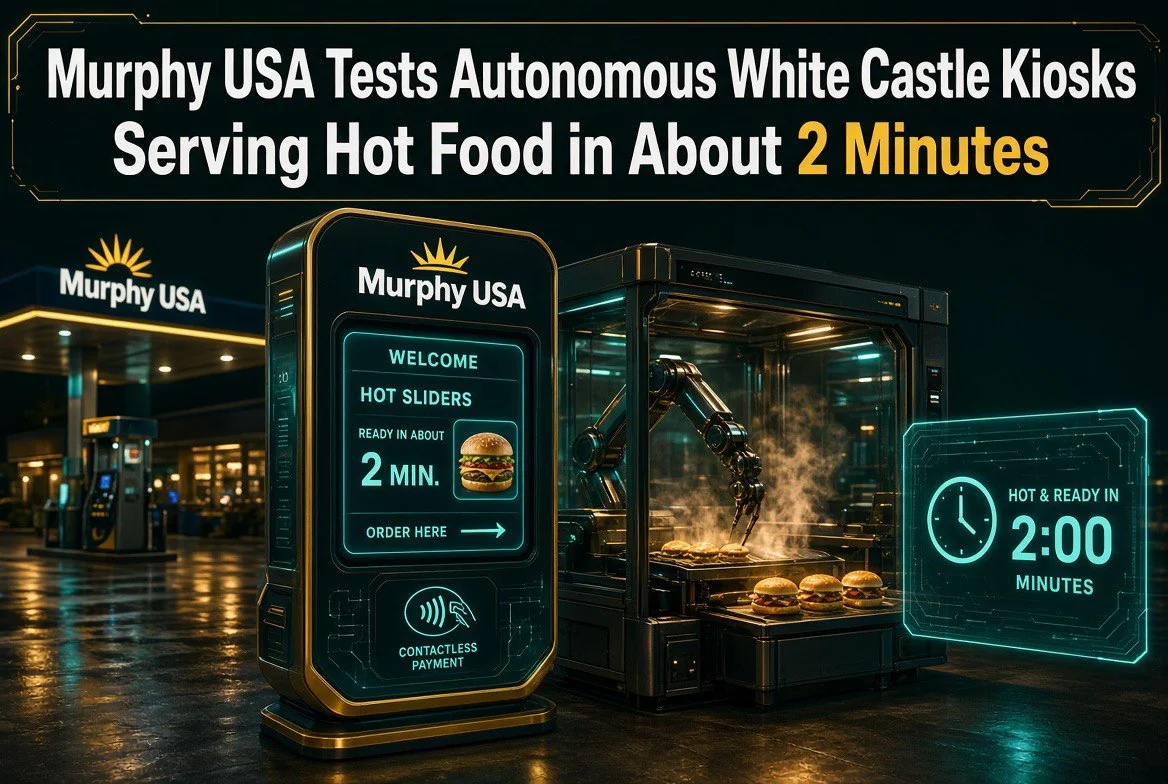
Murphy USA Is Testing Autonomous White Castle Kiosks That Serve Hot Food in About 2 Minutes
⚡ Expert Summary: Murphy USA announced it will trial an autonomous foodservice platform from Automated Retail Technologies (ART) at select large-format stores, with White Castle food on the menu to start. Customers order on a touchscreen and get hot food in roughly two minutes, with no kitchen build-out and no extra food-prep staff required. The test is a signal that the convenience-store giant — long focused on fuel and low-priced grab-and-go — is shifting toward fresh food as it evaluates new formats, services, and foodservice across its banner. It is not expected at every store near term; the company is stepping in deliberately.
What’s Happening at Murphy USA
Murphy USA, one of the largest convenience-store and fuel-station operators in the United States, is rolling the dice on automated foodservice. The company announced Thursday that it will bring an autonomous foodservice platform to selected large-format stores. The platform is developed by foodservice technology firm Automated Retail Technologies (ART), and it will initially serve food from the White Castle menu — the burger QSR chain known for its sliders.
Customers order on a touchscreen interface and receive hot food in about two minutes. The announcement did not specify how many locations will get the technology, but the intent is clear: Murphy wants to test demand for fresh, convenient food options that can be prepared in a compact space without a traditional kitchen.
Why This Matters for the Convenience Industry
This is a notable strategic shift for Murphy USA. Although the company acquired the fresh-food-centric QuickChek chain in 2021, its main banner has historically leaned on fuel sales and low-priced, standard convenience-store items inside the store. Bringing an automated kitchen into that model is a departure — and it signals that the company sees fresh food as a real growth lever rather than a sideline experiment.
“We’re continually evaluating opportunities that create additional value for our customers while building on the strengths that have made Murphy USA successful,” said Scott Woodward, Murphy USA’s senior vice president and chief merchandising officer. “This relationship allows us to introduce a new convenience offering informed by customer insights, while maintaining the operational discipline and focus on everyday value.”
The move also fits a broader industry trend: convenience stores are racing to add hot food because it drives higher margins and repeat trips than fuel alone. The challenge has always been labor and kitchen space. ART’s modular platform attacks both — it automates the preparation, heating, and delivery of food inside a self-contained system that fits into a store without a kitchen build-out or additional food-prep employees.
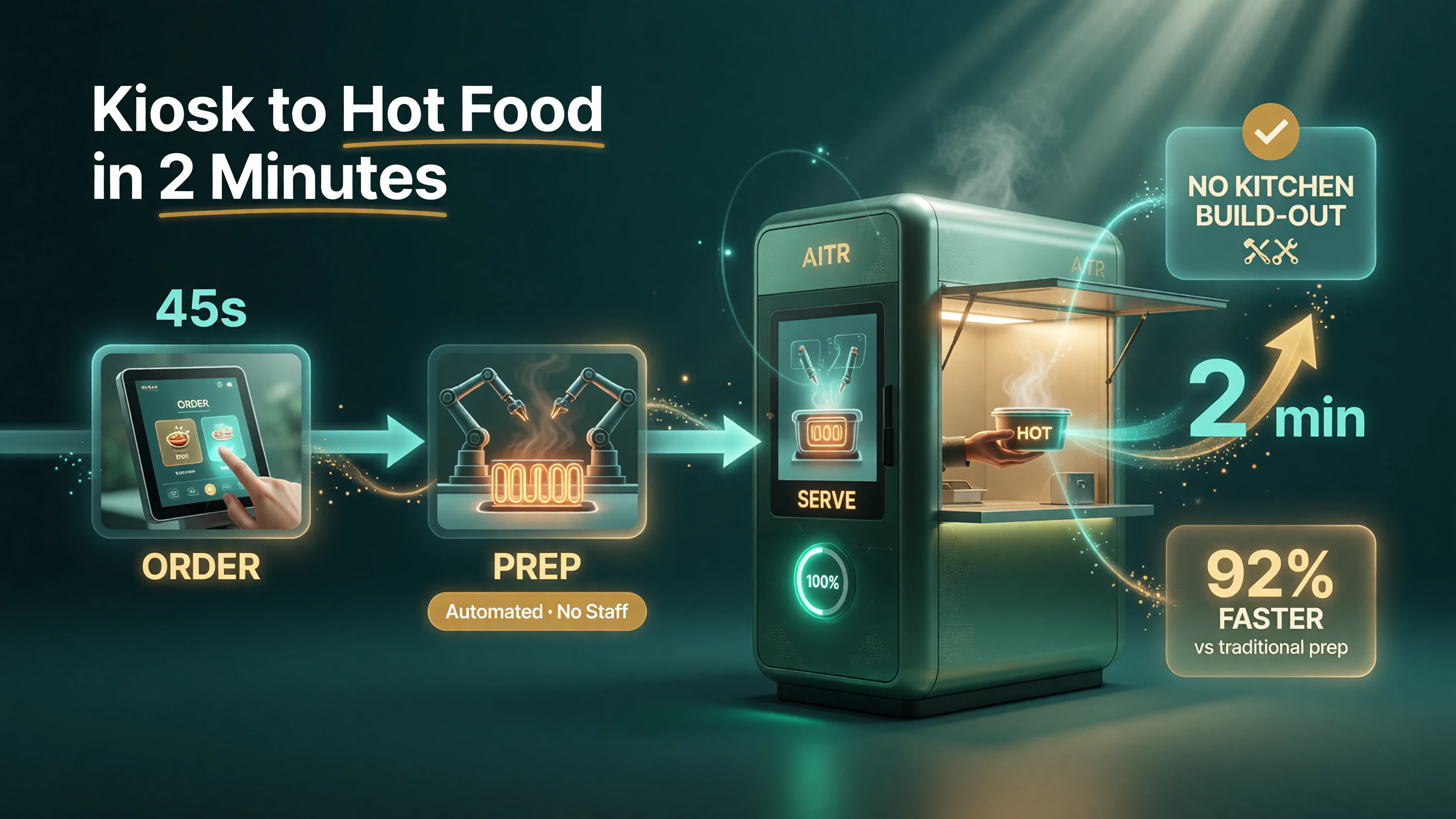
ART autonomous platform: touchscreen ordering feeds automated prep and heating, with hot food served in about 2 minutes and no kitchen build-out or dedicated prep staff.
How the Autonomous Kitchen Works
| Step | What Happens |
|---|---|
| 1. Customer orders | Guest uses a touchscreen interface to select items from the White Castle menu |
| 2. Automated prep | The self-contained system handles preparation and heating automatically |
| 3. Fast delivery | Hot food is delivered in roughly two minutes from ordering |
| 4. No kitchen build-out | Modular unit fits into existing footprint without construction |
| 5. No extra prep staff | Automation removes the need for dedicated food-preparation employees |
What It Means for Operators
For independent restaurant and foodservice operators, the Murphy USA trial is worth watching for three reasons. First, it demonstrates that automated, compact kitchens are moving out of the pilot lab and into real high-traffic retail environments. Second, it shows a major chain betting that touchscreen ordering plus automated prep can deliver the speed and convenience customers want without the labor burden that sinks most foodservice expansions. Third, it validates a model where a retailer does not need to build a kitchen or hire a prep team to offer fresh hot food.
That has direct implications for restaurants of all sizes. If automated kitchen units can reliably serve hot food in about two minutes with minimal labor, the economics change for anyone considering adding a foodservice lane, a ghost-kitchen concept, or an automated pickup point. The technology removes one of the biggest barriers to offering fresh food: the ongoing cost and complexity of staffing a kitchen.
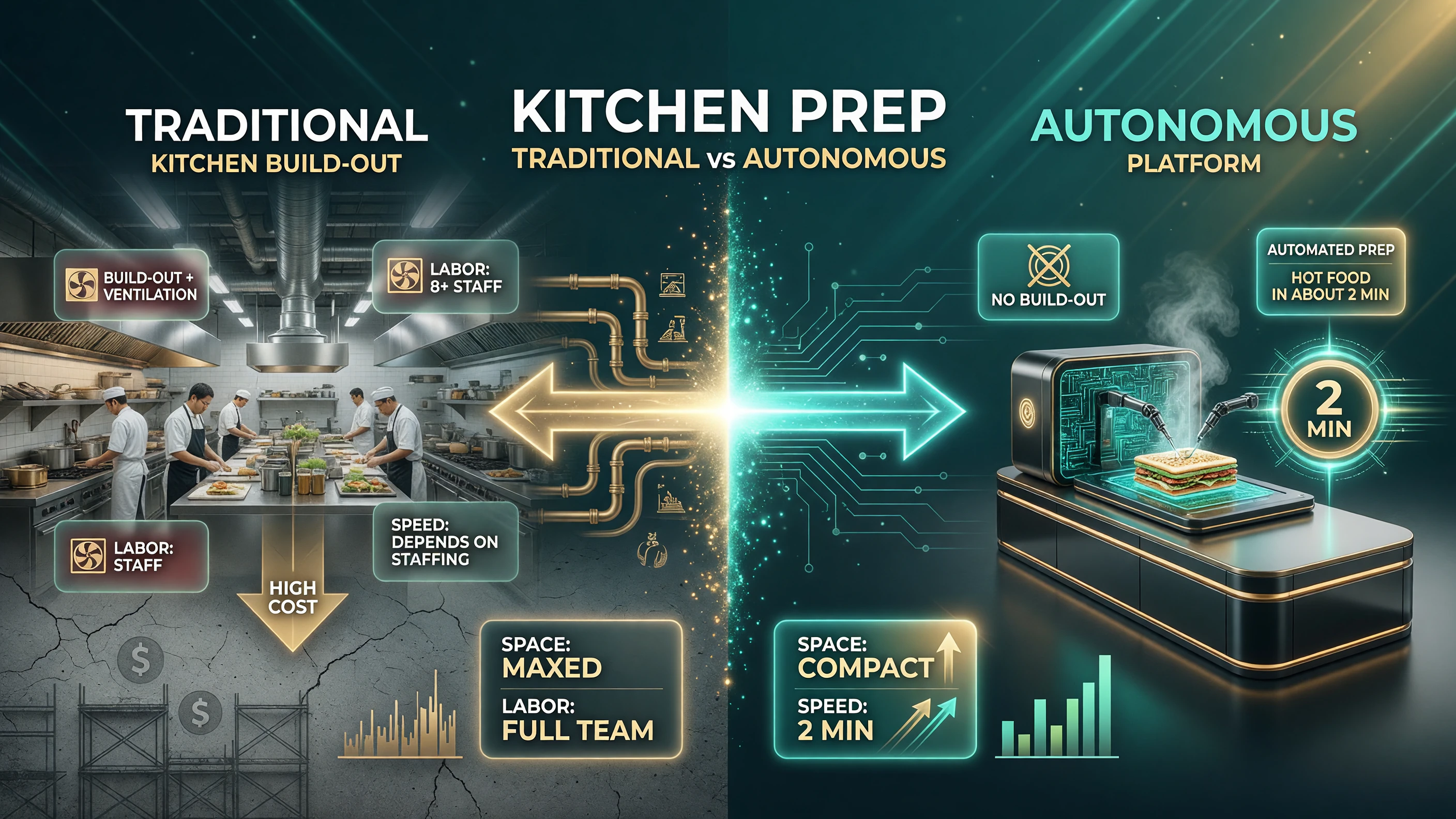
What ART’s autonomous platform removes vs a traditional kitchen build-out: the ventilation, the prep staff, and the reliance on staffing to hit speed — swapping them for a compact unit that serves hot food in about 2 minutes.
Murphy USA vs a Traditional Kitchen Expansion
| Factor | Traditional Kitchen Build | ART Autonomous Platform |
|---|---|---|
| Space | Large footprint, ventilation, build-out | Compact, self-contained unit |
| Labor | Cooks and prep staff needed | Automated prep and heating, no dedicated staff |
| Speed | Depends on staffing and demand | Hot food in about two minutes |
| Ordering | Counter or app, human-led | Touchscreen interface |
| Deployment cost | High upfront construction cost | Designed to fit in without build-out |
Where Murphy USA Is Headed
Murphy’s leadership has been weighing how to bring more food options into the main banner for a while. During the company’s Q1 earnings call in April, CEO and President Mindy West noted that Murphy was evaluating ways to enhance its stores using new formats, services, and foodservice. But she was careful to set expectations: the company does not expect foodservice to feature at every store in the near term. “We’re going to be very thoughtful about how we step into that,” West said.
The autonomous foodservice trial is one piece of a broader refresh. Murphy also announced earlier this year that it would roll out an updated store design for its main banner, including a new color scheme, better forecourt lighting, clearer signage, and updates to the surfaces used inside and outside the store. Taken together, the changes point to a Murphy USA that is actively modernizing its stores and testing new ways to capture more of each customer visit.
What White Castle Brings to the Deal
White Castle is a smart choice for the launch menu, not because it is the only brand capable of working in an automated format, but because its menu is designed for speed and consistency. Sliders are small, uniform, and built to be served fast — the kind of product that suffers least from being prepared by a machine. For a compact autonomous kitchen, a menu built around standardized, quick-cook items is easier to deliver reliably within a two-minute window than a full made-to-order menu.
There is also a brand halo at work. White Castle has strong recognition and a loyal following, which gives the trial a better chance of drawing curious customers in the early days. Pairing a recognizable QSR brand with an untested automation platform lowers the risk that a customer attributes a poor experience to the technology rather than the testing phase. As the platform matures, ART will have a chance to demonstrate how well it handles other menus and brands — but starting with White Castle is a deliberate low-risk first step.
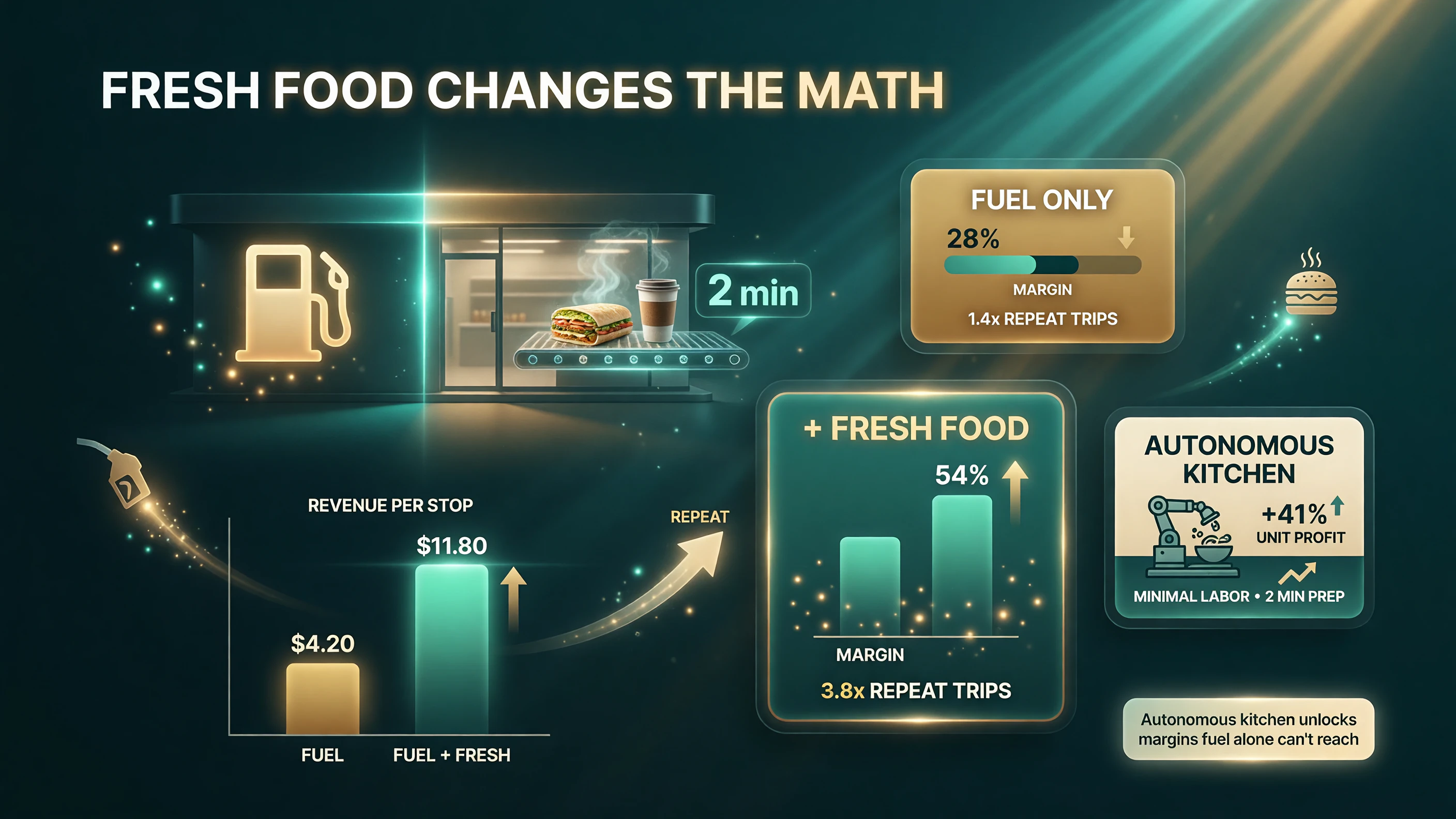
Why the math matters: fresh food lifts revenue per stop, margins, and repeat trips versus fuel alone — and an autonomous unit delivers it in about 2 minutes without the fixed cost of a kitchen staff.
The Labor and Speed Economics
The two variables that have kept convenience stores out of hot food for years are labor and speed. Hiring and retaining prep staff in a high-turnover retail environment is expensive, and the revenue a single store can generate from a limited kitchen often does not justify the headcount. The ART platform goes after both problems at once: automation removes the labor line, and the self-contained unit promises hot food in about two minutes without a dedicated crew.
That changes the unit economics in a meaningful way. A store that could not previously justify the fixed cost of kitchen staff can now offer fresh food with minimal marginal labor. For a large operator like Murphy USA, which runs thousands of stores, even a modest improvement in per-store foodservice economics multiplied across the network is a big number. It also opens the door to smaller-format stores that could not support a full kitchen but could host a compact automated unit.
What Operators Should Watch
For independent operators, the Murphy USA trial is less about Murphy itself and more about what it signals for the category. Three things are worth paying attention to. First, throughput: can an automated kitchen sustain consistent two-minute service during a lunch rush, or does it degrade under pressure? Second, quality consistency: do customers come back, or is it a novelty that fades? Third, cost of goods and maintenance: what does it actually cost to keep a modular automated kitchen running versus a traditional prep line?
None of those answers are in the announcement — they will only emerge from the live trial. That is precisely why this deployment matters more than most press releases. It is a real, announced test in a real high-traffic retail network, not a concept video. The data it produces will shape whether other chains adopt automated kitchens and what the economics look like at scale.
Limitations and Open Questions
- Limited rollout — the technology is only going to select large-format stores, and Murphy has not said how many locations or which markets.
- Menu scope — the platform launches with White Castle food, so the full range of what ART can prepare across other brands remains to be demonstrated.
- Demand question — the company itself frames this as a test of demand, meaning it is not yet proven at scale in Murphy’s footprint.
- Brand fit — White Castle sliders are a recognizable menu, but whether the automated format holds up on quality and throughput over time is unproven.
The Bigger Convenience-Store Foodservice Trend
Murphy USA is not the only major chain betting on automated foodservice, but it is one of the most visible to do so in the convenience channel. The broader industry has spent years trying to answer one question: how do you get fresh, hot food into stores that were never built for kitchens? Margins on fuel are thin, and the way convenience-store chains grow profitability is by capturing more of the trip — getting the customer who stopped for gas to also pick up food, coffee, or snacks.
Hot food is the strongest lever for that, because it turns a five-minute fuel stop into a meal decision. The blocker has never been demand; it has been operations. Staffing a kitchen in every store is impractical, and building out full kitchens in thousands of locations is cost-prohibitive. Automated modular kitchens are the emerging answer because they fit into existing footprints and remove the labor line that made foodservice expansion uneconomical. That is the exact bet Murphy USA is making, and it is a bet many operators across the channel are watching closely.
Final Verdict
Murphy USA’s trial of autonomous white Castle kiosks is a meaningful data point for the entire foodservice industry. It proves that a large, historically fuel-focused operator is willing to bet on automated compact kitchens to enter fresh food — without the kitchen build-out or labor costs that have always made foodservice expansion expensive and slow. For operators watching from the sidelines, the lesson is clear: the automated kitchen is becoming a practical, deployable answer to the labor and space problem, and it is no longer confined to futuristic concept stores. Expect more chains to follow Murphy’s lead as the technology matures.
Frequently Asked Questions
What is Murphy USA testing?
Murphy USA is testing an autonomous foodservice platform from Automated Retail Technologies (ART) that serves White Castle food at select large-format stores.
How fast does the automated kitchen serve food?
Customers order on a touchscreen and receive hot food in about two minutes.
Is Murphy USA opening full kitchens?
No. The ART platform is a compact, self-contained system that prepares, heats, and delivers food without a kitchen build-out or dedicated food-prep staff.
Why is this a change for Murphy USA?
Murphy’s main banner has traditionally focused on fuel and low-priced convenience items, so testing automated fresh food is a shift toward higher-margin foodservice.
Will every Murphy store get this?
No. The company is testing demand at select large-format stores and says foodservice will not feature at every store in the near term.
Who developed the autonomous platform?
Automated Retail Technologies (ART), a foodservice technology firm, developed the modular platform that automates food preparation, heating, and delivery.

About Barak Schurr
Barak Schurr built and exited a major ticketing platform, ran global operations at Eventbrite, and now focuses on one question: which AI tools actually help independent restaurant owners run leaner and grow faster. He writes from the operator’s perspective — no vendor spin, no theory, just what’s real in 2026.
Email: [email protected]
More Restaurant AI Resources