Get the AI Restaurant Quick-Start Guide — Free
The 5 AI tools independent US restaurant owners are using right now to cut labor costs and answer every call.
McDonald’s Is Putting AI in the Kitchen: What Independent Restaurant Owners Should Actually Take From It
⚡ Expert Summary: McDonald’s has put AI to work on drive-thru ordering, inventory management, and order accuracy across thousands of locations. Independent operators cannot buy what McDonald’s built — but they can steal the operating logic behind it. The three lessons that transfer are: count your inventory daily instead of weekly, treat waste as a measurement problem before treating it as a discipline problem, and put a human gate on anything an AI orders or promises on your behalf. The rest of McDonald’s stack — the custom data pipelines, the proprietary models, the scale — is not available to you and pretending otherwise wastes money. This guide separates the transferable from the theatre, and prices what an independent restaurant can realistically deploy in 2026.
Every time a chain announces an AI rollout, independent restaurant owners get the same two reactions in the same order: that sounds expensive, then am I falling behind. Both reactions are about the wrong thing.
McDonald’s announcement covered drive-thru AI for order-taking, AI applied to inventory management, and AI systems aimed at order accuracy. That is a real deployment at real scale. It is also built on data pipelines that no single-location restaurant will ever have, and it costs more than most independents gross in a month.
What matters is not what McDonald’s bought. It is what their deployment says about where the money is. Three of those lessons transfer cleanly to a one-location operation, and they are all about inventory and waste.
What McDonald’s Actually Did
Three separate systems are usually lumped together when this story gets reported, and they have very different economics.
Drive-thru AI. Voice systems taking orders and confirming them back to the customer. This is the most visible piece and the one with the most public failures — order-taking in a noisy environment with accents, background noise, and unusual requests is genuinely hard, and McDonald’s has scaled back some deployments rather than pretend otherwise.
Inventory management AI. This is the piece independents should pay attention to. The system watches usage against sales, predicts when a given item will run out, and flags where product is disappearing faster than the sales data says it should. That gap between what was sold and what was consumed is where waste lives.
Order accuracy systems. Vision and data checks that catch mistakes before they reach the customer. At McDonald’s volume, a one percent error rate is a very large number of wrong orders each day.
Notice that the inventory and accuracy systems do not require a customer to talk to a machine. They run quietly in the background against data the restaurant already produces. That is why they transfer.
⚠️ One caveat worth stating plainly: if you run an independent restaurant, do not read the drive-thru story as a mandate to put AI on your phone or your ordering line. McDonald’s has the volume to absorb the error rate and the staff to fix mistakes in real time. A single-location restaurant that mishandles a regular’s order at the window pays for it in a way a chain does not. The drive-thru piece is the least transferable part of this story, and the loudest.
The Three Lessons That Actually Transfer
1. Count daily, not weekly
The single biggest reason independent restaurants lose money on food cost is that they measure it too slowly. A weekly count tells you what disappeared. A daily count tells you when and roughly why, while you still remember the shift that caused it.
You do not need an AI to count daily. You need one person, fifteen minutes, and a phone. What AI adds is the next step: comparing today’s usage against today’s sales and flagging the categories where the two do not line up.
If beef usage is twelve percent above what sales predicts for three days running, something is wrong — over-portioning, waste, theft, or a yield change from a supplier. Weekly data hides that pattern inside a plausible-looking average.
2. Treat waste as a measurement problem first
Most owners treat waste as a discipline problem: staff are careless, staff need reminding. Sometimes true. Far more often, waste is a measurement problem wearing a discipline costume — nobody knows the actual number, so everyone assumes it is small.
The moment you can show a kitchen the real number, behavior changes without a single conversation about attitude. “We threw away $340 of product last week” lands differently than “try to be careful.”
3. Put a human gate on anything that orders or promises
Whatever you automate, keep a person on the final action for two categories: anything that spends money, and anything that makes a promise to a customer. An AI that suggests an order is useful. An AI that places the order unsupervised is a liability with a telephone number.
| Capability | McDonald’s Scale | Independent Operator |
|---|---|---|
| Drive-thru voice AI | Custom build, heavy volume, absorbs errors | Not worth it — error cost lands on you |
| Inventory prediction | Proprietary pipeline across thousands of stores | Off-the-shelf tools, same core idea |
| Usage vs sales variance | Automated, continuous | Daily count plus a spreadsheet flag |
| Order accuracy checks | Vision systems on high volume | Expo station discipline, no AI needed |
| Cost to deploy | Enterprise budget | $50–$300 per month |
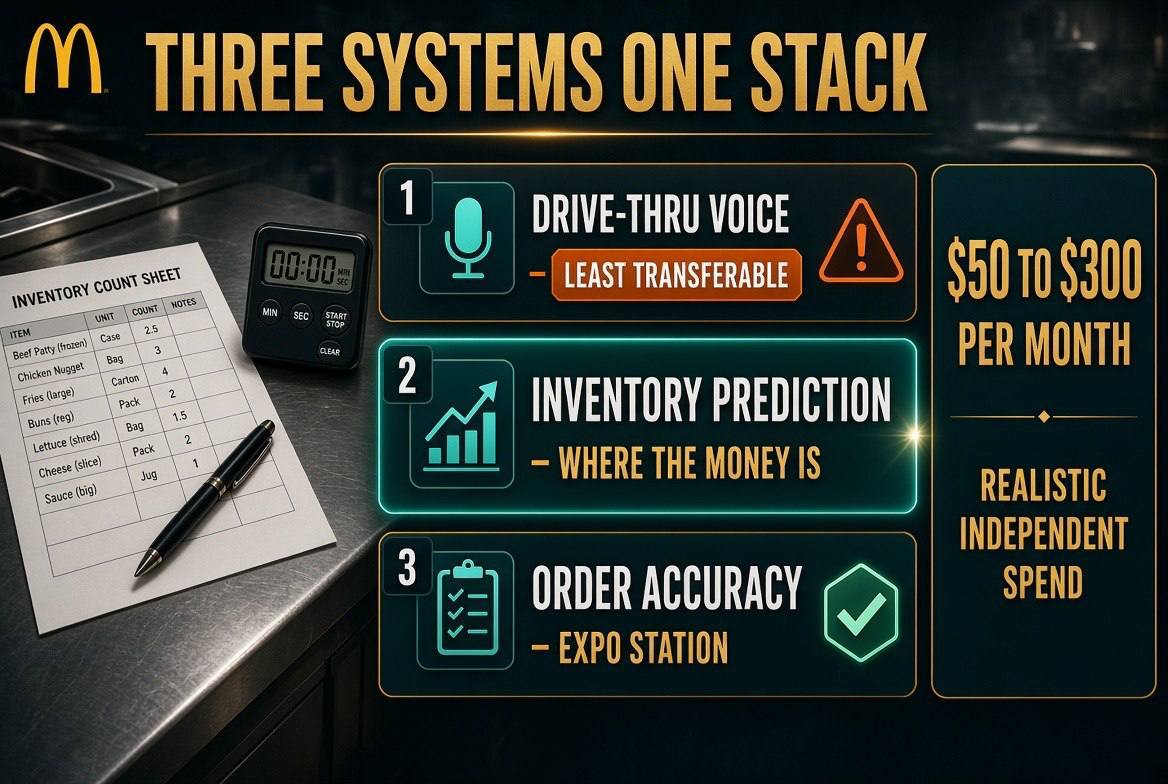
The three AI systems McDonald’s deployed, separated: drive-thru voice is the loudest and least transferable, inventory prediction is where the money is
What This Costs an Independent Operator
Here is the honest price range for the transferable parts of this story, without the enterprise layer you cannot buy.
Daily counting. Free beyond labour. Fifteen minutes a day of someone already on payroll.
A spreadsheet or simple inventory app. Free to about $50 a month. For most one and two-location restaurants, this is the entire tool. The value is not the software — it is the daily habit and the variance flag.
Purpose-built inventory AI. Roughly $100 to $300 a month for a single location, depending on feature depth. Worth it if you are already counting daily and the manual comparison has become the bottleneck. Not worth it as a first step — it automates a discipline you have not built yet, and automating an absent discipline just produces faster confusion.
Waste tracking with photo capture. Many modern versions include a phone camera step: staff photograph what is being thrown out, the system categorizes it, and you get a waste number by category at the end of the week. This is the highest-value feature in the category for independents, because it converts an invisible cost into a visible one.
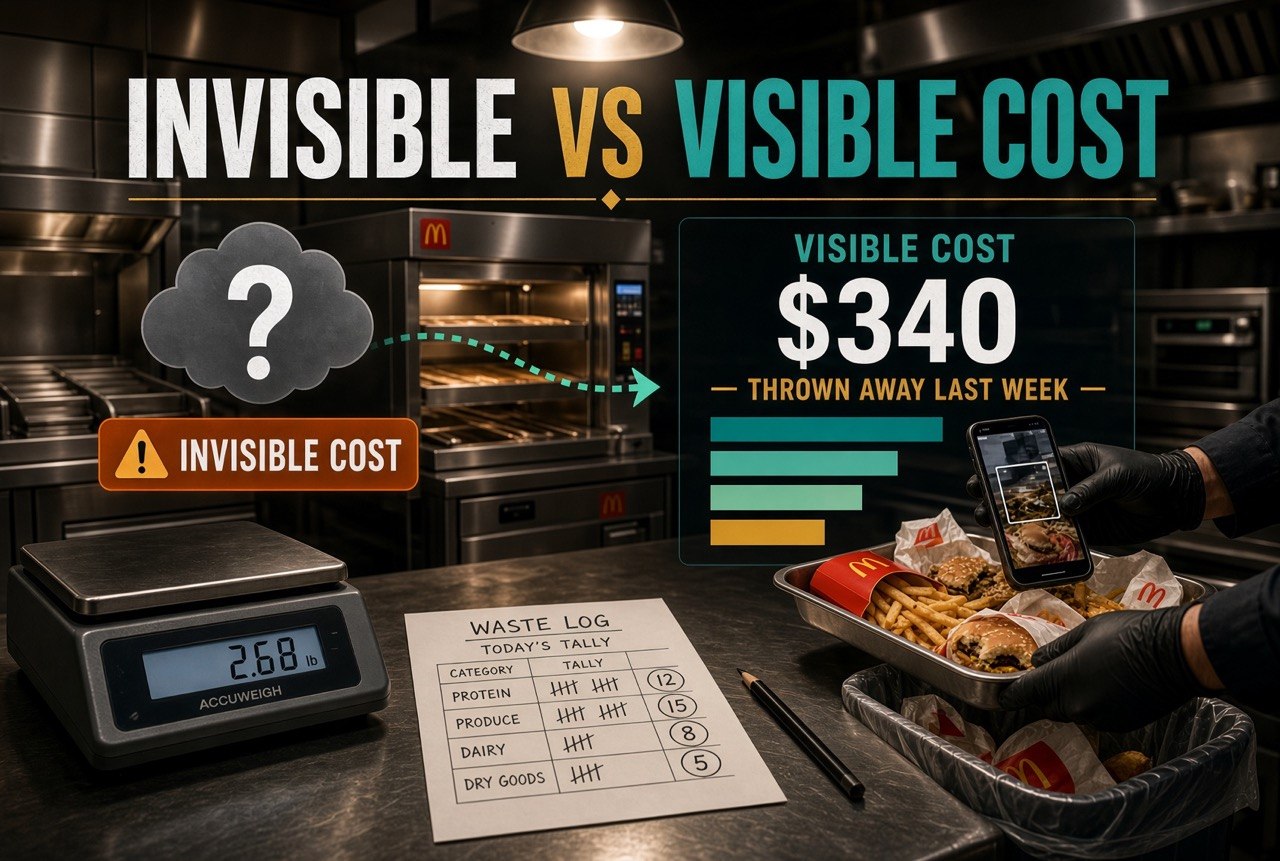
The invisible cost versus the visible number: $340 of product thrown away in a week, once somebody photographs it
The Four-Week Test
Do not buy anything to start. Run this for four weeks and see whether the problem is real.
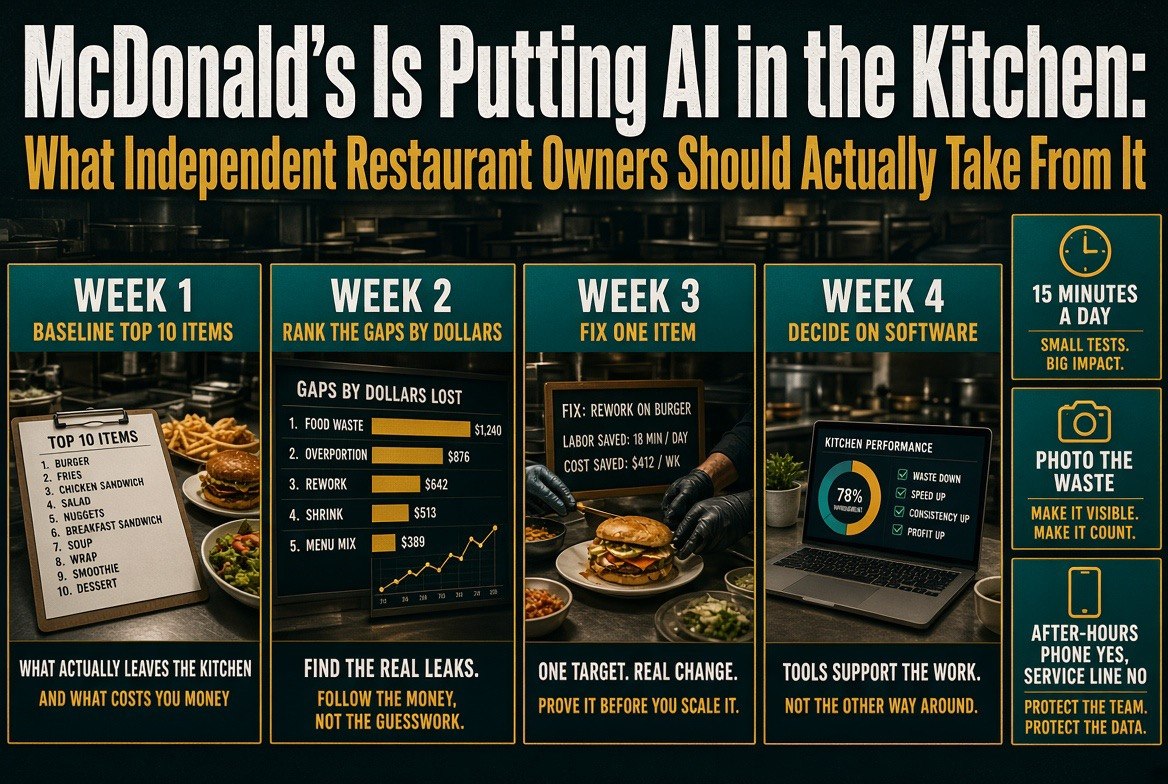
- Week 1 — Baseline. Count your top ten inventory items every day at close. Record usage. Record sales. Do not change anything yet. Most operators find the baseline painful to look at.
- Week 2 — Find the gap. For each item, compare usage against what sales predicts. Rank the gaps by dollar value. You will usually find two or three items carrying most of the loss.
- Week 3 — Fix the top one. One item only. Portion it, secure it, or stop over-ordering it. Whatever the gap suggests. Measure again.
- Week 4 — Decide. If the number moved, you have a repeatable process and software will make it easier. If it did not move, the problem was not what you thought, and you just saved a subscription.
This costs you fifteen minutes a day and nothing else, and it tells you whether the AI step is worth taking.
| Approach | Monthly Cost | Catches Theft | Best For |
|---|---|---|---|
| Weekly count only | $0 | Poorly — pattern hidden in averages | Stable menus, low variance |
| Daily count + spreadsheet | $0–$50 | Yes, within a few days | Almost every independent restaurant |
| Inventory AI platform | $100–$300 | Yes, with alerting | Multi-location or high-volume kitchens |
| Waste photo tracking | Included in most platforms | Indirectly — surfaces anomalies | Kitchens with high prep waste |
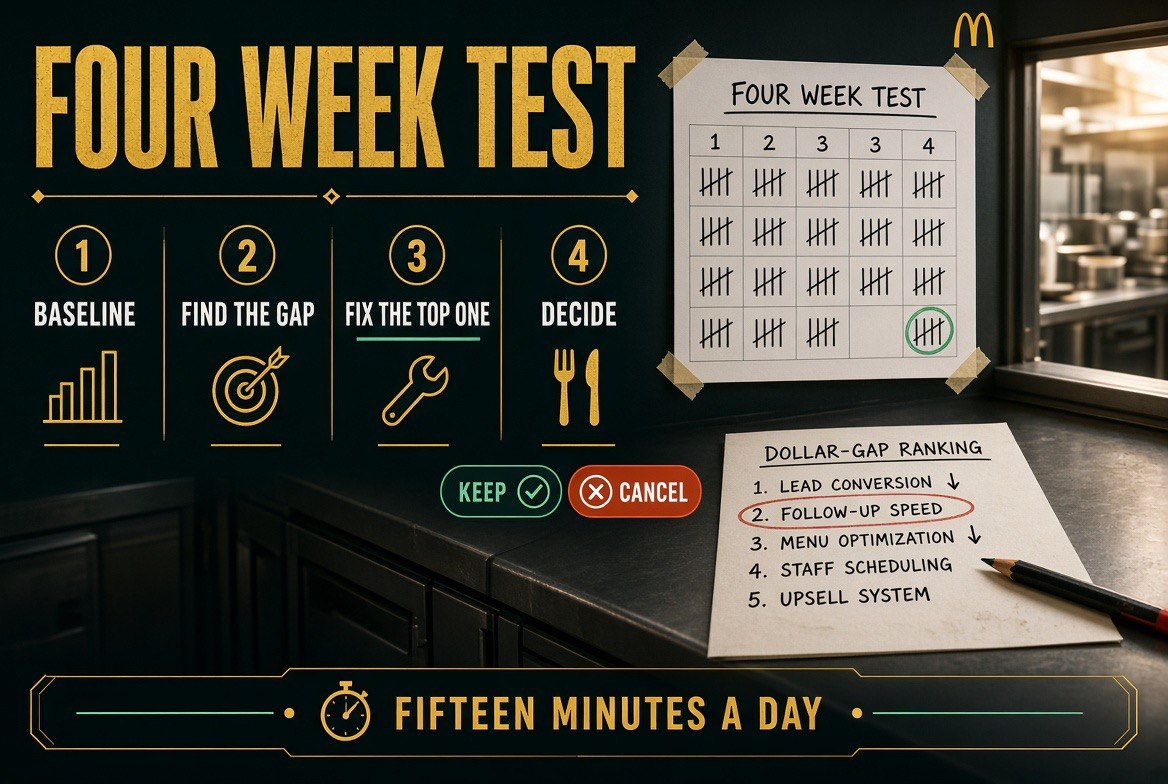
The four-week test, run with nothing but a count sheet and a spreadsheet: baseline the top ten items, rank the gaps by dollars, fix the top one, then decide
The Drive-Thru Question, Answered Honestly
The most common question independents ask after a story like this is whether they should put AI on their drive-thru or phone line.
The answer for almost every single-location restaurant is no, and the reasoning is arithmetic. McDonald’s can accept a small error rate on order-taking because the volume is enormous and the staffing to correct mistakes is already in place. If an independent restaurant gets one in twenty orders wrong, that is a meaningful share of customers having a bad experience, and the regulars who make your margins are the ones most likely to notice.
There is one exception worth naming: after-hours. If you are closed and the phone is ringing with reservation requests or catering inquiries, a simple scripted answering system that takes a message or books a standard slot is a genuinely good investment. That is different from replacing your order-taker during service. Take the after-hours win, leave the busy-period experiments to the chains.
What Not to Copy
Do not copy the scale. The custom data pipelines McDonald’s runs exist because they have thousands of locations producing identical data. You have one restaurant and a manager who knows the menu better than any model does. Use that person.
Do not copy the customer-facing pieces first. The drive-thru voice system is the visible part of this story and the least valuable part for you. The inventory work is invisible and it is where the money is.
Do not automate before you measure. An AI that predicts your ordering based on a process nobody follows will produce confident, wrong numbers. Get the daily count habit first — every deployment that fails in this category fails on that step.
Frequently Asked Questions
Should my independent restaurant put AI on the drive-thru? Almost certainly not. The error rate a chain can absorb is a customer-relationship cost at one location. The exception is after-hours answering for reservations and catering inquiries, which is a genuine win.
What is the highest-value AI use for a small restaurant’s inventory? Daily usage-against-sales variance tracking. It surfaces over-portioning, waste, and theft while the cause is still identifiable, which a weekly count cannot do.
How much should I expect to spend? Between nothing and about $300 a month. Most one-location restaurants get most of the benefit for free by counting daily and comparing against sales in a spreadsheet. The purpose-built platforms are worth it once the manual comparison is the bottleneck.
Can AI really reduce food waste? Not by itself. It can show you where waste is happening and how much it costs, which is what changes behaviour. Restaurants that reduce waste do it because they finally saw the number.
Is McDonald’s AI deployment a sign I am falling behind? No. The gap between you and McDonald’s is not AI. It is data volume, staffing, and budget. Take the operating logic — daily counting, variance flagging, human gates — and ignore the rest.
The Bottom Line
McDonald’s deployed AI at a scale you cannot match and do not need to. Read past the drive-thru headlines, because the transferable lesson is smaller and much better: count your inventory every day, compare usage against sales, find the gap, and fix one item at a time. That is the same logic the chain’s inventory systems are built on, and it costs you fifteen minutes a day.
Start there. Add software when the counting has become a habit and the manual comparison is what is slowing you down. Do not start by automating a customer conversation you cannot afford to get wrong.

About Barak Schurr
Barak Schurr built and exited a major ticketing platform, ran global operations at Eventbrite, and now focuses on one question: which AI tools actually help independent restaurant owners run leaner and grow faster. He writes from the operator’s perspective — no vendor spin, no theory, just what’s real in 2026.
Email: [email protected]
More Resources for Restaurant Operators