Get the AI Restaurant Quick-Start Guide — Free
The 5 AI tools independent US restaurant owners are using right now to cut labor costs and answer every call.
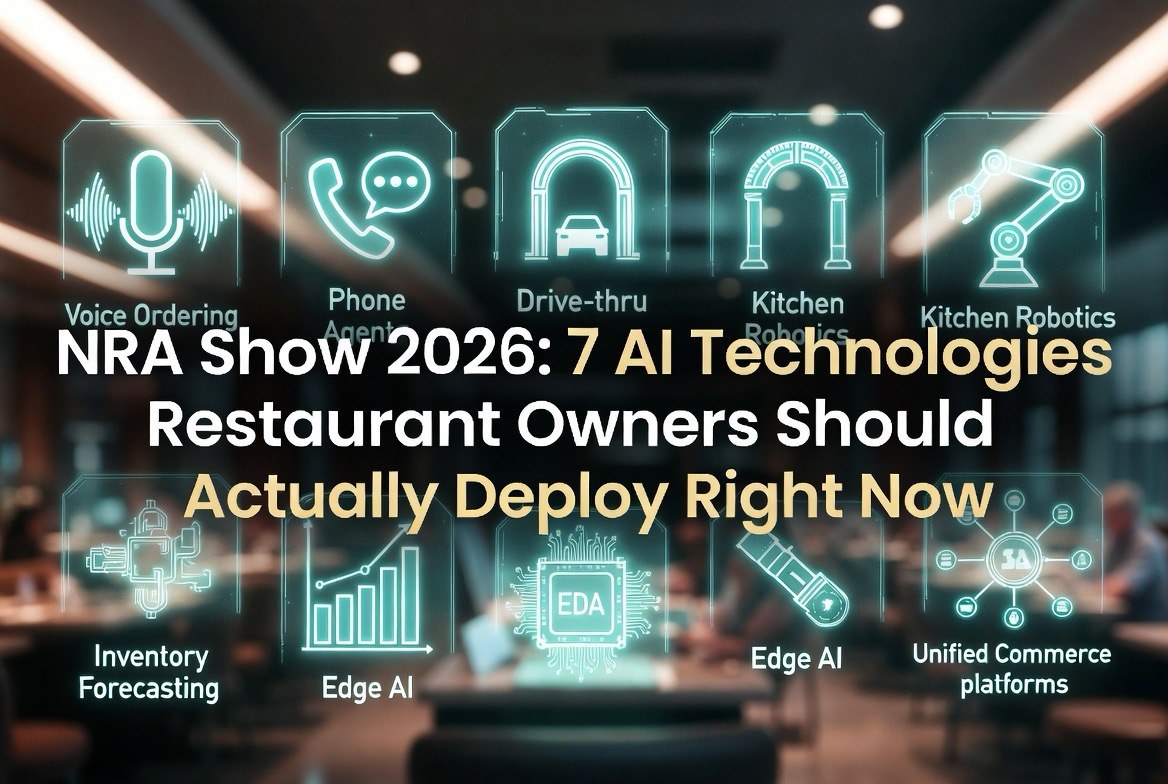
NRA Show 2026: 7 AI Technologies Restaurant Owners Should Actually Deploy Right Now
⚡ Expert Summary: The NRA Show 2026 drew over 55,000 attendees and 2,300 exhibitors to McCormick Place, with AI and automation dominating the floor. Unlike previous years focused on hype, this year’s show emphasized measurable ROI — tools that reduce labor costs, increase order accuracy, and eliminate specific operational bottlenecks. This article cuts through the noise to identify the 7 AI technologies with the fastest payback periods for independent US restaurant owners, with specific costs, installation timelines, and expected savings.
The 2026 National Restaurant Association Show in Chicago marked a turning point for restaurant technology. With over 55,000 attendees walking the floor at McCormick Place, the dominant theme was not the promise of AI — it was the proof. Exhibitors moved past theoretical demonstrations to show real production deployments with measurable returns: higher answer rates on phone calls, faster drive-thru throughput, reduced inventory waste, and lower labor costs per guest served.
For independent US restaurant owners, the signal from this year’s show is clear: the AI tools that deliver the fastest, most predictable ROI are already available, already integrated with the POS systems you use, and already deployed in thousands of locations across the United States. Here is what actually works, how much it costs, and how quickly it pays for itself.
1. Voice AI for Phone Ordering — The Fastest Payback in Restaurant Technology
Voice AI for phone ordering was the most talked-about category at NRA Show 2026, and for good reason. It hits a pain point that every restaurant owner knows intimately: the cost of missed and mishandled phone calls. Independent restaurants report that approximately 20-30% of inbound phone calls go unanswered during peak hours, and each missed call represents a lost order that averages $15-30 in revenue.
SoundHound AI dominated this category with its OASYS agentic AI platform, handling drive-thru ordering, kiosk interaction, phone responses, and enterprise-level guest support through a single voice AI system. Other notable players included Presto Voice, ConverseNow, PolyAI, and Kea, all showing AI agents that handle the full order lifecycle — taking orders, upselling menu items, verifying payment, and confirming pickup or delivery times.
These systems integrate directly with major POS platforms including Toast, Square, and Clover. Installation requires no hardware beyond the phone system you already have. Most providers charge $300-500 per month per location and report increasing answered call rates from 65% to 95%+, with average order values increasing 8-15% through AI-driven suggestive selling.
For a restaurant doing $20,000 per month in phone orders, a voice AI agent that captures 80% of previously missed calls adds approximately $1,200-2,400 in monthly revenue. At $400/month cost, the payback period is under one month.
2. AI Phone Agents for Customer Service
Separate from voice ordering, AI phone agents handle the broader range of customer calls — reservation inquiries, dietary restrictions, delivery status, complaint resolution, and general questions. Unlike voice ordering systems optimized for transaction speed, phone agents focus on conversation quality, accuracy, and intelligent escalation.
Loman AI and Slang AI were the prominent players at the show, both offering AI phone agents that integrate with POS systems, reservation platforms, and delivery networks. These agents maintain natural conversation flow while accessing real-time inventory, pricing, and reservation availability.
The key capability shown at NRA 2026 was intelligent escalation — the ability to determine when a call requires human judgment and transfer the customer with full conversation context. This prevents the worst-case scenario of an AI agent confidently giving wrong information while still handling 80%+ of routine calls without human involvement.
Pricing runs $200-600 per month per location with a 2-4 week setup period that typically includes menu digitization, policy configuration, and integration testing. Operators at the show reported cost recovery within 4-8 weeks of deployment.
3. AI-Enhanced Drive-Thru Ordering
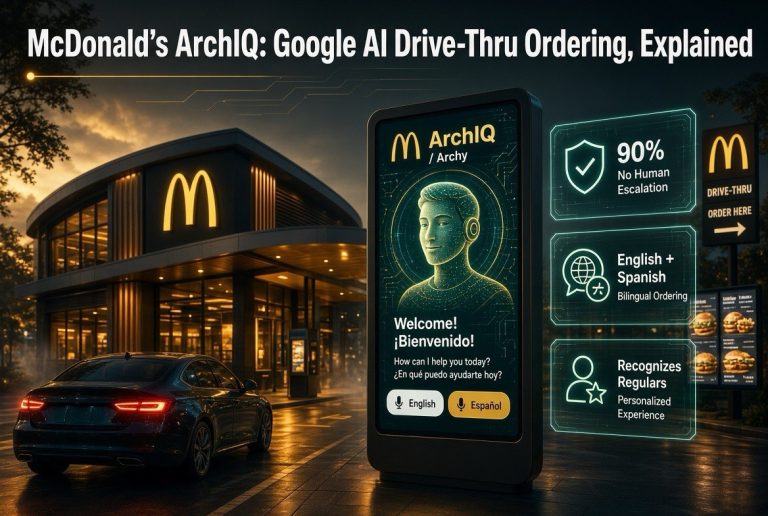
Drive-thru AI had a major presence at NRA 2026, with SoundHound, Presto, Valyant AI, and Hi Auto all showing systems that handle the full drive-thru ordering conversation. These systems combine voice recognition with visual AI that confirms menu items on digital menu boards before the order is submitted.
The numbers are compelling. Drive-thru AI reduces average order times by 20-30 seconds per vehicle, increases upsell acceptance rates by taking every opportunity consistently, and reduces order errors by eliminating misheard items. For a drive-thru doing 300 cars per day, saving 25 seconds per car recovers over 2 hours of labor per day without adding staff.
Most drive-thru AI solutions require hardware installation (microphone arrays, speaker upgrades, menu board integration) and cost approximately $1,000-2,000 per location per month including hardware. Payback typically ranges from 3-6 months depending on drive-thru volume.
4. Kitchen Robotics for Repetitive Cooking Tasks
Robotics at NRA 2026 was more practical and task-specific than previous years. The headline robots that drew crowds were impressive — Richtech Robotics’ ADAM preparing fresh noodles and a voice-enabled robotic beverage server — but the tools with the fastest payback were the ones targeting specific repetitive tasks.
Bear Robotics’ Servi Q (food running and bussing), Aniai’s grill automation, and Miso Robotics’ kitchen AI systems all showed deployments in real restaurant environments, not just trade show demonstrations. These systems handle the tasks that are hardest to staff and most prone to inconsistency when performed by tired or rushed employees.
The pitch is direct: a robotic grill station costs approximately $2,000-3,000 per month (lease or subscription), replaces 1-2 part-time cooks, and eliminates inconsistency in cook times and temperatures. For restaurants that struggle to maintain kitchen staffing, the ROI is not just financial — it is operational reliability.
5. Back-Office AI for Labor and Inventory
Back-office AI tools from Restaurant365, SpotOn, and other providers showed how AI is transforming the parts of restaurant operations that customers never see. Restaurant365’s AI-powered dashboards and labor suite analyze historical data combined with weather, local events, and seasonal patterns to forecast demand with higher accuracy than manual scheduling.
SpotOn’s Profit Assist flags P&L anomalies in real time — sudden increases in food cost percentage, unusual labor variances, or inventory shrinkage that might indicate theft or waste. For a restaurant with monthly food costs of $8,000-12,000, reducing waste by even 5% saves $400-600 per month.
These tools cost $150-400 per month as add-ons to existing POS platforms and typically pay for themselves within 2-3 months through reduced food cost and optimized labor scheduling.
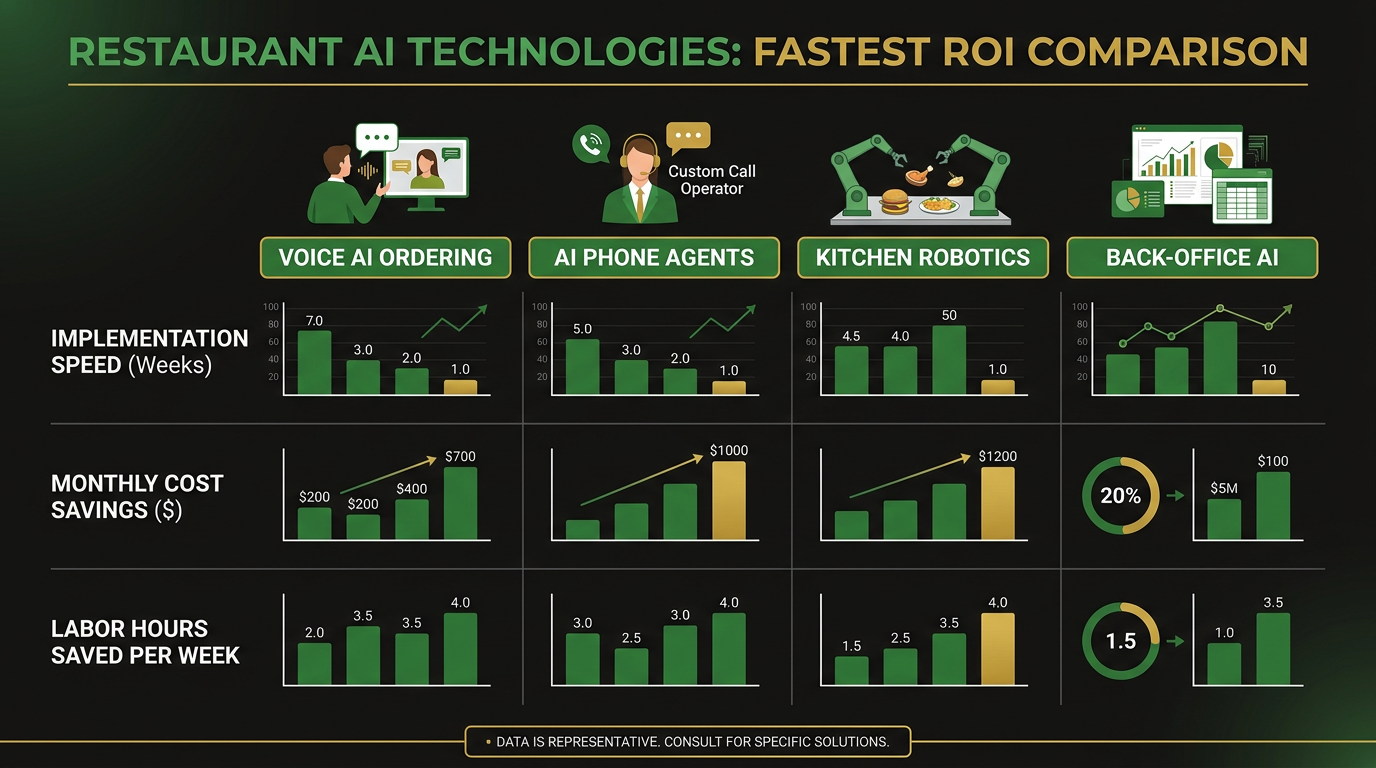
Voice AI and AI phone agents deliver the fastest payback with the shortest implementation time. Kitchen robotics offers the highest absolute savings but requires more capital and longer deployment.
6. Edge AI for Real-Time Decision Making
A new category that gained significant attention at NRA 2026 was edge AI — running AI models directly on hardware in the restaurant rather than sending data to the cloud. This approach eliminates latency and internet dependency, both critical for real-time kitchen operations.
Edge AI applications shown at the show included inventory cameras that scan stock levels every 30 seconds and automatically trigger reorder alerts when supplies run low, drive-thru cameras that identify vehicles and prepare order suggestions before the customer reaches the speaker, and kitchen display systems that predict prep needs based on the current order queue combined with historical timing data.
The advantage of edge AI for independent restaurants is reliability. The system continues working even if the internet connection drops, restarting with full context when connectivity returns.
7. Unified Technology Stacks
The most important trend at NRA 2026 was not any single product — it was the shift toward unified technology stacks. The fragmented approach of the last decade — separate systems for POS, delivery, labor scheduling, inventory, marketing, and customer engagement — is giving way to integrated platforms where all data lives in one ecosystem.
Toast led this trend with an expanding platform that now includes ordering, labor, inventory, delivery, and AI-powered analytics in a single system. The benefit for independent operators is simple: integrated data means better AI predictions. A system that knows your real-time inventory, historical sales patterns, current labor costs, and upcoming reservations can make scheduling, ordering, and pricing decisions that no single-purpose tool can match.
The message from NRA 2026 was unambiguous: if the tools you are buying do not share data with each other through clean APIs or a common platform, you are building future technical debt.
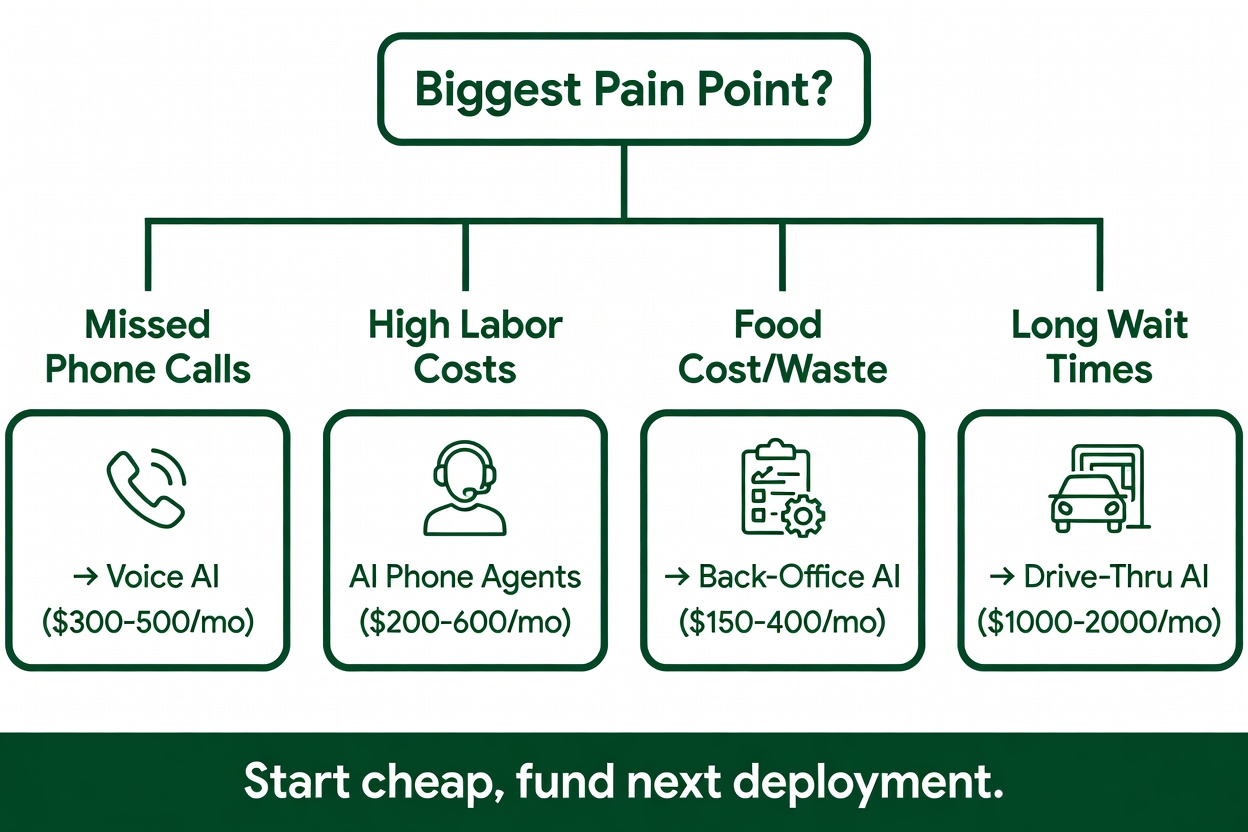
Start with your biggest pain point. Voice AI for missed phone calls pays back in weeks. Kitchen robotics for staffing gaps pays back in months. The decision framework from NRA 2026 starts with the problem, not the technology.
How to Prioritize Your First AI Investment
For independent US restaurant owners who attended NRA 2026 or followed the coverage, the challenge is not finding AI tools that work. It is choosing where to start. The speakers and exhibitors at McCormick Place consistently emphasized one principle: deploy AI where the pain is most acute, not where the technology is most impressive.
Here is a ranked deployment priority based on the consensus at NRA 2026:
| Priority | Technology | Monthly Cost | Implementation | Payback Period |
|---|---|---|---|---|
| 1 | Voice AI phone ordering | $300-500 | 1-3 weeks | Under 1 month |
| 2 | AI phone agents (service) | $200-600 | 2-4 weeks | 4-8 weeks |
| 3 | Back-office AI (labor/inventory) | $150-400 | 1-3 weeks | 2-3 months |
| 4 | AI-enhanced drive-thru | $1,000-2,000 | 3-6 weeks | 3-6 months |
| 5 | Kitchen robotics | $2,000-3,000 | 4-8 weeks | 6-12 months |
The consistent message from operators who have deployed these tools: start with the cheapest, fastest-to-deploy option that addresses your most painful operational problem. Usually that is voice AI for phone ordering. The revenue lift from capturing missed calls funds the next deployment. Within 12 months, a restaurant can move through the stack from voice AI through back-office tools without taking a capital hit at any single step.
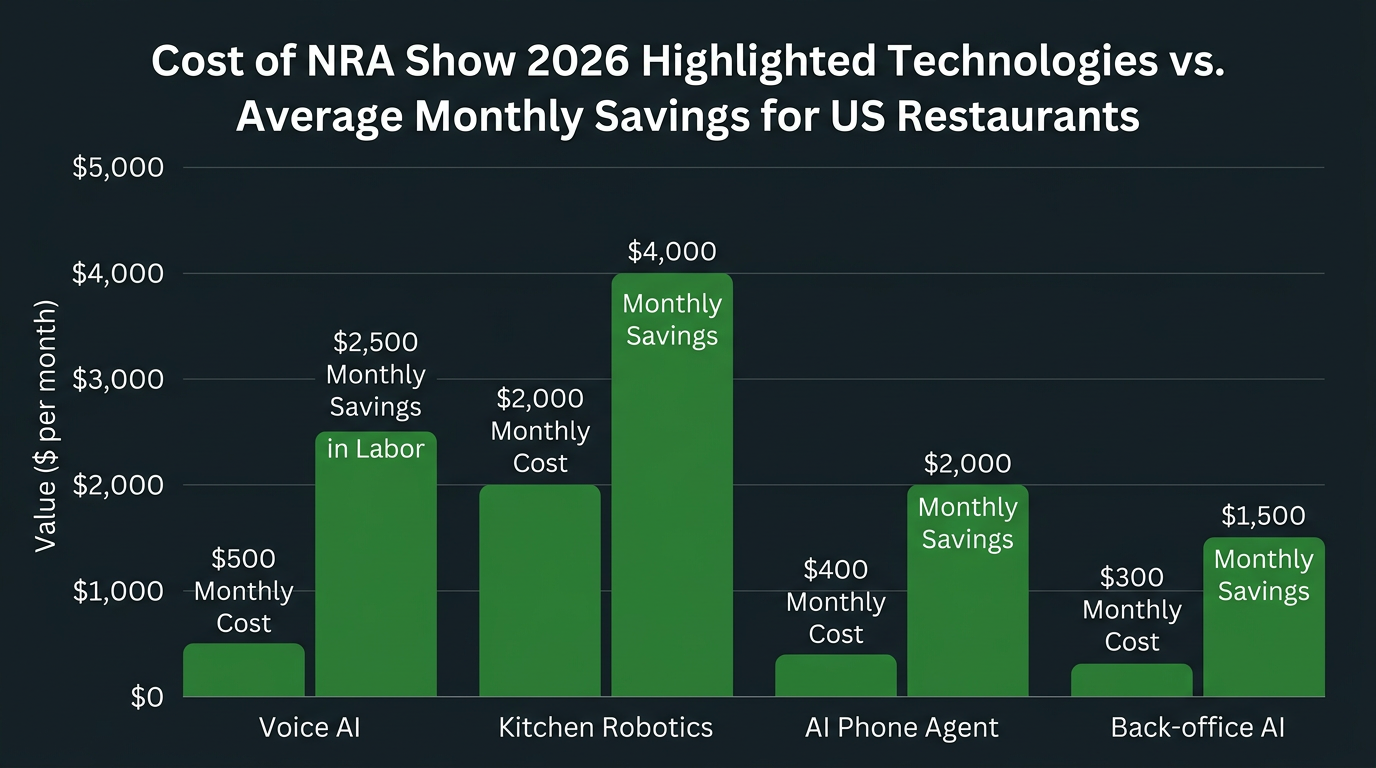
Every AI technology highlighted at NRA 2026 delivers positive ROI, but the ratio varies significantly. Voice AI and back-office tools offer the best cost-to-savings ratio for independent operators with limited capital.
The Bottom Line
NRA Show 2026 confirmed that restaurant AI has moved from experimental to operational. The over 55,000 attendees and 2,300 exhibitors were not looking at concepts — they were looking at production deployments with measurable results. SoundHound, Loman AI, Restaurant365, Bear Robotics, and dozens of other exhibitors showed tools that are already running in thousands of US restaurants, not PowerPoint slides.
For independent US restaurant owners, the decision is no longer whether to adopt AI. It is which AI tool to deploy first. Voice AI for phone ordering is the consensus answer from this year’s show — fastest deployment, lowest cost, shortest payback. Operators who deploy it now will have the revenue and operational data to fund their next AI investment within 60-90 days.
The restaurants that attended NRA 2026 and acted on what they saw are already ahead. The gap between early adopters and the rest of the industry is growing. The tools work. The ROI is proven. The only variable left is when each operator decides to start.
Frequently Asked Questions
What was the biggest trend at NRA Show 2026?
Voice AI for phone ordering and customer service was the most prominent trend at NRA Show 2026, with SoundHound, Loman AI, Slang AI, Presto Voice, and Kea all showing production-ready systems. The broader theme was practical, measurable AI deployments over theoretical demonstrations — tools with proven ROI in real restaurants.
How much does AI phone ordering cost for a restaurant?
Voice AI phone ordering systems for restaurants typically cost $300-500 per month per location. AI phone agents for customer service run $200-600 per month. Setup takes 1-4 weeks depending on menu complexity and POS integration requirements. Most providers report payback within 1-2 months.
Which AI tool has the fastest payback for restaurants?
Voice AI for phone ordering has the fastest payback — typically under one month for restaurants with significant phone order volume. The same AI agent that answers calls also captures previously missed calls, increasing revenue without adding labor cost. Back-office AI for labor and inventory is second, with 2-3 month payback periods.
What happened at NRA Show 2026?
The 2026 National Restaurant Association Show took place May 16-19 at McCormick Place in Chicago, drawing over 55,000 attendees and 2,300 exhibitors. The show featured significant AI and robotics demonstrations focused on practical, ROI-driven deployments. Over 55,000 industry professionals attended, and the dominant theme was operational AI tools that are immediately deployable with measurable results.
Is kitchen robotics worth it for independent restaurants?
Kitchen robotics typically costs $2,000-3,000 per month with a 6-12 month payback period, making it best suited for restaurants with high-volume repetitive cooking tasks and ongoing staffing challenges. For most independent operators, voice AI and back-office tools deliver faster ROI with lower upfront costs and are a better first investment.
How do I choose the right AI tool for my restaurant?
Start with your biggest operational pain point. If you are missing phone calls, deploy voice AI ordering first. If food cost is high, start with back-office AI for inventory and forecasting. If staffing is your main challenge, consider AI phone agents or voice ordering to free up existing staff. The NRA 2026 consensus was clear: solve the most expensive problem first, and use the savings to fund the next deployment.

About Barak Schurr
Barak Schurr built and exited a major ticketing platform, ran global operations at Eventbrite, and now focuses on one question: which AI tools actually help independent restaurant owners run leaner and grow faster. He writes from the operator’s perspective — no vendor spin, no theory, just what’s real in 2026.
Email: [email protected]
More AI Resources for Your Business