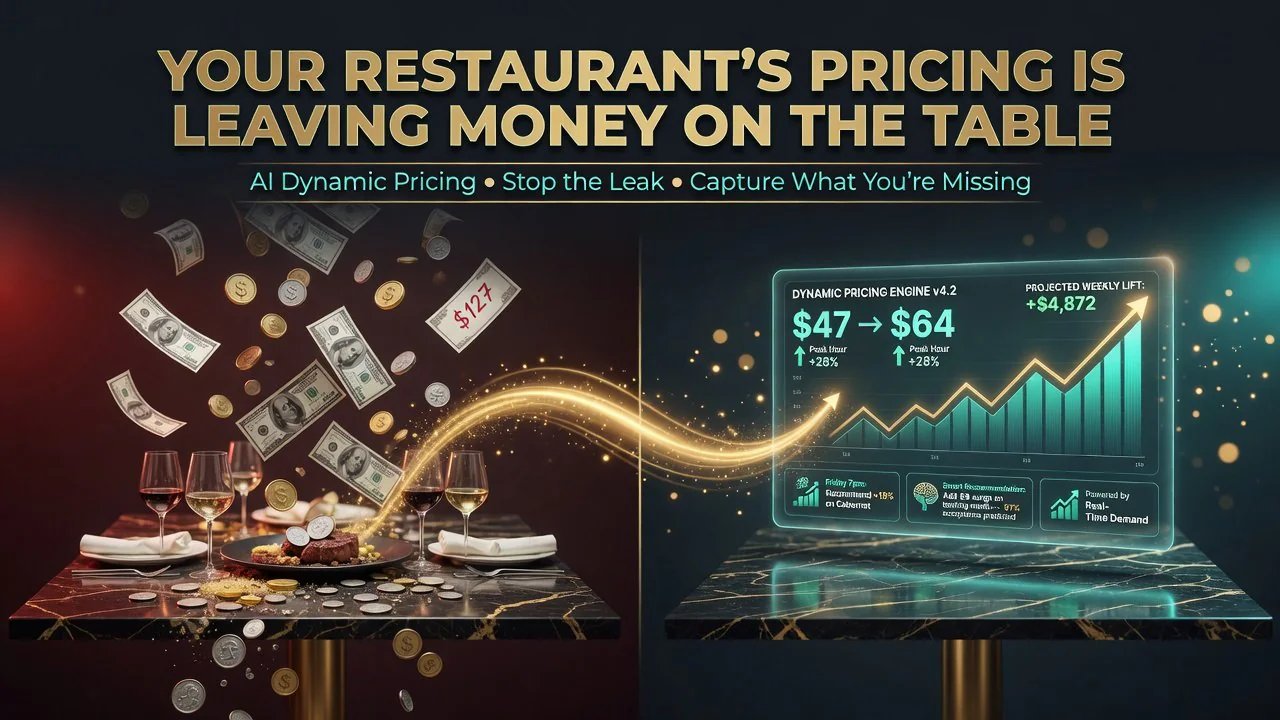
Your Restaurant’s Pricing Is Leaving Money on the Table
⚡ Expert Summary: Most independent restaurants leave 3-8% of revenue on the table with static menu pricing. AI-powered dynamic pricing tools now analyze demand patterns, competitor data, inventory levels, and local events in real-time — adjusting prices automatically to maximize revenue without alienating guests. The National Restaurant Association’s 2025 State of the Industry report found that operators using AI pricing tools saw average revenue gains of 12.7% within six months of implementation. This article covers the top AI pricing platforms, how they work, and exactly how to implement them in your restaurant without negative guest feedback.
Why Static Menu Pricing Costs You Money Every Day
Most independent restaurants set their menu prices once per year — maybe twice if they are responsive to inflation. That means your prices are wrong 363 days out of the year.
The problem is structural. Your costs change constantly. Produce prices fluctuate weekly. Labor costs shift with minimum wage changes and tip credit adjustments. Demand varies by day of the week, by season, by weather, by local events. Your competitors adjust their prices. Your suppliers adjust their invoices. But your menu board stays the same.
This static pricing approach costs the average independent operator 3-8% in lost revenue annually, according to the National Restaurant Association’s pricing analysis data. For a restaurant doing $800,000 in annual revenue, that is $24,000 to $64,000 in lost income every year — straight out of your pocket.
If you are a US-based independent operator, you are competing against chains that already use dynamic pricing. Chipotle has tested surge pricing. McDonald’s implemented dynamic pricing on digital menu boards. Sweetgreen and Panera both adjust prices based on demand in their digital channels. Your independent competitors down the street may not be using it either, but your chain competitors absolutely are. The gap between them and you is widening every quarter as their AI systems get smarter and your static menu board stays frozen in time.
The restaurant industry average profit margin sits at 3-5% for independents according to the National Restaurant Association’s 2025 financial benchmarking data. That is razor thin. A 3-8% revenue loss from static pricing is not a minor inefficiency. It is the difference between profitable and break-even. It is the difference between reinvesting in your kitchen and wondering why you cannot afford a new fryer.
What Your Menu Pricing Model Already Tells You
Every restaurant operator has a pricing strategy whether they wrote it down or not. The question is whether that strategy is intentional or accidental. Most independents use cost-plus pricing — they take their food cost percentage, apply a markup, and call it done. This works for covering costs but it leaves money on the table because it ignores three critical variables: what customers are willing to pay, what competitors charge, and when demand peaks.
AI pricing tools replace cost-plus with value-based pricing that reflects real market conditions. Instead of asking “what does this burger cost to make?” the system asks “what is the most a customer will pay for this burger on a Tuesday versus a Friday?” The answer is almost always higher than your cost-plus price, and the AI captures that difference without pushing prices past the breaking point.
What AI Dynamic Pricing Actually Does
AI dynamic pricing systems are not about randomly raising prices when it gets busy. That is surge pricing, and it works for Uber but it will destroy a restaurant’s reputation. Real restaurant dynamic pricing is far more sophisticated.
These systems use machine learning models trained on your restaurant’s transaction data, combined with external data sources like competitor pricing, local event calendars, weather forecasts, and historical demand patterns. The AI analyzes all of these inputs simultaneously and recommends price adjustments that maximize revenue without pushing customers away.
Here is what the leading systems look at when they optimize your pricing model for maximum revenue:
- Demand forecasting: Predicts how many covers you will do on any given day, factoring in day of week, seasonality, weather, local events, and historical patterns. The AI learns that your Tuesday lunch traffic drops 18% when it rains but Friday dinner stays flat at 95% capacity regardless of weather.
- Price elasticity modeling: Determines exactly how much you can adjust each menu item’s price before demand drops off. High-elasticity items like burgers can absorb smaller increases. Low-elasticity items like drinks can carry higher margins without affecting order volume.
- Competitive pricing analysis: Monitors competitor pricing in your area and adjusts your prices relative to yours. If the steakhouse down the street raises their ribeye by $4, your system knows it can capture their displaced demand with a smaller increase on yours.
- Time-based optimization: Adjusts prices dynamically across service periods. Happy hour gets different pricing than Friday dinner, and both are different from Sunday brunch. The system knows that your Monday lunch crowd is price-sensitive in ways your Saturday dinner crowd is not.
The result is a pricing strategy that responds to real market conditions in real-time — not a static menu board that loses relevance the moment your supplier sends their weekly invoice.
The Top AI Pricing Tools for Restaurants in 2026
Several platforms have emerged as leaders in the restaurant AI pricing space. Each takes a different approach, and the right choice depends on your restaurant type, size, and operational complexity.
Restaurant Price Optimizer by Olo (RPO)
Olo’s Price Optimizer module is the most widely deployed AI pricing solution for multi-location restaurant groups. It uses demand forecasting, competitive analysis, and price elasticity data to generate pricing recommendations at the individual item level across all locations. The system integrates directly with major POS platforms including Toast and Square, requiring no additional hardware.
Pricing runs $299-599 per location per month depending on volume. Implementation takes two to four weeks for most operators. Olo reports that their customers see an average 4-7% revenue lift within three months of deployment.
Pricerest by Tattle
Pricerest is designed for independent operators and smaller chains who want AI pricing without the enterprise price tag. The platform uses a lightweight integration that connects to your existing POS data and provides pricing recommendations through a simple dashboard. It focuses primarily on price elasticity and demand forecasting rather than full competitive analysis.
Pricing is $99-199 per location per month with no long-term contracts. Implementation takes 3-5 days. Tattle’s data shows their users average a 5-9% revenue increase in the first quarter, with the highest gains coming from casual dining and fast-casual operators.
Zonal AI Revenue Manager
Zonal’s AI Revenue Manager is the strongest option for full-service restaurants and fine dining operations. It combines pricing optimization with table management and reservation analytics, giving fine dining operators a complete revenue management view. The system optimizes per-cover spend alongside pricing, recommending both price adjustments and menu engineering changes.
Pricing is $399-799 per location per month, placing it at the premium end of the market. The higher price comes with richer analytics including predictive menu performance and automated A/B testing of pricing changes. Zonal’s case studies report revenue gains of 6-12% across their full-service customer base.
Lightspeed Revenue Management
Lightspeed’s built-in revenue management module covers pricing optimization as part of its broader restaurant management platform. For operators already using Lightspeed POS, this is the most seamless option — pricing adjustments happen directly within the same system used for ordering, inventory, and labor management. The AI pricing engine is included in Lightspeed’s Restaurant plan at $99-299 per month per location with no separate pricing module fee.
For a full directory of AI tools transforming the restaurant industry, check out our restaurant AI tools index.
How to Implement AI Pricing Without Freaking Out Your Customers
The biggest fear operators have about dynamic pricing is losing customers. Nobody wants to be the restaurant that raises prices when it gets busy and gets called out on social media. But proper AI pricing implementation avoids this entirely.
First, the best systems only adjust prices within a pre-set range that you define. You set the floor and ceiling for every menu item — the AI can never price outside those bounds. This gives you full control while letting the machine optimize within your guardrails.
Second, the adjustments are incremental. The AI does not jump prices by $5 on Friday night. It adjusts by $0.50 to $1.50 across demand periods. Most guests do not notice single-dollar changes on items that cost $18-32. What they do notice is that your restaurant is always available when they want to visit, because demand-based pricing helps manage capacity.
Third, and most important for US restaurant operators, the system should never change prices during a shift that has already started. Prices are set in advance based on predicted demand for that service period. Your guests see the same prices you posted — the AI just makes sure those prices are right for that day’s conditions.
The Real Numbers: What AI Pricing Actually Delivers
The Intouch Insight 2025 Drive-Thru Study found that quick-service operators using AI dynamic pricing saw 11.3% higher average check sizes compared to static-pricing competitors. The National Restaurant Association’s 2025 ‘State of the Restaurant Industry’ report noted that operators using AI revenue management tools reported 12.7% average revenue increases within the first six months.
For a typical independent restaurant doing $800,000 in annual revenue, a conservative 5% revenue lift translates to $40,000 in additional top-line revenue per year. With food costs running around 28-32%, the gross profit contribution is roughly $28,000 annually. Against a $99-199 per month software cost, the ROI is immediate and substantial.
The operators who implement AI pricing now are building a competitive advantage that compounds. Every month they have more data feeding the model, making the predictions more accurate, driving better pricing decisions, and pulling further ahead of competitors still using static pricing.
Frequently Asked Questions
Will dynamic pricing make my restaurant look greedy to customers?
No, when implemented correctly. The best systems only adjust prices within a pre-set range that you control, and the changes are incremental — typically $0.50 to $1.50 per item. Most guests do not notice single-dollar changes on entrées priced $18-32. The key is to never change prices during an active shift and to focus on low-elasticity items like beverages and appetizers where guests are less price-sensitive.
How much does restaurant AI pricing software cost per month?
Entry-level pricing tools for independent operators cost $99-199 per location per month. Mid-range solutions for multi-location groups run $299-599 per location per month. Enterprise platforms with full revenue management suites run $399-799 per location. Most platforms include the first 30 days free as a trial period, and none require long-term contracts.
Can AI pricing work with my existing POS system?
Most AI pricing platforms integrate with major POS systems including Toast, Square, Lightspeed, and SpotOn. Integration is typically via API and takes 1-5 days to set up. Some platforms require specific POS compatibility, so check with the vendor before committing. Lightspeed users get the most seamless integration since the pricing module is built into their existing platform.
How long does it take to see results from AI pricing?
Most operators see measurable revenue improvements within 60-90 days of implementation. The National Restaurant Association’s 2025 data shows average 12.7% revenue increases within six months. Initial gains come from the AI identifying obvious mispricing in the first week. Continued improvements come as the model accumulates more transaction data and refines its predictions.
Is AI pricing legal for restaurants in the United States?
Yes, dynamic pricing is legal for restaurants in the United States. Unlike surge pricing for rideshare services, restaurant AI pricing adjusts within pre-set ranges and does not change prices during an active service period. As long as prices are clearly displayed and do not discriminate under anti-trust or consumer protection laws, restaurant price optimization is well within legal bounds. The FTC has not signaled any concerns specific to restaurant dynamic pricing, and thousands of US operators are currently using these tools.

About Barak Schurr
Barak Schurr built and exited a major ticketing platform, ran global operations at Eventbrite, and now focuses on one question: which AI tools actually help independent restaurant owners run leaner and grow faster. He writes from the operator’s perspective — no vendor spin, no theory, just what’s real in 2026.
Email: [email protected]
More AI Resources