Get the AI Restaurant Quick-Start Guide — Free
The 5 AI tools independent US restaurant owners are using right now to cut labor costs and answer every call.
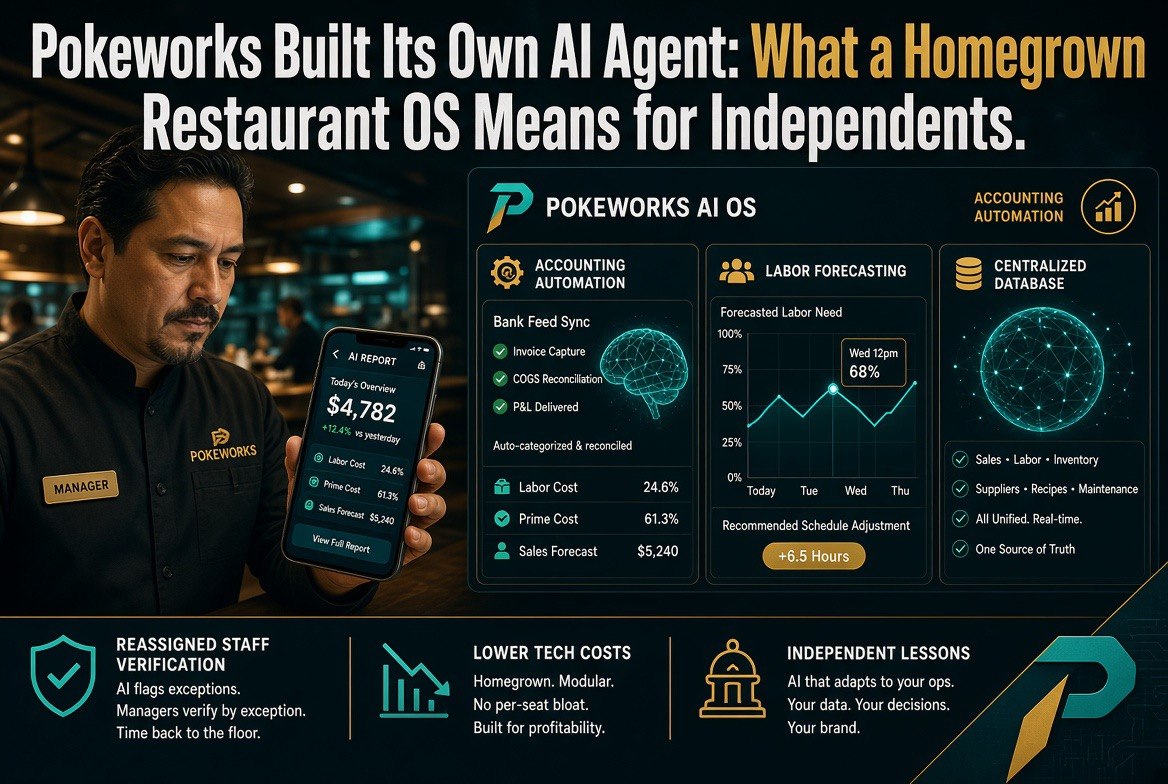
Pokeworks Built Its Own AI Agent: What a Homegrown Restaurant OS Means for Independents
⚡ Expert Summary: Pokeworks, an 86-unit fast-casual chain founded in New York City in 2015, spent 2025 consolidating every one of its tech systems into a single database — then built its own AI agent on top of it. The agent is called Pokebot, and it now handles accounting, builds financial reports on request, and plans the day for staff at company-owned stores through a dedicated phone app. Two of the co-founders hold advanced computer science degrees and worked at Intel and Lockheed Martin, which is why “build, don’t buy” was their default. The part that matters most to an independent operator is not the technology. It is what Pokeworks did with the humans whose work the agent absorbed: they reassigned them to check the agent’s work, and they plan to grow store count without adding headquarters headcount. That is the operating model quietly arriving for everyone.
Every restaurant owner has heard the pitch: AI will run your back office. And every owner has a reasonable follow-up question — run it how, with what data, and who checks the answer?
Pokeworks has an unusually honest answer to all three, and it comes from a position most restaurant companies will never have. Two of its co-founders earned advanced degrees in computer science, worked for companies like Intel and Lockheed Martin, and launched a startup during the dot-com boom. When the founders of an 86-unit brand can read a technical spec themselves, the build-versus-buy calculation changes.
“We had a leg up because we were always kind-of ahead of the curve on technology,” said Michael Chen, co-founder and president of the chain. His first company, the supply-chain-focused ImportLA, built its own website, online marketing, and other technology back in the early 2000s — the same playbook he and his seven co-founders applied when Pokeworks opened its first location in New York City in 2015.

Worth remembering what all the back-office automation protects: an 86-unit chain still lives or dies at the pass, mid-service.
How Pokeworks Got From ChatGPT to a Real Operating System
The path matters, because it is the sequence almost every restaurant group is going to walk whether they plan for it or not.
It started small. The company rolled ChatGPT out at its Irvine, California headquarters in 2023, and staff used it to answer questions, build presentations, and produce content. That is where most restaurant companies still are today — a chat window and some cautious enthusiasm.
By the beginning of last year, the leadership team realized AI had stopped being a PowerPoint assistant. AI-powered coding tools like Replit and Cursor were changing how software got built, and agents were beginning to carry out tasks rather than just answer questions.
“When AI came onto the scene, it was just a natural fit for us to utilize it,” said Wen Wei, Pokeworks’ co-founder, CFO, and head of AI.
Then came the unglamorous year. Pokeworks spent 2025 consolidating data from its various tech systems into a central database — no agent, no automation, no headlines. Only after that groundwork was in place, and after what Wei called another “step change” in AI capability at the beginning of this year, did they start developing agents that could actually use the data.
That ordering is the single most transferable lesson in the story. The agent was the easy part. The database was the work.
| Phase | What Pokeworks Did | What an Independent Can Copy |
|---|---|---|
| 2023 — Chat tools | Rolled ChatGPT out at headquarters for questions, presentations, and content | Pick one task — writing schedules, drafting supplier emails — and standardize how it is done |
| 2025 — Data consolidation | Merged data from multiple tech systems into one central database | Get POS, labor, and purchasing data in one place you can export. This is the real bottleneck |
| Early 2026 — Agent build | Built agents on top of that data to automate reporting and accounting tasks | Buy the agent layer. Do not build it unless you have a technical co-founder |
| Now — Review layer | Reassigned staff to verify the agent’s output rather than letting them go | Name one person who checks AI output weekly. Unverified automation is a liability |
What Pokebot Actually Does — and What It Replaced
Before the agent, a Pokeworks finance report was a manual relay. Someone downloaded data from multiple sources, then used Excel to organize and analyze it. Later, ChatGPT helped streamline parts of that grind.
With Pokebot, the team asks for the report and gets it. More importantly, the questions themselves got better. Instead of only “what were sales,” they can ask why sales moved, or whether restaurants are using labor efficiently relative to sales volume.
“They no longer need to go gather all this information … to consolidate into one report,” Wei said. “The agent is able to consolidate all of those data sources, and intelligent enough to build a report for them.”
Pokebot is one component of a larger AI layer the company calls the Pokeworks Operating System. It handles tasks that were previously done by people — accounting among them. And it is not confined to the home office. Employees at company-owned stores use a dedicated smartphone app that helps them plan the day, generating a task list ordered from most to least important.
“It gets rid of a lot of the judgment that needs to happen,” Wei said.
Read that quote carefully, because it is doing double duty. In a restaurant, the daily judgment call is triage — the walk-in cooler, the schedule gap, the vendor invoice, the broken POS terminal all competing for the same hour. Handing the ranking of those tasks to an agent is not a small change in how a shift runs. It is a change in who decides what matters first.
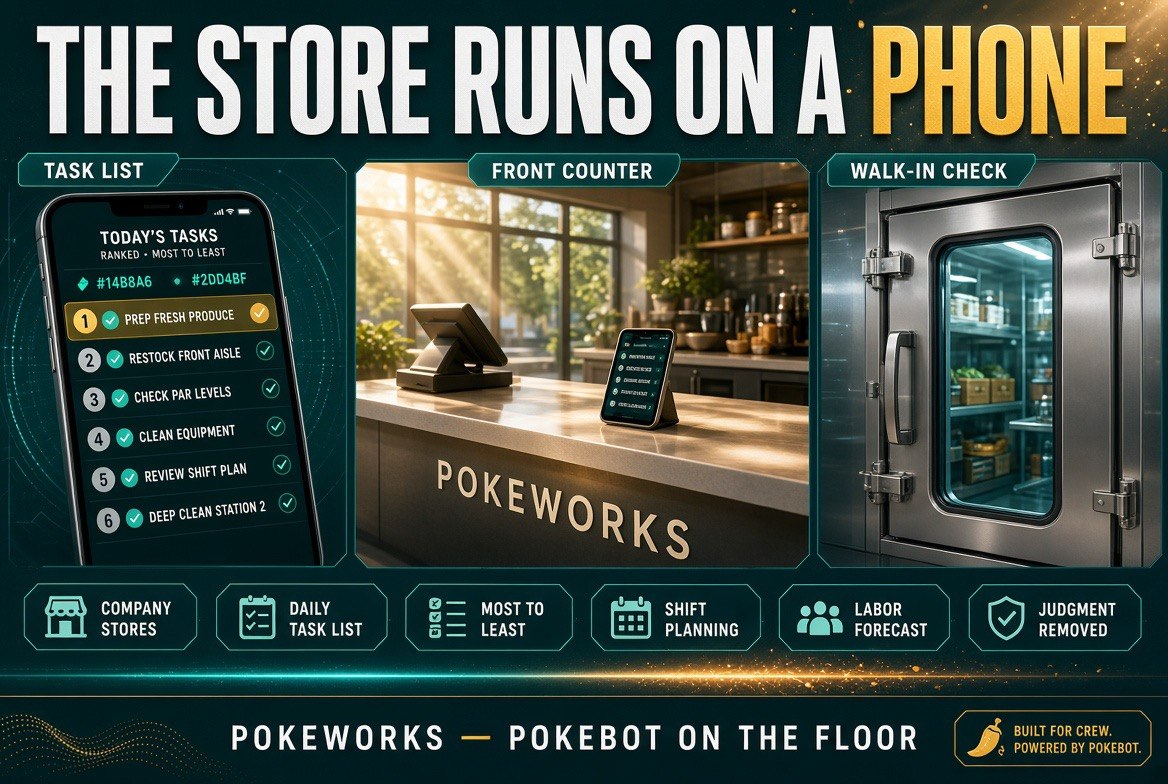
Pokebot on the floor: the task list arrives ranked most-to-least important, which is where the daily judgment call used to live.
The Headcount Decision Every Operator Should Study
Here is the fork in the road, and where most AI-vendor marketing gets vague on purpose.
Pokebot absorbed work that humans used to do. Pokeworks did not lay those people off. It reassigned them to other roles — including checking Pokebot’s work. And the company says it does not plan to hire more headquarters employees anytime soon, even as it opens more restaurants.
“Our goal is to maintain headcount with our future growth,” Wei said. “I don’t think we would need to hire anybody else.”
Two separate things are happening in that sentence, and they should be read apart.
The first is that growth no longer automatically means more back-office bodies. That is the promise every AI pitch is quietly selling. The second, and the more interesting one, is that the humans were not removed from the loop — they were moved to the verification layer. Someone at Pokeworks is accountable for whether Pokebot’s numbers are right. That is a review function, and it is a real job.
For an independent operator with two or three locations, the translation is blunt. You will not get a headcount dividend, because you never had a headquarters team to trim. What you get is capacity: the bookkeeping that used to eat your Sunday nights can be compressed, and the time goes back to the floor. The verification step is not optional, though. If nobody checks the agent, you have not automated your accounting — you have merely stopped looking at it.
| Decision | Multi-Unit Chain (Pokeworks Model) | Independent Operator (1-3 Units) |
|---|---|---|
| Build the agent or buy it? | Built in-house — viable because co-founders are computer scientists | Buy. Any off-the-shelf tool beats a homegrown project you cannot maintain |
| Where does the payoff show up? | Headcount stays flat while store count grows; software licenses get consolidated or dropped | Hours return to the owner, not to payroll. Value is time, not savings on staff |
| Who verifies the output? | Reassigned staff, formally tasked with checking the agent | The owner or a trusted manager, on a fixed weekly review slot |
| Biggest hidden cost | Token costs, plus the internal disruption of changing how the home office works | Subscription creep and dirty data — wrong inputs produce confident wrong reports |
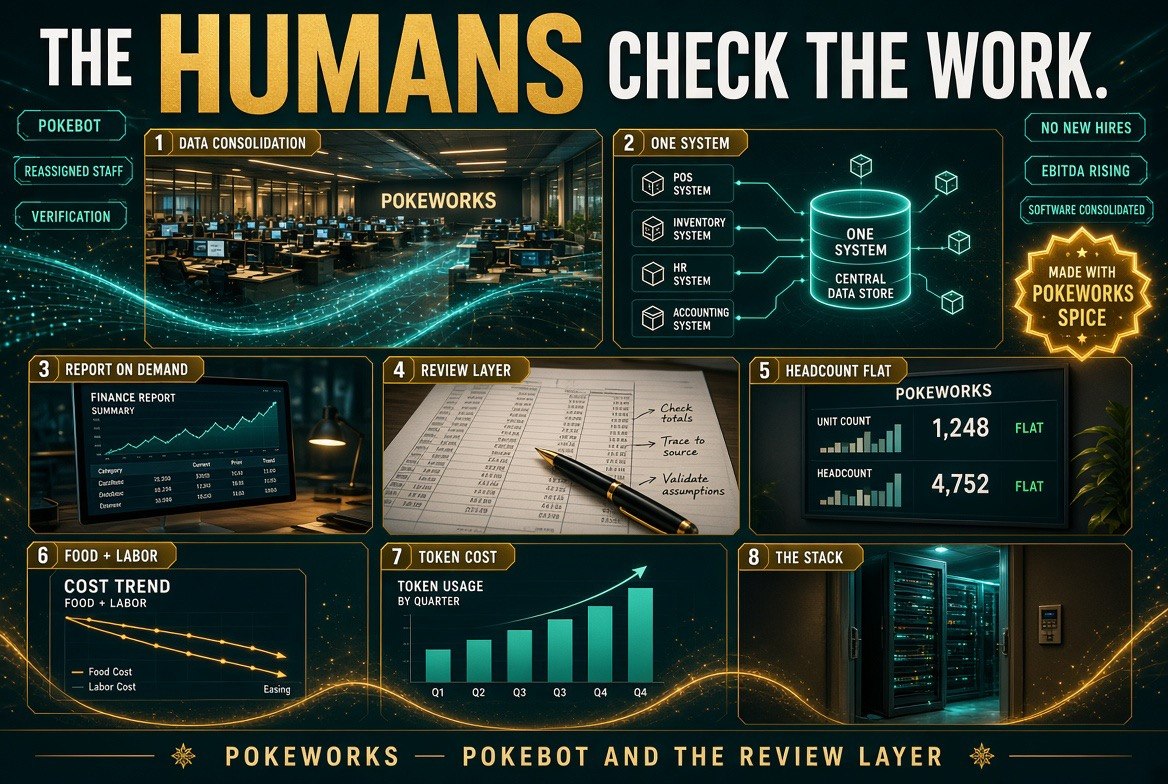
The detail most AI pitches skip: the humans were not removed from the loop, they were moved into the review layer that checks what the agent produces.
The Numbers: What Pokeworks Says It Is Getting
Pokeworks declined to publish specific figures, which is worth stating plainly rather than dressing up. What the co-founders would say is directional, and it is still meaningful because it comes from operators rather than a vendor deck.
- The company says it is saving percentage points on food and labor costs through automated sourcing and labor forecasting.
- EBITDA is rising, and same-store sales remain positive year over year.
- The homegrown approach has lowered technology costs by letting the chain consolidate or drop other software.
- Token costs are acknowledged as a real line item, with Wei expecting them to stay a small percentage of sales.
Those first two points — food and labor, the two largest cost lines in any restaurant — are the ones to hold onto. Labor forecasting and sourcing are exactly the areas where a good model can outperform a busy human, because they reward consistency over intuition. A manager guessing Thursday’s prep level after a rough Wednesday is working from a feeling. A forecast built on three years of POS history is working from a pattern.
Chen’s framing of the software strategy also has a clear boundary worth copying: “Besides very, very specialized software, like accounting or POS, things that we can’t replace ourselves, we’re gonna integrate it and do it ourselves.”
The token-cost caveat deserves its own moment, because it is the part of the AI economics story that is currently being subsidized. The big labs are absorbing inference costs to win market share, and that will not last forever. Wei’s expectation that tokens stay a small percentage of sales is reasonable — but any operator budgeting an AI stack in 2026 should model what happens if that price doubles, because the current pricing is not a permanent floor.
What Independents Should Take From This — and What to Ignore
The temptation with a story like this is either to dismiss it (“I’m not an 86-unit chain with computer scientists on staff”) or to overreach (“I need to build my own AI operating system”). Both miss the useful part.
1. Copy the sequence, not the software. Pokeworks spent an entire year consolidating data before building a single agent. If your POS, labor, and purchasing data live in three systems that do not talk, that is your project — and it is worth more than any subscription you could buy this quarter.
2. Do not build agents without a builder. Pokeworks built in-house because two co-founders have advanced CS degrees and corporate engineering backgrounds. That is the specific condition that makes build rational. Without it, buying the tool is not a compromise; it is the correct answer.
3. Assign the verification job on purpose. The most underrated line in the whole story is that displaced staff were reassigned to check the agent. Whoever owns that review at your restaurant should be named, not implied.
4. Watch your technology spend with the same suspicion as your food cost. Pokeworks lowered tech costs by consolidating or dropping software it no longer needed. Most independent restaurants do the opposite — they add an AI tool for scheduling, another for inventory, another for reviews, and never audit whether the old one still earns its fee.
5. Treat the smartphone task list as the real product. An app that tells a shift lead what to do first, ranked, is the most concrete thing in this story for a single-location operator. It is also the easiest capability to test with tools you already pay for.
None of this requires a technical co-founder. It requires deciding, deliberately, which parts of your operation you are willing to hand to software — and who checks the work afterward.
Frequently Asked Questions
What is Pokebot?
Pokebot is the AI agent Pokeworks built in-house on top of a consolidated company database. It handles tasks such as accounting and financial reporting, and it is part of a broader AI layer the company calls the Pokeworks Operating System.
Did Pokeworks lay off staff when the AI agent took over their work?
No. Pokeworks reassigned those employees to other roles, including reviewing and checking Pokebot’s output. The company also says it does not expect to add more headquarters employees soon, even as it continues opening restaurants.
Should an independent restaurant build its own AI agent?
Almost certainly not. Pokeworks built in-house because two of its co-founders hold advanced computer science degrees and previously worked at Intel and Lockheed Martin. Without that in-house technical capability, buying an existing tool is the correct decision — maintenance and troubleshooting alone will exceed the cost of a subscription.
How long did it take Pokeworks to get AI actually working?
Roughly three years from ChatGPT adoption to a functioning agent. The company started with chat tools at headquarters in 2023, spent 2025 consolidating data from multiple systems into one database, and only began building agents at the beginning of 2026. The data consolidation was the longest phase.
What results has Pokeworks reported from using AI?
The co-founders declined to share specific figures, but said the company is saving percentage points on food and labor costs through automated sourcing and labor forecasting, with rising EBITDA, positive same-store sales year over year, and reduced technology costs from consolidating software.

About Barak Schurr
Barak Schurr built and exited a major ticketing platform, ran global operations at Eventbrite, and now focuses on one question: which AI tools actually help independent restaurant owners run leaner and grow faster. He writes from the operator’s perspective — no vendor spin, no theory, just what’s real in 2026.
Email: [email protected]
More Resources for Restaurant Operators