Get the AI Restaurant Quick-Start Guide — Free
The 5 AI tools independent US restaurant owners are using right now to cut labor costs and answer every call.
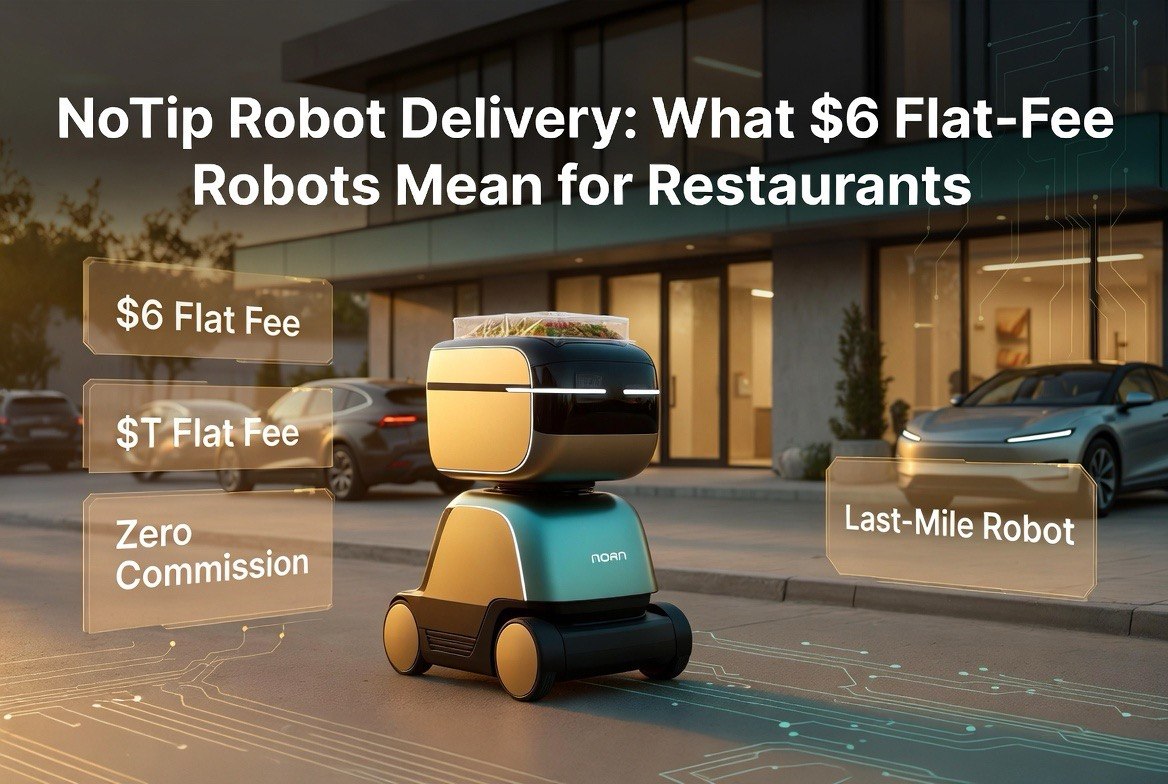
NoTip Robot Delivery: What $6 Flat-Fee Robots Mean for Restaurants
⚡ Expert Summary: NoTip, founded by EV entrepreneur Steve Burns, launches robot-assisted delivery in Mason, Ohio that charges restaurants zero commission and customers a flat $6 fee — a direct attack on the 15-30% third-party platforms take from every order. An electric vehicle hauls food to the neighborhood, then a robot named Noah completes the curb-to-door stretch using cameras, LiDAR, sonar, GPS, and AI. Limited to one market and about a dozen partners today, but the zero-commission model targets the single biggest cost drag in US restaurant delivery.
Your delivery costs are bleeding you dry. Between third-party commissions that eat 15–30% of every order and labor that keeps climbing, delivery can turn a profitable kitchen into a break-even operation. For US restaurant owners, delivery margins have been squeezed for years, and the pressure is only getting worse. That’s exactly the pain NoTip, a Cincinnati-area startup, is attacking with a two-stage robot delivery system that charges restaurants zero commission and customers a flat $6 fee.
NoTip just launched in Mason, Ohio, after four years of development, and it’s already partnered with about a dozen local restaurants. I’ve been tracking restaurant automation for years, and this is one of the first robot delivery models built specifically to kill the commission problem rather than just swap one delivery driver for another. Here’s what it actually does, what it costs, and whether it’s worth watching.
What NoTip Actually Does
NoTip isn’t a drone dropping tacos from the sky. It’s a clever two-stage system designed to solve the hardest part of delivery economics: the last 100 feet.
Here’s the flow:
1. The customer orders through the NoTip app. You browse local NoTip partner restaurants, pay, and pick a delivery window.
2. An electric vehicle carries the food to the neighborhood. A human driver handles the long drive — the part that’s genuinely hard to automate safely on public roads.
3. A robot named Noah takes over at the curb. Once the vehicle reaches the customer’s block, the robot rolls out and completes the final stretch to the front door.
4. Noah navigates autonomously. Cameras, LiDAR, sonar, GPS, and AI work together to avoid obstacles — trash cans, pets, kids’ bikes, uneven sidewalks.
The design is deliberate. Remember the last time a delivery robot tried to cross a busy street or navigate downtown traffic? That’s where these systems fail. NoTip sidesteps it by keeping the risky driving with a human and letting the robot handle the predictable, low-speed final leg.
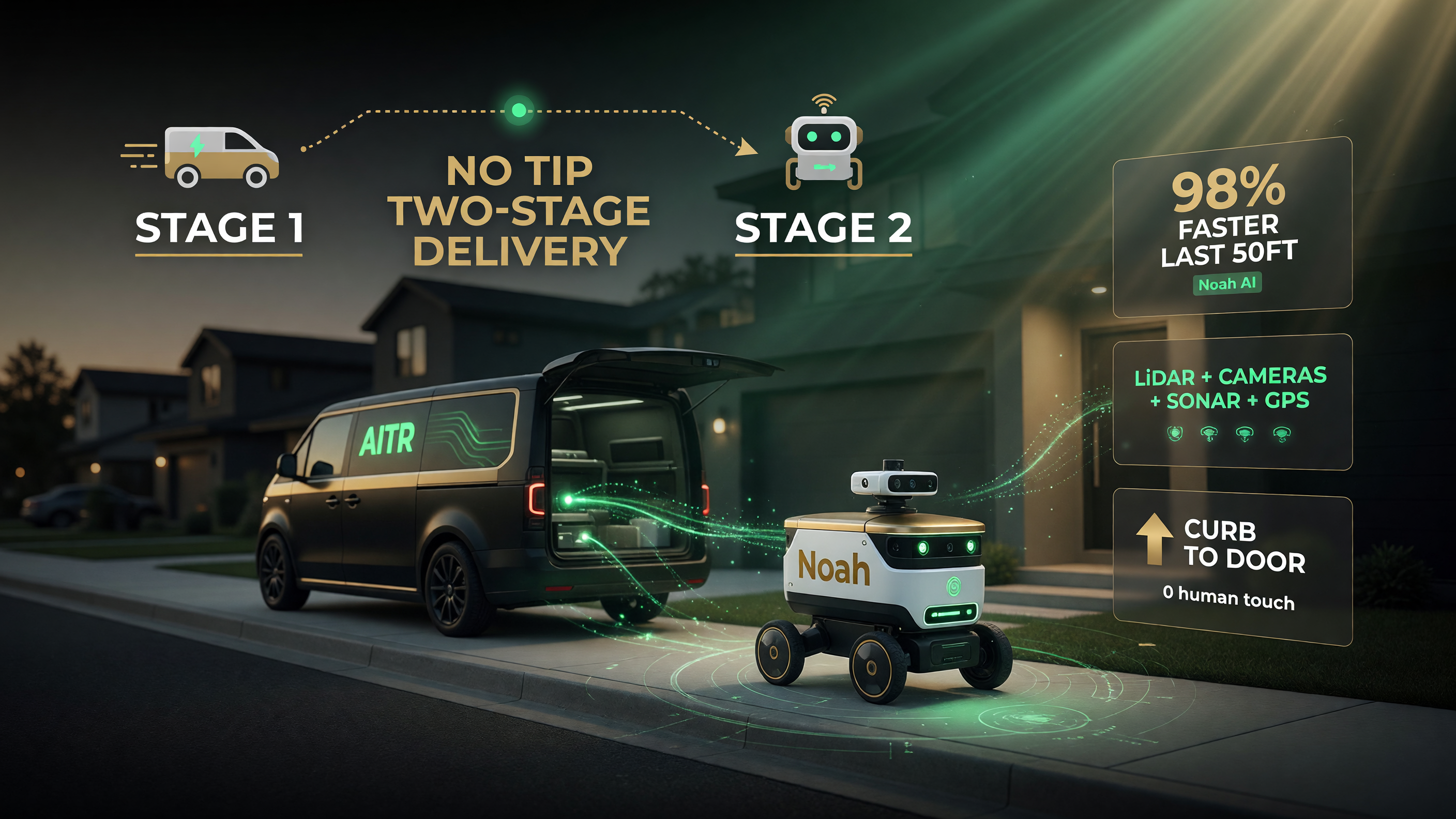
NoTip splits delivery into a human-driven long haul and a robot final mile — the part where most robot delivery systems fail.
The Business Model That Gets Restaurants’ Attention
Let’s be direct about why this matters for a restaurant owner: the economics are the story.
Third-party delivery platforms like DoorDash, Uber Eats, and Grubhub typically charge restaurants 15–30% commission per order. On a $35 ticket, that’s $5 to $10 straight out of your margin — before you even account for the fact that delivery orders usually require extra packaging and more labor.
NoTip flips that.
- Restaurants pay zero commission. No percentage cut on every order.
- Customers pay a flat $6 delivery fee. Predictable, no surge pricing, no tip required.
- Menu prices stay the same. You don’t have to inflate prices to absorb platform fees.
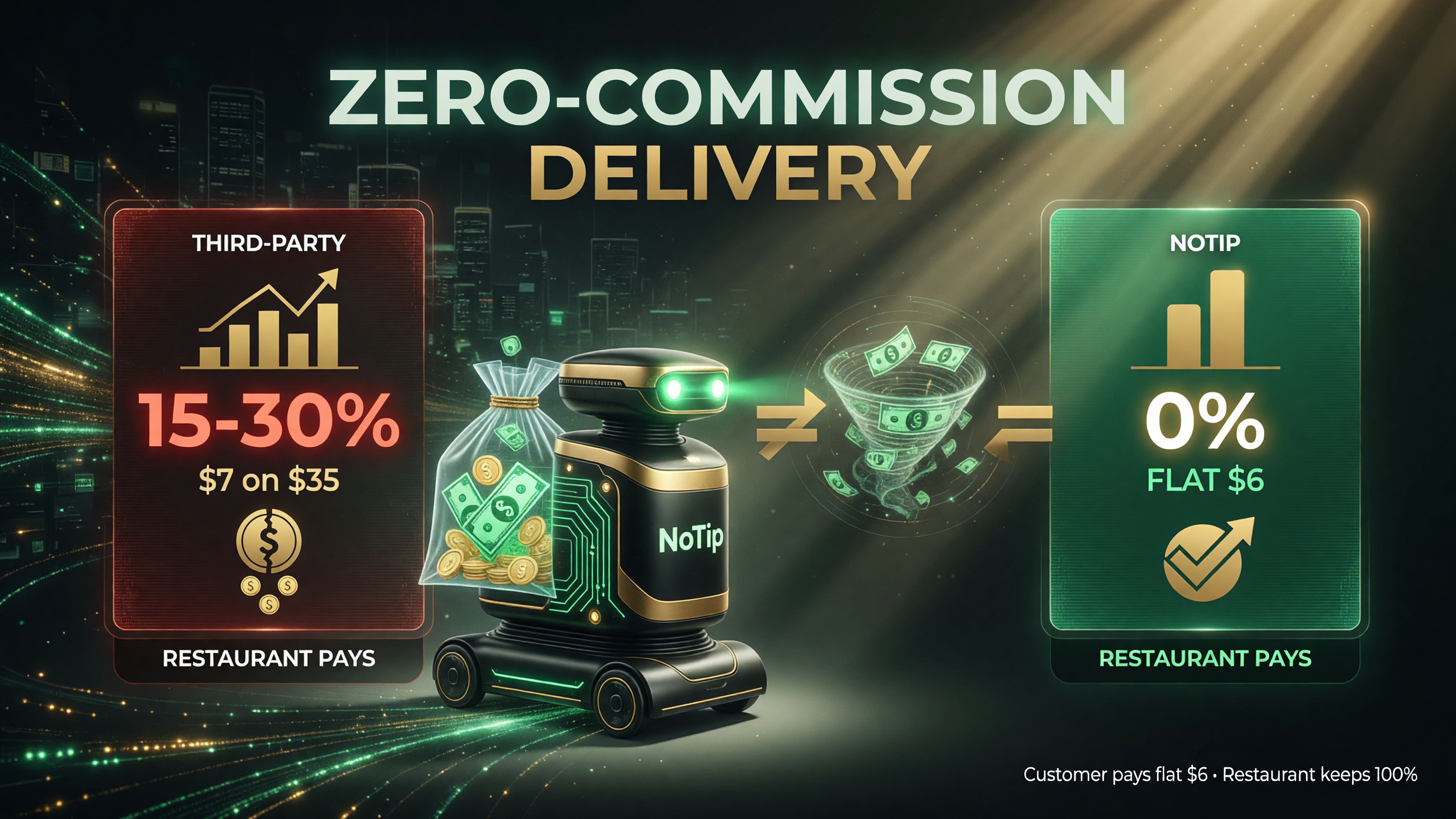
On a $35 order, a 20% platform commission costs the restaurant $7 — NoTip takes $0 while the customer pays a flat $6.
For an independent restaurant doing even 20 delivery orders a day at a $35 average ticket, a 20% commission means giving up about $140 a day — roughly $4,200 a month — to a third-party platform. Under a zero-commission model, that stays in your margin. That’s the difference between a kitchen that’s profitable and one that’s just staying busy.
What the Founder Is Actually Saying
NoTip is the brainchild of Steve Burns, the electric vehicle entrepreneur who founded Lordstown Motors. He’s not a restaurant guy — he’s an EV and robotics guy who got frustrated with delivery costs as a customer.
“I just realized how expensive these incumbent door delivery companies are. We’re a bunch of electric vehicle and robotics guys, and I don’t order food too much, but like a lot of dads, my kids do, and somehow I wind up paying for it.”
Burns is also selling the non-financial upside of robots over human couriers, and honestly, some of it lands:
- A robot doesn’t steal food. No “missing fries” disputes or mysterious order shrinkage.
- Always on time. No traffic delays on the final leg, no personal stops.
- Sterile environment. The food stays in a sealed compartment in the electric vehicle — not in a hot bag in a personal car.
- No strangers on your porch at night. A real concern for customers ordering late.
He also points out the robot travels at walking speed and currently operates alongside a human driver who can monitor and stop it if something goes wrong. So this isn’t a fully autonomous, unattended rollout — it’s automation with a safety net, which is the sensible way to test it.
The Honest Risks and Limits
I want to be straight with you, because every robot delivery headline hides a few caveats. Before you get excited about cutting delivery costs, here’s what NoTip hasn’t solved yet — and why US restaurants should watch, not rush:
1. Limited service area. Right now this is Mason, Ohio only, a single suburb of Cincinnati. That’s a controlled test, not a network. The economics only work if the model scales.
2. About a dozen restaurant partners. Small footprint. No national coverage, no mobile ordering integration with the big POS systems yet — orders go through the NoTip app, not your own channel.
3. The last mile is still the hard part. NoTip handles the final few hundred feet well. But apartments with security doors, gated communities, steps, and dense downtown sidewalks are all tougher than a suburban single-family home. The robot currently operates with a human nearby — scaling to unattended operation is the real challenge.
4. Robot upkeep and capex. Who pays for the robots, the EVs, the maintenance, the failures? NoTip is absorbing that cost to get restaurants to zero commission. That’s a heavy capital load, and it remains to be seen if the economics hold as the fleet grows.
5. Adoption is a habit problem. Customers are used to one app for everything (DoorDash). Asking them to download a separate NoTip app for a limited set of restaurants is a real friction point. The model lives or dies on order volume.
None of these are deal-breakers for the concept — but they’re exactly why NoTip is testing in one market before expanding to Greater Cincinnati.
What This Means for Independent Restaurants
Here’s my honest read for the restaurant owner wondering whether to care about NoTip:
You don’t need to sign up today. It’s one market, one app, a small partner list. There’s no reason to chase it yet.
But you should watch the model closely. The key insight NoTip is betting on is correct: third-party commission is the single biggest cost drag in restaurant delivery. Any model that moves to zero commission — whether it’s robot delivery, in-house delivery fleets, or AI ordering that goes straight through your own POS — attacks the same problem.
That direction is already spreading. Square and Toast are adding conversational AI ordering through Google Maps that runs on your own POS checkout, not a third-party marketplace. AI voice ordering plugs into your existing systems and keeps the order — and the margin — yours. The trend is clear: restaurants are getting their delivery margin back, one automation layer at a time.
Start thinking now about what your ordering and delivery stack would look like if a third-party commission disappeared. That’s the future NoTip is pointing at, and it changes the numbers on every delivery ticket you run.
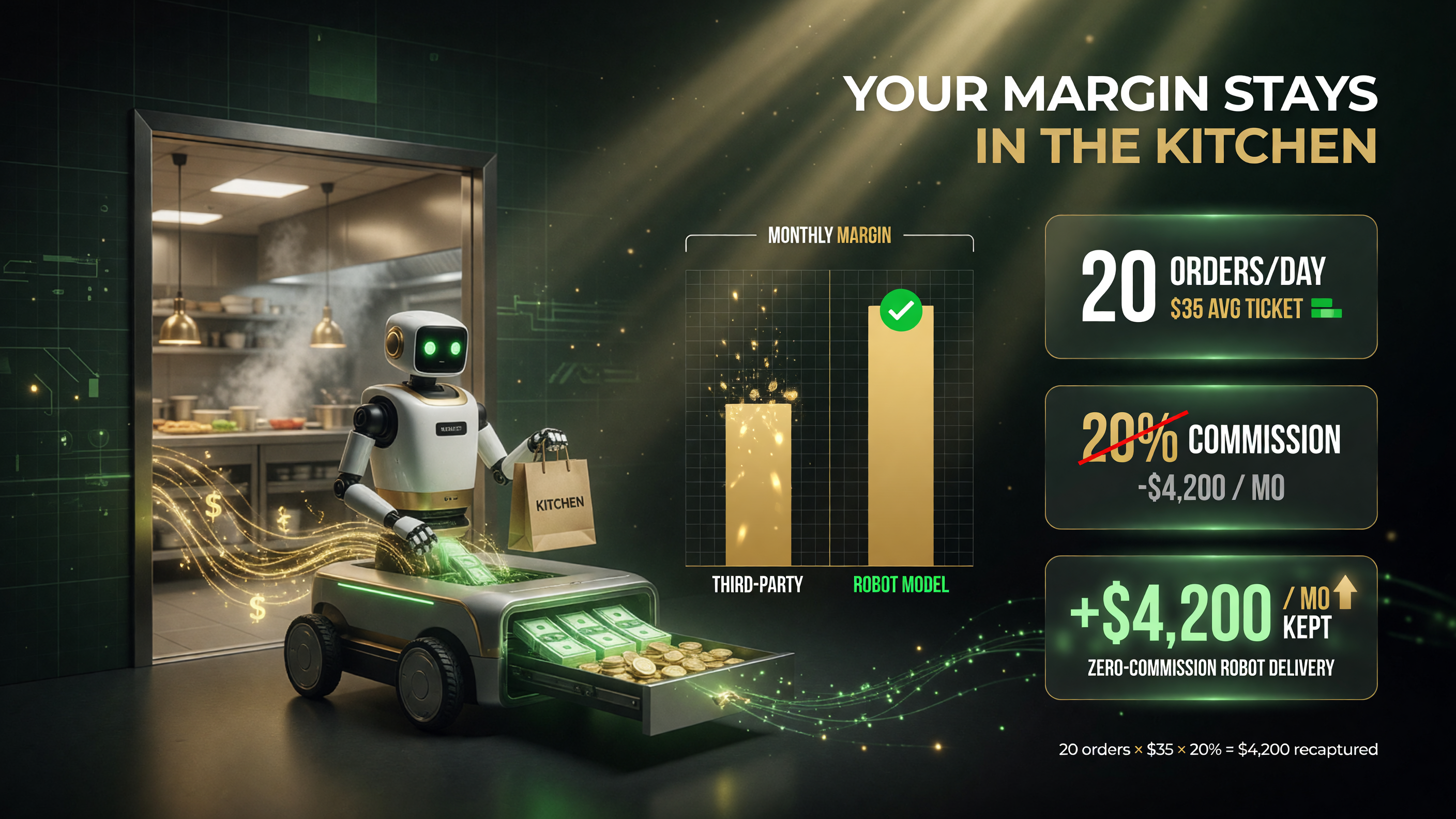
What a restaurant keeps per $20 order under a 30% commission vs NoTip’s flat $6 fee model.
Frequently Asked Questions
Is NoTip delivery really free for restaurants?
Yes. NoTip says it charges restaurants zero commission, and customers pay a flat $6 delivery fee. That’s a meaningful departure from third-party platforms that take 15–30% per order.
How does NoTip’s robot delivery work?
Orders go through the NoTip app. An electric vehicle carries the food to the customer’s neighborhood, then a robot named Noah uses cameras, LiDAR, sonar, GPS, and AI to complete the final stretch from the curb to the front door.
Where is NoTip available?
Currently only in Mason, Ohio, a suburb of Cincinnati. The company has partnered with about a dozen local restaurants and plans to expand to more communities in Greater Cincinnati as it refines the technology.
Is the delivery robot autonomous?
Mostly, on the final leg. Noah navigates autonomously at walking speed using sensors and AI, but currently operates alongside a human driver who can monitor and stop it if necessary.
Who founded NoTip?
Steve Burns, the electric vehicle entrepreneur who founded Lordstown Motors. He developed the concept after becoming frustrated with the cost of third-party food delivery.
Will robot delivery replace human delivery drivers?
Not in the near term. NoTip still uses a human driver for the long-haul portion, with the robot handling only the final stretch to the door. Full replacement of drivers is not yet on the table.
——

About Barak Schurr
Barak Schurr built and exited a major ticketing platform, ran global operations at Eventbrite, and now focuses on one question: which AI tools actually help independent restaurant owners run leaner and grow faster. He writes from the operator’s perspective — no vendor spin, no theory, just what’s real in 2026.
Email: [email protected]
More Resources for Restaurant Operators