Get the AI Restaurant Quick-Start Guide — Free
The 5 AI tools independent US restaurant owners are using right now to cut labor costs and answer every call.
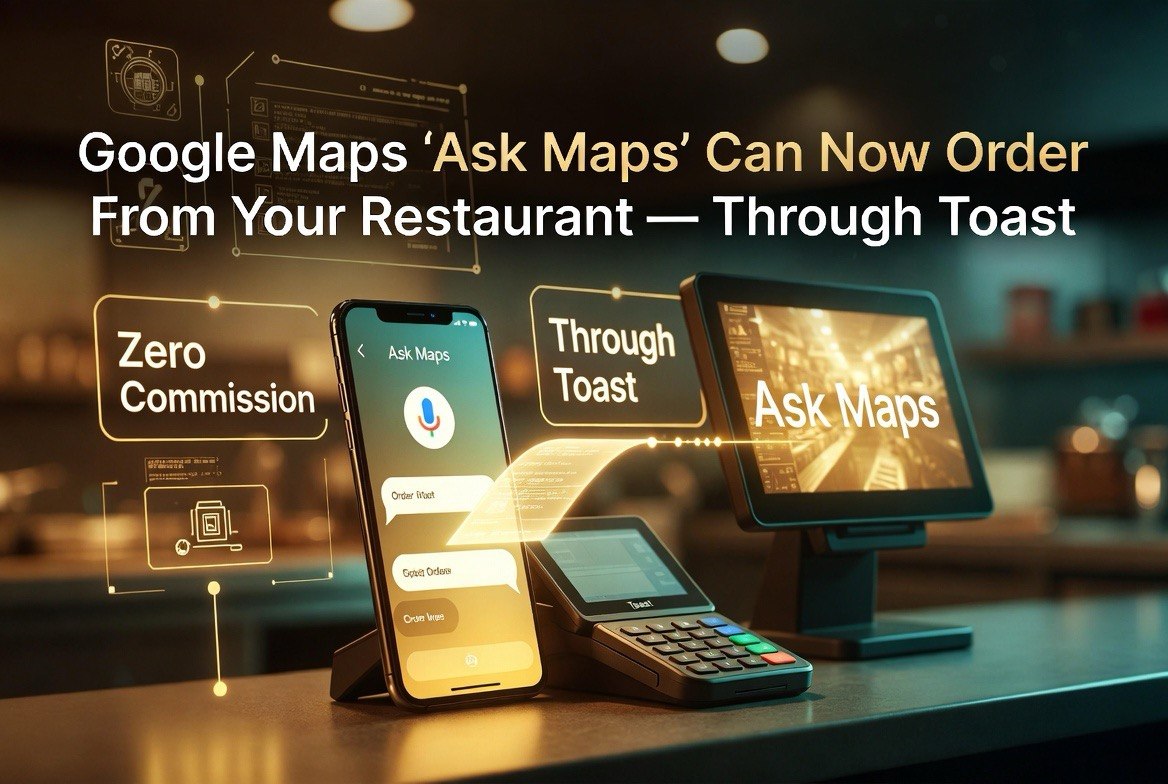
Google Maps "Ask Maps" Can Now Order From Your Restaurant — Through Toast
⚡ Expert Summary: Toast now powers commission-free AI ordering inside Google Maps’ “Ask Maps.” Customers order in plain language, the order flows through Toast’s own first-party system (not a third-party marketplace), and you keep your menu, your pricing, and your guest data. No per-order commission. The catch: it only works on restaurants that have their online presence wired through Toast — which is exactly the nudge to get your digital ordering house in order before your competitors do.
Your customer is standing in line at a coffee shop, phone in one hand, and instead of opening an app she says, out loud: “Order spicy pad kee mao with seafood — pickup on my way home.” And Google Maps just does it. Picks your restaurant, reads your menu, builds the order, pays, and hands it to your kitchen.
That is not a demo. That is live, right now, on your customers’ phones — and Toast is the plumbing behind it.
On August 6, 2026, Toast expanded its Google integration to support agentic ordering through Google’s “Ask Maps.” For an independent restaurant owner, this is the single most important thing to understand about where your customers order from next — because it decides whether you keep your direct orders or hand more of the margin to a third-party marketplace.
What “Ask Maps” Actually Does to Your Order Flow
Google has been adding agentic features to Maps all year — hotel bookings, event tickets — and food ordering is the piece restaurant owners need to care about. “Ask Maps” lets a customer type or speak a natural request. Google’s AI surfaces the relevant restaurants, shows their menus, adds items to a cart, and helps complete the order on the supported platform. It is starting with Toast and Square on the restaurant side, with Uber Eats coming soon after.
Here is the part that matters for your P&L: those orders run through Toast’s first-party ordering system, not through a delivery marketplace. That means no third-party commission on the order value. Google is collecting the order intent, but your existing Toast direct-order pipeline is what fulfills it. For a 100-seat restaurant that already pays 15-30% per marketplace order, the difference between “captured in Maps, fulfilled direct” and “routed through a marketplace” is thousands of dollars of margin a month.
Commission-Free Is the Whole Point
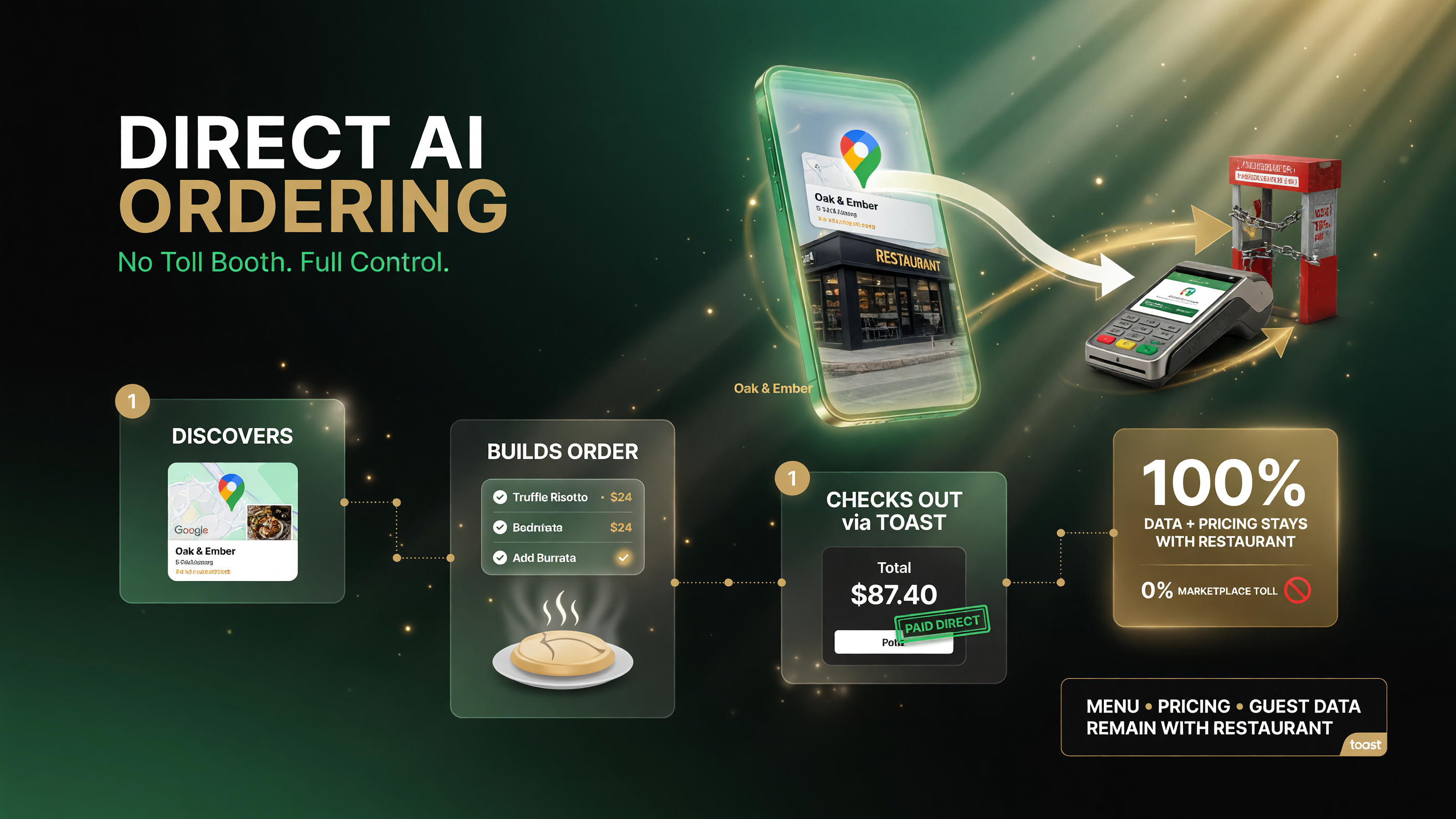
Agentic ordering routes around the marketplace toll — the restaurant keeps the menu, the pricing, and the full ticket.
Let me be blunt about what this removes from the table. If a customer finds you on Google Maps today and orders, in many cases the order is being sent through a third-party platform that takes a cut of every transaction — typically 15-30% depending on the market and the service tier. On a $50 ticket, that’s $7.50 to $15 out of your pocket before you even pay for food and labor.
With the Toast-Google “Ask Maps” integration, the order is fulfilled through Toast’s first-party systems. Google positions this as a growth channel for operators precisely because it avoids those typical marketplace commissions. Toast is treating this as a way to make direct ordering more discoverable — your restaurant shows up where customers already are (Google Maps), but the money flows through your own channel.
For a restaurant running labor around 30% of revenue and food cost near 30%, protecting the gross profit on every order is not a nice-to-have. It is the difference between a profitable month and a break-even one. Every percentage point of commission you avoid is margin you keep.
The Universal Commerce Protocol: Why This Matters Long-Term
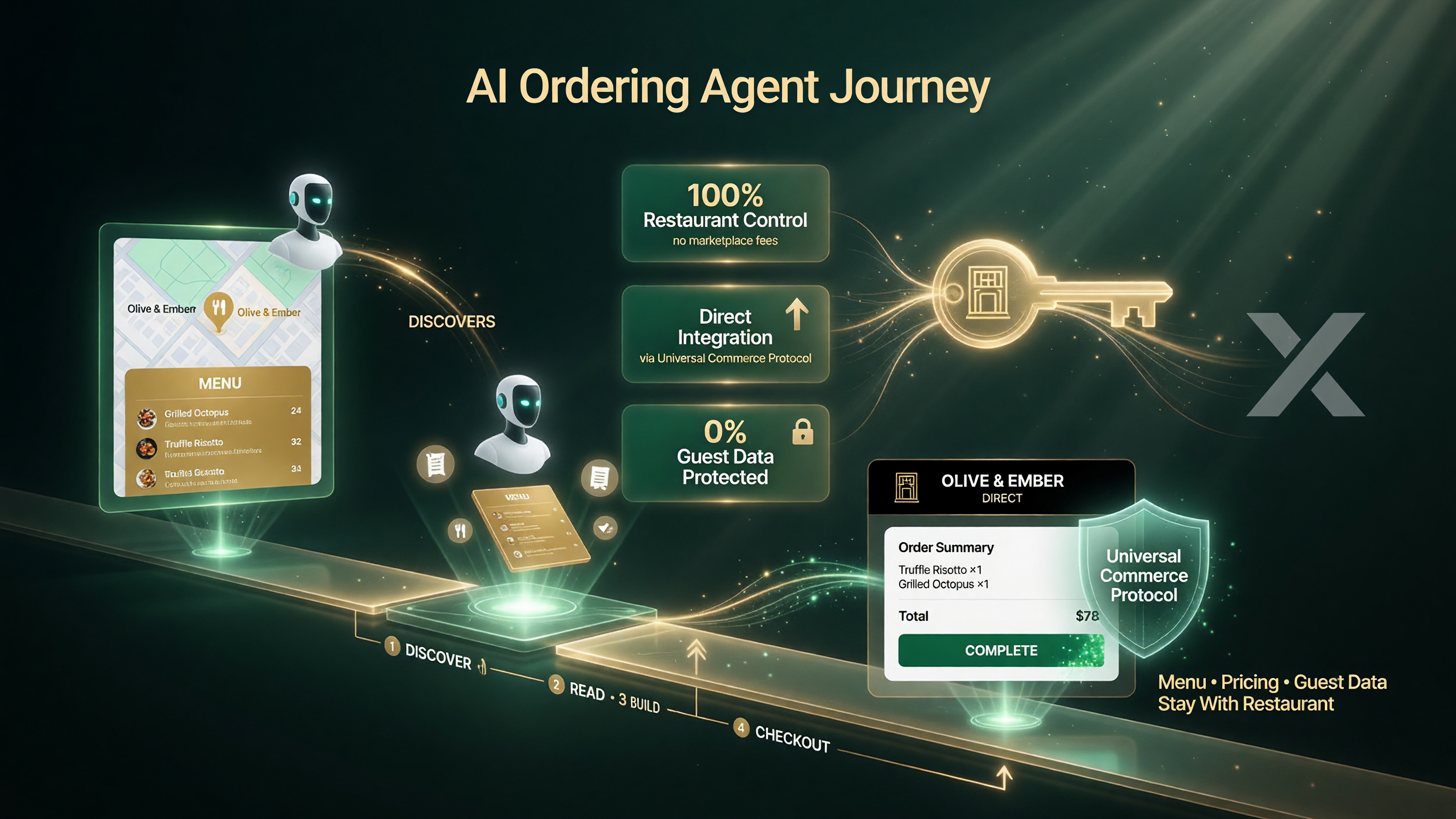
The UCP lets AI agents discover, order, and check out across Google Maps, Search, and Gemini — with the restaurant in control.
You do not need to become an expert in open standards to run a restaurant, but you should know the name behind this, because it tells you where the industry is headed. Toast is a co-developer of the Universal Commerce Protocol (UCP) for Food — an open standard hosted on GitHub that defines how AI agents discover, order from, and check out with restaurants across interfaces like Google Maps, Google Search, and Gemini.
Read that again: the idea is that an AI agent anywhere can find your restaurant and order from it without a human clicking through a marketplace app. The protocol exists to keep restaurants in control of their menus, pricing, and guest data, even as the ordering happens through increasingly automated, conversational surfaces.
Why should a busy owner care about an open standard? Because whoever controls the way AI agents order controls a growing slice of your revenue. If the standard is open and restaurant-first, you keep your data and your direct relationship with the customer. If a closed marketplace controlled it, they could eventually insert themselves between you and every AI-assisted order. UCP for Food is the restaurant industry’s attempt to make sure the agents order from you directly — not through a toll booth.
What It Means for Your Kitchen and Your Floor
There is a practical, shift-level reality here, and it is where this gets real for anyone who has worked a Saturday night service. Agentic ordering is not just a marketing channel — it changes how tickets hit your kitchen.
These orders come in the same way your other direct and online orders do — through your existing point-of-sale flow. When a customer completes an order via Ask Maps, it drops into your normal order pipeline. Your kitchen sees the ticket like any other online order. But there are differences you need to plan for:
- Modifiers and special requests. A conversational order can carry nuance — “no peanuts, extra basil, mild spice.” Your menu has to be set up so the AI can read those options cleanly. If your online menu is a mess of confusing modifiers, the agent will make mistakes or your staff will have to call to clarify.
- Pickup timing. Orders placed “on my way home” expect a pickup window. If your digital ordering is not tied to real prep times and slot availability, you will get an order that hits when your line is already slammed.
- Two systems, one flow. If you run Toast, the ordering is unified. If you run a different POS and only take marketplace orders, an AI agent ordering for you may route through a third party — and you are back to paying commission.
The Tool That Decides Whether You Win
Here is where I give you the practical answer instead of the tech-bro version. The restaurants that benefit from “Ask Maps” are the ones where the AI ordering experience connects cleanly to their own operation. That means three things need to be true in your restaurant:
First, your online menu must be accurate and complete. If your prices, descriptions, modifiers, and availability are stale, the AI will either not surface you or will surface you with wrong information. This has always been true for online ordering — the difference is that now an agent is reading it, not a patient human. An outdated item or a wrong price is a lost order or a customer-service problem.
Second, your ordering must be connected to live prep and fulfillment. The days of treating online ordering as a separate annex are over. If the AI can promise a 20-minute pickup and your kitchen cannot deliver it, the review that comes back is on you, not on Google.
Third, you should be on a platform that supports direct, commission-free agentic ordering. That is the Toast argument in one line. If you are on Toast, “Ask Maps” orders route through your existing direct-ordering system and you keep the margin. If you are not, you are reliant on whatever path the agent finds — and the marketplace toll may be back in the picture.
If you use Toast already, here is the near-term action: audit your online menu and your pickup/fulfillment settings before the promotion the company is funding later in August rolls out. Toast is expected to offer $5 in Toast Cash for qualifying orders placed through Ask Maps — that is a real incentive that will push customer volume into this channel fast, and you want your kitchen ready to take it.
What It Costs You to Wait
Operators hesitate on digital ordering changes because they have been burned by tech that sounded good and did not move revenue. Fair. But the cost of sitting on this one is concrete, not abstract.
Every month, customers near you are going to start using “Ask Maps” to order food — because it is faster and less friction than opening a separate app. When they do, Google surfaces the restaurants that are set up to fulfill it. If your competitor on the same block has a clean, Toast-connected ordering flow and you do not, that agentic order goes to them, not to you. You are not losing a customer to a better restaurant; you are losing them to a better ordering setup.
Restaurant margins punish delay. A 28-35% labor line, a 30% food cost, and shrinking customer acquisition headroom mean you cannot afford to let a new ordering channel mature without you in it. The restaurants that win the next five years are not the ones with the fanciest dining rooms — they are the ones wired so that every channel, including AI agents inside Google Maps, routes revenue to their own operation.
How This Compares to What You Already Use
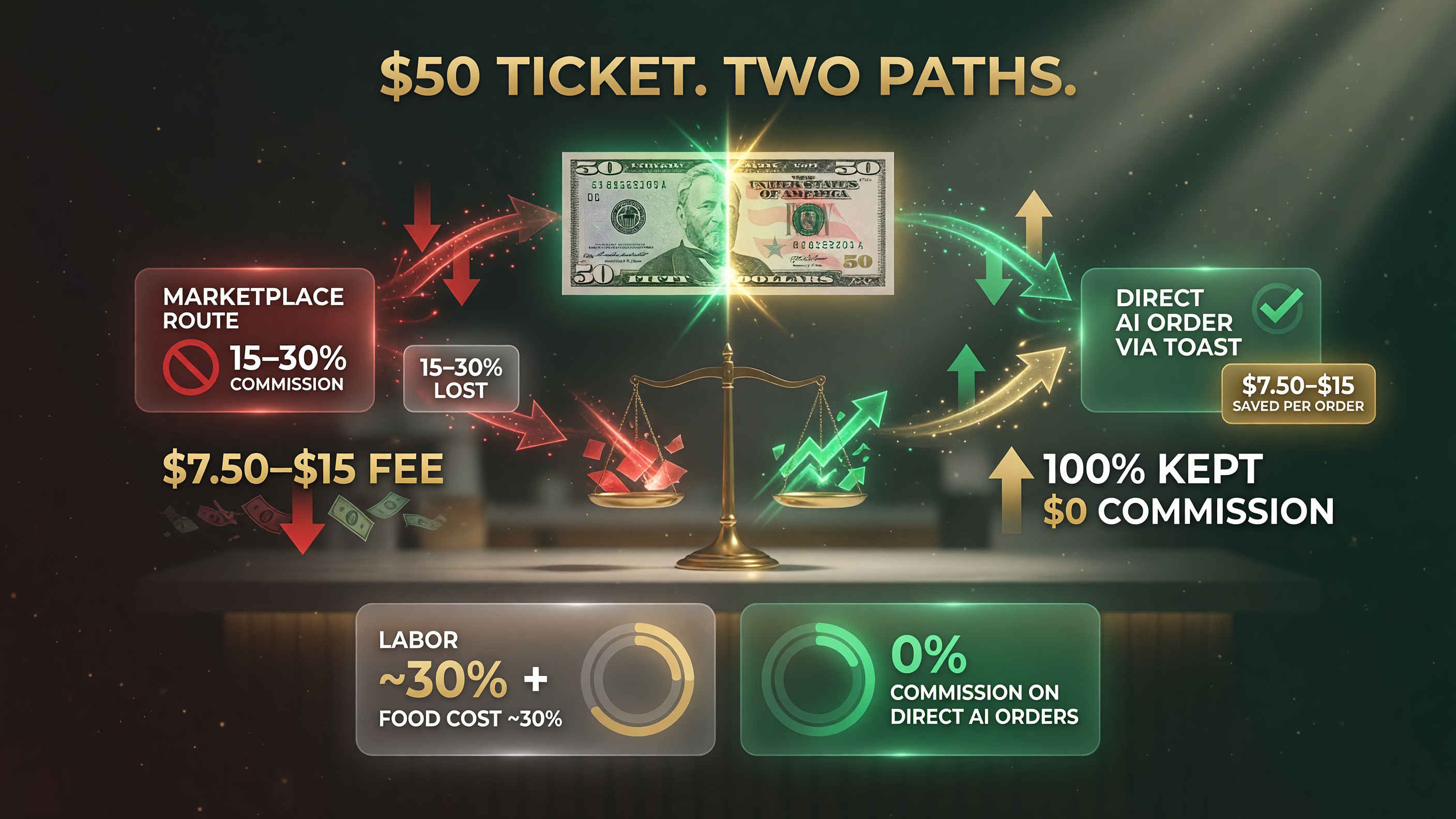
On a $50 ticket the marketplace skims $7.50-$15. Direct AI ordering through Toast keeps 100%.
You probably already take direct orders through your website, and you may take marketplace orders through DoorDash or Uber Eats. Here is how agentic ordering through “Ask Maps” fits alongside them:
| Order channel | Commission | Customer finds you via | Data / guest ownership |
|---|---|---|---|
| Direct (your website) | None | Your marketing / Google | Yours |
| Marketplace (DoorDash, Uber Eats) | 15-30% | Marketplace app | Marketplace’s |
| Agentic via Ask Maps (Toast) | None — first-party flow | Google Maps search | Yours |
The row that should stick with you is the last one. You keep margin, you get discovered by new customers where they already search, and you keep the guest relationship. That is the combination independent operators have been chasing for a decade.
What a Restaurant Owner Should Do This Week
You do not need a tech team to act on this. You need an hour and a checklist:
- Confirm your online ordering is current. If you run Toast, verify your menu, prices, modifiers, and categories in the Toast online ordering system are accurate and complete. An agent reads this — accuracy now prevents errors later.
- Set up pickup slots honestly. Review your prep and pickup timing so a “pickup on my way home” order lands when you can actually make it.
- Get your guest data in line. Because direct orders keep guest data with you, make sure your email/SMS capture is on. Every AI-assisted order is a new customer you can market to directly — that is margin you are not giving the marketplace.
- Get ready for the Toast Cash wave. When the $5-per-order consumer promotion hits later in August, expect a spike in Ask Maps orders. Your kitchen should be able to absorb it.
- Ask your rep the direct question. If you are on Toast, ask your account rep when Ask Maps ordering is enabled for your location and what your onboarding checklist is. If you are not on Toast, ask your POS provider whether they are connected to UCP for Food — because that is what determines whether agents order from you directly or through a toll booth.
Frequently Asked Questions
Is Google “Ask Maps” restaurant ordering live now?
Yes. Toast announced its expanded Google integration for agentic ordering in Ask Maps on August 6, 2026, and it is rolling out now, starting with Toast and Square (with Uber Eats coming). Restaurants on the supported platforms can receive these orders through their existing systems.
Do I pay a commission on Ask Maps orders through Toast?
No. Orders flow through Toast’s first-party ordering system, not a third-party marketplace, so you avoid typical third-party commissions on those orders. This is positioned as a commission-free growth channel.
Do I need to build anything to accept Ask Maps orders?
Not if your digital ordering is already set up correctly through a supported platform like Toast. The main work is operational: keeping your online menu accurate, tying ordering to realistic prep/pickup times, and being ready for the volume.
What is the Universal Commerce Protocol (UCP) for Food?
It is an open standard hosted on GitHub — with Toast as a co-developer — that defines how AI agents discover, order from, and check out with restaurants across surfaces like Google Maps, Google Search, and Gemini. Its goal is to keep restaurants in control of their menus, pricing, and guest data as ordering becomes more automated.
Will this hurt my existing direct or marketplace orders?
It adds a channel rather than removing one. You still run your own direct ordering and can keep marketplace channels. The risk is the opposite: if you are not set up for agentic ordering, customers who use Ask Maps may end up ordering from a competitor who is.

About Barak Schurr
Barak Schurr built and exited a major ticketing platform, ran global operations at Eventbrite, and now focuses on one question: which AI tools actually help independent restaurant owners run leaner and grow faster. He writes from the operator’s perspective — no vendor spin, no theory, just what’s real in 2026.
Email: [email protected]
More Resources for Restaurant Operators