Get the AI Restaurant Quick-Start Guide — Free
The 5 AI tools independent US restaurant owners are using right now to cut labor costs and answer every call.
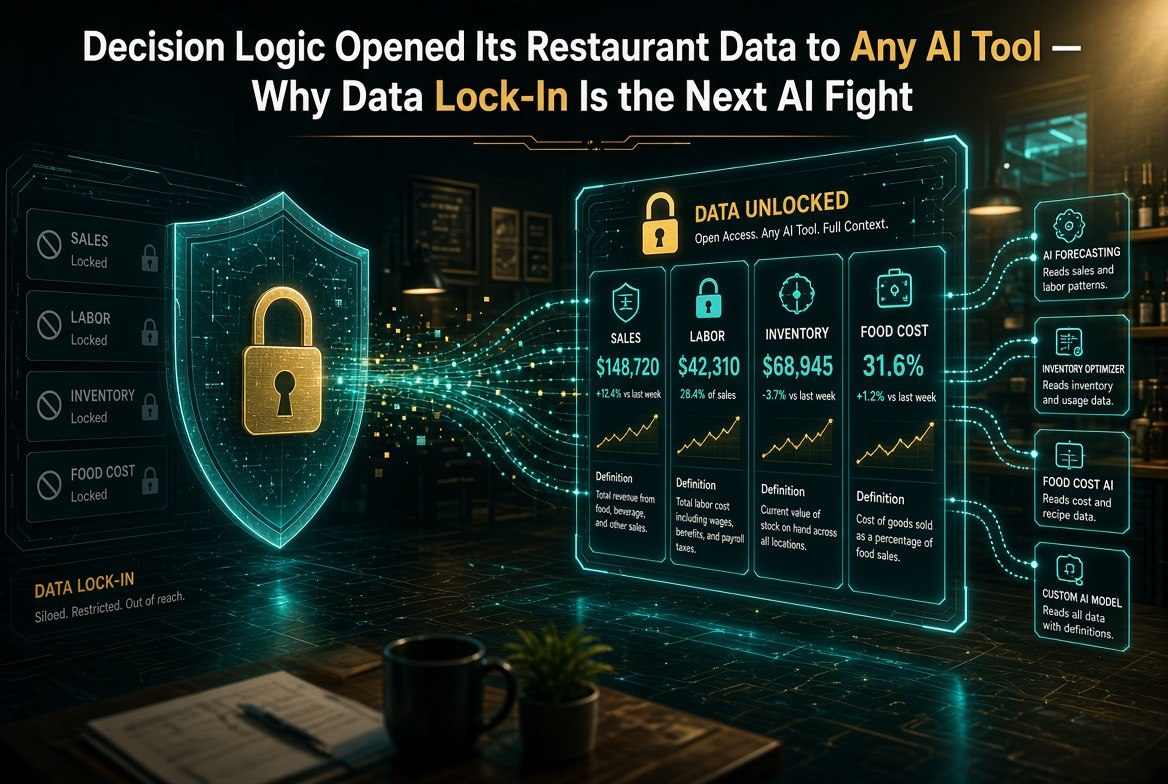
Decision Logic Opened Its Restaurant Data to Any AI Tool — Why Data Lock-In Is the Next AI Fight
⚡ Expert Summary: Decision Logic — a restaurant operations platform covering inventory, food cost, labor, and sales analytics — launched Open Semantic Access on September 17, 2026. It gives operators read-only access to their own operating data plus the definitions that explain what that data means, so they can point any AI tool at it — ChatGPT, Claude, Gemini — instead of being confined to one vendor’s built-in assistant. It ships at no extra charge, with no per-location fee. CEO Keegan Conrey’s framing: “Restaurant operators shouldn’t have to buy their own data back just because they want to use it with AI.” The reason this matters beyond one vendor: the missing ingredient in nearly every failed restaurant AI project isn’t model quality — it’s semantics. AI can’t reason about numbers it can’t define.
Your POS knows your sales. Your inventory system knows your food cost. Your scheduling tool knows your labor. None of them will let an AI assistant read any of it — unless you pay extra, buy the right module, or upgrade to the tier that includes “AI access.” That is the deal most independent restaurant operators signed without realizing it.
On September 17, 2026, restaurant operations platform Decision Logic launched something that cuts against that entire model. It’s called Open Semantic Access, and the premise is blunt: the data is yours, and you should be able to point any AI tool at it.
This matters to you even if you run a handful of locations and have never heard of Decision Logic. Because the fight it represents — who owns your operating data, and whether you can use it with AI without paying a toll — is about to land on every contract you sign.
What Decision Logic Actually Launched
Decision Logic is not a small player. The platform covers inventory management, food cost intelligence, labor optimization, manager logs, digital line checks, and consolidated sales reporting. Its partner list includes 54th Street Restaurants, RibCrib BBQ, Golden Corral, Taco John’s, and Twin Peaks — multi-unit brands, not single-store independents, but brands in the same operational universe you live in.
What Open Semantic Access does is specific and worth understanding precisely, because “we’re AI-friendly” is a claim every vendor now makes and almost none of them substantiate:
- Read-only access to your operating data across sales, labor, inventory, and food cost — you get it out, they don’t hand you a write key.
- The context travels with the data. This is the part most vendors skip. You don’t just get a column called
sales_amt. You get the definitions that explain what it means — so an AI tool can tell the difference between gross and net sales, or between a case and an individual item, before it starts answering questions. - Bring your own AI. ChatGPT, Claude, Gemini, whatever your team already uses. The release names them explicitly.
- No per-location fee. Included at no additional charge.
That last point is the one to underline. Decision Logic put a price on the alternative in their own release: an illustrative AI or API add-on priced at $300 per restaurant would cost a 450-location organization more than $135,000 annually — and that bill grows every time you open a new store.
Keegan Conrey, Decision Logic’s CEO, said it plainly: “Restaurant operators shouldn’t have to buy their own data back just because they want to use it with AI.” And then: “We don’t think restaurant companies should have to choose between getting more value from AI and keeping control of their data.”
| Factor | Closed Data Model (Typical POS/Inventory Vendor) | Open Semantic Access (Decision Logic) |
|---|---|---|
| Can you export your data? | Usually yes — raw CSV, definitions stripped out | Yes — data plus the context that defines it |
| Which AI can read it? | Only the vendor’s built-in AI chat, if any | Any tool you choose — ChatGPT, Claude, Gemini |
| Cost to enable AI access | Often a paid add-on; ~$300/location is a common shape | $0 — no per-location fee |
| Cost at 10 locations | ~$36,000/year in add-on fees (illustrative) | $0 |
| What happens when you switch AI tools? | Access is tied to the vendor’s product; you start over | Access to the underlying data doesn’t change |
| Who decides what you can ask? | The vendor’s roadmap | You do |
Side-by-side: the closed data model most operators are already paying for, versus the open-access model Decision Logic launched on September 17, 2026. The per-location add-on math is Decision Logic’s own illustrative figure.
Why “the Context Travels With the Data” Is the Whole Story
Every restaurant operator who has tried to use AI on their own numbers has hit the same wall, and it isn’t the AI. It’s the definitions.
You export last month’s sales. You paste it into ChatGPT. You ask a reasonable question — “which menu items are dragging my margin?” — and you get a confident, well-formatted, completely wrong answer. Because the AI doesn’t know whether your “sales” column is net of comps and discounts. It doesn’t know that a “unit” in your inventory export is a case of 12, not a single item. It doesn’t know that two locations report breakfast under different GL codes.
So you spend an afternoon writing a data dictionary by hand. And then next month the export format changes and you do it again.
This is the actual reason restaurant AI projects stall. Not model quality. Not cost. Missing semantics. The AI can’t reason about numbers it can’t define.
When a vendor ships the definitions alongside the data — gross vs. net, case vs. item, which locations map to which GL codes — the question changes entirely. You stop asking “do we have a report for that?” and start asking the business question directly.
Decision Logic frames the payoff as making the path from question to answer three to four times faster in applicable use cases. Treat that number as the vendor’s own claim rather than an audited benchmark. But the mechanism behind it is real, and it’s the same mechanism that determines whether your own AI experiments work or waste your time.
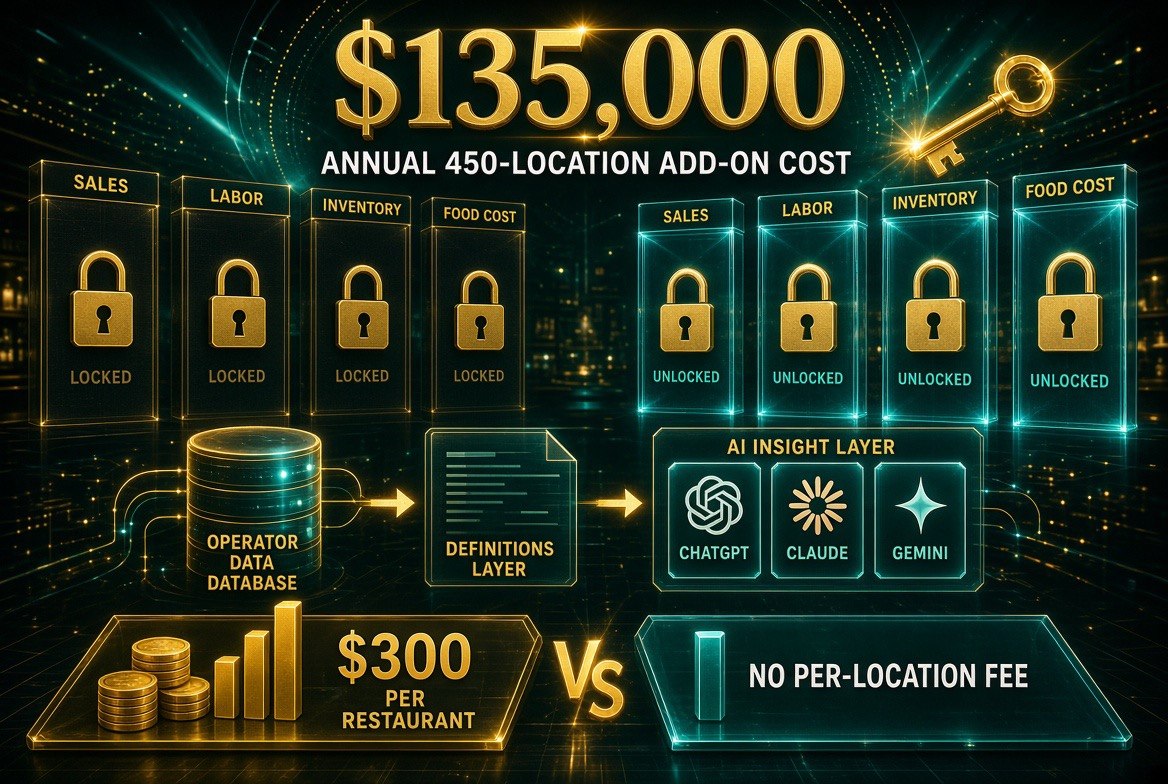
Locked data versus open semantic access: Decision Logic put the price of the alternative at roughly $135,000 a year for a 450-location group, against no per-location fee for open access.
What This Means If You Run Independent Restaurants
Here’s the honest framing up front: Open Semantic Access is built for operators with enough locations and enough data complexity that “combining exports from hundreds of restaurants” is a sentence that describes their actual Tuesday. If you run two locations and your weekly numbers live in a spreadsheet you built yourself, this product is not aimed at you.
The lesson is aimed at you. Hard.
Three things to take from it:
1. Ask the AI access question before you sign — not after
Your next POS, inventory, scheduling, or loyalty contract is going to arrive with an AI feature bolted on. Before you sign, get answers to these in writing:
- Can I get my own data out, in a format an outside AI tool can read?
- Do I get the definitions with it, or just the raw columns?
- Can I point ChatGPT or Claude at it, or only your built-in assistant?
- Is AI access included, or is it an add-on priced per location?
- What happens to my access if I leave?
That last one is the trap. Plenty of vendors will happily export your data on the way out — as an unstructured dump that no AI can interpret without you rebuilding the dictionary from scratch. The data technically leaves with you. Its usefulness doesn’t.
2. Price the per-location toll before you feel it
The $300-per-restaurant figure is illustrative, but the shape of it is not hypothetical. Per-location AI add-ons are becoming the default pricing motion in restaurant tech, because it aligns perfectly with how vendors want to grow: your expansion becomes their recurring revenue.
Do the math on your own footprint before you sign anything. If a proposed AI add-on runs $150 per location per month, a five-store operator is looking at $9,000 a year for a capability that may or may not change how they run the business. That is real money — roughly the cost of a part-time employee’s worth of hours — and it deserves the same scrutiny as any other line item.
3. Build the data dictionary once, and stop paying for it repeatedly
Whether or not you ever buy a platform that hands you semantics, you can build the equivalent yourself in an afternoon and it pays for years.
Write down, in plain language: what each of your key metrics means, how it’s calculated, which locations report it, and where it comes from. What counts as a sale. What counts as food cost. How you treat comps, voids, and discounts. What a “unit” is in each system.
Then attach that document to any AI conversation you have about your numbers. It’s the difference between an AI that guesses and an AI that knows. And it’s the exact asset Decision Logic is now selling as a feature — you can own it for the cost of one focused afternoon.
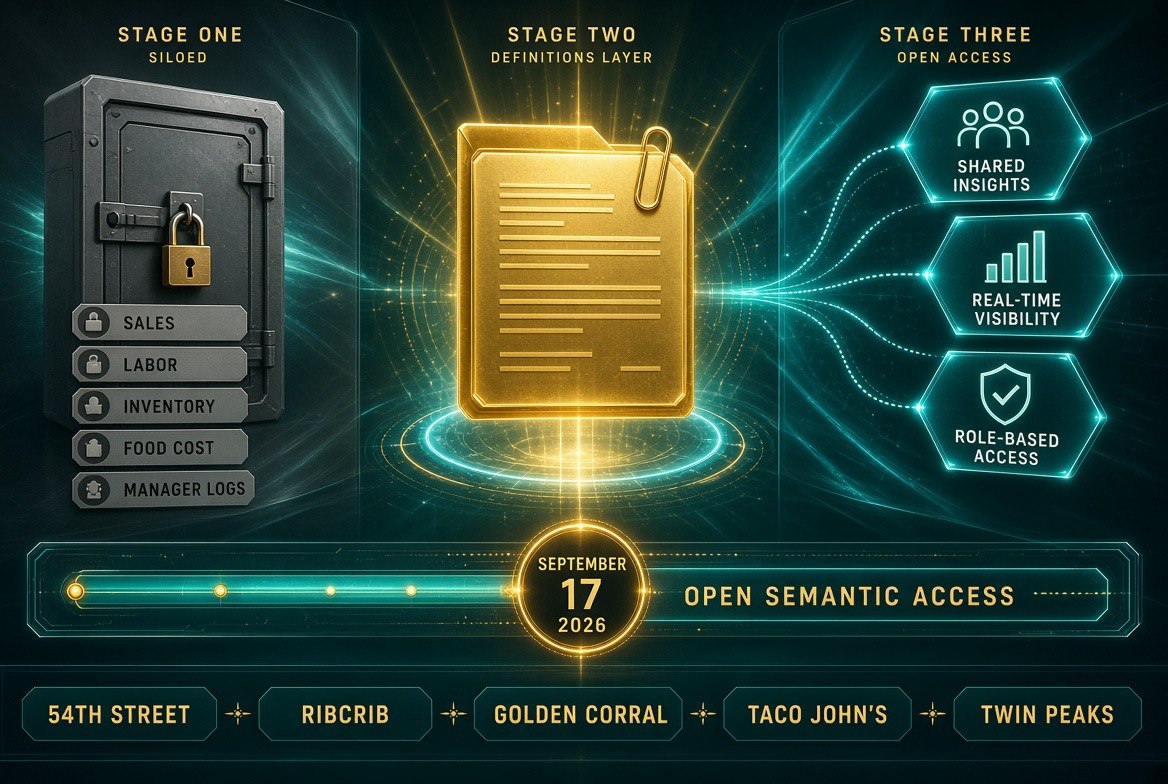
The move in three stages: siloed data, the definitions layer that gives it context, and open access dated September 17, 2026 — with Decision Logic’s multi-unit partner brands listed along the bottom.
The Bigger Fight This Represents
The restaurant technology industry spent the last two years shipping AI features into everything and the last twelve months discovering that operators don’t trust what they can’t verify. Now the ground is shifting to a different question: not “do you have AI?” but “whose AI, running on whose data, and who’s allowed to look?”
Under the closed model, the answer is the vendor’s. Your data goes in, insights come out, and the pipeline belongs to somebody else. You get the outputs they decided to build a dashboard for.
| Question to ask | Closed model answer | Open-access answer |
|---|---|---|
| Can I compare ideal vs. actual on one menu item? | Only if a report already exists | Ask the AI directly, on your own definitions |
| Can I build a menu margin view for my market? | Submit a request; wait weeks to months | Build it yourself with any tool you like |
| Can I investigate true guest traffic? | Depends on what’s on the dashboard | Query the underlying data and find out |
| Who owns the analysis pipeline? | The vendor | The operator |
The practical difference: under a closed model every new question becomes a project; under an open-access model it becomes a prompt. Both answers are drawn from Decision Logic’s own description of the workflow it replaces.
Under the open model, the pipeline is yours and the AI is a commodity you rent month to month. You can change your mind about which assistant you like without losing your history, your definitions, or your ability to ask the next question.
For independent operators, that portability is worth more than any single AI feature. Tools will churn fast over the next three years. Your data definitions won’t. Whoever holds those holds the leverage — and the entire point of Open Semantic Access is that the answer should be you.
One caution worth naming: read-only access with enterprise privacy standards is a meaningfully better posture than handing a vendor write access to your systems. But “read-only” is not the same as “risk-free.” You are still allowing an outside AI tool to process your sales, labor, and food cost data. Before you point any assistant at operating data, know where that data goes, whether it trains the model, and who on your team can see the outputs. Portability solves the lock-in problem. It does not solve the governance problem.
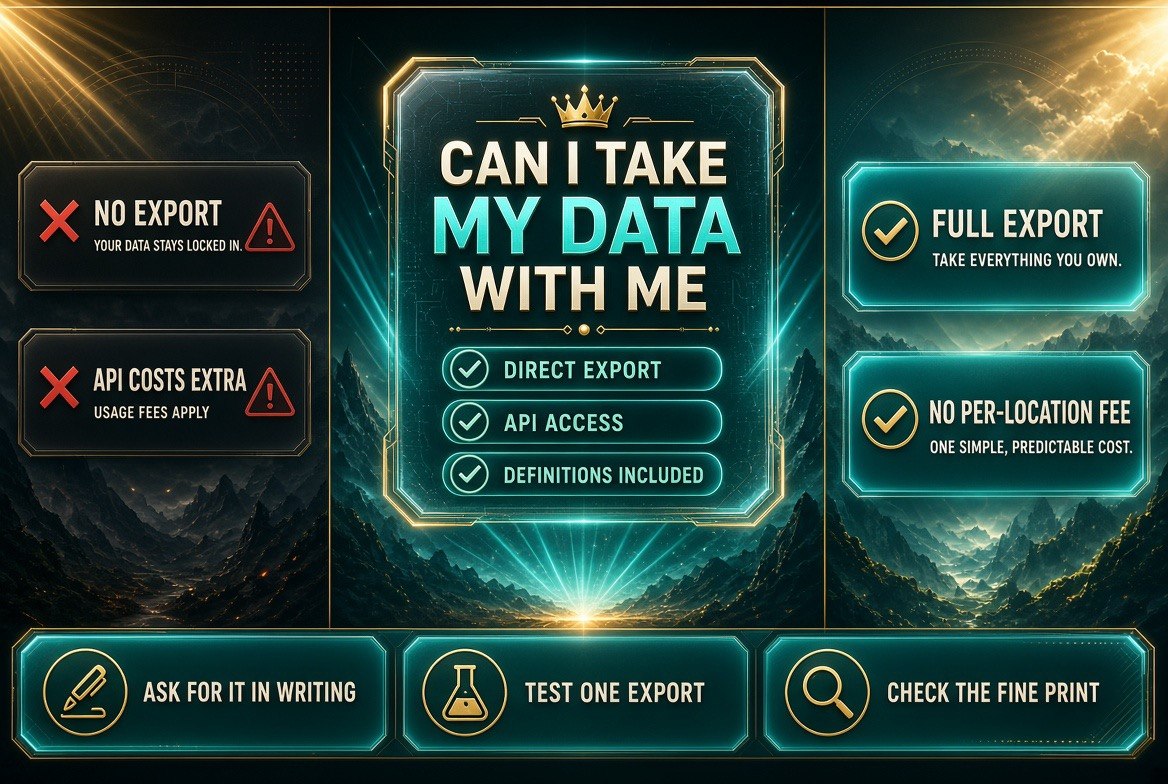
The question to put to any vendor this week: can you take your data with you? Export and API limits sit on one side, full export and no per-location fee on the other.
What to Do This Week
- Open your current contracts. Find the data export and add-on clauses. Note whether AI access is included, priced per location, or simply absent.
- Write your data dictionary. One page. Definitions, calculations, sources. This is the single highest-leverage AI asset an independent operator can own.
- Test the export. Pull your own data and feed it to an AI tool with your dictionary attached. See whether it can answer one genuinely useful question about your margin. If it can’t, you’ve just learned exactly what your vendor is charging for.
- Ask before renewal. If your vendor can’t give your data meaning to an outside AI, that is a real cost of staying — and it belongs in the renewal conversation, not in a footnote.
The restaurant AI conversation has moved past novelty. Operators are no longer impressed that a system can talk; they want to know whether it can think with their numbers, and whether they’ll still have access to those numbers when the next tool arrives. Decision Logic just made a bet that the answer should be yes, and that giving operators that answer is better business than charging them rent on their own data.
Whether or not you ever use their platform, that’s the standard to hold every vendor to from here on out.
Frequently Asked Questions
What is Open Semantic Access from Decision Logic?
It’s a capability launched September 17, 2026 that gives restaurant operators read-only access to their own operating data — sales, labor, inventory, and food cost — along with the definitions and context that explain what that data means. The point is that an outside AI tool can then interpret the data correctly instead of misreading it. It’s designed for multi-unit restaurant operators and is included at no additional charge, with no per-location fee.
Can I use ChatGPT or Claude on my restaurant data if I’m not a Decision Logic customer?
Technically yes, with caveats. Nothing stops you from exporting your own data and feeding it to an AI tool. What you’ll be missing is the semantics — the definitions that tell the AI whether a number is gross or net, or whether a unit is a case or an item. That missing context is exactly what causes AI to produce confident but wrong answers about restaurant margins. You can solve it manually by writing your own data dictionary, which is the practical workaround for operators on any platform.
Why is a per-location AI fee such a big deal for small restaurant groups?
Because it scales against you. Decision Logic’s illustrative example — an AI add-on at $300 per restaurant — works out to more than $135,000 a year for a 450-location organization, and the bill grows with every new opening. At the smaller end, an add-on at $150 per location per month costs a five-store operator about $9,000 a year. That’s a meaningful recurring expense for a capability whose return you may not be able to measure, and it’s worth pricing before you sign rather than after.
Is this an AI story or just a data-access feature?
It’s both, and the distinction matters. Open Semantic Access exists specifically because AI tools can’t reason about restaurant data without context. The entire feature is about making operating data legible to AI systems the operator chooses, rather than confining AI to a single vendor’s built-in assistant. Remove AI from the equation and there is no product — the semantic layer is only valuable because something downstream needs to interpret it. That’s what makes this a genuine restaurant-AI development rather than a generic data-export announcement.
Does read-only access make it safe to point AI at my operating data?
Read-only is a better posture than write access, and Decision Logic states that privacy standards are retained in the data their customers can access. But read-only is not the same as risk-free. You are still allowing an external AI tool to process your sales, labor, and food cost information. Before you do that, establish where the data goes, whether it’s used for model training, who on your staff can see outputs, and what your obligations are to any brand or franchise agreement you operate under. Data portability solves vendor lock-in. It doesn’t solve data governance.

About Barak Schurr
Barak Schurr built and exited a major ticketing platform, ran global operations at Eventbrite, and now focuses on one question: which AI tools actually help independent restaurant owners run leaner and grow faster. He writes from the operator’s perspective — no vendor spin, no theory, just what’s real in 2026.
Email: [email protected]
More Resources for Restaurant Operators