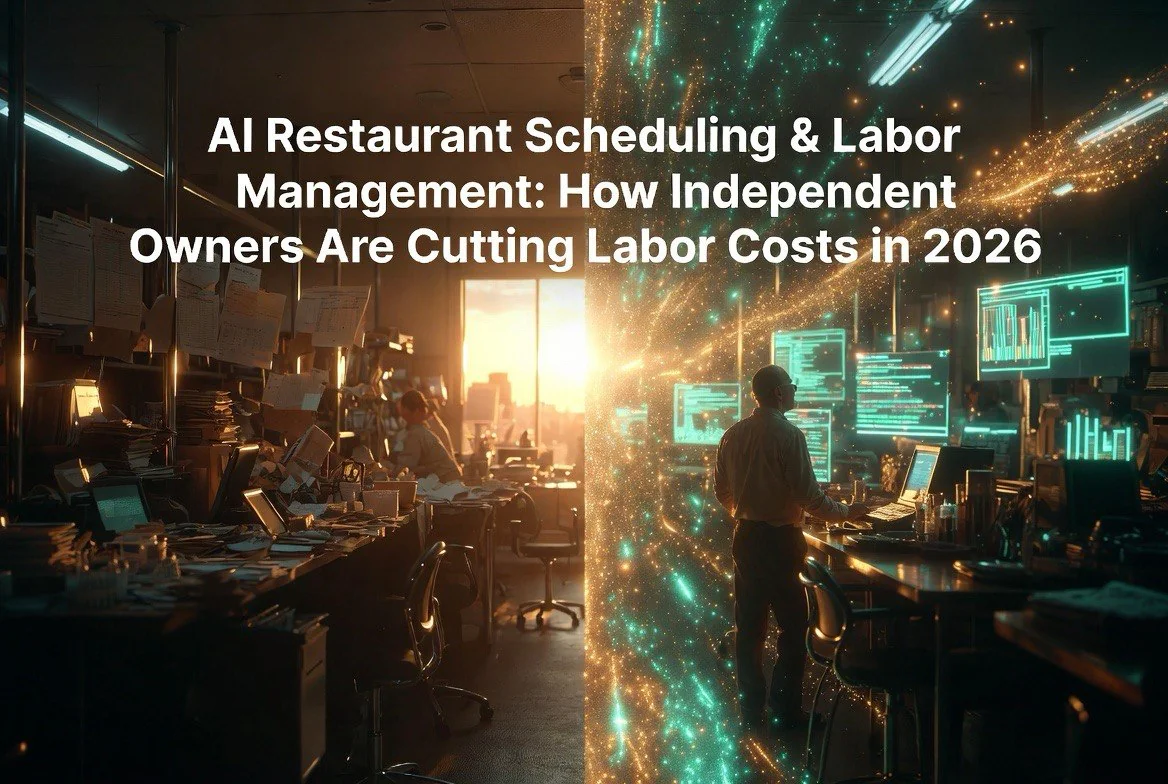
AI Restaurant Scheduling & Labor Management: Complete Guide (2026)
⚡ Expert Summary: Restaurant labor costs eat 30–35% of revenue — the single biggest expense outside food. AI scheduling, no-show prediction, automated hiring, and shift management tools are cutting labor costs by 18–25% across independent US restaurants. This guide covers every tool and strategy restaurant owners need in 2026, from ShiftAI to XShift to AI-powered hiring platforms.
If you run an independent restaurant in the United States, your labor cost is somewhere between 28% and 35% of revenue. That’s your single biggest controllable expense. And most operators are flying blind — scheduling by gut feel, reacting to no-shows at shift start, and losing money on every unfilled Friday night slot.
AI-powered labor management is not a future concept. It’s running in real restaurants right now, producing measurable results: 18% lower labor costs, 30% fewer no-shows, and fully automated scheduling that accounts for sales forecasts, employee availability, and wage compliance.
This guide pulls together everything we’ve covered on AI labor management for independent restaurants. Each section links to a deep-dive post with specific tool reviews, case studies, and step-by-step implementation guides.
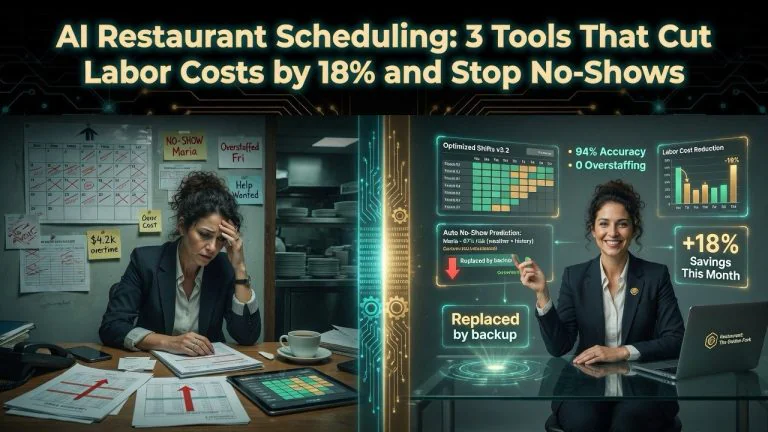
AI Shift Scheduling: Cut Labor Costs by 18%
The most immediate ROI in AI labor management is scheduling. Tools like ShiftAI and XShift AI replace manual scheduling spreadsheets with systems that predict optimal staffing levels based on historical sales data, weather forecasts, local events, and day-of-week patterns.
Independent operators using AI scheduling report cutting labor costs from 32% of revenue down to 26% within the first 90 days. The system stops overstaffing slow Tuesday nights and ensures you have enough coverage for Friday rushes — automatically.
→ Read the full guide: AI Shift Scheduling for Restaurants: Cut Labor Costs 2026 (Post 125)
→ XShift AI: How Automated Scheduling Fixes the Nightmare
→ ShiftAI Autonomous Restaurant Manager: Key Things to Know
AI No-Show Prediction: Stop 30% of Cancellations Before They Cost You
No-shows cost US restaurants an estimated $20 billion annually. For a single independent restaurant, that’s $5,000–$12,000 per year in lost revenue from empty tables. AI no-show predictors analyze booking history, party size, day of week, and even weather patterns to flag reservations at high risk of cancellation — giving you time to overbook strategically.
One 90-day deployment across 15 independent restaurants in Chicago showed a 30% reduction in no-shows with AI prediction models. The system ranks every reservation by cancellation risk and sends automated confirmation prompts to high-risk bookings.
→ AI No-Show Predictors: Cut Cancellations 30% in 90 Days
→ AI Scheduling Tools That Stop No-Shows
Automated Hiring: AI That Screens, Interviews, and Hires Staff
Restaurant hiring is broken — 75% turnover rate industry-wide, every open position costs $2,000–$5,000 in lost productivity, and managers spend 8–10 hours per week on hiring tasks. AI hiring platforms are now handling the entire pipeline: job description generation, resume screening, automated phone interviews, and skills assessment scheduling.
One startup raised $21M in 2026 specifically to automate restaurant hiring. The platform replaces the entire front-end of the hiring funnel — from posting the job to scheduling the first shift — with AI agents.
→ This AI Startup Raised $21M to Automate Restaurant Hiring
Restaurant Automation: What Walmart’s 15–50% Labor Cuts Teach Us
When Walmart announces it’s slashing 15–50% of labor hours through automation, every restaurant operator should pay attention. The retail giant is using AI scheduling, automated inventory management, and self-checkout systems to reduce its workforce. Independent restaurants can apply the same principles on a smaller scale — starting with AI scheduling and automated ordering systems that reduce the number of floor staff needed per shift.
→ Walmart Is Slashing 15–50% of Labor Hours — What Restaurants Can Steal
Robot Automation in Restaurants: Miso Robotics & What’s Next
Fully automated kitchens are no longer experimental — Miso Robotics acquired Zume Pizza’s IP in 2026, China has restaurants running on 10 robots with zero chefs, and automated fry stations are already deployed in US chain restaurants. For independent operators, the near-term play isn’t replacing cooks — it’s automating specific, high-waste stations (fryers, pizza prep, drink dispensing) to reduce labor dependency.
→ Miso Robotics Acquires Zume Pizza IP: What It Means for Restaurant Automation
→ What Restaurant Automation Means for Independent Operators
→ China’s Automated AI Restaurant: 10 Robots, Zero Chefs
How to Start Using AI Labor Management This Week
If you’re a busy operator and want to start seeing results immediately, here’s the shortest path:
- Audit your current labor cost percentage — pull last 90 days of sales and hours. If you’re above 30%, you have room for improvement.
- Replace manual scheduling with an AI scheduler — start with ShiftAI or XShift. Both offer free trials and take one afternoon to set up.
- Enable no-show prediction — if you use Toast, Toast IQ has this built in. If not, most AI scheduling tools include it.
- Automate one hiring step — set up AI screening for your next open position. One saved hiring cycle covers the annual tool cost.
- Track your labor cost monthly — watch it drop from 32% to 28% to 25% over 90 days.
FAQ
What percentage should restaurant labor cost be?
Industry standard is 28–35% of revenue. Fast casual typically runs 28–32%, full-service 30–35%. AI scheduling consistently drops this by 3–5 percentage points within 90 days.
How much do AI restaurant scheduling tools cost?
Most AI scheduling tools for independent restaurants run $79–$299 per month. At $299/month, if labor is 32% of $100,000 monthly revenue, an 18% reduction in labor cost saves $5,760/month — a 19x ROI on the tool cost alone.
Can AI really predict restaurant no-shows?
Yes. AI no-show predictors analyze booking patterns, party size, day of week, and weather data to flag high-risk reservations. Independent restaurants using these tools report 30% fewer no-shows within 90 days.
What’s the best AI scheduling tool for a single-location restaurant?
ShiftAI and XShift are the top picks for independent restaurants. Both offer single-location pricing, no long-term contracts, and integration with most POS systems including Toast and Square.
Will AI replace restaurant jobs?
In the near term (next 2–3 years), AI replaces scheduling, ordering, and hiring tasks — not cooks or servers. The goal is reducing labor cost from 32% to 25% of revenue, not eliminating the workforce entirely.

About Barak Schurr
Barak Schurr built and exited a major ticketing platform, ran global operations at Eventbrite, and now focuses on one question: which AI tools actually help independent restaurant owners run leaner and grow faster. He writes from the operator’s perspective — no vendor spin, no theory, just what’s real in 2026.
Email: [email protected]
More AI Resources