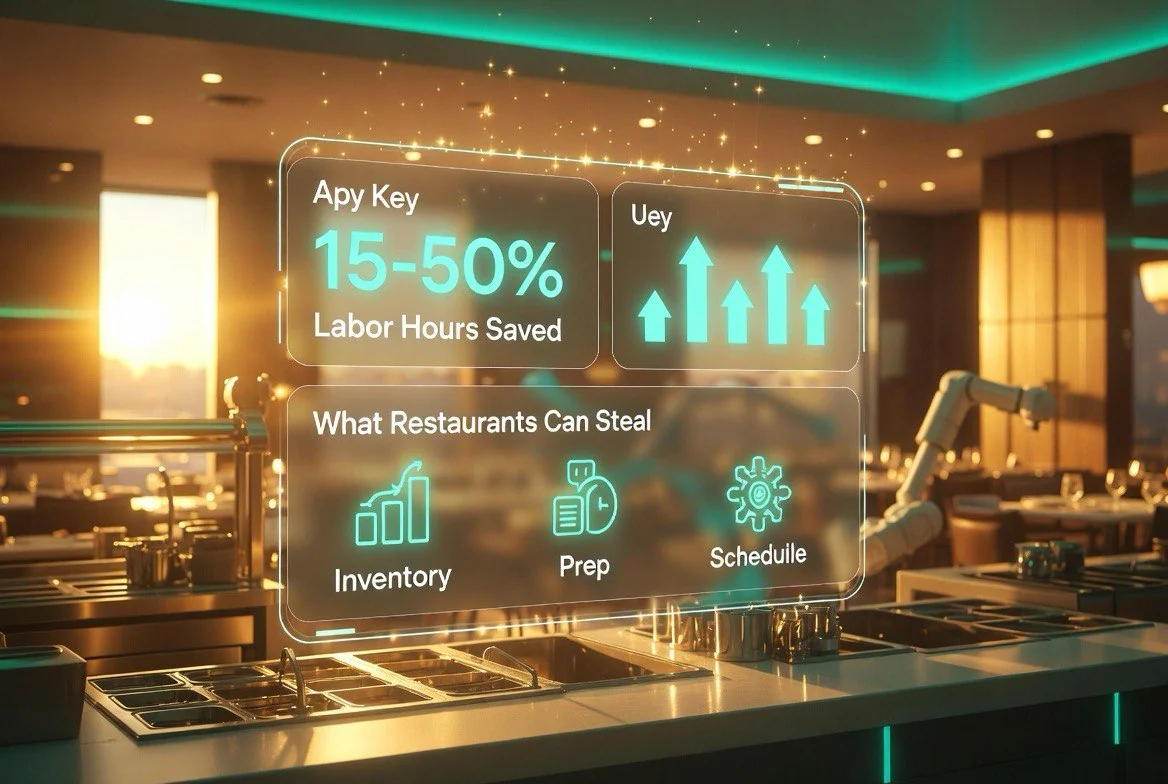
Walmart Is Slashing 15-50% of Labor Hours With Automation — What Restaurants Can Steal
⚡ Expert Summary: Walmart’s latest automation push is cutting 15-50% of labor hours across distribution, shelf scanning, and checkout. The retail giant is proving what restaurant operators have been told for years — automation reduces labor costs at scale. But the lessons for independent restaurants are not about robots. They are about where to automate and where to keep humans.
Retail is not restaurants. But when Walmart finds a way to cut labor hours by 50% in a department and service levels go up, independent operators should pay attention.
Walmart’s 2026 automation strategy update revealed that AI-powered systems across inventory management, shelf-scanning robots, and automated checkout are delivering 15-50% labor hour reductions depending on the department and deployment depth. The company reported that stores with the deepest automation integration saw customer satisfaction scores rise — not fall — because employees were redeployed to customer-facing roles rather than eliminated.
There is a direct through-line to independent restaurants, and it does not start with buying a robot.
What Walmart Actually Did
Walmart’s automation story is not about replacing cashiers with kiosks. That is 2023 thinking. In 2026, Walmart is running automation on three layers:
- Back-end inventory AI (30-50% labor reduction): Computer vision systems track shelf stock in real time, generate automated replenishment orders, and route staff only to areas that need attention. Shelf-scanning robots handle the counting humans used to do manually.
- Checkout optimization (15-25% labor reduction): AI predicts checkout demand by hour and reallocates staff between traditional lanes and self-checkout. Peak coverage improves while off-peak labor drops.
- Distribution and logistics (25-40% labor reduction): AI routing and predictive demand planning reduce the number of human touches between warehouse and shelf.
Walmart projects that full deployment across its US store network will save approximately $2 billion annually in labor costs by 2028 — without reducing total headcount. The key number is not the cost savings. It is that headcount stayed flat because redeployed employees handled higher-value work.
The Restaurant Parallel: Labor Is Not Going Away — It Is Moving
The restaurant industry is facing the same structural pressure. Labor costs at 28-35% of revenue. Turnover rates above 70% for hourly staff. Fewer young workers entering the industry. The National Restaurant Association’s 2026 State of the Industry report found that 26% of operators now use AI, up from 18% in 2025, but most deployments are in customer-facing tools rather than the back-end automation that delivers Walmart-scale labor savings.
Here is what independent operators can steal from Walmart’s playbook without a nine-figure automation budget.
The Automation Hierarchy: Where Restaurants Should Start
Walmart’s $2 billion savings projection did not come from a single automation initiative. It came from a stacked approach where each layer of automation built on the previous one. Restaurants can replicate this with a clear hierarchy.
Level 1 — Data collection (0% labor reduction, prerequisite): Before any automation works, the restaurant needs clean data. POS data, inventory counts, labor hours, and sales history must be digitized and accessible. This is not automation — it is hygiene. Most independent operators skip this step and wonder why AI tools produce unreliable predictions. Walmart spent years cleaning data before layering AI on top of it.
Level 2 — Visibility (5-10% labor reduction): Once the data is clean, real-time dashboards give managers visibility into inventory levels, labor costs, and sales trends. This alone reduces labor because managers stop spending time gathering data from multiple sources. One screen replaces 30 minutes of clipboard walking and spreadsheet filling per shift.
Level 3 — Prediction (10-20% labor reduction): AI models that forecast demand, inventory needs, and labor requirements produce recommendations that managers act on. This is where the first meaningful labor savings appear. The manager is not replaced — but they spend less time predicting and more time executing.
Level 4 — Automation (15-50% labor reduction): At the top of the hierarchy, systems act on their own predictions — automated purchase orders, auto-generated schedules, self-optimizing cook times. This is Walmart’s current state. It requires that all lower levels are stable first.
The mistake most restaurant operators make is attempting Level 4 without Levels 1-3 in place. Buying a voice AI system for phone ordering when inventory is still tracked on a clipboard is the restaurant equivalent of Walmart installing shelf-scanning robots before digitizing its inventory database. The technology is not the problem. The foundation is.
Three Restaurant Automation Plays That Mirror Walmart’s Strategy
1. Automated Inventory Management (Target: 15-25% Labor Reduction)
Walmart’s shelf-scanning robots are overkill for a 60-seat restaurant. But AI inventory tools from providers like XtraCHEF and MarketMan connect to your POS and automate counting, ordering, and waste tracking. The labor savings come from eliminating manual inventory counts — typically 4-8 hours per week for a busy independent. At $15-20/hour, that is $3,000-8,000 in annual savings for a tool that costs a fraction of that.
Multiple case studies from Restaurant365 show operators cutting 4-6 hours of weekly manual inventory labor per location after deployment. That is not a robot. That is a spreadsheet connected to a scale. The principle is the same as Walmart’s: automate the counting, reallocate the human.
2. Demand-Driven Scheduling (Target: 4-7% Labor Cost Reduction)
Walmart’s checkout optimization uses AI to predict traffic and allocate staff accordingly. Restaurants can do the same with tools like 7shifts or Schedulefly that include AI-powered demand forecasting. The Popmenu 2026 Restaurant AI Survey found that operators using AI scheduling cut overtime costs by an average of 22% in the first quarter of deployment.
The labor savings here are not about cutting staff. They are about having the right number of people at the right time. Walmart proved that automating the schedule — not the task — produces the biggest labor efficiency gains.
3. Kitchen Display System Optimization (Target: 10-20% Throughput Improvement)
Walmart does not run restaurants, but its automation philosophy applies to kitchens: organize work around data, not intuition. AI-enhanced KDS systems like those from SpotOn and Toast use historical ticket data to predict when the rush will hit and automatically adjust prep schedules. The result is not labor reduction — it is labor efficiency, which translates to fewer overtime hours and higher table turns during peak periods.
What Walmart Teaches About Automation in US Restaurants
Walmart’s lesson is not that automation replaces people. It is that automation redeploys them. The company’s own data shows that stores with the highest automation density also have the highest employee retention rates — because staff spend less time doing boring, repetitive work and more time doing tasks that require human judgment.
For American restaurant operators, the application is direct. Independent owners often fear that AI and automation will make service feel cold or impersonal. Walmart’s counter-evidence is compelling: customers rated automated stores higher on service quality because employees who had been freed from counting inventory and scanning shelves were actually interacting with customers.
When a host who used to spend 20 minutes per shift counting inventory has 20 minutes to check on tables? That is not a tech story. That is a service story.
Frequently Asked Questions About Restaurant Automation
Can small restaurants afford automation like Walmart uses?
Yes — but not the same tools. Independent operators should focus on AI inventory management ($50-150/month) and AI scheduling tools ($30-80/month) rather than robotics. Walmart-scale automation starts at millions. Restaurant-scale automation starts at a monthly subscription.
Does automation reduce restaurant jobs?
Walmart’s experience shows that automation redeploys jobs rather than eliminating them. In restaurants, AI inventory and scheduling tools typically reduce administrative labor (counting, scheduling, ordering) while maintaining or increasing front-of-house staffing for service.
What is the cheapest automation a restaurant can implement?
AI-powered scheduling is the lowest-cost, highest-impact automation for most independent restaurants. Tools like 7shifts with AI features start under $50/month and show measurable labor savings within the first pay period.

About Barak Schurr
Barak Schurr built and exited a major ticketing platform, ran global operations at Eventbrite, and now focuses on one question: which AI tools actually help independent restaurant owners run leaner and grow faster. He writes from the operator’s perspective — no vendor spin, no theory, just what’s real in 2026.
Email: [email protected]
More on AI Restaurant Labor Management
This post is part of our comprehensive AI Restaurant Scheduling & Labor Management Guide. Check the full guide for AI scheduling tools, no-show prediction, automated hiring, and automation strategies for independent restaurants.
More AI Resources