73% of Restaurant Operators Invest in AI — Only 29% See ROI. Here Is the Fix.
⚡ Expert Summary: New data from PAR Technology and Point-of-Sale surveys shows 73% of restaurant operators are investing in AI tools, but only 29% report measurable ROI. The gap is not because AI fails in restaurants — it is because operators are buying the wrong tools first. Here is where independent owners should deploy AI dollars for actual returns.
If you own an independent restaurant and you are not investing in AI, you are in the minority. And if you are investing and seeing the returns you expected, you are an even smaller minority.
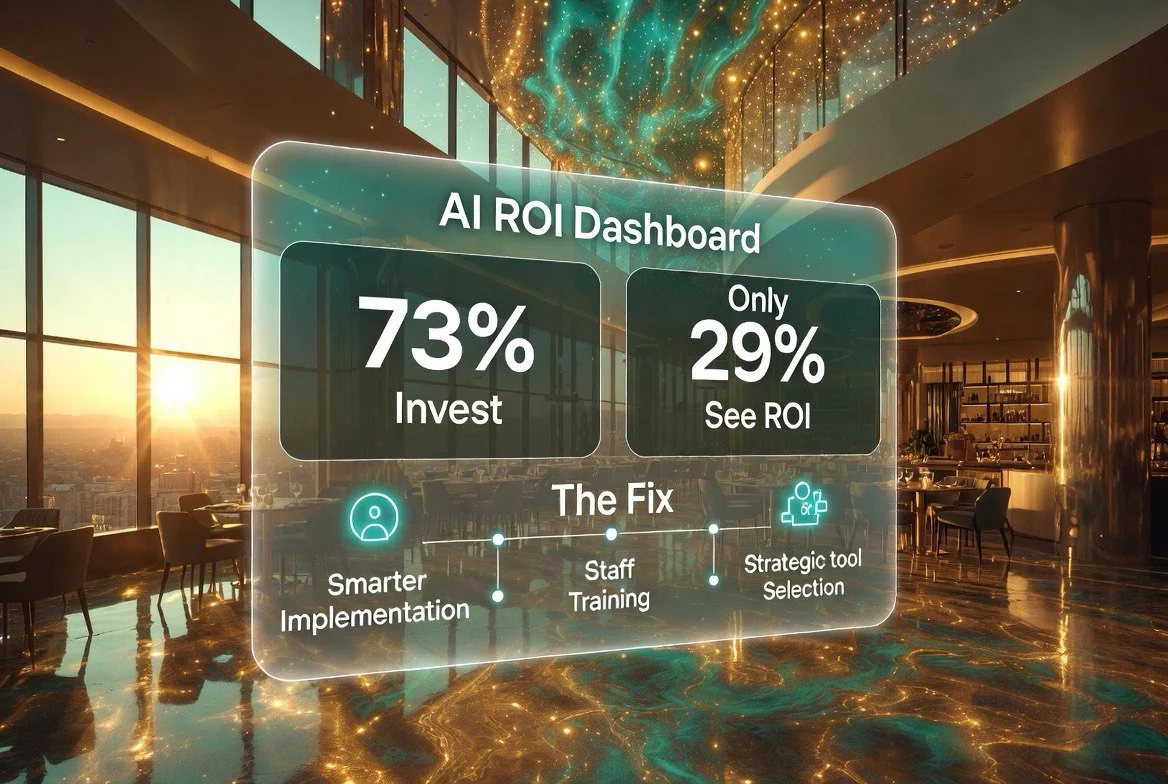
PAR Technology’s 2026 Restaurant AI Adoption Survey, combined with Point-of-Sale industry data, reveals a startling gap: 73% of US restaurant operators have invested in AI-powered tools, but only 29% can point to measurable ROI. That 44-point gap between investment and return is the single biggest problem in restaurant technology today.
Where the Money Is Going vs. Where It Should Go
The PAR survey breaks down where operators are spending their AI budgets:
- Kiosks and self-service (38%): The biggest category — QSRs and fast-casual leading
- Voice AI for drive-thru/phone (31%): SoundHound, Presto, OpenSpan deployments
- Inventory management (27%): Predictive ordering and waste tracking
- Labor scheduling (22%): AI-driven shift optimization and demand forecasting
- Marketing and loyalty (18%): Hyper-personalization and automated campaigns
Here is the problem with that distribution: the two categories with the highest spend — kiosks and voice AI — are also the ones with the longest payback periods and the highest integration complexity for independent operators. Meanwhile, the categories with the fastest ROI — inventory management and labor scheduling — are getting less than half the investment.
The ROI Disconnect: Why 71% of Operators Cannot Show Returns
The 29% who see ROI share a pattern that the 71% do not. They deployed AI in cost centers first — areas where a percentage improvement translates directly to dollars saved — rather than revenue centers where results are harder to isolate.
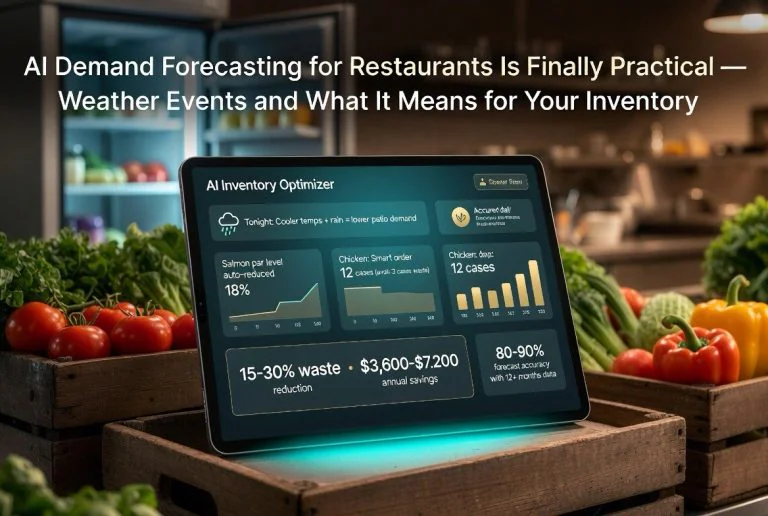
Inventory AI delivers ROI in weeks, not months. Predictive ordering systems that adjust stock levels based on historical data, weather patterns, and local event calendars cut food waste by 22-35% across multiple deployment case studies. For a restaurant with $800,000 in annual food cost, a 25% waste reduction saves $40,000-50,000 per year. That is a line item you can see on your P&L.
Labor scheduling AI delivers ROI in the first pay period. Demand forecasting that accounts for day-of-week, seasonality, and local events produces schedules that match labor to covers more precisely. The Restaurant365 2026 State of AI Report found that operators using AI scheduling saw average labor cost reductions of 4-7% — without cutting service quality.
Voice AI and kiosks need volume to pay off. These tools require a baseline transaction volume that independent restaurants often do not hit, especially outside peak hours. For a busy QSR doing 1,000+ transactions per day, drive-thru voice AI can cut labor seconds per order and improve throughput. For a 60-seat independent doing 150 covers per night, the math does not work the same way.
The Real Cost of Buying AI in the Wrong Order
To understand why 71% of operators cannot show ROI, it helps to trace what happens when a restaurant buys a voice AI system before fixing inventory. The scenario is common enough that PAR documented it as a case study in their survey data.
A 120-seat American independent restaurant spends $800/month on a voice AI phone ordering system. The system answers calls, takes reservations, and handles basic order inquiries. The owner expects it to reduce front-of-house labor by 10-15 hours per week. After 90 days, the actual labor reduction is 5 hours per week — not enough to cover the $800 monthly cost plus the $2,000 setup fee. The owner is now $4,400 into a deployment with no ROI in sight.
The same restaurant has a food cost of 32% of revenue, roughly $280,000 annually. Industry benchmarks show that independent operators with manual inventory processes typically have 5-8% waste — meaning $14,000-22,000 in food that is purchased and discarded. An AI inventory tool at $100/month, deployed for one year at $1,200 total, would cut waste by 22-35%, saving $3,080-7,700 annually. That is a 250-640% ROI in year one — and the owner spent the money on voice AI instead.
This is the arithmetic that explains the PAR survey results. The 71% who cannot show ROI are not unlucky. They deployed the wrong tool first. And that single decision cascades into the data that says “AI does not work for restaurants” — when the reality is that the deployment order was wrong, not the technology.
The 3-Step ROI Fix for Independent Operators
If you are an independent restaurant owner reading the 73% investment / 29% ROI numbers and recognizing yourself in the 71%, here is the fix:
Step 1: Start with food cost. Get an AI inventory tool that connects to your POS and generates purchase orders based on actual usage, not par levels you set six months ago. This is the highest-ROI, lowest-friction AI deployment a restaurant can make. ROI is measurable within 60 days.
Step 2: Fix labor before you fix marketing. AI scheduling tools are mature, cheap, and proven. Deployment takes one to two weeks. The impact appears on the first payroll run. Do not spend on AI marketing or loyalty tools until you have the labor line item under control.
Step 3: Only then — deploy customer-facing AI. Once your cost centers are optimized, the margin you free up funds the customer-facing tools — voice AI for phones, AI-driven loyalty, automated marketing. At this point, you are funding growth tools with savings, not gambling operating capital on promises.
Why AI ROI Feels Lower in Restaurants Than in Retail
The restaurant industry has a measurement problem that makes the ROI gap look worse than it is. In retail or e-commerce, AI metrics are straightforward: conversion rate lift, average order value increase, cart abandonment reduction. These are tracked by platforms the business already uses.
In restaurants, the metrics are harder to isolate. Reduced food waste shows up in the P&L as a lower cost of goods sold — but unless you are tracking COGS monthly with a dedicated tool, the improvement is invisible. Labor savings from AI scheduling show up as lower overtime spend — but only if you are comparing payroll runs with and without the tool, which most operators do not do.
The 29% who see ROI are not deploying better AI. They are deploying any AI with a measurement system attached. The 71% who cannot show returns are using tools that work but tracking nothing. The tools are not the variable. The measurement discipline is.
Why US Independent Operators Are Facing an AI Accountability Crisis
The 73% investment rate proves that independent operators are not hesitating — they are buying. The 29% ROI rate proves they are not buying in the right order.
This is not a technology failure. AI inventory tools work. AI scheduling tools work. Voice AI works at scale. The failure is deployment sequencing. Operators are buying the shiny tools — the voice AI that answers phones, the kiosk that takes orders — before they automate the unsexy back-office functions that actually pay the bills.
The Popmenu 2026 Restaurant AI Survey found that 44% of US restaurants now use AI in some form — up from 26% the year before — but the ROI gap is not narrowing. More tools are arriving, but deployment discipline is not keeping pace.
For independent operators in 2026, the competitive advantage is not having more AI. It is having the right AI, deployed in the right order, measured against the right metrics. The 29% who found the formula are not smarter. They just started with the bottom line.
Frequently Asked Questions About AI ROI for Restaurants
What is the fastest ROI for AI in a restaurant?
Inventory management AI consistently delivers the fastest ROI — typically within 60-90 days — by reducing food waste 22-35%. Labor scheduling AI follows closely with measurable savings in the first pay period.
What percentage of restaurants use AI in 2026?
PAR Technology and the Popmenu survey estimate that 44% of US restaurants now use AI tools, up from 26% in 2025. Among larger operators and chains, the number exceeds 70%.
Why do most restaurants not see AI ROI?
Operators are deploying AI in customer-facing tools (kiosks, voice AI) before automating cost centers (inventory, labor). The PAR survey shows ROI jumps when operators deploy in the reverse order — cost optimization first, customer tools second.

About Barak Schurr
Barak Schurr built and exited a major ticketing platform, ran global operations at Eventbrite, and now focuses on one question: which AI tools actually help independent restaurant owners run leaner and grow faster. He writes from the operator’s perspective — no vendor spin, no theory, just what’s real in 2026.
Email: [email protected]
More AI Resources