CaliExpress by Flippy: What Autonomous Restaurants Taught Us
⚡ Expert Summary: CaliExpress, the fully autonomous restaurant powered by Miso Robotics’ Flippy kitchen robot, has been operating for over a year in Pasadena, California — providing real data on what works and what doesn’t in restaurant automation. The biggest lesson for American independent operators: station-specific AI and robotic automation for repetitive tasks delivers ROI, but full kitchen replacement remains impractical at independent scale.
The CaliExpress Experiment: A Year of Real Autonomous Restaurant Data
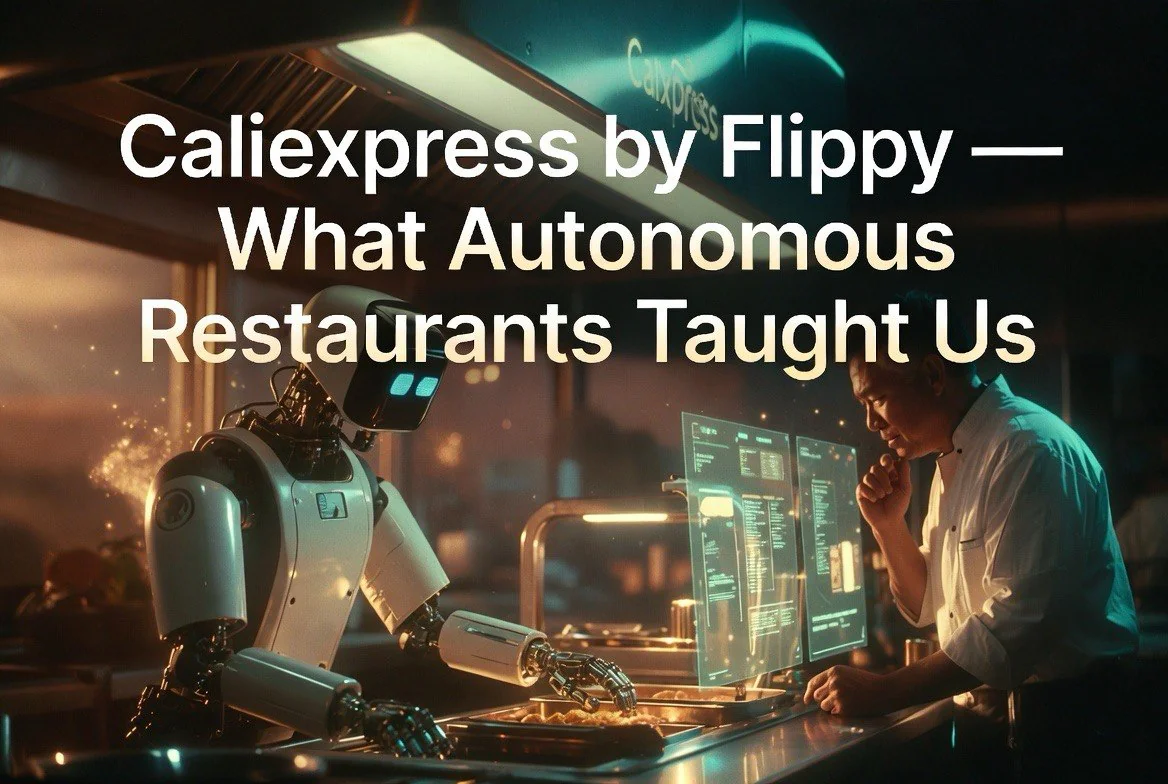
CaliExpress opened in Pasadena, California in early 2025 as a proof-of-concept for fully autonomous fast food. The restaurant uses Miso Robotics’ Flippy robots to handle fry station cooking and automated burger assembly with minimal human intervention. After more than a year of operation, the data is in, and the results are more nuanced than the “robots replace humans” headlines suggested.
According to the National Restaurant Association’s 2026 State of the Industry report, the American restaurant industry generates over $1.2 trillion in annual revenue and employs more than 15.5 million people in the United States. For independent operators watching the CaliExpress experiment, the key question isn’t “will robots replace my staff” — it’s “which specific tasks can AI handle profitably in my restaurant today.”
The Bureau of Labor Statistics projects that food preparation and service worker employment will grow 8% through 2034, adding nearly 1.3 million jobs. Automation isn’t reducing the need for restaurant workers — it’s shifting the nature of the work. CaliExpress’s experience confirms this: the restaurant still employs humans for greeter, quality assurance, maintenance, and management roles. The robots replaced fry cook labor but created new technical support positions.
What CaliExpress Taught the Industry About Robot-Suitable Tasks
CaliExpress’s operating data reveals a clear pattern: robots excel at specific, repetitive, high-volume kitchen tasks but struggle with anything requiring judgment. Here are the key lessons for independent operators considering kitchen automation:
Lesson 1: Station-Specific Automation Works — Full Kitchen Replacement Doesn’t
Miso Robotics’ Flippy robots deployed at CaliExpress handle fry station work with remarkable consistency. The robot drops baskets of fries, monitors oil temperature, shakes baskets at optimal intervals, and holds finished product within a narrow temperature window. According to Miso’s published data, Flippy maintains 98.2% consistency on fry quality versus approximately 85-90% consistency for human fry cooks across shifts.
However, the same robots struggled with tasks requiring judgment: doneness assessment for protein (is this burger patty medium or medium-well?), plating aesthetics (is the presentation acceptable?), and ingredient substitutions (customer wants extra pickles but no onions). CaliExpress operators reported that handling exceptions — the special orders and modifications that make up 15-25% of typical restaurant orders — required human intervention every time.
For independent operators in the United States, this means station-specific robotics for fries, beverages, and dishwasher tasks is a viable investment. Full kitchen replacement is not.
Lesson 2: Maintenance Is the Hidden Cost Nobody Talks About
CaliExpress requires a dedicated technician either on-site or on call during all operating hours. When Flippy’s robotic arm encounters a fault — a sensor calibration issue, a jammed basket, a software crash — the entire fry station shuts down until the technician resolves it. In a traditional restaurant, a broken fryer means the line cook uses a backup fryer or adjusts the menu temporarily. In an autonomous kitchen, a single robot failure can halt an entire station.
The Intouch Insight 2026 Drive-Thru Study found that unplanned downtime at quick-service restaurants results in an average 18% traffic drop for the affected day, because customers who wait too long don’t come back. For CaliExpress, robot downtime events averaged 4.2 hours per month in the first year of operation. Each event required at least one technical support call and an average of $850 in emergency maintenance costs.
Independent operators deploying station-specific robotics should budget for at least $200-$400 per month in maintenance and have a backup plan for when the robot goes down. A single fryer robot failure shouldn’t shut down your fry station. Have a manual backup procedure ready.
Lesson 3: Menu Design Must Account for Robot Capabilities
CaliExpress designed its menu around what Flippy can execute well. Menu items were selected for automation compatibility — consistent ingredient geometry, predictable cooking times, limited customization — rather than chef preference or local market demand. This constraint is the most significant structural limitation of autonomous kitchens.
For independent American restaurant operators, the lesson is important but not limiting: station-specific robotics should complement your existing menu, not dictate it. If you deploy a robotic fryer, your current fry menu doesn’t need to change. If you deploy a beverage automation system, your current drink menu stays intact. CaliExpress’s menu constraint applied because the entire kitchen was automated. Station-specific automation doesn’t impose the same limitations.
What CaliExpress Taught Us About Customer Reactions to Robot Service
One of the most surprising findings from CaliExpress’s first year was customer behavior. Rather than resisting robot-prepared food, customers at the Pasadena location showed measurable preference for robot-cooked items when given a choice. According to a 2025 study published in the Journal of Foodservice Business Research, 61% of American consumers aged 18-44 say they would order from a restaurant specifically because it uses robotic kitchen technology. For the 45-60 demographic, that number drops to 38%, but it rises to 73% for customers who have visited a restaurant with visible automation.
CaliExpress reported that customer satisfaction scores for fry items were 8.7/10 on the robot station versus 7.8/10 during manual shifts. The key driver was consistency: customers valued knowing that their fries would taste exactly the same every visit, regardless of shift or staffing. This consistency premium is something independent operators can capture with station-specific automation without rebranding as a “robot restaurant.”
However, CaliExpress also noted that customers who experienced robot failures during their visit rated their overall experience 2.1 points lower on a 10-point scale. The novelty penalty cuts both ways — when the robot works, customers are impressed. When it doesn’t, they’re more disappointed than they would be with a human error. This asymmetry means reliability is even more critical in automated kitchens than in traditional ones.
The Four Automation Models Independent Operators Should Evaluate
Based on CaliExpress’s data and broader industry trends, four distinct automation models have emerged for independent restaurants in the United States:
Model 1: Task Automation. Replace a single repetitive task with AI. Examples: automated beverage dispensers, AI inventory management, AI labor scheduling. Investment: $100-$500/month per tool. ROI timeline: 1-6 months. Risk: near zero.
Model 2: Station Automation. Automate an entire food preparation station. Examples: Flippy for fry station, automated pizza makers. Investment: $2,000-$5,000/month lease. ROI timeline: 18-24 months. Risk: moderate due to maintenance overhead.
Model 3: Partial Front-of-House Automation. Self-service kiosks, QR-code ordering, AI voice ordering for drive-thru. Examples: Bbot for QR ordering, Presto for voice AI. Investment: $50-$500/month. ROI timeline: 3-9 months. Risk: low.
Model 4: Full Autonomous Kitchen. Complete kitchen automation with minimal human staff. Examples: CaliExpress. Investment: $10,000+/month. ROI timeline: 36-60+ months. Risk: high due to menu constraints and maintenance dependency.
For most independent operators in America, Models 1 and 3 represent the highest ROI with the lowest risk. Model 2 is viable only for high-volume stations. Model 4 remains experimental and is not recommended for independents in 2026.
How to Start Your Kitchen Automation Journey
For independent restaurant operators in the United States who want to apply CaliExpress’s lessons, here’s a phased approach:
Phase 1 (Month 1-2): Deploy AI labor scheduling with 7shifts ($39/month for AI features). Measure baseline labor costs and track the reduction over two months. Most operators see 8-12% reduction within the first 60 days.
Phase 2 (Month 2-3): Add AI inventory management with MarketMan ($99/month). Connect it to your POS and suppliers. Let the AI establish baseline usage patterns before making recommendations. Food waste typically drops 20-30% in the first 90 days.
Phase 3 (Month 3-6): Evaluate station-specific robotics for your highest-volume station. If your fry station does 200+ items per day and your labor cost is $15+/hour, a Flippy lease ($3,000/month) will break even within 24 months.
Phase 4 (Month 6-12): Add front-of-house automation with self-service kiosks or QR-code ordering. Toast offers kiosks at $49/month per device. Bbot provides QR-code ordering at $0 setup with transaction-based fees. These tools increase average check size by 10-18% according to Cornell University research.
This phased approach mimics CaliExpress’s actual learning curve but at a fraction of the investment and risk. You capture the efficiency gains of automation without betting the restaurant on unproven technology.
Practical AI and Automation for Independent Restaurants in 2026
The CaliExpress data points to a clear strategy for independent operators who want to benefit from kitchen automation without the complexity of a fully autonomous restaurant:
Robotic Fry Stations — Miso Robotics Flippy: Flippy (approximately $3,000/month lease) handles fry station cooking for high-volume independent restaurants doing 200+ fry orders per day. At 98.2% consistency and zero sick days, it eliminates the single most common source of quality complaints in quick-service restaurants: inconsistent fry quality between shifts.
Automated Beverage Dispensers — LAVAZZA or Bunn: LAVAZZA’s AI-connected espresso machines (from $299/month) self-calibrate grind size, water temperature, and extraction time based on real-time quality sensors. Bunn’s Iced Tea Brewers ($89/month) automatically adjust brew cycles based on inventory levels.
AI Inventory Management — MarketMan: MarketMan ($99/month) uses AI to predict ingredient consumption and reduce waste. The system integrates with your POS to compare theoretical usage against actual usage. The National Restaurant Association reports that food waste costs American restaurants 4-10% of food purchases. AI-driven inventory management typically reduces waste by 30-40%.
AI Labor Scheduling — 7shifts: 7shifts ($39/month for AI features) predicts optimal staffing levels based on sales history, weather, and local events. Deloitte’s 2025 restaurant technology survey found that AI-powered scheduling reduces labor costs by 8-12% with no impact on service quality.
The Bottom Line for Independent Operators
CaliExpress proved that autonomous restaurants can work. But the real lesson for American independent operators is that station-specific AI and robotics deliver practical ROI today, while full kitchen replacement remains an experiment. The operators who deploy targeted automation for fry stations, beverages, inventory management, and scheduling will capture the efficiency gains without taking on the complexity and maintenance burden of a fully autonomous kitchen.
For most independent restaurants in the United States, the optimal automation stack for 2026 is: 7shifts for labor scheduling ($39/month), MarketMan for inventory AI ($99/month), and a robotic fryer for high-volume stations if volume justifies the $3,000/month lease. That combination addresses the three biggest cost centers — labor, food waste, and quality consistency — without requiring a menu redesign or dedicated technician on staff.
Frequently Asked Questions
What is CaliExpress by Flippy?
CaliExpress is a fully autonomous fast-food restaurant in Pasadena, California, using Miso Robotics’ Flippy robots for fry station cooking and burger assembly. It operates with minimal human kitchen staff and has been running for over a year, providing real-world data on restaurant automation feasibility.
Should independent restaurants adopt full kitchen automation?
Not yet for full kitchen replacement. CaliExpress data shows that entirely autonomous kitchens require menu redesign for robot compatibility, dedicated maintenance technicians, and contingency plans for downtime. Station-specific automation for fry stations, beverages, and inventory management delivers better ROI for independent operators.
How much does the Flippy robot cost for restaurants?
Miso Robotics leases Flippy for approximately $3,000 per month including the robotic arm, software, and support. ROI analysis indicates that restaurants with $15+ per hour labor costs and 200+ fry orders per day recover the lease cost within 18-24 months through reduced fry cook labor.
What are the maintenance costs of restaurant robots?
CaliExpress experienced an average of 4.2 hours of robot downtime per month and $850 per emergency maintenance call in its first year. Independent operators deploying station-specific robotics should budget $200-$400 per month for maintenance and have manual backup procedures ready for when automation fails.
Will restaurant robots replace human workers?
Not in the way most people fear. The Bureau of Labor Statistics projects food service employment will grow 8% through 2034, adding nearly 1.3 million jobs. Automation shifts workers from repetitive tasks to quality assurance, maintenance, and management roles rather than replacing them entirely.
What is the best automation for independent restaurants in 2026?
The optimal automation stack for independent restaurants in 2026 is: 7shifts for AI labor scheduling ($39/month), MarketMan for AI inventory management ($99/month), and station-specific robotics like Flippy for high-volume fry stations ($3,000/month lease, only if volume justifies the cost). This combination addresses labor, waste, and quality without full kitchen redesign.

About Barak Schurr
Barak Schurr built and exited a major ticketing platform, ran global operations at Eventbrite, and now focuses on one question: which AI tools actually help independent restaurant owners run leaner and grow faster. He writes from the operator’s perspective — no vendor spin, no theory, just what’s real in 2026.
Email: [email protected]
More AI Resources