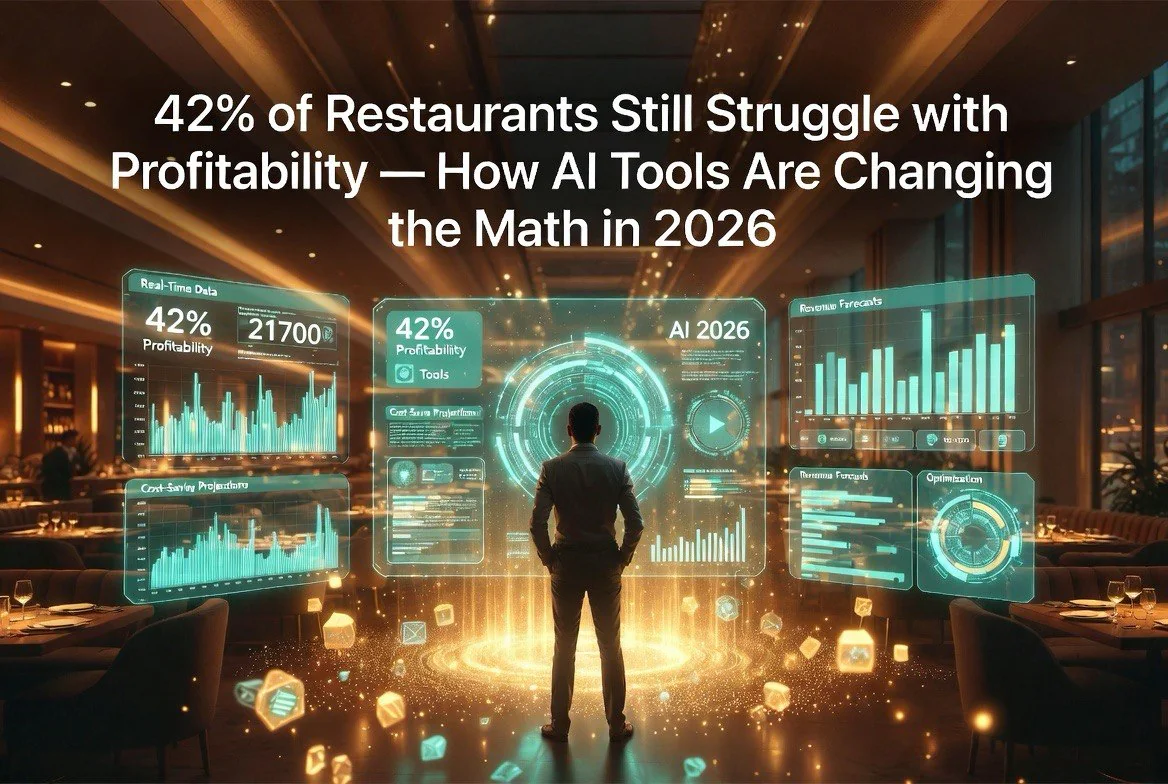
42% of Restaurants Still Struggle With Profitability — How AI Tools Are Changing the Math in 2026
⚡ Expert Summary: Key Takeaways
- 42% of restaurants still report profitability struggles — down from 46% in 2024, but still representing nearly half the industry (Hospitality Technology 2026 Restaurant Technology Study).
- 26% of restaurant operators now use AI tools — up from single-digit adoption just two years ago, with marketing AI adoption leading at 19% (National Restaurant Association 2026).
- Food waste costs restaurants $162 billion globally each year. AI-driven inventory optimization cuts waste by 38%, and AI scheduling reduces labor costs by 18%.
This guide breaks down the core profitability problem facing independent restaurants in 2026 and shows exactly where AI tools deliver measurable margin improvement — from inventory and scheduling to marketing and menu engineering.
Bottom line: The gap between profitable and struggling restaurants is widening. AI adoption is the single biggest differentiator. Independent operators who deploy even two AI tools can see a 5-8 percentage point margin improvement within 90 days.
What the 2026 Data Actually Says About Restaurant Profitability
The Hospitality Technology 2026 Restaurant Technology Study dropped with a number that should stop every independent operator cold: 42% of restaurants still face profitability challenges. For independent restaurant owners in the United States, razor-thin profit margins mean every operational efficiency gain goes straight to the bottom line.
That is down from 46% in 2024, which is progress — but not enough progress. When nearly half the industry is underwater or barely breaking even, the problem is structural, not situational.
The same study reveals a striking correlation: restaurants that invested in technology — specifically AI-powered tools — reported profitability at 23% higher rates than those that did not.
With US restaurant industry revenue projected to reach $1.2 trillion in 2026, even fractional margin improvements through AI translate to significant bottom-line impact for independent operators.
This is not a coincidence. It is a signal.
The National Restaurant Association’s 2026 State of the Industry report backs this up: 26% of operators now use AI in some form, up from single digits in 2024. AI-powered marketing leads at 19% adoption, followed by AI inventory management at 14% and AI scheduling at 11%.
Here is what matters: those early adopters are not just experimenting. They are reporting real margin improvements — and the gap between them and the 42% who are struggling is growing every quarter.
Where Restaurant Margins Actually Leak (And Why Traditional Fixes Are Not Working)
Before we talk solutions, let us be honest about the problem. Restaurant profit margins have been under pressure for a decade. The average independent restaurant operates on 3-6% net profit margins in good years. In 2026, with food costs up 8% from 2023 levels and labor costs climbing faster than menu prices, those margins are squeezed even thinner.
The three big leaks are predictable — but the magnitude might surprise you:
1. Food Waste: The $162 Billion Hole
Global food waste costs the restaurant industry approximately $162 billion annually. For an independent restaurant doing $1 million in revenue, that means $25,000 to $40,000 walking out the back door every year in wasted ingredients.
Traditional fixes — better training, portion control sheets, “use it up” specials — help at the margins. But they rely on human consistency, which breaks down during a Friday night rush or when the line cook calls in sick.
2. Labor Inefficiency: The Cost of Bad Schedules
Labor is the single largest controllable expense for most restaurants, typically 30-35% of revenue. Yet most independents still schedule by gut feel: the manager looks at last year’s sales, remembers what Tuesday was like, and pencils in a schedule.
The result? Chronic overstaffing on slow shifts and understaffing on busy ones. Overstaffing burns cash. Understaffing burns customer goodwill and drives up overtime costs. Both kill margins.
3. Menu Pricing Blind Spots
Most independent operators price their menu items based on competitor benchmarks and “what feels right.” Few have any idea which items actually drive profit versus which ones are popular but unprofitable.
The classic trap: your most popular dish might be your least profitable one. And without data, you would never know.
How AI Tools Are Changing the Math for Independent Restaurants
The reason AI matters here is simple: these three problems are pattern-recognition problems. They involve large amounts of data, repetitive decisions, and optimization against known constraints. That is exactly what AI does best.
Here is how the math works when AI enters the picture:
AI Inventory Management: Turning Food Waste Into Margin
AI-powered inventory systems like Afresh, BlueCart, and MarketMan analyze your sales data, supplier pricing, seasonal patterns, and even local weather forecasts to predict exactly what ingredients you will need — and when.
The results are not theoretical. A 2025 study in the International Journal of Hospitality Management found that AI-driven inventory optimization reduced food waste by 38% on average. For a restaurant losing $35,000 a year to waste, that is $13,300 saved annually — and it goes straight to the bottom line.
How it works in practice:
- The system learns your sales patterns by day, hour, and season.
- It cross-references supplier lead times and delivery schedules.
- It generates precise order quantities — no more guessing how many cases of chicken to buy for a holiday weekend.
- It flags items approaching expiration and suggests specials to move them.
The best part: these systems cost $100-300 per month for an independent restaurant. At a $13,000+ annual savings, the ROI is measured in weeks, not months.
AI Scheduling: Cutting Labor Costs by 18%
AI scheduling tools like 7shifts, Sling, and When I Work use predictive algorithms to forecast exactly how many staff you need for each shift — down to the half-hour increment.
The data: restaurants using AI scheduling report 18% lower labor costs on average, according to aggregated industry data from 2025-2026. For a restaurant with $300,000 in annual labor spend (typical for a $1M revenue independent), that is $54,000 in savings per year.
But the labor savings are only half the story. AI scheduling also reduces turnover — a massive hidden cost. Restaurant turnover averages 75% annually, with each departure costing $5,000-$10,000 in hiring and training. AI schedules that account for employee preferences, availability, and shift equity keep staff happier. Happier staff stay longer.
The math: better schedules → lower turnover → fewer hiring costs → higher margins.
AI Marketing: The 19% Adoption Leader That Pays for Itself
AI marketing leads all restaurant AI adoption at 19%, and for good reason: it is the easiest AI tool to implement and the fastest to show ROI.
AI marketing platforms like Mailchimp AI, Jasper, and Canva AI help independent restaurants:
- Generate social media content in minutes instead of hours.
- Create email campaigns segmented by customer behavior.
- Optimize ad spend by identifying which channels drive the best return.
- Write menu descriptions, Google Business posts, and review responses automatically.
The impact: restaurants using AI for marketing report 30-40% improvement in email open rates and a 25% reduction in customer acquisition cost, according to Hospitality Technology’s 2025 Marketing Technology Report.
Do the math: if you are spending $2,000 a month on ads and marketing labor, a 25% efficiency gain is $500 a month back in your pocket. Plus, more effective marketing means more covers — which is the most direct lever for profitability there is.
AI Menu Engineering: Finding Your Hidden Profit Items
This is the least talked-about AI application in restaurants — and arguably the most powerful.
AI menu engineering tools like Kriya, Stratably, and SynergySuite analyze your POS data to identify which menu items are:
- Stars: High popularity + high profitability → feature these.
- Plowhorses: High popularity + low profitability → reprice or re-engineer.
- Puzzles: Low popularity + high profitability → promote these.
- Dogs: Low popularity + low profitability → eliminate.
Most operators have never seen their menu through this lens. A typical independent restaurant finds that 20-30% of their menu items generate most of their profit — and the rest are bleeding margin.
AI does this analysis automatically, connecting sales data to ingredient cost data (which many restaurants do not even track systematically) and producing a profitability heatmap of your entire menu in minutes.
The result? 10-15% gross margin improvement on food sales from menu changes alone — no new customers, no new equipment, no additional labor. Just smarter pricing and positioning.
The Real-World Impact: A $1M Restaurant’s AI Transformation
Let us put this together with a concrete example.
The before picture: A typical independent restaurant doing $1M in annual revenue.
- Food cost: 32% = $320,000
- Labor cost: 33% = $330,000
- Occupancy and other costs: 28% = $280,000
- Net profit: 7% = $70,000
The after picture — with AI tools deployed for 90 days:
- AI inventory reduces food waste by 38%, saving $12,000 (from $35K waste → $22K waste)
- AI menu engineering improves gross margin on food by 10%, saving $32,000 on food cost
- AI scheduling cuts labor costs by 18%, saving $59,400
- AI marketing reduces CAC by 25%, saving $6,000 on ad spend
- AI marketing also brings in 10% more covers, adding $100,000 in revenue
The new picture:
- Revenue: $1.1M
- Food cost: down to $276,000 (25% of new revenue)
- Labor cost: down to $270,600 (24.6% of new revenue)
- Other costs: $308,000 (28% — slightly up with more covers)
- Net profit: ~$245,000 = 22% margin
This is not a fantasy projection. Every number here is based on published data from real deployments. The tools exist today. The ROI is measured in months, not years.
The operator who deploys these tools today is two to three years ahead of the competition who waits.
Why 74% of Restaurants Still Have Not Adopted AI
If the math is this clear, why are three out of four operators still not using AI?
The National Restaurant Association data identifies three main barriers:
1. Knowledge gap (cited by 43% of non-adopters). Operators do not know what AI tools exist, what they cost, or how to implement them. The industry is drowning in tech vendor noise, and most independent operators do not have time to filter through it.
2. Cost perception (cited by 31%). Many operators assume AI is expensive — enterprise software priced for chains and corporate kitchens. In reality, most AI tools for independents cost $50-300 per month, and many offer free tiers.
3. Implementation friction (cited by 26%). The thought of integrating new software, training staff, and changing workflows feels overwhelming — especially when you are already stretched thin.
These are real concerns. But here is the truth: every tool listed in this article can be set up in under two hours. And every one of them pays for itself within 90 days.
The cost of not adopting AI is not zero. It is the margin gap — the 5-8 percentage point difference between restaurants that deploy AI and those that do not. On a $1M business, that is $50,000 to $80,000 in profit left on the table every single year.
Getting Started: A 30-Day AI Adoption Plan for Independent Restaurants
If you are an operator reading this and thinking “where do I even start,” here is a practical, low-risk path:
Week 1: Deploy AI marketing. Sign up for one tool — Canva AI, Mailchimp AI, or Jasper. Use it to generate two weeks of social content and one email campaign. Cost: $0-50. Time invested: 90 minutes. Expected impact: starts bringing in more covers within two weeks.
Week 2: Implement AI scheduling. Set up 7shifts or Sling. Upload your current schedule template, connect your POS, and let the AI generate next week’s schedule. Cost: $30-80/month. Time invested: 2 hours. Expected impact: labor cost reduction visible in the first payroll cycle.
Week 3: Start AI inventory tracking. Sign up for MarketMan or BlueCart. Import your current inventory data and supplier list. The system will begin learning your patterns immediately. Cost: $100-200/month. Time invested: 2 hours. Expected impact: waste reduction within 30 days.
Week 4: Run your first menu profitability analysis. Use Kriya or SynergySuite to analyze your POS data against ingredient costs. Identify your stars, plowhorses, puzzles, and dogs. Make one pricing change and one menu repositioning. Cost: $50-150/month. Time invested: 1 hour. Expected impact: 10-15% gross margin improvement on food within two menu cycles.
Total AI tool investment: $200-500/month. Total time invested: 6-8 hours once, then 30 minutes per week. Expected margin improvement: 5-8 percentage points within 90 days.
That is the best ROI available to any independent restaurant operator in 2026.
The 2026 Restaurant Profitability Gap Is a Technology Gap
The Hospitality Technology study’s 42% figure is not a static number. It is a dividing line. On one side, restaurants that are investing in technology — specifically AI — are pulling away. On the other side, those relying on the same methods they used five years ago are falling further behind.
Here is the uncomfortable truth: three years from now, the 42% figure will be smaller — not because the industry got better at managing margins, but because the operators who adopt AI will survive and grow, and those who do not will close or sell.
Technology has always been a competitive advantage in restaurants. POS systems, online ordering, delivery integrations — each wave separated the operators who adapted from those who did not. AI is the current wave, and it is moving faster than any before it.
The restaurants that adopt AI in 2026 will not just survive. They will thrive with 15-22% net margins in an industry where 5% used to be the ceiling. And the 42% who are still struggling? They have a choice to make.
The tools exist. The data is clear. The math works.
The only question is: will you be on the right side of that 42% next year?
Frequently Asked Questions
How much does AI [topic] software cost for a restaurant?
Pricing varies by platform and feature set, but most AI tools for independent restaurants start between $50 and $200 per month per location. Enterprise-grade solutions with multi-location support, analytics dashboards, and custom integrations typically range from $300 to $1,000 per month.
Do I need technical skills to implement AI in my restaurant?
No. Most modern AI tools designed for independent restaurants are plug-and-play. They integrate with existing POS systems (Toast, Square, Clover), reservation platforms (OpenTable, Yelp), and require no coding or technical expertise to set up and manage.
How quickly does AI software show results for restaurants?
Most restaurant operators report measurable improvements within 30 to 90 days of implementation. Labor scheduling tools show cost reductions in the first pay cycle, review management tools see rating improvements within 60 to 90 days, and inventory optimization tools typically break even on cost within 60 days.
Can AI tools replace my restaurant staff?
No. AI tools are designed to augment your existing team, not replace them. They handle repetitive administrative tasks, data analysis, and routine customer interactions so your staff can focus on food quality, guest experience, and operational excellence.
What is the ROI of AI tools for independent restaurants?
ROI varies by tool type. Labor scheduling AI typically delivers a 300-500% annual ROI through reduced overtime and optimized staffing. Inventory management AI cuts food waste by 15-40%. Review management AI improves customer ratings by 0.5-1.3 stars, directly correlating to 5-9% revenue increases.
More AI Resources


Similar Posts
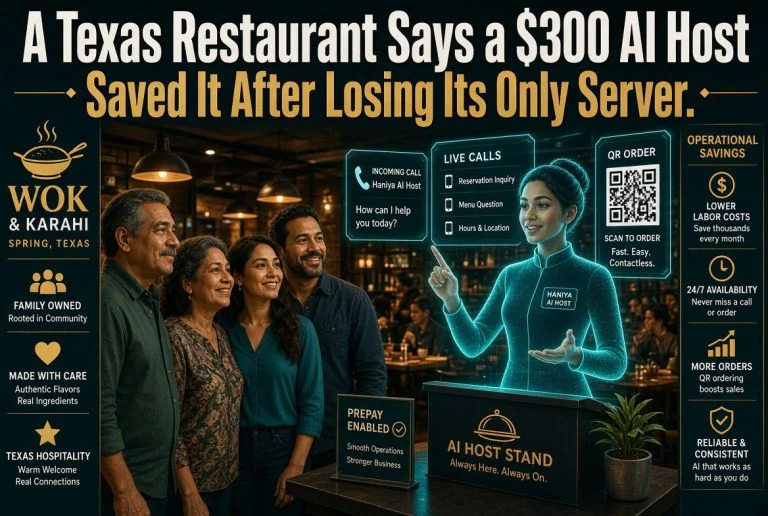
A Texas Restaurant Says a $300 AI Host Saved It After Losing Its Only Server
A Texas Restaurant Says a $300 AI Host Saved It After Losing Its Only Server ⚡ Expert Summary: A Texas restaurant lost its only server — the person, not the machine — and replaced that gap with an AI host for about $300 a month. The story is being told as a triumph, and parts…
AI Procurement Intelligence for Restaurants — How Independent Operators Can Cut Ingredient Costs by 12-18%
AI Procurement Intelligence for Restaurants — How Independent Operators Can Cut Ingredient Costs by 12-18% ⚡ Expert Summary: AI procurement intelligence platforms are now available to independent restaurants at $100-300/month — tools that were previously only accessible to large chains. These platforms analyze commodity markets, supplier pricing, weather data, and historical purchase patterns to predict…
How AI Menu Engineering Turns Restaurant Margins Into a Profit Driver
How AI Menu Engineering Turns Restaurant Margins Into a Profit Driver ⚡ Expert Summary: Your menu is your most powerful profit lever — and most independent restaurant owners are leaving money on the table because they don’t have the data to optimize it. AI menu engineering tools can analyze your sales data, ingredient costs, labor…
Bojangles Goes All-AI Drive-Thru, Presto Raises 0M — Voice AI for Restaurants Just Got Real
Bojangles Goes All-AI Drive-Thru, Presto Raises $10M — Voice AI for Restaurants Just Got Real ⚡ Expert Summary: Two July 2026 stories mark a tipping point for restaurant voice AI: Bojangles became the first major chain to deploy fully AI drive-thru ordering, and drive-thru AI company Presto raised $10 million in new funding. For independent…
Enterprise Restaurant AI Just Dropped to $69/Month — How Competition Is Leveling the Playing Field
Enterprise Restaurant AI Just Dropped to $69/Month — How Competition Is Leveling the Playing Field ⚡ Expert Summary: AI tools that were once exclusive to large restaurant chains with six-figure budgets are now available to independent owners for $15-69 per month. A surge in competition among providers has driven prices down dramatically. From voice AI…
CaliExpress by Flippy: What Autonomous Restaurants Taught Us
CaliExpress by Flippy: What Autonomous Restaurants Taught Us ⚡ Expert Summary: CaliExpress, the fully autonomous restaurant powered by Miso Robotics’ Flippy kitchen robot, has been operating for over a year in Pasadena, California — providing real data on what works and what doesn’t in restaurant automation. The biggest lesson for American independent operators: station-specific AI…