Get the AI Restaurant Quick-Start Guide — Free
The 5 AI tools independent US restaurant owners are using right now to cut labor costs and answer every call.
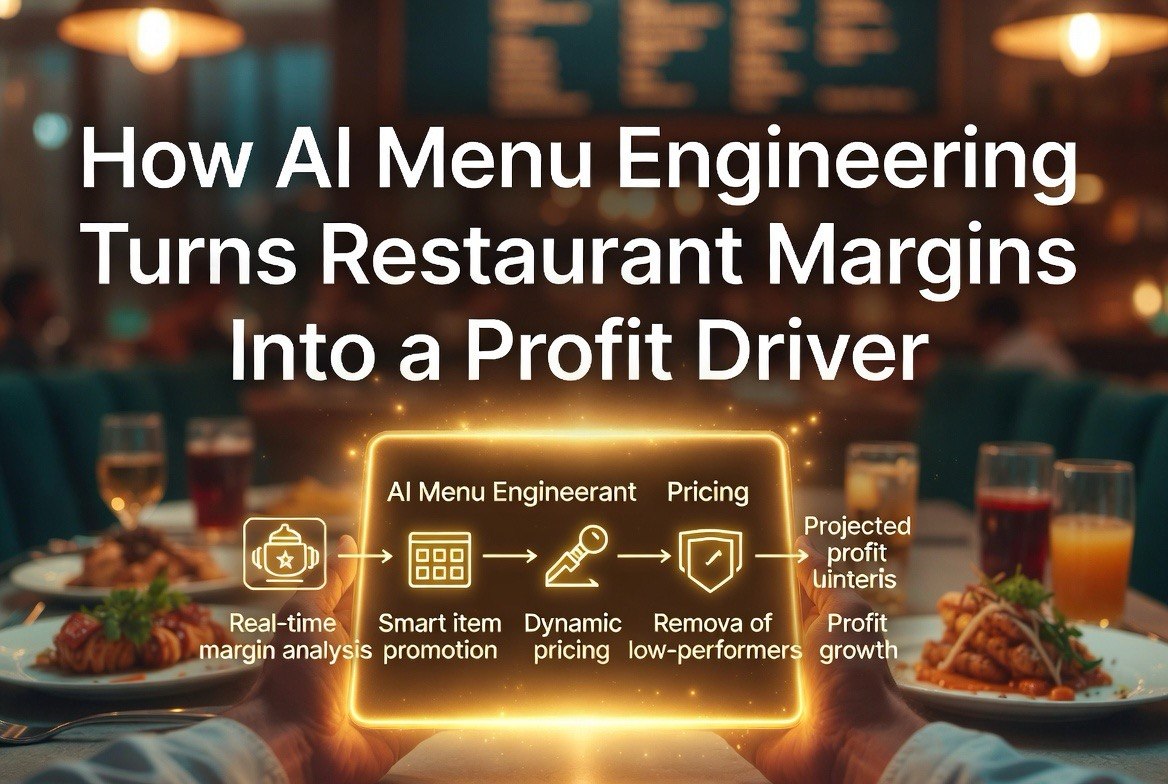
How AI Menu Engineering Turns Restaurant Margins Into a Profit Driver
⚡ Expert Summary: Your menu is your most powerful profit lever — and most independent restaurant owners are leaving money on the table because they don’t have the data to optimize it. AI menu engineering tools can analyze your sales data, ingredient costs, labor hours, and customer preferences to tell you exactly what to price, promote, cut, and reposition. The average restaurant using AI for menu optimization sees margin improvements of 3-7 points within 90 days. Here is how it works, which tools to use, and why waiting is costing you money every single service.
You’ve probably heard the stat by now: 42% of independent restaurants in the United States are unprofitable. The National Restaurant Association reported that figure in early 2026, and it hasn’t improved much since. Food costs are up 32% since 2020. Labor costs have climbed to 28-35% of revenue. And the average customer is more price-sensitive than they’ve been in a decade.
Every owner I talk to is trying to squeeze margins somewhere. They’re cutting hours. They’re raising prices. They’re reducing portion sizes. And some of those moves work. But most of them are shooting in the dark because they don’t have one critical piece of information: what their menu is actually telling them.
Your menu isn’t just a list of items with prices. It’s a optimization problem with dozens of variables — ingredient costs, prep time, popularity, seasonality, customer demographics, competitor pricing — and the restaurants that solve it best win. This is where AI menu engineering comes in.
What Is AI Menu Engineering?
The average US independent restaurant operates on a 3-6% profit margin, making menu optimization one of the highest-ROI changes an operator can make.
Menu engineering is the practice of analyzing your menu items by profitability and popularity, then strategically positioning, pricing, and promoting them to maximize overall margin. It’s been around for decades, but traditional menu engineering was a manual process of spreadsheets, guesswork, and intuition. You’d look at last quarter’s numbers, decide what to cut, and hope you were right.
AI menu engineering does the same thing — but with real-time data, predictive analytics, and automated optimization suggestions. Instead of waiting three months to see what worked, you get daily recommendations based on actual sales patterns, ingredient market prices, labor availability, and even weather forecasts.
According to Craftable, a restaurant technology company that recently published a detailed breakdown of AI-driven menu optimization, AI systems can analyze pricing elasticity, substitution patterns, and item cannibalization in ways that human analysts simply can’t replicate at scale.
How AI Menu Engineering Works in Practice
Real-Time Cost Tracking
The first thing an AI menu engineering system does is connect to your POS and inventory management system. It tracks every ingredient that goes into every dish, every day. When beef prices spike, the system knows immediately which menu items are affected and by how much. When avocado prices drop, it knows which items just got more profitable.
This matters because food costs change constantly. According to the US Department of Agriculture, commodity prices for restaurant staples like beef, poultry, and dairy fluctuate by 15-30% annually. If you’re not adjusting your menu margins in real-time, you’re losing money every time a key ingredient goes up — and leaving money on the table every time it goes down.
Popularity and Profitability Analysis
Every menu item falls into one of four categories:
- Stars — High popularity, high profitability. Promote these aggressively. They drive traffic and margins.
- Plowhorses — High popularity, low profitability. These are your volume drivers, but they’re eating into your margins. Can you raise the price? Reduce portion size? Switch to cheaper ingredients?
- Puzzles — Low popularity, high profitability. These are hidden gems that customers just aren’t ordering enough. Better placement, better descriptions, or a small price drop could turn them into Stars.
- Dogs — Low popularity, low profitability. Cut them. Every item on your menu costs you money in inventory, prep labor, and complexity. If it’s not popular and not profitable, it’s costing you twice.
Traditional menu engineering requires you to manually categorize items and update a spreadsheet every quarter. AI does it automatically, continuously, and with more granular data. It can tell you not just which items are Stars and Dogs, but why — and what to do about it.
Dynamic Pricing Suggestions
According to Craftable’s analysis, many restaurants using AI-driven pricing suggestions see a 5-8% increase in average check size within 60 days. The system doesn’t just raise prices across the board — it identifies which items have pricing room and which ones would lose volume if adjusted. A $12 appetizer might have room to go to $13.50 without affecting sales volume, while a $16 entree priced near a competitor might need to hold steady.
This is where AI menu engineering earns its keep. The system analyzes pricing elasticity — how customer behavior changes when prices go up or down — and recommends optimal prices for every item. The recommendations account for:
- Ingredient cost trends — Rising beef costs? The system knows before your next supplier invoice arrives
- Competitor pricing — If the restaurant down the street raised their burger prices, you might have room to raise yours
- Time of day and day of week — Lunch and dinner pricing might differ, and weekend prices might differ from weekday prices
- Customer segments — Regular customers might have different price sensitivity than first-time visitors
McDonald’s has been doing this for years with its AI-powered dynamic menu boards. The technology is now available to independent restaurants through platforms like Craftable, SpotOn, and Toast’s AI add-ons.
The Hidden Cost: Menu Complexity
There’s a hidden cost that AI menu engineering exposes better than any human analysis: menu complexity. Every additional menu item increases inventory complexity, training time, prep labor, and waste. According to the Restaurant Dive analysis of restaurant operations data, chains that reduced their menu by 20-30% during the COVID period saw an average 6% improvement in kitchen throughput and a 4% reduction in food waste. Those aren’t small numbers.
AI systems can model the exact cost of every menu item — not just the ingredient cost, but the labor cost, the waste cost, the opportunity cost of not using those ingredients on something more profitable. It can tell you the optimal number of items for your menu size, kitchen capacity, and customer base. For many restaurants, the optimal number is smaller than they think.
The psychology here matters too. A study published in the Journal of Retailing found that menus with 15-25 items drive higher per-customer spending than menus with 30-50 items. Why? Choice overload. When customers have too many options, they either default to the cheapest item or struggle to decide and leave. AI can help you find the sweet spot between variety and focus.
Case Study: What Real Restaurants Are Seeing
The data on AI menu engineering is still emerging, but early results are impressive. A 2025 study by Intouch Insight found that restaurants using AI for menu optimization saw an average 4.3% improvement in gross margins within 90 days of implementation. For a restaurant doing $1 million in annual revenue, that’s $43,000 in additional profit.
Dave’s Hot Chicken, a rapidly growing fast-casual chain, recently discussed its technology strategy in Restaurant Dive. While the brand is cautious about customer-facing AI (more on that in a separate article), it’s aggressive about back-of-house AI tools for inventory, pricing, and operations optimization.
How to Get Started With AI Menu Engineering
Step 1: Clean Up Your Data
AI menu engineering is only as good as your data. If your POS system doesn’t track ingredient-level costs, or your inventory counts are unreliable, the AI can’t help you. Start by getting your data house in order: standardized recipes, accurate cost tracking, and consistent portioning.
Step 2: Pick the Right Platform
Not all AI menu engineering tools are created equal. Some are add-ons to existing POS systems (Toast AI, Square AI). Others are standalone platforms that integrate with your existing tech stack (Craftable, SpotOn, Crunchtime). The right choice depends on your current systems, your budget, and how much of your operations you want to run through AI.
Step 3: Start Small, Iterate Fast
You don’t need to AI-optimize your entire menu on day one. Pick one category — appetizers, or beverages, or your top 10 selling items — and optimize those first. Measure the impact on margins, customer satisfaction, and prep time. Then expand to the next category. The iterative approach gives you quick wins and builds confidence before you invest in full deployment.
Step 4: Train Your Team
The biggest failure mode for AI menu engineering isn’t the technology — it’s the people. If your kitchen team doesn’t follow the optimized recipes, or your servers don’t promote the high-margin items, the AI recommendations are worthless. Invest in training and make sure everyone understands why the changes matter. A $43,000 annual margin improvement is a powerful incentive to follow the system.
The Bottom Line
AI menu engineering isn’t a futuristic concept. It’s available today, it’s affordable for independent restaurants, and it delivers measurable results. In a market where 42% of restaurants are losing money, the ones that adopt AI-driven margin optimization aren’t gaining a competitive advantage — they’re catching up to where the industry is heading.
The other thing that AI menu engineering does that manual analysis can’t is model scenarios instantly. What happens to your margins if beef prices go up 15% next month? What if you switch from fresh to frozen chicken? What if you raise your burger price by $0.50? A human analyst might take a day to build a spreadsheet for one scenario. AI can model a hundred scenarios in seconds and tell you which one maximizes margin without sacrificing volume.
This kind of rapid scenario modeling is why large chains like Darden Restaurants and Brinker International have been investing in AI menu optimization for years. The technology has finally reached the independent operator level, with platforms that cost less than a single shift of labor per month and require no technical expertise to run.
Whether you run a single diner or a 20-unit group, your menu is your most powerful profit lever. AI just gives you the data to pull it with confidence. The restaurants that start now will build margins that survive the next commodity price spike, labor shortage, or economic downturn. The ones that wait another year will be playing catch-up while their competitors are already optimizing.
For more on how AI is transforming restaurant operations, check out our complete guide to AI in restaurants.
Frequently Asked Questions
What is AI menu engineering?
AI menu engineering uses artificial intelligence to analyze restaurant menu items by profitability and popularity. It provides real-time recommendations on pricing, positioning, portion sizes, and ingredient substitutions to maximize overall margins.
How much can AI menu engineering improve restaurant profits?
Early studies show an average 4.3% improvement in gross margins within 90 days of implementation. For a restaurant doing $1 million in annual revenue, that’s approximately $43,000 in additional profit per year.
What AI tools are best for restaurant menu optimization?
Top options include Craftable for full operations integration, Toast AI for existing Toast POS users, SpotOn for dynamic pricing, and Crunchtime for inventory and cost management. The best choice depends on your existing POS system and specific needs.
Is AI menu engineering affordable for independent restaurants?
Yes. Most AI menu engineering platforms start at $100-500 per month, with ROI typically achieved within 30-60 days. Many platforms offer free trials or pilot programs for independent restaurants.
Do I need special technical skills to use AI menu engineering?
No. Most platforms are designed for restaurant operators, not data scientists. They connect to your existing POS and inventory systems and provide simple dashboard views with actionable recommendations. Training typically takes a few hours.
More AI Resources