Get the AI Restaurant Quick-Start Guide — Free
The 5 AI tools independent US restaurant owners are using right now to cut labor costs and answer every call.
AI Email and SMS Marketing for Restaurants: Win Back Guests on Autopilot
⚡ Expert Summary: AI marketing automation lets independent restaurants send the right email or text to the right guest automatically — win back lapsed customers, fill slow nights, stop no-shows before they happen, and get more online reviews without nagging. Tools like Bloom Intelligence, Owner.com, ChowNow, and SevenRooms run these campaigns off your own POS data, typically for $95–$150/month per location. Here is what to set up, in plain English.
Here is a number every owner should hear: your most profitable customers aren’t new ones — they’re the regulars who already like you and just need a reason to come back. Most independent restaurants have hundreds or thousands of these people in their POS, and do almost nothing with them. Meanwhile, an AI tool is quietly sending a win-back text to someone who hasn’t visited in 60 days, and that guest books a table for Friday.
That’s the gap AI marketing closes. It’s not about blasting coupons to everyone. It’s about automating the right message to the right guest at the right moment — off your own sales data, with no one on your payroll watching it all day. Here is how it works and what’s worth setting up.
Why This Matters More Than New-Customer Ads
Let’s be honest about where restaurants waste marketing money. Chasing brand-new customers through paid ads is expensive and gets harder every year, as delivery apps and review platforms squeeze margins. The cheaper, more reliable revenue sits in the guest list you already have — the people who have eaten at your place, shown they’ll pay, and just need a nudge.
AI marketing platforms are built around exactly that. They connect to your POS, learn who your customers are and when they last visited, and then run automated campaigns that would take a full-time marketer to manage by hand — win-back sequences, birthday offers, review requests, reservation reminders. For an independent owner who is also the chef, the bookkeeper, and the hiring manager, that automation is the difference between “we should do more marketing” and “marketing is running itself in the background.”
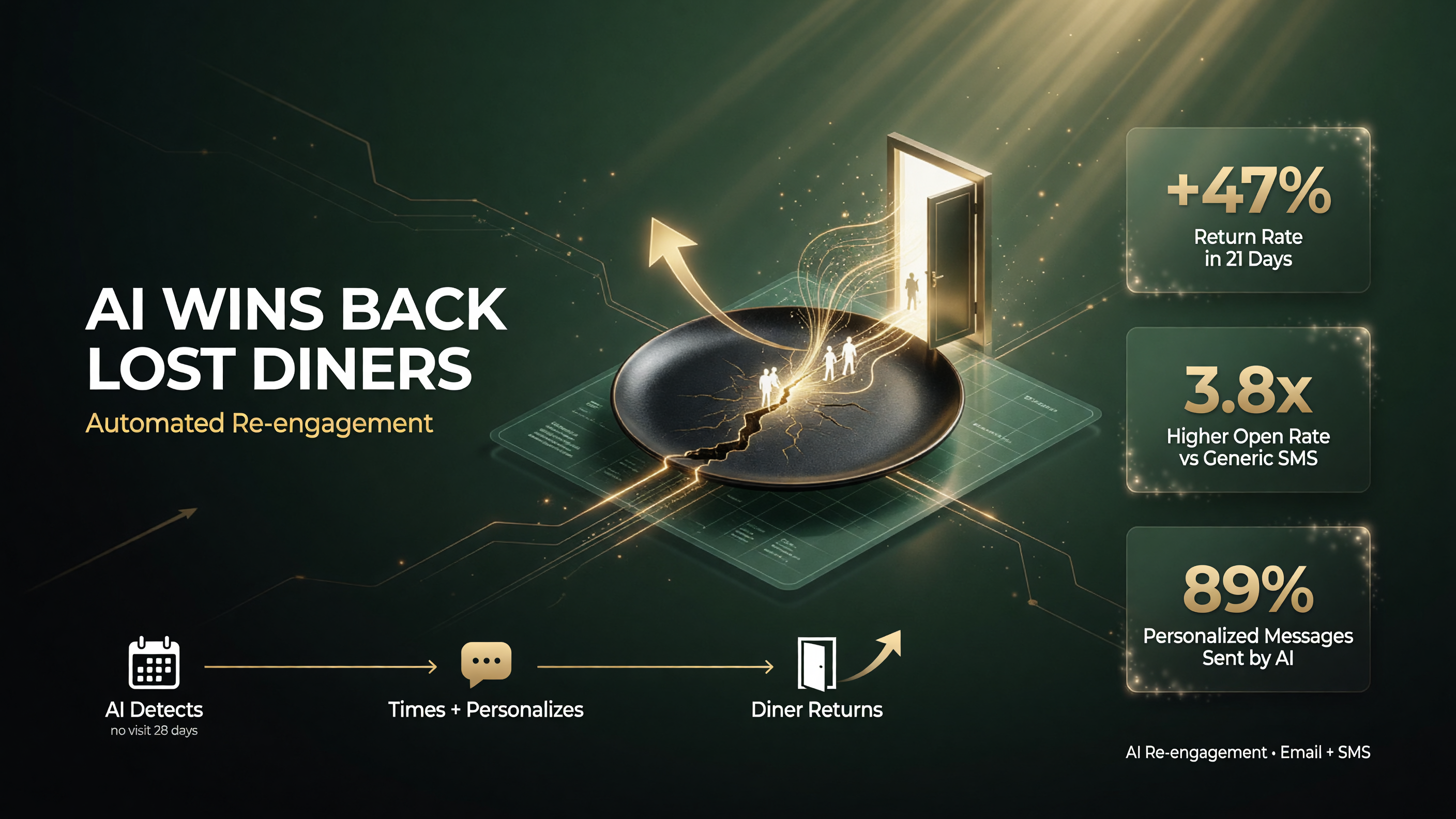
AI email/SMS win-back: automated re-engagement campaigns bring back diners who stopped visiting, using AI to time and personalize the message (+47% return rate, 3.8x open rate vs generic SMS).
What AI Marketing Actually Automates
Here are the four campaigns that give independents the most return, and how each works with AI:
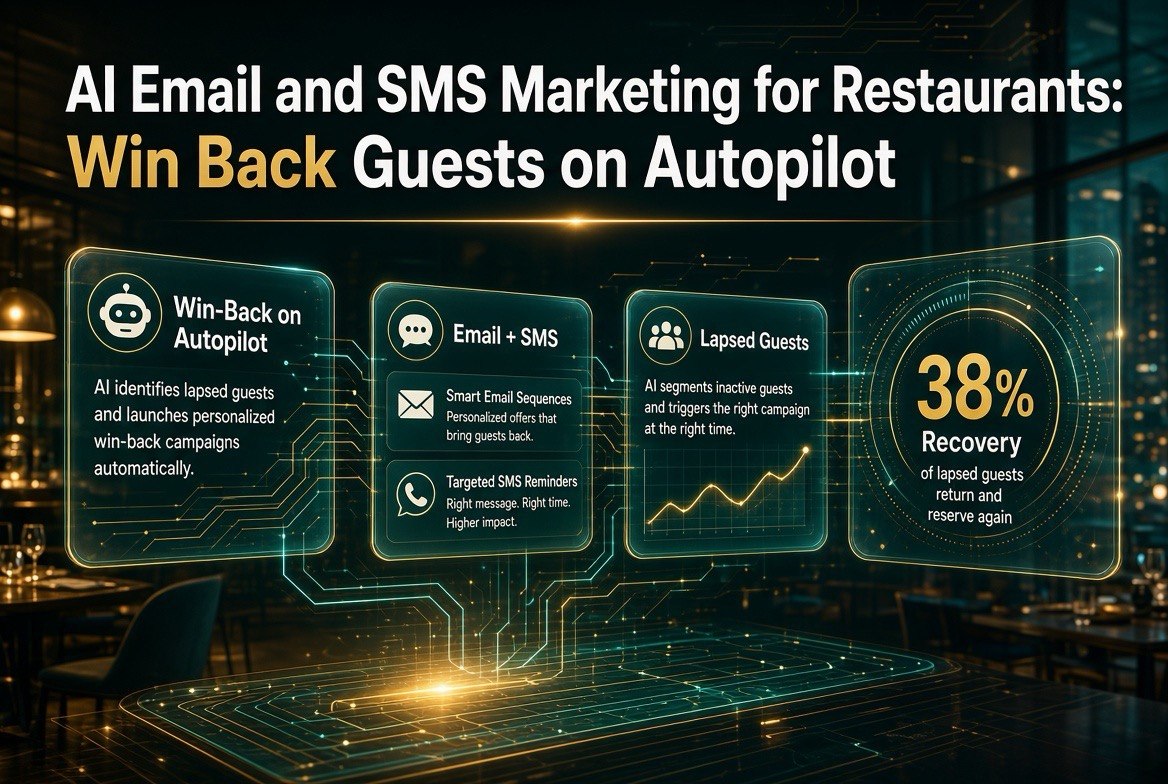
- Win-back (reactivation). The platform spots guests who haven’t visited in, say, 45–90 days and sends a targeted email or text with a reason to return. Bloom Intelligence, which builds customer data platforms for restaurants, reports roughly 38% recovery on lapsed guests with this kind of program — guests who ate again because they were reminded.
- No-show prevention. Automated reminders go out by text or email ahead of reservations, cutting the empty tables that cost you money every week. SevenRooms factors in no-show scoring and predictions on the reservations side, so you know which bookings are risk.
- Review generation. After a visit, the system automatically sends an SMS or email asking for a review, with a single tap-through link. Tools like Birdeye and Momos also draft responses for you, so good reviews get acknowledged and bad ones get a careful, human-sounding reply without you writing every one.
- Slow-night fills. When you know Tuesday is dead, send a “weekday special” to nearby past guests automatically — targeted, not spam.
None of this needs a marketing degree or a big team. The AI writes the messaging, picks the audience from your data, and sends on schedule. You set the guardrails and approve the voice.
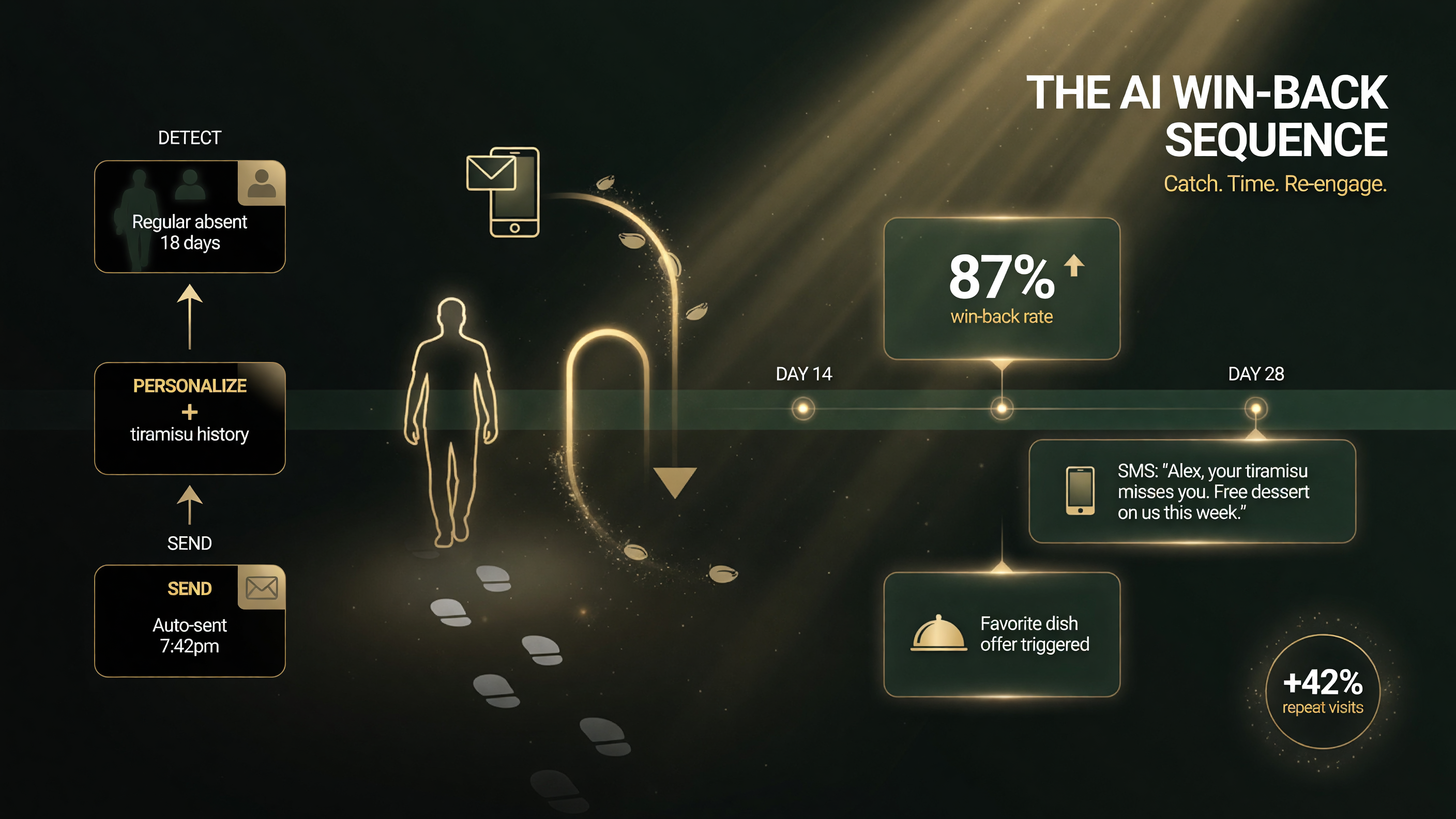
The AI win-back sequence: detect when a regular stops visiting, then auto-send a timed, personalized offer (like a free dessert for a favorite dish) at the right moment.
Real Tools for Independent Restaurants
You don’t need to build anything from scratch. Several platforms are built specifically for independent operators and run on your POS data:
| Tool | What It’s Strong At |
|---|---|
| Bloom Intelligence | AI customer data platform; win-back and churn prevention off POS, WiFi, and reservation data. ~38% lapsed-guest recovery reported. |
| Owner.com | Email/SMS campaigns triggered by behavior, plus website, loyalty, and direct ordering to reduce app commissions. |
| ChowNow | Marketing suite with unified customer records from ordering, loyalty, email, and SMS; behavior-triggered campaigns. |
| SevenRooms | Reservations-focused; no-show scoring and automated post-visit follow-ups and review requests. |
| Birdeye / Momos | Automated review requests by SMS and AI-drafted responses, plus broader guest-lifecycle automation. |
Most of these integrate with the POS systems independents actually use — Toast, Square, Clover — and pricing for this category generally lands around $95–$150 per month per location. That’s a fraction of what one slow Tuesday or a run of bad reviews costs you.
How to Start Without Overwhelming Yourself
You don’t set all four campaigns up on day one. You start with the one that pays back fastest, prove it works, then add the next. Here is the order that works for most independents:
- Step 1 — Win-back campaign (highest ROI first). Set the lapsed threshold, write one genuine message in your voice — not corporate-speak — and let the tool run. Watch the guests it brings back.
- Step 2 — Reservation reminders. If you take reservations, turn on automated reminder texts to cut no-shows before you do anything else creative.
- Step 3 — Review requests. Add the post-visit SMS asking for a review, and turn on AI response drafting so nothing goes unanswered.
- Step 4 — Slow-night and campaigns. Once the basics are running, use the data to fill your weakest shifts.
The key is to keep the messaging human. Your guests are not a Nielsen audience — they’re people who know your food and your team. Write the AI’s scripts in your own voice, and the automation does the rest.
The Compliance Piece: Texting Rules You Can’t Skip
Before you turn on any SMS campaign, know this: texting customers is regulated, and the rules aren’t optional. In the United States, commercial text messages require opt-in consent — a customer has to agree to receive texts from you before you send them. That’s a federal rule under the TCPA, and ignoring it can mean real fines. Email has its own rules under the CAN-SPAM Act, including giving recipients a clear way to unsubscribe.
The good news is that reputable marketing platforms bake compliance into the product: they collect and store consent, honor opt-outs automatically, and keep the audit trail you’d need if a customer ever pushed back. But the platform tools only work if you do your part. Never buy a list of numbers and blast them. Only send to people who actually gave you their information — through a reservation, a loyalty sign-up, a WiFi login, or an online order. That’s not just about staying legal; it’s about the fact that a text from a stranger reads as spam, and spam doesn’t bring anyone back to your dining room.
To decide which channel to lean on first, compare them directly on the factors that matter for a marketing campaign:
| Factor | SMS | |
|---|---|---|
| Best for | Win-backs, offers, newsletters, long content | Time-sensitive reminders, short nudges |
| Typical open rate | Roughly 20-30% | 90%+ within minutes |
| Consent standard | CAN-SPAM; unsubscribe required | TCPA opt-in required; fines for violations |
| Cost feel | Cheaper per message | Per-message cost, but high attention |
| Start here? | Yes — lower risk path | Only with clean opt-in data |
Worth noting: email marketing is more lenient than SMS, so if you’re unsure, start with email win-backs and reservation reminders, and add SMS only once you have clean consent data. The tools above handle the mechanics; you handle the consent hygiene.
What AI Marketing Won’t Do (Be Honest With Yourself)
No tool fixes a tired menu, an empty Tuesday, or a reputation problem by itself. AI marketing is a force multiplier for a restaurant that’s already decent — it reminds people you exist and pulls them back. It cannot make up for bad food, slow service, or a dining room that’s unwelcoming. The owner who makes real money off this is the one who treats the marketing automation as one part of a solid operation, not a fix for a broken one.
There’s also an adjustment period. The first month is about setting up the data connection, writing scripts in your voice, and getting the triggers right. You won’t see a flood of guests on day three. Give it a full business cycle — a month or two — and watch the trends, not the first few sends. Restaurants that abandon the tool after two weeks because it wasn’t instant are the ones that never see the win-back revenue compound.
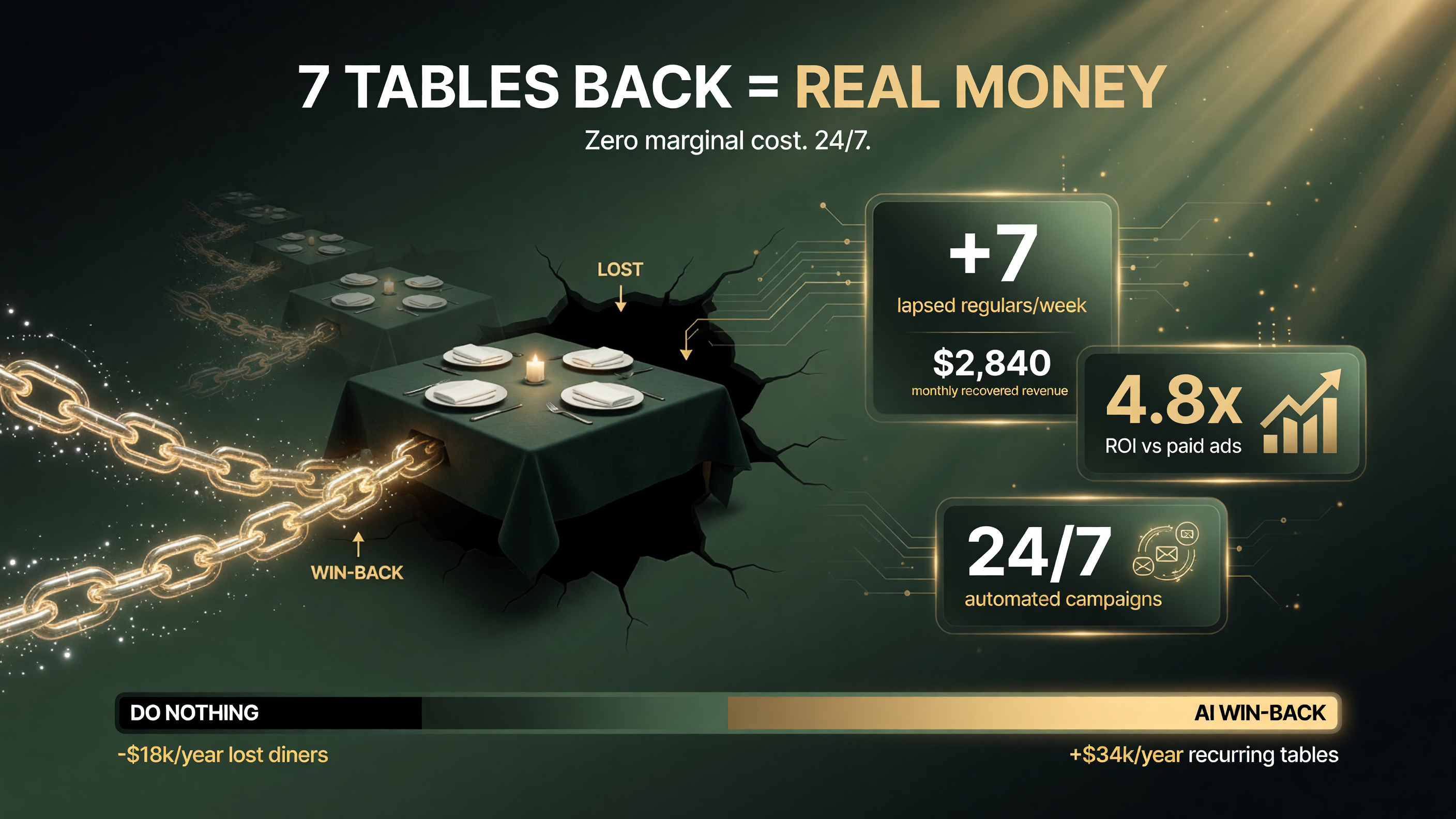
The payoff: recovering a handful of lapsed regulars per week adds real revenue — automated win-back runs 24/7 at near-zero marginal cost instead of losing those diners for good.
The Numbers Worth Paying Attention To
This is the part that matters when you’re deciding whether to spend $100 a month. Think about what a guest is worth to you per visit — let’s say it’s $35. If one reactivation campaign brings back just three lapsed guests a week, that’s roughly $105 a week in recovered revenue against a marketing tool that costs about $100 a month. That math works long before you count the no-shows prevented and the reviews that bring in other guests.
The businesses getting the most out of these tools aren’t the ones with the biggest budgets. They’re the ones who set it up, let it run, and check the numbers monthly instead of trying to micromanage every message. AI marketing is a habit — set the voice, set the rules, and let the system do the daily work of showing a regular they’re remembered.
Frequently Asked Questions
What is AI email/SMS marketing for restaurants?
It’s software that automatically sends the right email or text to the right customer based on their behavior — like a win-back offer to a lapsed guest or a reservation reminder — using your own POS data, without a marketer running it by hand.
How much does restaurant marketing automation cost?
Platforms built for independents typically cost around $95–$150 per month per location. There are also all-in-one options like Fleksa that bundle marketing with POS and ordering features.
Which tools work with my POS?
Most AI marketing platforms integrate with the POS systems independents use, including Toast, Square, and Clover. Confirm integration with the specific tool before committing.
Can AI help me get more online reviews?
Yes. Tools like Birdeye and Momos automate post-visit review requests by SMS or email with a tap-through link, and they can draft AI responses to reviews so nothing goes unanswered.
Does AI marketing stop no-shows?
Yes. Automated reservation reminders sent by text or email before the booking cut no-shows, and platforms like SevenRooms add no-show scoring so you can tell which reservations are at risk.
Is this only for big chains?
No. Many of these tools — Owner.com, ChowNow, Bloom Intelligence — are built specifically for independent restaurants and scale from a single location up.

About Barak Schurr
Barak Schurr built and exited a major ticketing platform, ran global operations at Eventbrite, and now focuses on one question: which AI tools actually help independent restaurant owners run leaner and grow faster. He writes from the operator’s perspective — no vendor spin, no theory, just what’s real in 2026.
Email: [email protected]
More AI Resources for Your Business