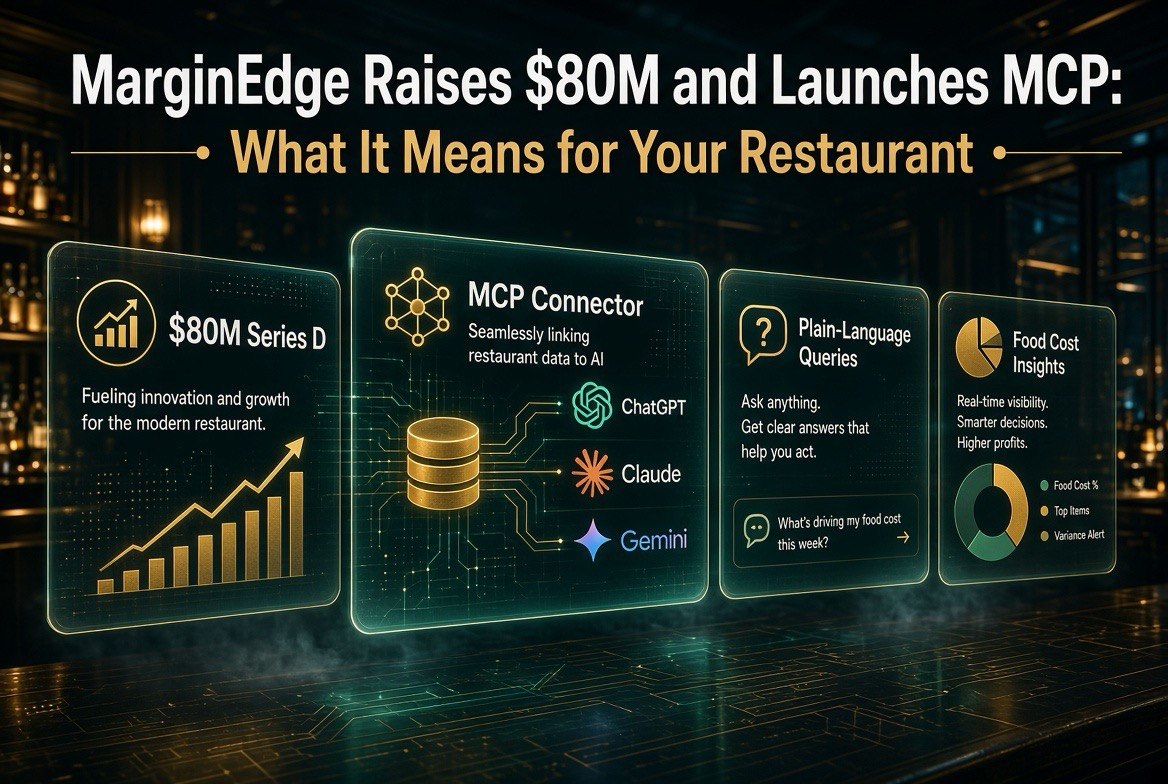
Get the AI Restaurant Quick-Start Guide — Free
The 5 AI tools independent US restaurant owners are using right now to cut labor costs and answer every call.
MarginEdge Raises $80M and Launches MCP: What It Means for Your Restaurant
⚡ Expert Summary: MarginEdge closed an $80 million Series D (announced August 11, 2026, total funding now $162M) and, one week earlier, launched the first MCP connector from a restaurant management platform. For independent owners, this means your back-office data — invoices, food cost, labor, P&L — can now be queried directly inside ChatGPT, Claude, and Gemini. Here is what changed and what it realistically does for your restaurant.
Two things happened at MarginEdge in the space of a week, and both point the same direction: restaurant back-office data is about to get a lot easier to use.
On August 4, 2026, MarginEdge launched the first MCP connector from a restaurant management and bill payment platform. On August 11, 2026, it announced an $80 million Series D — co-led by Schooner Capital and Ten Coves Capital — bringing its total funding to $162 million and fueling an aggressive push into AI-powered back-office tools.
If you run an independent restaurant, you don’t need to know what “MCP” stands for to care about this. You need to know that the software tracking your invoices, food cost, and labor is now able to talk directly to the AI tools you may already be using. Here is the plain-English version of what happened and what it means for your operation.
First, What MarginEdge Actually Does
MarginEdge is a back-office platform for restaurants. If you’ve ever spent your evening reconciling invoices, chasing food cost, or trying to understand why labor ran over, you know the problem it solves. It connects to your POS and accounting systems and gives you visibility into the numbers that decide whether you make money:
- Automated invoice processing — line-item invoice data captured without manual entry.
- Bill payment — pay vendors from the platform instead of juggling a dozen portals.
- Inventory and food cost — real-time visibility into what you’re spending on product.
- Labor cost — connect the hours and the dollars.
- Daily P&L — a profit-and-loss view without waiting for month-end.
- Integrations — works with POS systems and accounting software like QuickBooks and Toast, so your numbers actually line up.
The value proposition has always been the same: cut the back-office busywork so you, the owner, can be on the floor. The new moves are about making that data smarter — and that’s where the last two weeks matter.
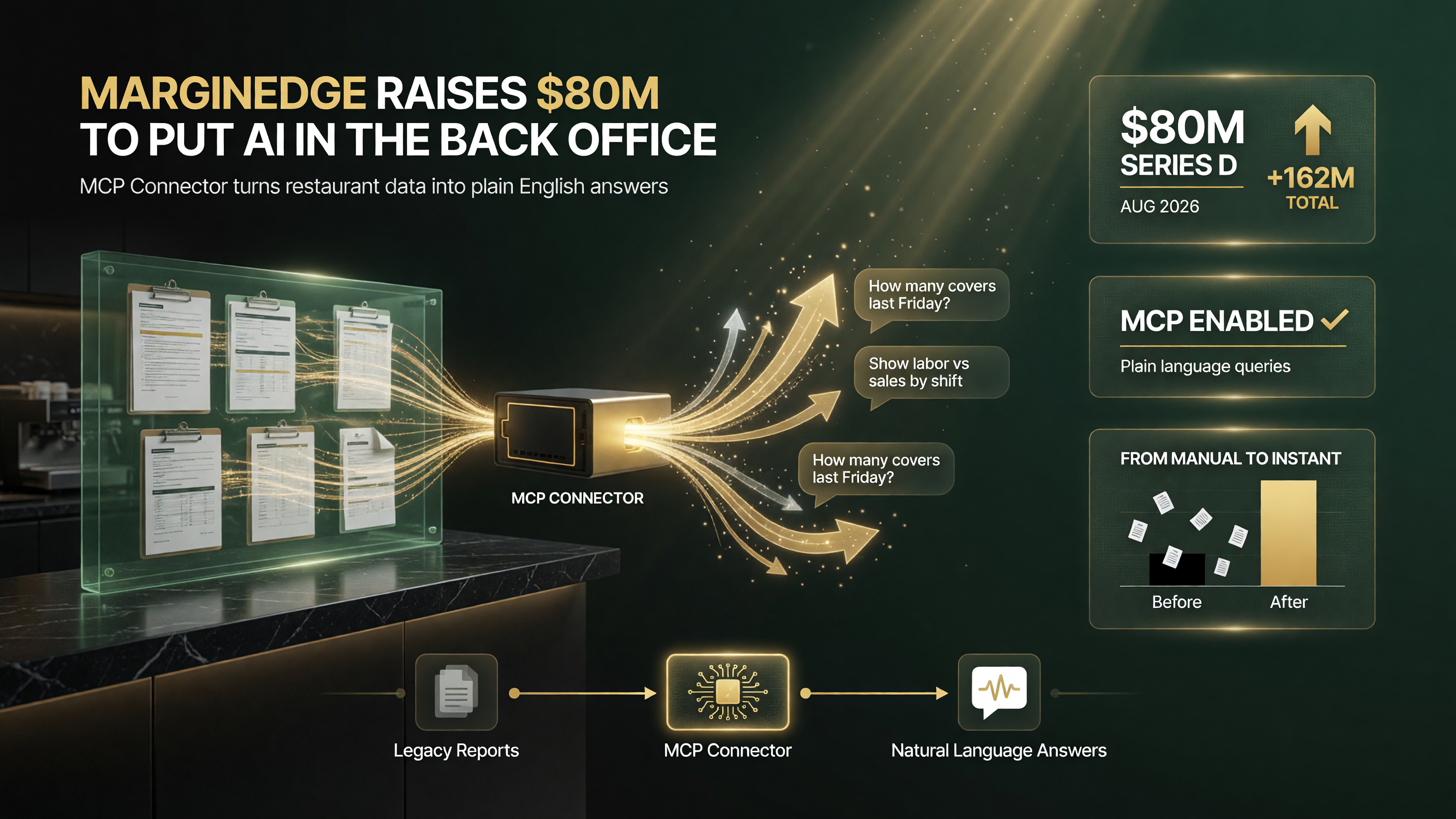
MarginEdge raised $80M (Aug 2026, $162M total) to push AI into restaurant back-office — and the MCP connector turns manual reporting into instant plain-language answers.
What Is the MCP Connector, in Plain English?
MCP stands for Model Context Protocol. Put the acronym away — the practical meaning is simple: it’s a secure, standardized way for AI tools to read your restaurant’s data.
Before this, if you wanted ChatGPT or another AI to look at your actual restaurant numbers, you had to export spreadsheets, clean them up, and paste them in. Clunky, error-prone, and mostly something nobody actually did. The MCP connector changes that. It lets an AI assistant like ChatGPT, Claude, or Gemini pull from your MarginEdge data — costs, sales, compliance records — in a structured, secure way, alongside the rest of your business information.
In practice, that means you could ask an AI a question like “What was my food cost last week compared to the week before?” or “Which vendors am I over budget with this month?” — and get a real answer drawn from your actual data, not a generic guess.
Here’s the concrete difference the MCP connector makes versus the way most owners have worked with their numbers up to now:
| Task | Before MCP (Manual) | With MCP Connector |
|---|---|---|
| Check food cost vs. last week | Export spreadsheet, clean, and read it yourself | Ask the AI in plain language; get the answer from live data |
| Find over-budget vendors | Manually pull vendor reports and compare | Ask “which vendors am I over budget with this month?” |
| Pull compliance records | Search through stored invoices and documents | AI pulls structured, secure records on demand |
| Time to get an answer | Minutes to hours, depending on the report | Seconds, in conversation |
This is the first connector of its kind from a restaurant management and bill payment platform, which makes MarginEdge an early mover on something that’s quietly becoming the standard way AI connects to business systems.
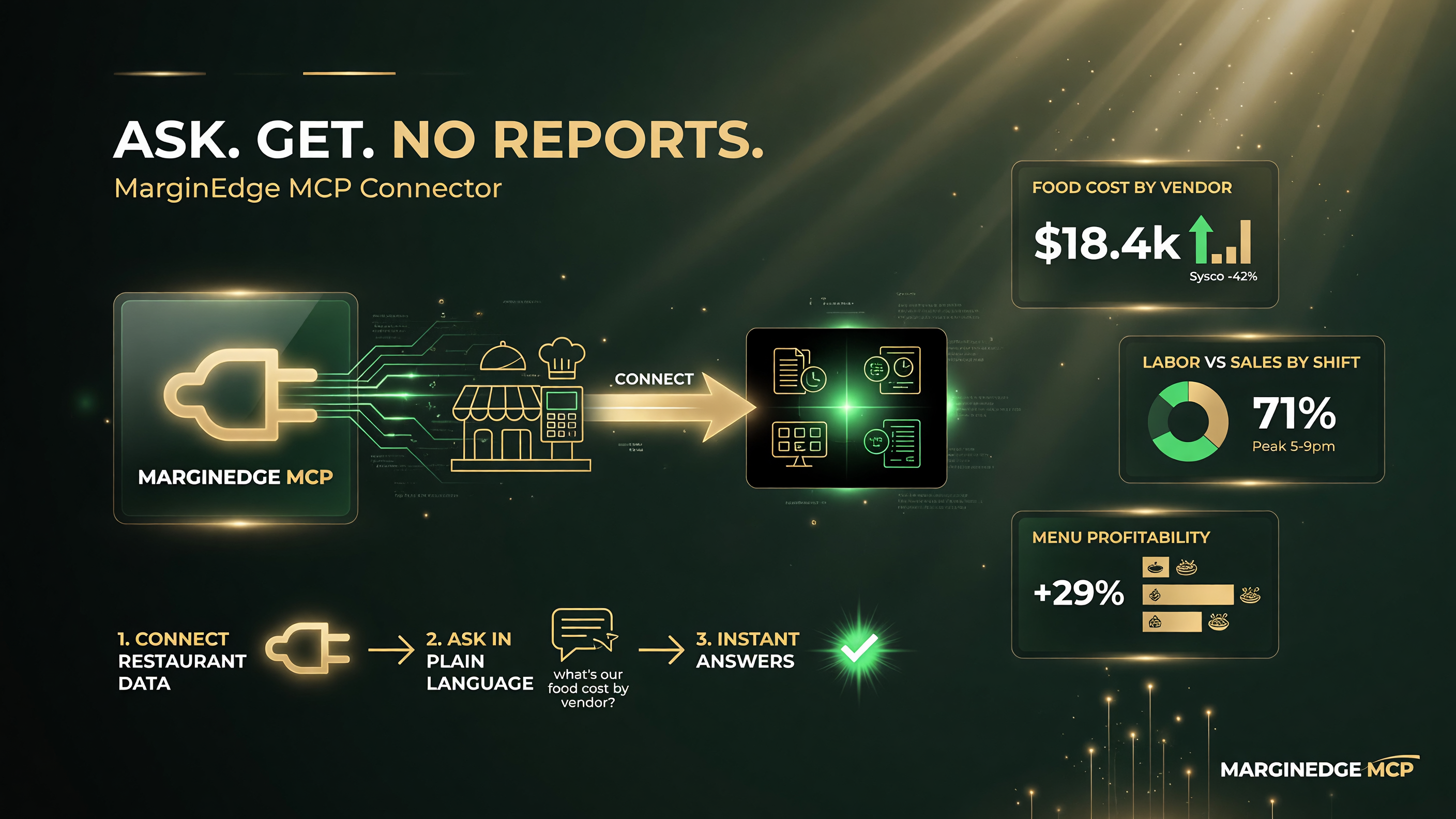
The MCP connector workflow: connect your restaurant data, then ask plain-language questions (food cost by vendor, labor vs sales by shift) and get instant answers — no manual report building.
Why the $80 Million Round Matters to You
Funding rounds get announced with big numbers and vague promises. Here is what this one is actually for, per MarginEdge’s own statements: expanding AI product development, hiring, R&D, sales, and marketing — as competition for the AI-powered restaurant back-office heats up.
Translation: MarginEdge is betting that AI is the next battleground in restaurant software, and it’s putting real money behind it. For an independent owner, that’s mostly good news. It means the platform you use is investing in making its AI features better, not just adding surface bells and whistles. And it means you’re not locked into a tool from a company standing still — the competitive pressure is driving the whole category forward.
The round is a mix of equity and debt, and the list of participants is notable — Osage Venture Partners, Derive Ventures, and Western Alliance Bank joined the co-leads. That’s a strong signal that serious money sees restaurant back-office AI as a real market, not a side project.
The Short Version of the MarginEdge Timeline
| Date (2026) | News |
|---|---|
| August 4 | Launched first MCP connector from a restaurant management/bill payment platform, letting AI tools query restaurant data securely. |
| August 11 | Closed $80M Series D (co-led by Schooner Capital & Ten Coves Capital), total funding now $162M. |
| Moving forward | Capital earmarked for AI product development, hiring, R&D, sales, and marketing. |
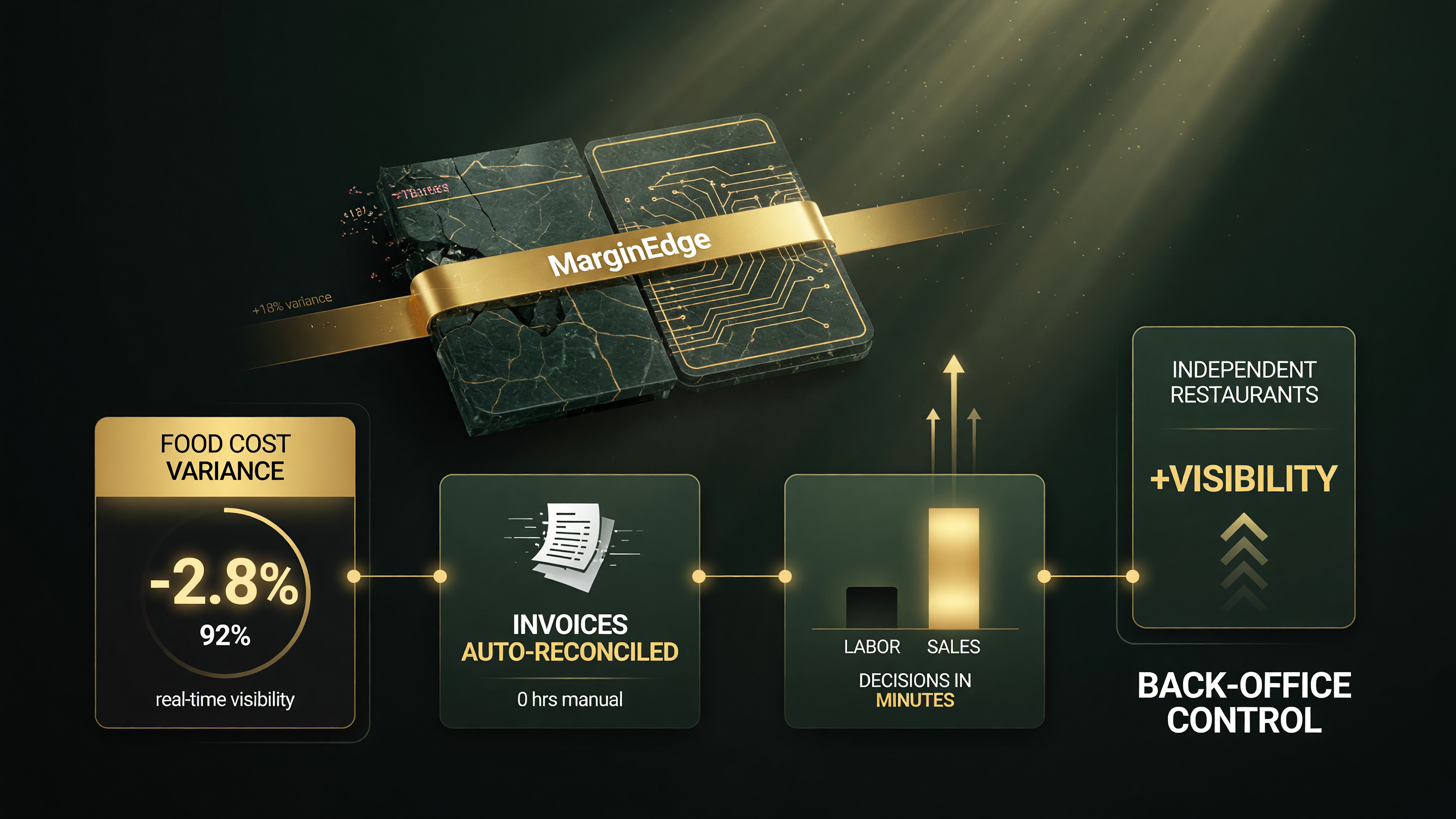
For independent owners: food cost variance down ~2-3%, invoices auto-reconciled (no hours of manual entry), and labor-vs-sales decisions made in minutes.
What This Realistically Means for Independent Owners
Let’s be honest about what this doesn’t do. It doesn’t run your restaurant for you. It doesn’t replace your accountant or make your vendors cheaper. What it does is close a gap that has frustrated operators for years: your business data already lives in software, but it’s been hard to actually ask questions of it.
Here are the realistic ways an independent operator might use this:
- Ask questions in plain language. “Show me last month’s food cost by category” becomes a question you can ask in ChatGPT rather than a report you have to build.
- Catch problems faster. An AI reading your live data can flag a category where spend jumped this week — before it becomes a month-end shock.
- Put your numbers next to everything else. MCP lets your restaurant data sit alongside other business info in the same AI conversation, so you’re not context-switching between tools.
A concrete example makes this tangible. Say your produce line runs heavy three weeks running. Without MCP, you’d only notice it when you pull a month-end report and see the number jumped. With the connector, you can ask the AI directly: “Which produce vendors am I over budget with this month?” — and get a specific answer tied to your own invoice data, at the moment you’re thinking about it, not two weeks later. That’s the difference between data you have to go find and data that answers your questions when you ask them.
The honest caveat: the MCP connector is new, and its usefulness depends on how well you set it up and how much you actually use it. The tool is only as good as the habit you build around it. But the direction here is clear — restaurant data is becoming something you can just talk to.
Should You Care About This Specifically?
If you already use MarginEdge, yes — this is a reason to look at what the platform’s AI features now offer, especially around asking questions of your own data. If you don’t use MarginEdge, this is a signal about the direction of restaurant software generally: the platforms that win will be the ones that make your data usable with AI, not just store it.
The bigger lesson for independent owners is about staying ahead of the back-office load. Tools that automate invoice entry, reconcile bills, and now answer questions from your live data are exactly what free you up to spend your energy on the floor and your guests. That’s the game — and MarginEdge just made a $162 million bet that data-and-AI is how it gets played.
One practical note on timing: if this interests you, it’s worth checking with your MarginEdge rep (or their help center) to see whether the MCP connector is enabled for your plan and which AI tools you can connect. New features often roll out unevenly, and the sooner you know what your plan includes, the sooner you can decide whether to use it. The capability is the headline, but the habit is where the value actually lands.
Frequently Asked Questions
What is MarginEdge’s MCP connector?
It’s the first MCP connector from a restaurant management and bill payment platform. In plain terms, it’s a secure, standardized way for AI tools like ChatGPT, Claude, and Gemini to read your restaurant’s MarginEdge data — costs, sales, compliance — so you can ask questions and get answers from your real numbers.
How much funding did MarginEdge raise?
MarginEdge closed an $80 million Series D, announced August 11, 2026, co-led by Schooner Capital and Ten Coves Capital, bringing its total funding to $162 million. The round includes equity and debt.
What does MarginEdge do for restaurants?
It’s a back-office platform that automates invoice processing, manages bill payment, tracks inventory and food cost, connects labor costs, and provides daily P&L — with integrations to POS systems and accounting software like QuickBooks and Toast.
How does the MCP connector help a restaurant owner?
It lets you ask questions of your live business data in plain language inside AI tools, so instead of building reports or exporting spreadsheets, you can ask things like “What was my food cost last week?” and get a data-backed answer.
Is the MarginEdge MCP connector available to all users?
MarginEdge launched the MCP connector on August 4, 2026. It accesses MarginEdge data via an MCP server; availability depends on your MarginEdge setup and the AI tool you’re connecting to. Check with MarginEdge support for setup specifics.
Why is the $80 million round important for restaurants?
It shows serious investment in AI-powered restaurant back-office software, which fuels better AI features and stronger competition in the category — meaning the tools you use are being built to make your data easier to act on, not just store.

About Barak Schurr
Barak Schurr built and exited a major ticketing platform, ran global operations at Eventbrite, and now focuses on one question: which AI tools actually help independent restaurant owners run leaner and grow faster. He writes from the operator’s perspective — no vendor spin, no theory, just what’s real in 2026.
Email: [email protected]
More AI Resources for Your Business