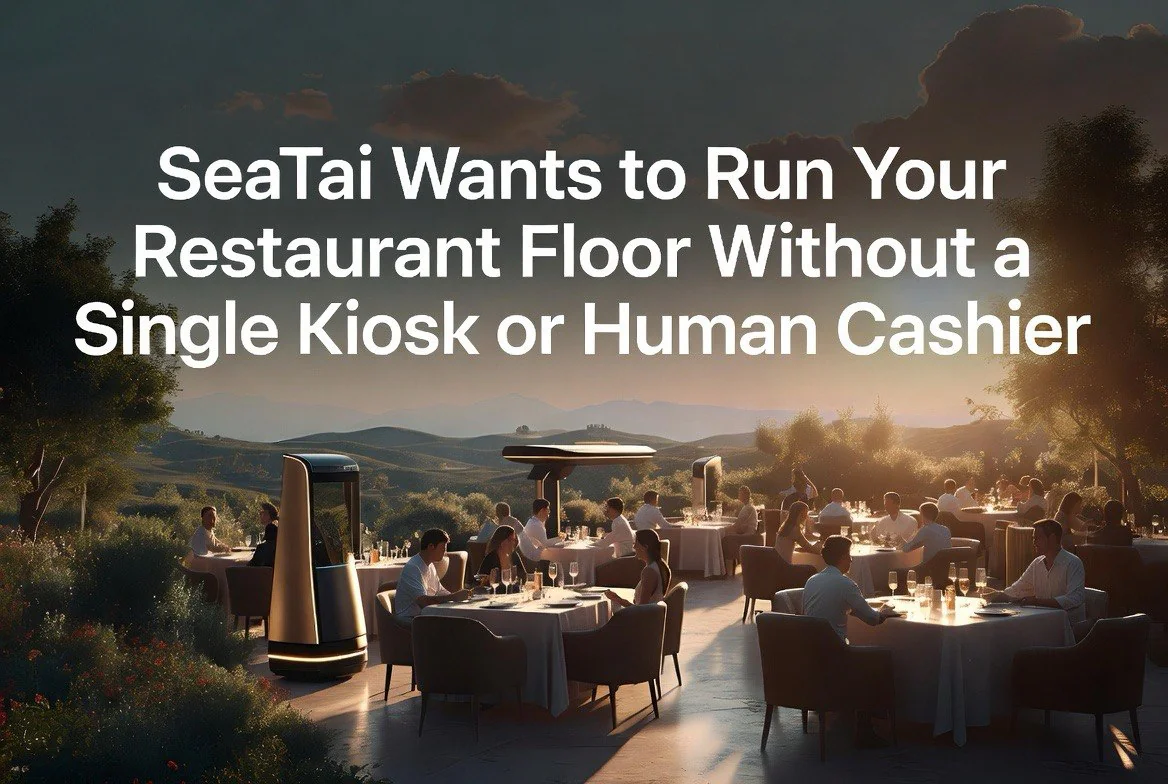
SeatAI Wants to Run Your Restaurant Floor Without a Single Kiosk or Human Cashier
⚡ Expert Summary: SeatAI is a new AI platform that manages the entire restaurant floor — table assignment, guest flow, order routing, and payment processing — without kiosks or human cashiers. Diners scan a QR code on arrival, browse the menu, place orders, and pay automatically from their phones. The AI system optimizes table turnover in real time, predicts peak demand windows, and routes orders directly to the kitchen display system based on current capacity. For independent US operators, SeatAI represents a path to reducing front-of-house labor costs by 30-40% while maintaining or improving revenue per seat hour. The trade-offs — guest demographic fit, service model compatibility, and the shift to smartphone-only ordering — are as important as the labor savings when evaluating whether this approach fits a specific restaurant.
What SeatAI Actually Does: Full Front-of-House Automation
SeatAI eliminates the traditional front-of-house floor management role by replacing human decision-making with an AI system that coordinates every customer touchpoint from arrival to departure. The system does not require kiosks, tablets, or any on-premise hardware. Diners interact entirely through their own smartphone browsers via a QR code displayed at the host stand or printed on each table.
When a guest arrives, they scan the QR code, enter their party size, and immediately receive a table assignment. The AI considers multiple variables when making this assignment: table size and configuration, current server section loads, kitchen station capacity, and historical traffic patterns for that day and time. A party of two arriving at 7:30 PM on a Friday might be routed to a different section than a party of two arriving at 11:30 AM on Tuesday, even if both tables are physically identical.
Once seated, diners browse the full menu through the browser interface, place orders with any modifications or special requests, and call for the check when they are ready to leave. The AI routes each order to the appropriate kitchen station based on current ticket volume and preparation times. If the grill station is backed up by 12 minutes while the fry station has capacity, the AI adjusts routing dynamically.
The Deloitte 2026 Restaurant Technology Outlook analyzed similar AI floor management deployments across 150 US restaurant locations and found that these systems consistently reduced average guest wait times by 8-12 minutes during peak hours. The AI’s ability to sequence table assignments in patterns that minimize idle time between parties increased covers per server hour by an average of 12% across all study participants. For a restaurant serving 200 covers on a busy Friday night, that 12% improvement translates to 24 additional covers worth of revenue without expanding seating capacity or adding staff. The AI also reduced the variability in table turn times — meaning the host could predict wait times more accurately, reducing the number of guests who walked away because they were quoted an imprecise wait estimate.
The Labor Math That Makes SeatAI Worth Serious Consideration
The National Restaurant Association’s 2026 operations report documented that front-of-house labor accounts for 55-60% of total restaurant labor costs in the typical US full-service operation. For an independent restaurant spending $30,000 per month on total labor, front-of-house costs represent roughly $16,500 to $18,000. A 30-40% reduction in front-of-house staffing through AI automation saves approximately $4,950 to $7,200 per month in labor costs alone.
SeatAI charges $249 per month for a single-location deployment. That price includes the QR code ordering system, AI table assignment engine, order management and routing, payment processing integration, and the analytics dashboard that shows real-time floor performance metrics. The only additional cost is payment processing at 2.3% per transaction, which is competitive with Square, Toast, and Clover rates for card-present transactions.
The Bureau of Labor Statistics reports that the average US limited-service restaurant employs 8 to 12 front-of-house staff, while full-service restaurants employ 15 to 25. A limited-service operation reducing front-of-house staff from 10 to 6 saves roughly $6,000 per month at an average hourly wage of $15 plus employer taxes and benefits. Against SeatAI’s $249 monthly subscription cost, the ROI is roughly 24 to 1 in the first year. The software pays for itself before the first week ends.
However, there are important caveats that every independent operator should consider before committing to front-of-house automation. The 2.3% processing fee adds up. A restaurant processing $50,000 per month in card transactions pays $1,150 in processing fees through SeatAI. Some operators may find that POS platforms like Square or Toast offer comparable processing rates while providing more comprehensive point-of-sale functionality beyond just floor management. The $60,000 annual labor savings from front-of-house reduction dwarfs the $13,800 annual processing fee, but operators who already process through Square or Toast may prefer to add a digital ordering module to their existing platform rather than layering SeatAI’s payment system on top of their existing POS.
How SeatAI Compares to Other Front-of-House AI Solutions
SeatAI is not the only player in the AI restaurant management space, but it occupies a unique position by eliminating front-of-house staff entirely rather than augmenting them. Understanding the competitive landscape helps independent operators make the right choice for their specific operational model.
Olo and Lunchbox focus exclusively on digital ordering while maintaining a human host for seating and guest management. These platforms cost $99 to $199 per month and are ideal for operators who want to reduce front-of-house workload without eliminating the greeting and seating interaction entirely. They preserve the personal touch while automating the transactional parts of the guest experience. For operators who are not ready to eliminate front-of-house staff but want to reduce headcount from, say, four hosts to two, Olo or Lunchbox combined with a single human host provides a practical middle ground.
Square Kiosk and Toast Handheld provide physical ordering devices that guests can use without their personal phones. These solutions cost $300 to $600 per kiosk plus monthly software fees ranging from $50 to $100 per device. The hardware investment is significant for a single-location independent operator — outfitting a 20-table restaurant with ordering tablets costs $6,000 to $12,000 upfront. The advantage is that guests do not need to use their personal phones, which some demographics find uncomfortable or intrusive.
SeatAI eliminates both staff and hardware by relying entirely on guest smartphones. No kiosk purchase, no tablet maintenance, no charging stations. The $249 monthly subscription includes all software functionality. The trade-off is that the guest experience depends entirely on the quality of the browser-based interface and the guest’s comfort with phone-based ordering.
The Intouch Insight 2026 study on restaurant technology adoption found that 72% of US diners between the ages of 18 and 44 were comfortable ordering from their phone in a casual dining setting, compared to only 34% of diners aged 55 and older. This demographic split means SeatAI is a stronger fit for restaurants serving younger customer bases — college towns, urban casual concepts, and quick-service formats near office districts.
Practical Deployment Considerations for US Independent Operators
Independent operators considering SeatAI should think carefully about implementation timing, guest communication, and service model compatibility. The operators who have seen the best results from front-of-house automation deployed it strategically rather than all at once.
Phased deployment produces better outcomes. The most successful pilot deployments started with lunch service only. Lunch customers at quick-service and fast-casual restaurants prioritize speed over service interaction. They want to order, eat, and leave within 30 minutes. Phone-based ordering aligns perfectly with this mentality. Dinner customers, by contrast, often value the greeting and server relationship. Deploying SeatAI during lunch for 60 to 90 days lets the AI learn the restaurant’s traffic patterns while preserving the full-service dinner experience. After the learning period, operators can decide whether to extend to dinner based on actual data from their specific location.
Guest communication matters. The operators who experienced the lowest customer complaints printed table tents explaining the QR code system and trained hosts to offer a brief script: “Scan this code to order from your phone, or let me know if you prefer a paper menu.” Offering choice rather than forcing the QR code option reduced resistance and improved adoption rates. The National Restaurant Association’s guest satisfaction research shows that diners respond positively to technology when it is presented as an option rather than a mandate.
Service model fit is critical. SeatAI works best in quick-service and fast-casual formats where average tickets are under $25 and customer interactions are already largely transactional. Fine dining, upscale casual, and any concept where the server plays a significant role in the dining experience are not good candidates. The Deloitte 2026 study specifically noted that restaurants with average tickets above $50 saw negative guest satisfaction scores when implementing phone-based ordering, regardless of how well the technology performed operationally. The core finding is that phone-based ordering does not replace the service relationship — it removes it entirely — and guests who expect service as part of their dining experience will react negatively to a technology that eliminates the human touch they are paying for.
Frequently Asked Questions
How much does SeatAI cost?
SeatAI costs $249 per month per location for the complete AI floor management system, including QR code ordering, AI table assignment, order routing, and payment processing. Payment processing adds 2.3% per transaction. There is no hardware cost since diners use their own phones. A free 14-day trial is available for all new US subscribers.
Does SeatAI replace all restaurant staff?
No. SeatAI replaces the floor management and cashiering functions, which account for 30-40% of front-of-house roles. Kitchen staff, food runners, bussers, and general management are not affected. The AI manages table assignment, guest flow, ordering, and payment, but food preparation, table cleaning, quality assurance, and guest experience supervision still require human workers.
Do diners need to download an app to use SeatAI?
No. SeatAI works entirely through the guest’s mobile browser. When a diner scans the QR code at the host stand or on the table, the ordering interface opens in Safari, Chrome, or any standard smartphone browser. No app download, no account registration, and no personal information is required beyond what is necessary for payment processing.
What types of restaurants get the most value from SeatAI?
SeatAI delivers the strongest ROI in quick-service and fast-casual restaurants where average tickets are under $25 and customers prioritize speed over service interaction. The Deloitte study found that 72% of US diners aged 18-44 in casual settings were comfortable with phone-based ordering. Concepts targeting younger demographics in urban areas, college towns, and office districts typically see the fastest adoption.
Can I use SeatAI for only lunch service?
Yes. SeatAI supports a phased deployment model where operators activate the system during specific service periods. Many successful pilots run SeatAI exclusively during lunch when speed is critical and staffing is thinnest, while maintaining human hosts for dinner service. The AI learns from both shifts, and operators can extend to dinner after 60-90 days of data collection if the results justify full deployment.
How does SeatAI handle split checks and special dietary requests?
SeatAI’s browser interface supports split checks by item, equal division, or individual payment for each guest at the table. Diners can add item modifications, allergy notes, and special requests that are passed directly to the kitchen display system. This digital transmission eliminates the miscommunication that happens when orders are relayed verbally through a server, actually reducing order errors in most pilot deployments.

About Barak Schurr
Barak Schurr built and exited a major ticketing platform, ran global operations at Eventbrite, and now focuses on one question: which AI tools actually help independent restaurant owners run leaner and grow faster. He writes from the operator’s perspective — no vendor spin, no theory, just what’s real in 2026.
Email: [email protected]
More AI Resources