Get the AI Restaurant Quick-Start Guide — Free
The 5 AI tools independent US restaurant owners are using right now to cut labor costs and answer every call.
Cinderloop: The Autonomous Back-of-House Crew That Runs Your Restaurant Ops 24/7
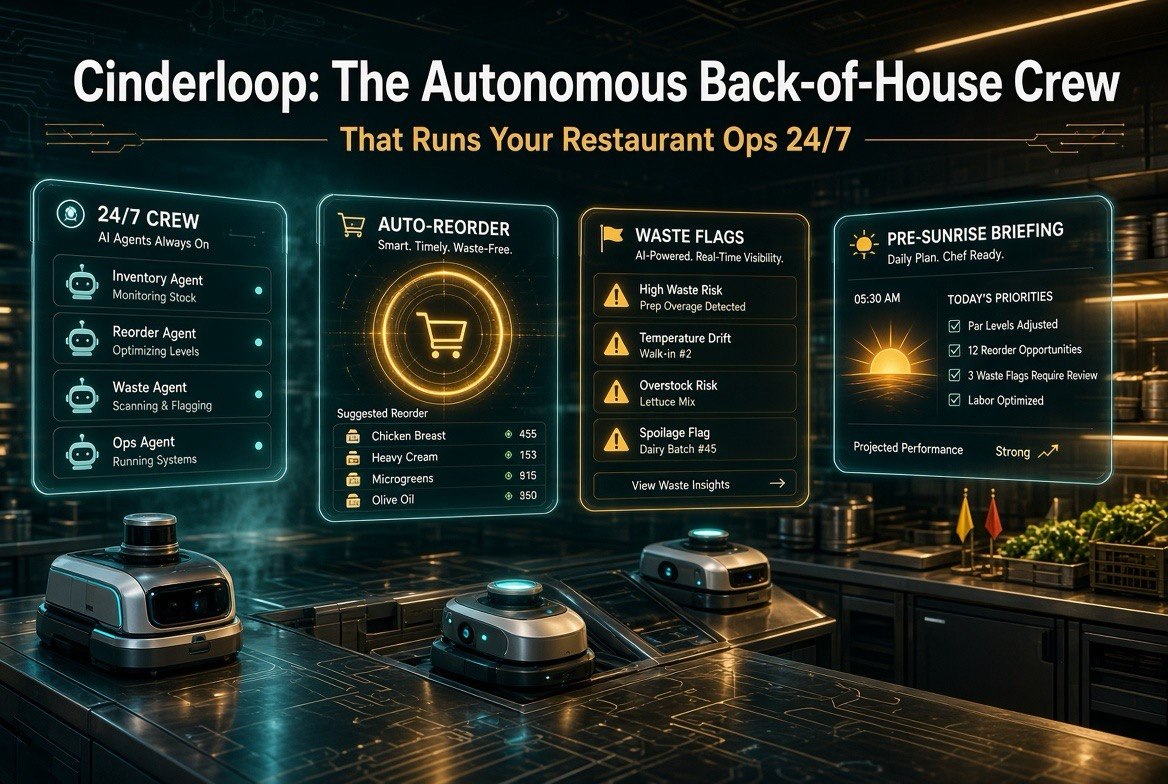
⚡ Expert Summary: Cinderloop is a new AI “back-of-house crew” — a team of autonomous agents that handle the unglamorous operational work of an independent restaurant around the clock: it watches inventory and reorders as needed, flags variances nobody caught, briefs the chef before sunrise, runs the daily special, handles delivery-app orders, and closes the books — no human on shift for the admin grind. Where single-purpose tools attack one pain, Cinderloop’s bet is that the real win for independents is a full crew that keeps executing so the owner can run the pass and the floor instead of the spreadsheet.
Here’s the uncomfortable truth about running an independent restaurant in 2026: the part of your job that’s actually about food — cooking, plating, tasting, running the pass — is maybe a third of your week. The other two-thirds is inventory sheets, order calls, variance spreadsheets, delivery-app disputes, scheduling, closing the books, chasing invoices, and answering the same review for the ninth time.
The chains don’t do that work. They have systems and, increasingly, AI agents doing it behind the scenes at scale. And that asymmetry — not the recipes, not the talent, not the build-out — is the real advantage the big guys hold over you. They free their operators to run the business while their back office runs itself.
Cinderloop, an AI “back-of-house crew” that announced its restaurant agent system on August 18, 2026, is built on the bet that independent operators can now buy that same advantage. Not a single tool for one problem, but a crew of autonomous agents that keeps executing your back office around the clock — no human on shift for the admin.
What a “Back-of-House Crew” Actually Means
Cinderloop comes from Polsia, a company that builds autonomous agents to run companies across different industries. Cinderloop is the restaurant vertical of that idea: instead of one agent solving one task, it’s positioned as a multi-agent crew that covers the operational work that eats chef and owner time.
The framing matters. When you think “software for restaurants,” you usually think of a tool: a POS, a scheduling app, an inventory module. Cinderloop is trying to sell something structurally different — a team of agents that works your back office the way a night crew works the line, continuously and without needing to be told what to do next.
The Jobs Cinderloop Handles
Based on how Cinderloop and its restaurant use-cases are being described, the crew covers a spread of back-of-house work:
Inventory, On Autopilot
It watches inventory and places reorders for produce and supplies based on real-time needs — attacking the manual, guess-based ordering that leaves independents either over-ordered with dead stock or under-ordered on a busy Friday.
Variance and Waste Flagging
It tracks discrepancies and waste that typically get found too late, if at all — the shrinkage “nobody flagged” at the clipboard round. It turns those silent leaks into flagged, actionable items.
The Pre-Sunrise Chef Briefing
It delivers a daily summary to the chef first thing in the morning — what’s in, what’s running low, what needs to move, what the day looks like. The morning briefing a good sous-chef would give, delivered before service without anyone compiling it.
Running Shift-Length Ops
In restaurant examples, it extends to running shift-length work: scheduling, picking the daily special, handling delivery-app orders, and monitoring reviews. The idea is that a small pizzeria or family-run spot can sustain the same 24/7 execution and financial discipline a chain gets from its layers of systems.
Closing the Books
Broadly, the crew is positioned to reconcile, chase invoices, and close the books — the back-office close-out that otherwise falls on the owner after service, long after everyone else has gone home.
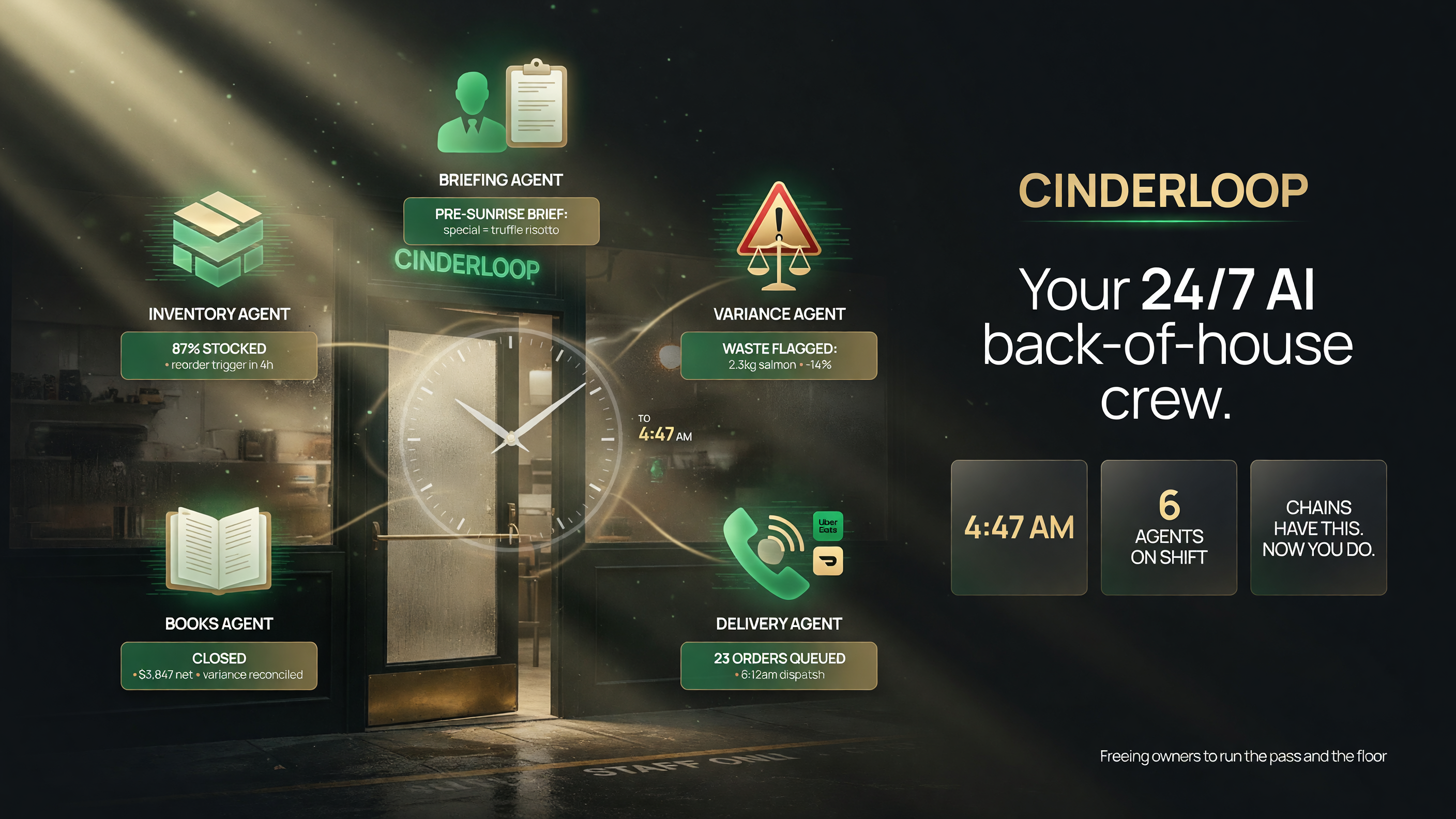
Cinderloop runs a crew of autonomous agents around the clock — inventory watching and reordering, variance and waste flagging, the pre-sunrise chef briefing, delivery-app orders, and closing the books. The bet: independents get the same 24/7 execution discipline the chains get from layers of systems, without an enterprise IT team.
The Big Idea: Beating Chains on Execution Discipline
The most important thing to understand about Cinderloop isn’t any single feature — it’s the thesis underneath. The pitch is that independent operators have been losing to chains not on cooking skill but on the boring, relentless work of staying operationally tight day after day. Chains run on systems: always-on ordering, always-on variance tracking, always-on financial review.
An owner with three hours after service to do the books, ordering, and scheduling simply cannot match that cadence by hand. Not because they’re not competent — because there aren’t enough hours. Cinderloop’s bet is that an autonomous crew closes that gap: independent execution at chain-like 24/7 discipline, without hiring a controller positions that would eat the margin.
That’s the real value proposition, and it’s worth sitting with, because it reframes what “buying AI” means for a restaurant. It’s not buying a faster invoice tool. It’s buying another shift of back-office coverage that never clocks out.
It’s the Crew Model That’s New, Not the Tasks
Be honest about the landscape before you get swept up. Inventory tracking, variance monitoring, scheduling, review response — none of these are new problems, and there are point tools for every single one. What’s novel in the Cinderloop approach is the crew model: agent tasks that coordinate and run together instead of separate apps you have to stitch together and babysit.
This is the same shift playing out across the industry. Last week’s focus landed on single-purpose back-of-house agents — tools that do one job (like inventory) exceptionally well. Cinderloop represents the adjacent step: a coordinated crew covering a spread of jobs so the owner isn’t managing five logins and re-entering data five times. Whether a broad crew or a sharp single tool wins for a given operator depends entirely on their specific gaps — but the direction of travel is clear.
Who This Is Really For
Cinderloop is explicitly aimed at independent and small restaurants — the neighborhood pizzerias, the family-run spots — and at the chefs and owners who are buried in administrative drudgery. The profile is an operator who:
- Wants to spend time on food and guests, not spreadsheets.
- Has felt the pain of a variance discovered too late or an order placed on a guess.
- Runs a small enough operation that there’s no back-office staff to absorb the load.
- Wants to compete with chains on consistency and financial discipline without hiring a whole support team.
If you have a controller, a full back-office staff, and a corporate process, this is not aimed at you. If you are the controller, the purchasing manager, and the night closer all in one apron, it’s aimed squarely at you.
The Real Arithmetic: What 24/7 Back-Office Coverage Is Worth
To make the case concrete, think in the terms every operator understands: hours and dollars.
| Back-office task | Owner hours (typical weekly) | Cinderloop crew |
|---|---|---|
| Inventory + ordering | 3-5+ hours | Autonomous, usage-based |
| Variance / waste recheck | 1-2+ hours | Continuous monitoring, auto-flag |
| Daily briefing / specials | 30-60 min | Pre-sunrise auto-briefing |
| Delivery-app orders | 1-3+ hours | Handled in crew |
| Closing the books / invoices | 2-4+ hours | Reconcile, chase, close |
| Realistic total | 8-15 hours/week of admin | Automated, supervised not done |
Eight to fifteen hours a week of admin work is not a rounding error. On a 60-hour owner week, that’s 13% to 25% of your time doing the work a crew is designed to carry. Even if the crew only recovers half of that, it’s an extra shift-and-a-half a week back in the building — time that either goes into the food and the floor or simply stops being burned.
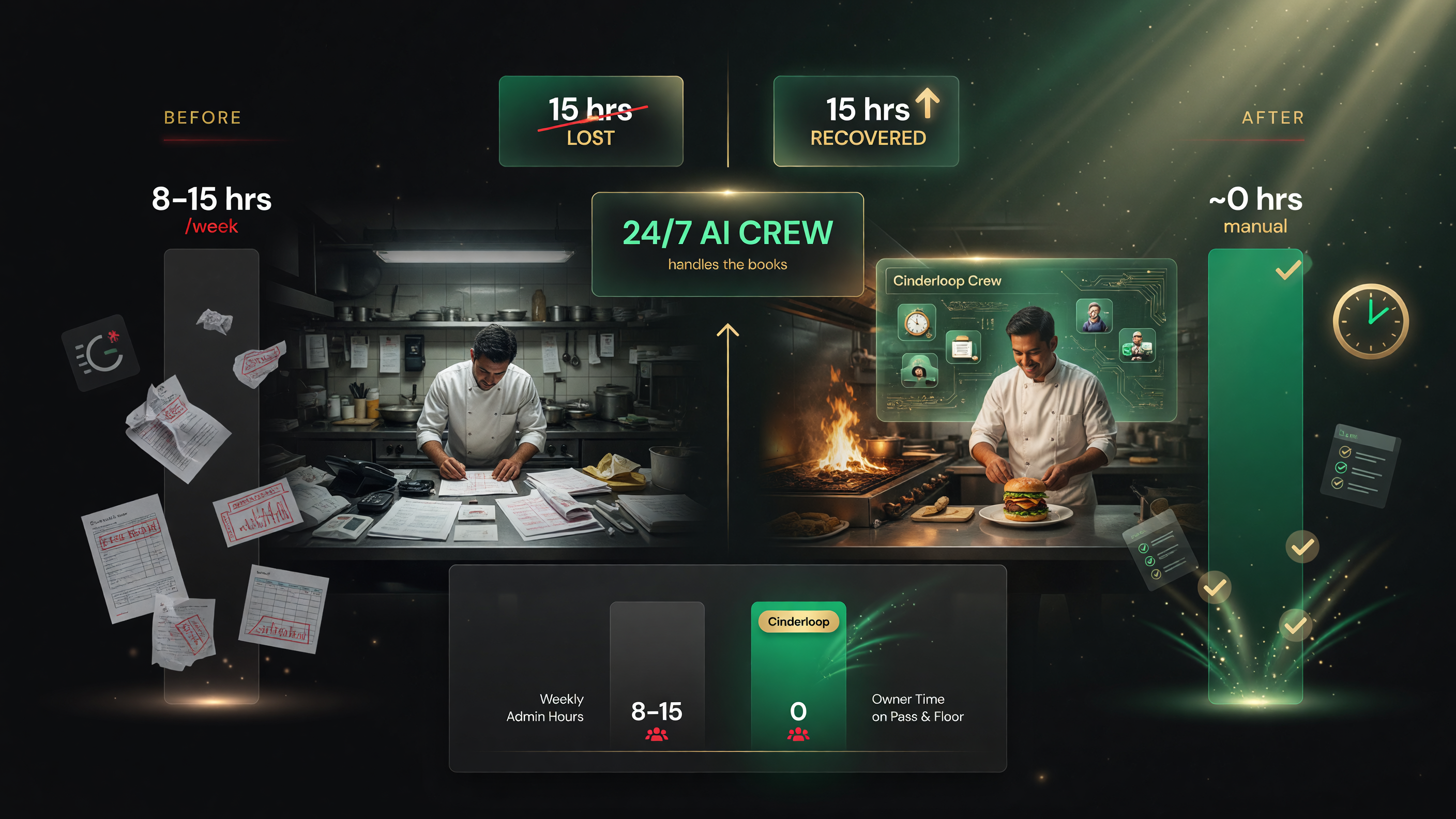
Eight to fifteen hours a week of admin is 13% to 25% of a 60-hour owner week. Cinderloop's crew carries the back-office load so that time either goes into the food and the floor or simply stops being burned.
Independent vs. Single-Purpose Agent
Because the “crew” framing is the core of what’s new, it’s fair to weigh it against the single-purpose back-of-house agents that have also been launching for independents.
| Factor | Single-purpose agent | Cinderloop crew |
|---|---|---|
| Focus | One job done deep | Many jobs coordinated |
| Coverage | A single pain point | Back office end to end |
| Setup | Simple, narrow | Broader, more to configure |
| Best for | A specific known pain | Owner buried across many tasks |
| Take | Quick win on one problem | Whole-back-office coverage |
Neither is objectively better — they solve different shapes of the same problem. If you know exactly where you bleed, a sharp single tool wins. If you’re drowning across the board, a crew that carries the whole load is the better fit. Most independents are the second profile.
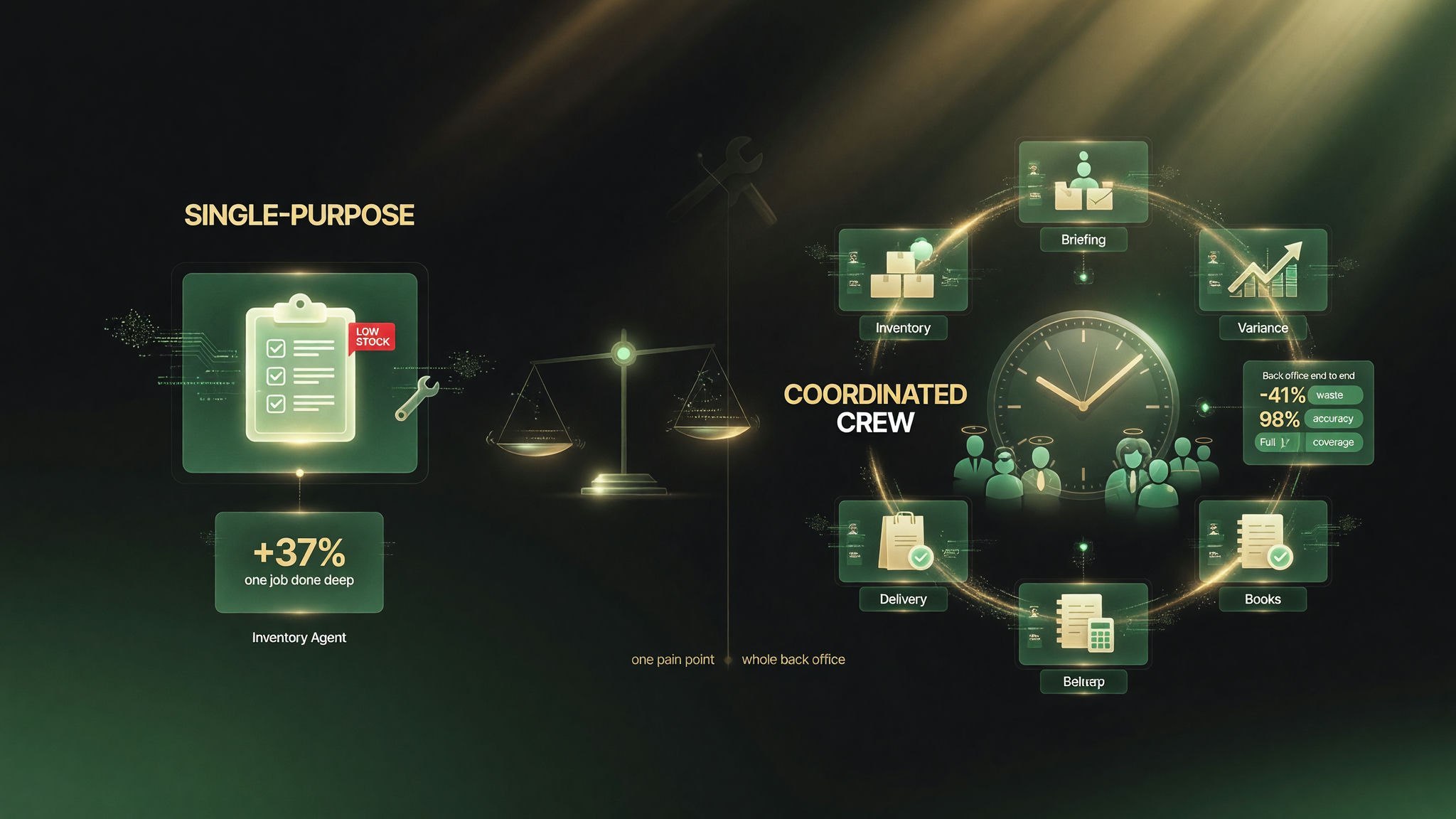
The difference in one picture: a single-purpose agent goes deep on one task, while the Cinderloop crew coordinates the whole back office end to end.
What to Watch Before You Commit
Cinderloop is in its “live soon” stage as of the August 18 announcement, so a few things deserve scrutiny before you build operations around it:
First, the specific agent coverage available to you. The “crew” is the pitch, but you need to know exactly which agents are available at launch and how they chain together. A crew you can’t configure to match how your kitchen actually runs is a toy, not a tool.
Second, integration with your real systems. Verify it connects to your actual POS, supplier channels, and delivery platforms — not a generic demo flow. The value of an autonomous crew lives or dies on whether it’s wired into the systems you already use.
Third, the supervision model. “No human on shift” should mean the agent runs the routine, not that you lose visibility. Clarity on what it flags for your approval versus what it acts on autonomously is essential — especially around spending (ordering) where a wrong call costs real money.
Fourth, pricing. As of the announcement, no specific pricing was published. Before you commit, get the actual cost structure and compare it against the 8-15 hours a week it’s meant to recover.
How to Get Started
If the crew model resonates, treat adoption the same way you’d staff a real shift:
- Map the back-office tasks consuming your week — inventory, ordering, variance, briefing, delivery, books — and rank them by pain and hours.
- Start the crew with the highest-pain agent first, so you can judge it against your real numbers before you expand coverage.
- Watch how it flags variances and places orders for the first two weeks, and tighten the rules to match your kitchen’s actual rhythm.
- Expand to the full crew once the first agent has proven itself on your operation.
- Re-focus the recovered hours on the floor and the pass — that’s the entire point.
Cinderloop is not magic. It’s a bet that the independent-restaurant owner’s worst enemy is the administrative grind — and that a crew of autonomous agents can carry it so you don’t have to. For the operator who’s tired of being the controller, the purchasing manager, and the night closer all in one apron, it’s a bet worth taking seriously.
Frequently Asked Questions
What is Cinderloop?
Cinderloop is an AI “back-of-house crew” for independent restaurants: a team of autonomous agents that handles inventory, reordering, variance tracking, chef briefings, scheduling, delivery-app orders, and closing the books — running the admin side of a restaurant around the clock so the owner can focus on the food and the floor.
Who builds Cinderloop?
Cinderloop comes from Polsia, a company that builds autonomous agents to run companies across different industries. Cinderloop is its restaurant-specific agent crew, aimed at independent and small operators rather than large chains.
How is Cinderloop different from inventory software?
It’s a crew model rather than a single tool. Instead of a dashboard you check and act on, Cinderloop is a set of coordinated agents that take action — tracking inventory, flagging variances, briefing the chef, handling delivery orders, and closing the books — so the owner supervises rather than executes the routine.
Is Cinderloop for large restaurant chains?
No. It’s targeted at independent and small restaurants, in particular chefs and owners buried in administrative drudgery who want to compete with chains on 24/7 execution and financial discipline without hiring a full back-office staff.
How much does Cinderloop cost?
As of the August 18, 2026 announcement, Cinderloop had not published specific pricing or subscription tiers. Operators considering it should confirm the actual cost structure against the hours it’s meant to recover in their specific operation.

About Barak Schurr
Barak Schurr built and exited a major ticketing platform, ran global operations at Eventbrite, and now focuses on one question: which AI tools actually help independent restaurant owners run leaner and grow faster. He writes from the operator’s perspective — no vendor spin, no theory, just what’s real in 2026.
Email: [email protected]
More Resources for Restaurant Operators