Get the AI Restaurant Quick-Start Guide — Free
The 5 AI tools independent US restaurant owners are using right now to cut labor costs and answer every call.
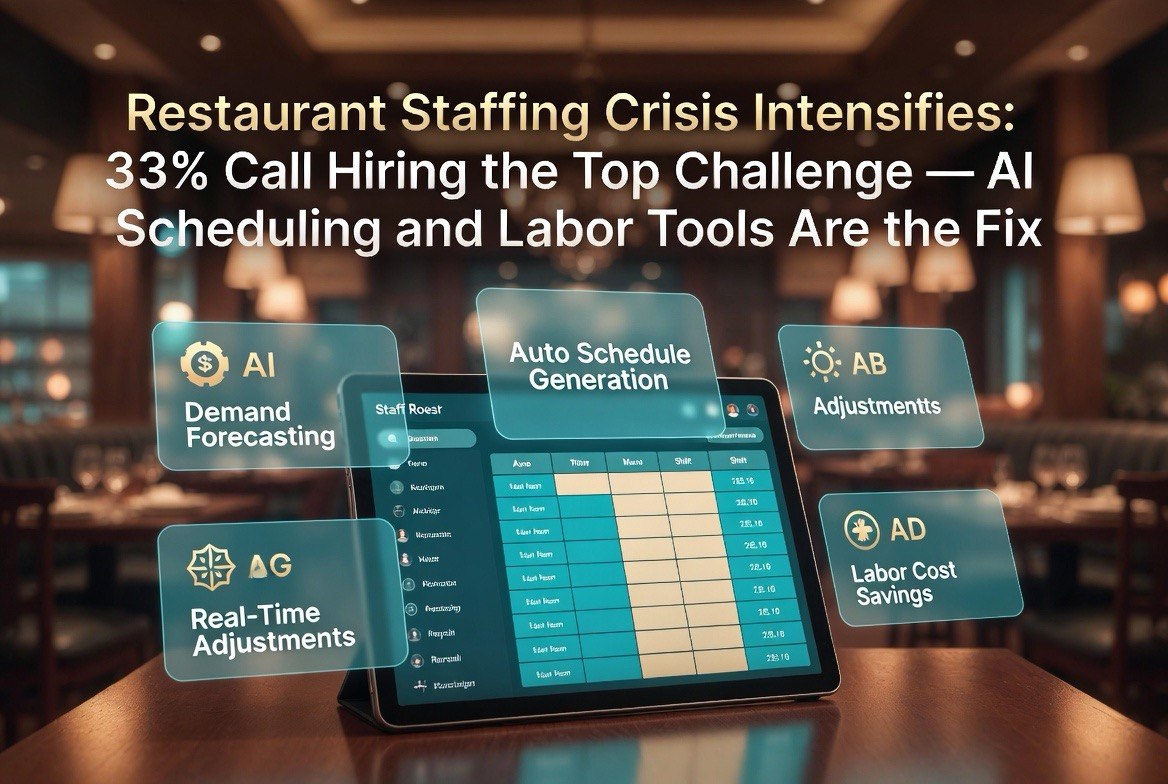
Restaurant Staffing Crisis Intensifies: 33% Call Hiring the Top Challenge — AI Scheduling and Labor Tools Are the Fix
⚡ Expert Summary: Restaurant staffing surged from the third-biggest operational challenge in January 2026 to the number-one pain point by mid-year, with 33% of operators now calling hiring their top concern. Training has overtaken pay as the primary retention strategy, and operators using AI scheduling and labor forecasting report measurable improvements — including up to 62% lower labor costs at some deployments. Restaurant365’s mid-year data and National Restaurant Association surveys paint a clear picture: the old approach of posting a sign and hoping someone walks in no longer works. AI-powered scheduling, demand forecasting, and automated labor management are the bridge between chronic understaffing and sustainable operations.
The restaurant staffing numbers for mid-2026 tell a brutal story. Restaurant365’s mid-year operator survey found that the percentage of operators naming hiring as their top challenge nearly doubled from January to July — jumping from approximately 18% to 33%. That is not a seasonal fluctuation. It is a structural shift in the labor market that the restaurant industry has not fully adapted to.
The old assumption was that pay was the primary leverage point. If you offered competitive wages, workers would come. The 2026 data says something different. Training has overtaken pay as the top retention strategy, according to operator surveys. Workers are not leaving because they are underpaid across the board. They are leaving because the job is stressful, the schedules are unpredictable, and the path from entry-level to a sustainable career is invisible.
For independent operators running one to five locations, this is both the biggest threat and the biggest opportunity in the current market. Chains have the HR infrastructure to manage training programs and career pathing. Independents do not. But independents also have the flexibility to adopt AI scheduling tools faster than chains, and the data shows that speed of adoption correlates directly with labor cost improvements.
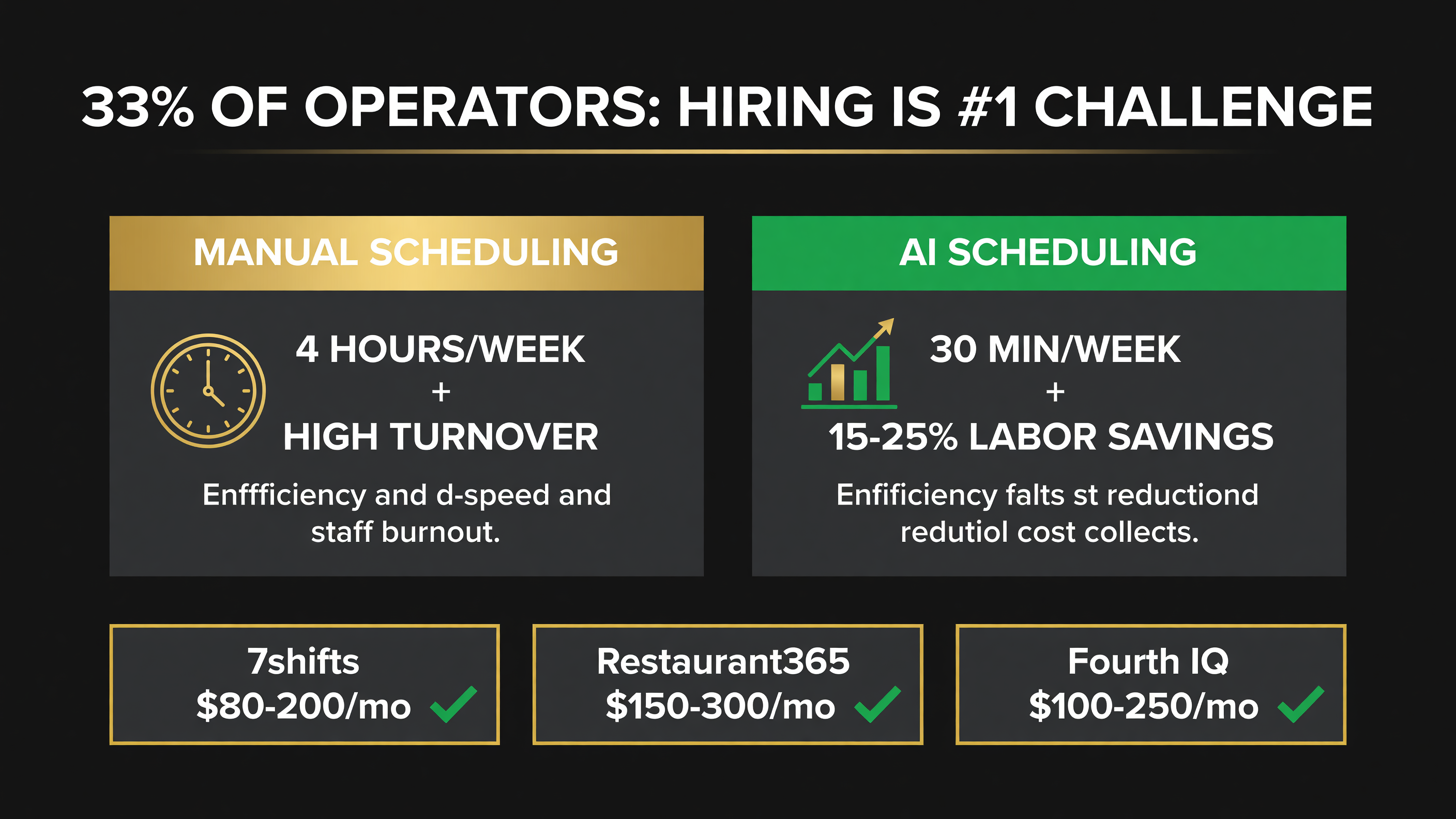
Nearly a third of restaurant operators now rank hiring their top challenge, up from 18% in January 2026. AI scheduling tools reduce labor costs by 15-25% and cut scheduling time from hours to minutes. Data from Restaurant365 mid-year survey and Fourth IQ analysis.
Why Hiring Jumped From Third to First in Six Months
The Restaurant365 mid-year report surfaced three converging trends that turned staffing from a manageable problem into a crisis.
First, the available labor pool continued to shrink in the first half of 2026. Full-service restaurant employment remained approximately 3.3% below pre-pandemic levels in many states as of May 2026, according to National Restaurant Association data. The industry saw a net loss of jobs in June 2026 — meaning more restaurants lost staff than gained them in a month that should have been a hiring ramp for summer.
Second, competition from adjacent industries intensified. Gig economy platforms, warehouse logistics, and healthcare support roles all offer comparable pay with more predictable schedules and less physical stress. A restaurant dishwasher earning $15 per hour can switch to a warehouse role earning $18 per hour with fixed shifts and no weekend work. The restaurant industry is not just competing with other restaurants for labor. It is competing with every other industry that needs entry-level workers.
Third, the workforce that remains has different expectations. The post-pandemic restaurant worker wants schedule flexibility, shift predictability, and clear advancement pathways. The industry norm of split shifts, on-call scheduling, and last-minute shift changes is incompatible with what workers in 2026 will tolerate. Restaurants that have not updated their scheduling practices are bleeding staff to competitors that have.
Training Overtakes Pay as the Retention Lever
The finding that surprised many operators in the 2026 data is that training has overtaken pay as the top retention strategy. This is counterintuitive for an industry where margin pressure keeps wages low.
The mechanism is straightforward. A new hire who receives structured training within the first week is significantly more likely to stay past the 90-day mark than a hire who is thrown into a shift with minimal orientation. The first 90 days are the highest-risk period for turnover. Approximately 70% of restaurant employee departures happen within the first three months, according to industry turnover data running at roughly 122% annually.
Training reduces early departure risk by giving the new hire three things: competence (they know how to do the job), confidence (they know they are doing it correctly), and connection (they know who to ask for help). AI scheduling tools support this by ensuring that new hires are paired with experienced staff during their first shifts rather than being left to figure it out during a skeleton crew shift.
Operators who invest in structured onboarding and pair it with AI-optimized scheduling see measurably lower first-90-day turnover. The cost of that investment is a fraction of the recurring cost of hiring and training replacements every six to eight weeks.
What AI Scheduling and Labor Tools Actually Deliver
The 2026 data on AI scheduling is not aspirational. It is operational. Restaurants using AI forecasting for labor management report approximately 15 to 25 percent improvement in labor cost control, according to industry analyses from Fourth and Restaurant365.
The specific mechanisms are worth understanding because they determine which vendor and approach fits each operator’s situation.
Demand forecasting is the core capability. AI scheduling tools use historical sales data, weather patterns, local events, and day-of-week trends to predict exactly how many customers will walk through the door during each shift. The forecast generates a labor schedule that matches staffing to predicted demand within a configurable margin. Overstaffing is eliminated because the tool will not schedule three line cooks for a shift that historically needs two. Understaffing is eliminated because the tool surfaces the predicted demand before the schedule is published, not after the shift starts when it is too late to adjust.
Automated schedule generation reduces the time a manager spends on scheduling from two to four hours per week to approximately 15 to 30 minutes. That time is redirected to training, coaching, and customer interaction — which directly supports retention.
Real-time adjustments allow the system to respond to unexpected changes. A sudden rainstorm that reduces walk-in traffic? The system can suggest sending a cook home early to save labor dollars. A booked private event that doubles expected covers? The system flags the gap and suggests adding a server.
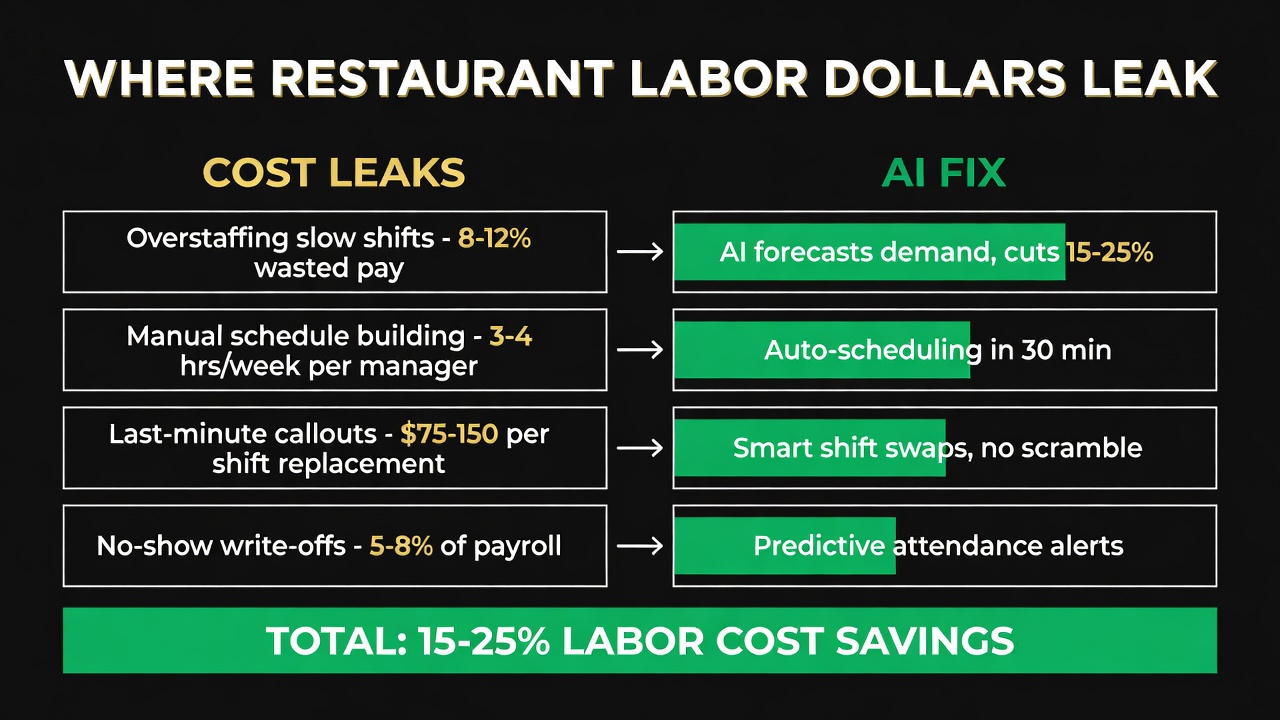
Labor costs leak through overstaffing, manual schedules, callouts, and no-shows. AI scheduling attacks each leak, cutting total labor cost by an estimated 15-25%. Figures drawn from Fourth IQ and 7shifts labor benchmarks.
The reported impact numbers from operators using these tools include: a 22 percent reduction in over-scheduling across chains using Fourth IQ, a 62 percent reduction in labor costs reported by Restaurant365 users practicing AI-driven scheduling, and an estimated 10 to 15 percent reduction in turnover at locations using predictive scheduling compared to manual scheduling.
Three AI Scheduling Tools Independent Operators Should Evaluate in 2026
Restaurant365 remains the most comprehensive option for operators who want scheduling, inventory, and accounting in one platform. Its AI forecasting module uses historical data from the operator’s own POS to generate demand predictions and schedule recommendations. Pricing starts at approximately $150 to $300 per month per location depending on module selection.
7shifts focuses exclusively on scheduling and team communication. Its AI features include sales-forecast-based scheduling, labor cost tracking, and shift trading. The platform integrates with most major POS systems and is designed for the independent operator workflow. Pricing starts at approximately $80 to $200 per month per location.
Fourth IQ is the enterprise solution that chains like Chili’s use, but Fourth offers scaled-down versions for smaller operations. The AI engine is the same — demand forecasting, labor optimization, and compliance tracking — but the pricing adjusts to location count. Expect approximately $100 to $250 per month per location for smaller deployments.
The common thread across all three platforms is that the AI component is not a separate module that requires training to use. It is embedded in the scheduling workflow. The manager inputs the expected volume or accepts the AI-generated forecast, and the system produces a schedule optimized for that number. The adoption barrier is low enough that an operator with basic POS literacy can implement within two weeks.
How to Implement AI Scheduling Without Disrupting Your Current Operation
The most common mistake operators make when adopting AI scheduling is implementing it across all locations and all shifts simultaneously. The predictable result is confusion, pushback from staff, and a return to manual scheduling within three weeks.
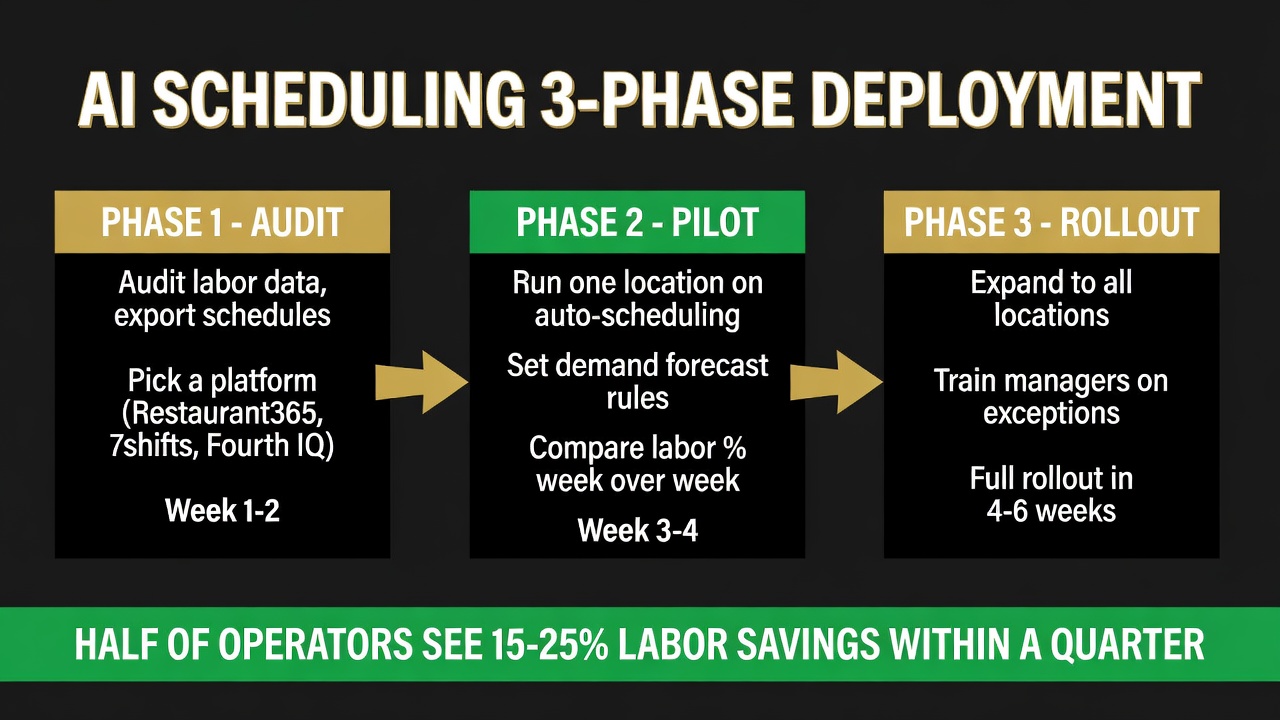
Rolling out AI scheduling in three phases limits risk: audit your labor data, pilot one location, then expand. Most operators reach 15-25% labor savings within a quarter of full rollout.
The correct approach requires three phases over approximately four to six weeks.
Phase one is data collection and validation. The AI tool needs at least three months of historical POS data to generate accurate forecasts. If the operator has been using a cloud-based POS that stores historical data, this is automatic. If the operator is on an older system, the data may need to be exported and imported manually. This phase takes roughly one week and determines whether the tool will work at all.
Phase two is parallel operation. Run the AI-generated schedule alongside the manual schedule for two weeks. Compare the labor cost percentage for each week. If the AI-generated schedule shows a lower labor cost percentage with comparable customer satisfaction scores, the operator has validation that the tool works for their specific operation. If the data shows no improvement or a negative impact, the configuration needs adjustment — typically the demand forecast needs a wider or narrower margin depending on the location’s variability.
Phase three is full adoption. Once the parallel test confirms the tool’s accuracy, switch to AI-generated schedules as the primary method. The manager’s role shifts from creating the schedule to reviewing and adjusting it. This typically takes 30 minutes per week instead of the two to four hours spent on manual scheduling.
The Cost of Not Adopting AI Scheduling
The numbers that independent operators should focus on are not the savings from AI scheduling. They are the costs of continuing without it.
Every unfilled shift at a restaurant costs approximately $3,000 to $5,000 in lost sales over three months, according to industry analyses from Fourth. A restaurant with 15 employees running at 122 percent annual turnover loses approximately 18 employees per year. Each departure costs $3,000 to $5,000 in lost sales during the replacement cycle. That is $54,000 to $90,000 in avoidable lost revenue per year for a single location.
Understaffed shifts do not just lose revenue. They damage the customer experience. A table that waits 15 minutes for service because the restaurant is running one server short does not blame the staffing shortage. They blame the restaurant. On a weekend night, that table generates a negative review that costs approximately 30 potential customers, according to industry reputation management data.
AI scheduling is not a technology experiment. It is a financial hedge against the cost of chronic understaffing. The tools exist. The data is clear. The operators who adopt them in 2026 will enter 2027 with a labor cost advantage that their competitors who continue manual scheduling will not be able to close.

About Barak Schurr
Barak Schurr built and exited a major ticketing platform, ran global operations at Eventbrite, and now focuses on one question: which AI tools actually help independent restaurant owners run leaner and grow faster. He writes from the operator’s perspective — no vendor spin, no theory, just what’s real in 2026.
Email: [email protected]
More Resources for Restaurant Operators