Get the AI Restaurant Quick-Start Guide — Free
The 5 AI tools independent US restaurant owners are using right now to cut labor costs and answer every call.
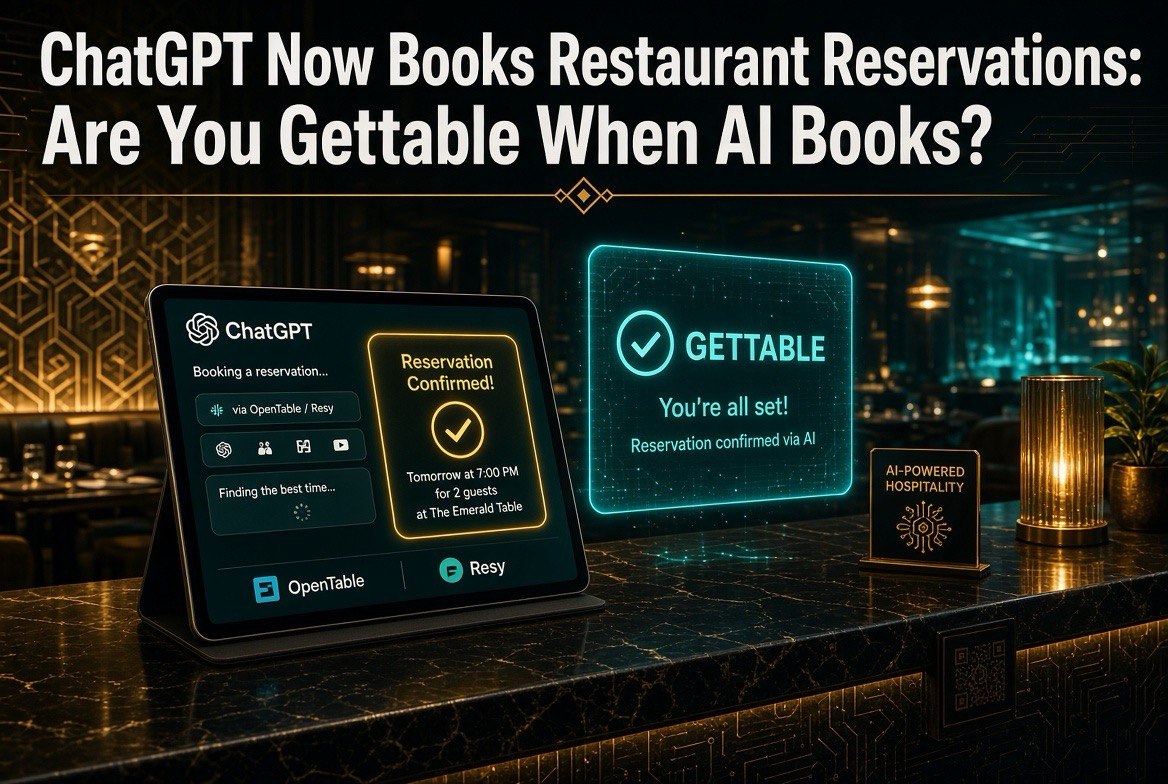
ChatGPT Now Books Restaurant Reservations: Are You Gettable When AI Books?
⚡ Expert Summary
ChatGPT now books real restaurant reservations through OpenTable and Resy directly on a diner’s behalf. For independent restaurants this is a discovery shift: if you are not listed on the platforms AI knows best (OpenTable, Resy, Google Business Profile) with a clean, bookable profile, AI can quietly skip you. The fix is not expensive — it is being Gettable: accurate hours, live availability, up-to-date menus, and a booking link AI can actually complete. Restaurants that are already reservation-friendly are capturing diners AI never would have found otherwise.
Imagine a customer in Texas telling ChatGPT, “Find me the best Italian place near downtown for tomorrow at 7, two people, and book it.” Seconds later it replies, “Done — confirmed at The Emerald Table, tomorrow 7:00 PM, 2 guests.” No phone call, no host stand, no OpenTable log-in on their end. The reservation just happened.
That is no longer a demo. In 2026, ChatGPT is actively booking restaurant reservations through OpenTable and Resy on behalf of diners — and this changes how independent restaurants need to think about being found, being bookable, and being “gettable.”
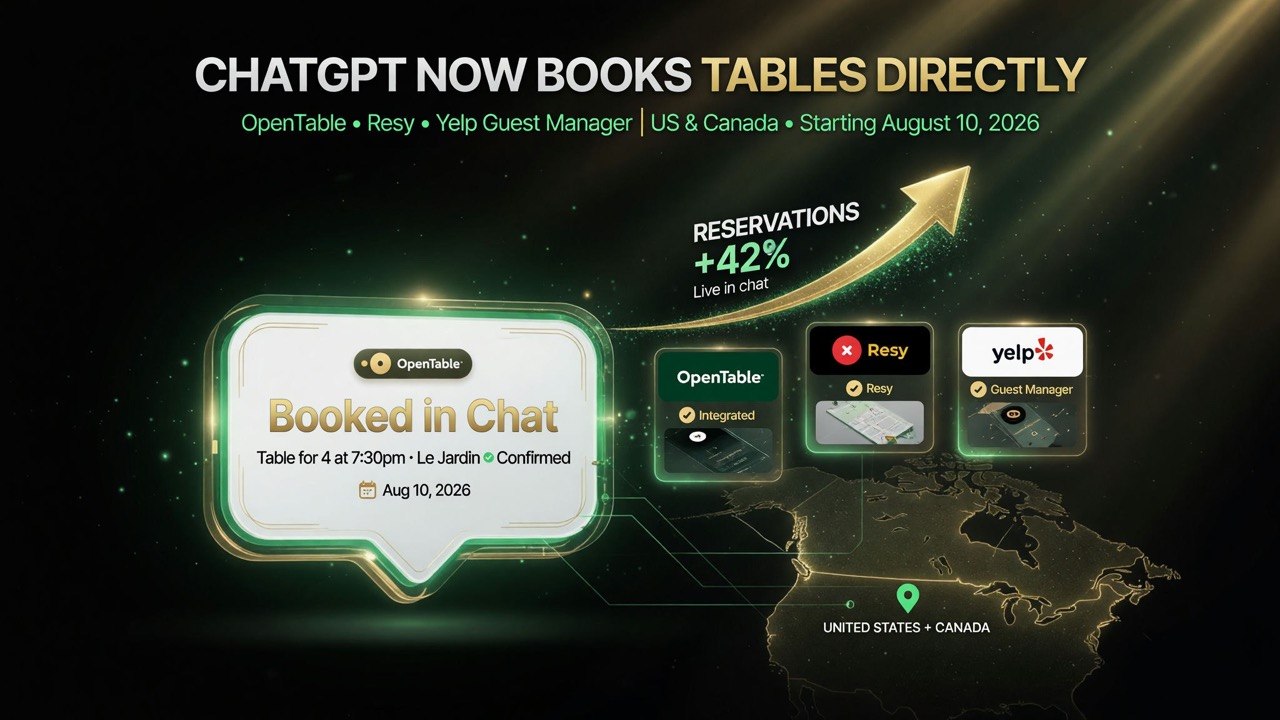
ChatGPT now completes table bookings in-chat through OpenTable, Resy and Yelp Guest Manager — announced for US and Canada starting August 10, 2026. This is the exact mechanic the rest of the post is about.
What Changed: AI Is Now the Dining Assistant That Books
For years, ChatGPT could suggest restaurants. It could pull from search results and say “try X or Y.” But the final step — actually reserving a table — happened outside the conversation, on the diner’s own device, through their own accounts.
That boundary is gone. ChatGPT now carries the booking action through to completion on platforms like OpenTable and Resy. It can present availability, pick a time, and confirm a reservation for two guests — all inside the chat window. The diner sees a confirmation with the exact time, party size, and restaurant name.
For the restaurant, this looks like a normal reservation arriving on its existing booking platform. The system already handles the “how.” The question is whether the restaurant was visible and bookable when AI went looking.
Why “Gettable” Is Now a Strategy, Not a Search Term
The word gettable in the viral framing is doing heavy lifting. It means: when an AI assistant needs to book a table, can it actually book you? There are three gates a restaurant has to pass, and they map directly onto how the AI completes the task.
Gate 1: Is the Restaurant Even In the AI’s View?
ChatGPT does not magically know every restaurant in a city. It pulls from the reservations and discovery data it has access to — the platforms with structured, machine-readable restaurant data. OpenTable and Resy listings are exactly that: structured, complete, bookable. A restaurant that is only on a proprietary website or a Facebook page with no structured availability is effectively invisible to the booking flow.
Gate 2: Can AI Actually Complete a Booking?
Being listed is not enough. The AI has to be able to finish the transaction — meaning the restaurant must have live, bookable inventory on a connected platform. If a listing exists but has no live availability (or the platform can’t complete a booking for it), the AI hits a wall and moves to the next option. It will not call the restaurant. It will not email the host. It will pick a restaurant it can actually book.
Gate 3: Does the Restaurant Convert Once Booked?
Once AI books, the restaurant still has to deliver the experience. A table that arrives with no email address, no confirmation, and no way to contact the diner is a smaller problem than the one the industry already had with no-shows — but it is a real operational piece. The AI-driven reservation still needs to hit the POS, the floor plan, and the confirmation message.
| Position | Online Booking | Platform Listing | AI Can Book You? |
|---|---|---|---|
| Fully Gettable | Live availability connected | Complete OpenTable/Resy/Google | Yes |
| Partly Gettable | Limited/some channels | Partial or outdated | Sometimes |
| Not Gettable | None / walk-in only | Missing or stale | No — AI skips |
What This Means for the Independent Restaurant Owner
The restaurant industry’s long-running tension is between “we want direct, commission-free bookings” and “diners start on the big platforms.” AI-assisted booking tilts that balance in a specific direction: diners start where AI can complete the job.
That is a subtle but important shift. It is not about being the best restaurant in a search engine ranking. It is about being the restaurant an AI assistant can actually book when a customer says “book me somewhere.” If you are not bookable in that instant, the AI does not wait — it moves on.
Practical Steps to Make Your Restaurant Gettable
None of this requires a big technology budget. It requires being present and bookable in the places AI already works. Here is the concrete checklist.
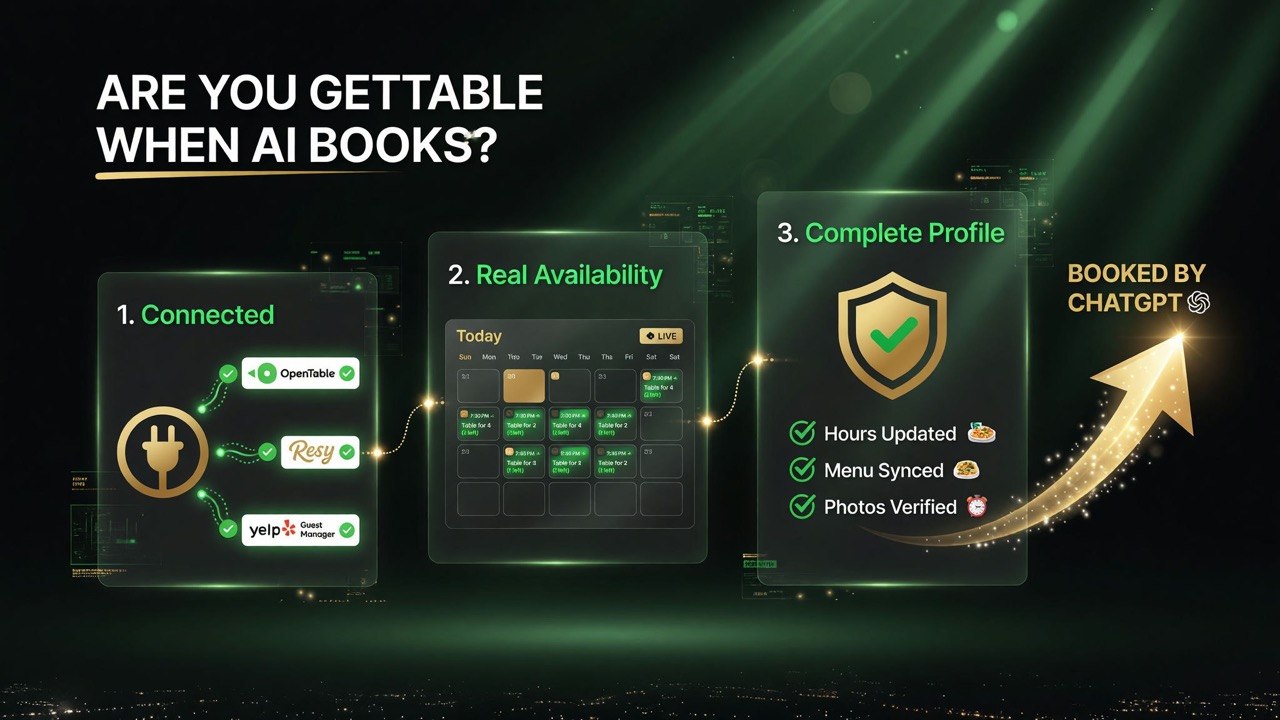
The three-part path AI follows before it books you: connected platforms, live availability, and a complete, verified profile. Restaurants that clear all three gates get found and booked by ChatGPT.
Think of it in the same frame the industry already uses for Google reviews and Google Business Profile hygiene. A few years ago, independents learned that accurate, complete online presence directly affected whether diners found them. The AI booking wave raises the same bar for bookability: not just being findable, but being executable in a single AI-driven action. Industry data has long shown that a majority of diners research restaurants online before visiting, and that a large share decide based on ability to book online rather than calling. When AI becomes the researcher and the booker in one step, that intent-to-action gap — the space between a diner wanting a table and actually reserving it — starts to close automatically.
The practical consequence is that your reservations platform is no longer just a bookings tool. It is a discovery surface. Every completed AI-driven booking is a signal about which restaurants are frictionless to reserve, and platforms and search assistants tend to reward the restaurants that convert cleanly. This is one of the few places where a small investment in hygiene — complete listings, current menus, live availability — pays off through a channel you never have to pay per-click for.
1. Fix Your Online Booking Presence
If you use OpenTable, Resy, or a system that feeds live availability to those platforms, make sure your listing is complete: accurate hours, correct address, up-to-date menu, and photos. An incomplete listing reads worse to an AI workflow than to a human — the AI needs the structured data to complete the booking.
2. Turn Off “Walk-In Only” Blind Spots
If your restaurant genuinely only takes walk-ins with no online inventory at all, you are not Gettable in the AI booking flow. You do not have to accept every request or pay for a full reservations platform — but you should have some live, bookable availability so AI can complete the job when it plays out. Many independents run a hybrid: online bookable for peak needs, walk-in for the rest.
3. Keep Your Google Business Profile Sharp
Google Business Profile is a major source of the structured restaurant data AI draws from. Keep your hours, phone, menu link, and booking buttons accurate. This is the cheapest leverage available — and it feeds directly into how AI assistants understand and present your restaurant.
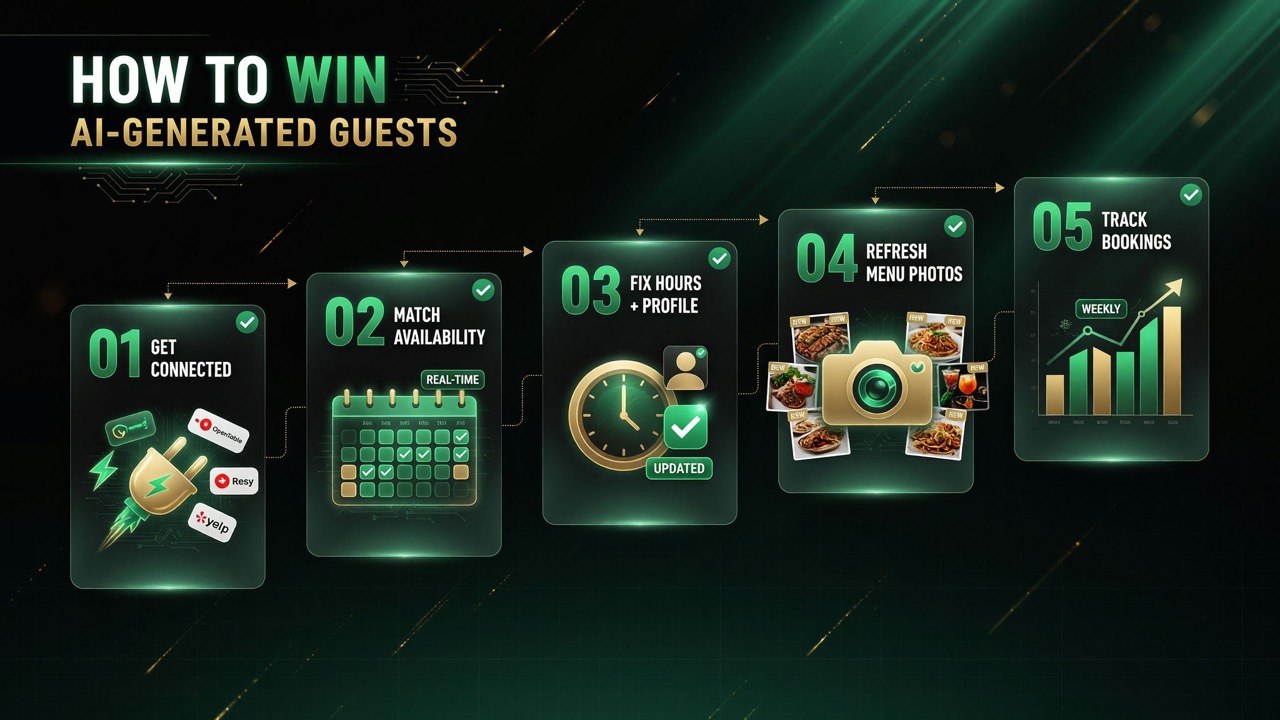
The five-step playbook for winning AI-generated guests: stay connected, match live availability, keep hours and profile current, refresh menu photos, and track inbound AI bookings weekly.
4. Be Ready for the Confirmation to Land in Your Existing System
When AI books, the reservation arrives through the normal channel. Make sure your confirmation flow is set: an automated confirmation email or text, a reminder, and a clear no-show or cancellation policy. These are the operational pieces that turn an AI-generated reservation into a seated guest.
4b. Automate Confirmations and Reminders
The operational upgrade that matters most once AI starts booking is making sure a reservation that lands actually becomes a seated guest. An automated confirmation — sent the moment the booking lands, and again as a reminder near arrival — does two things. First, it verifies the diner’s contact details so a real guest exists behind the reservation. Second, it reduces no-shows, which waste labor, inventory, and revenue. Independent restaurants that already run automated confirmation and reminder flows are far better positioned to keep AI-generated bookings on the books. If the confirmation requires manual work, a higher-volume AI booking flow will overwhelm it.
4c. Back It Up on Your Table Map
Once a reservation is confirmed and a diner verified, the booking still has to reach the floor. Make sure your reservations system is connected to your POS or table map so the confirmation, party size, and any notes appear where your team actually seats guests. A booking that is confirmed but never reaches the floor is, from the guest’s perspective, a failed reservation — the exact outcome you do not want when a new diner arrives via AI with no prior relationship to your brand.
A Quick Comparison: Where Independents Usually Stand
| Position | Online Booking | Platform Listing | AI Can Book You? |
|---|---|---|---|
| Fully Gettable | Live availability connected | Complete OpenTable/Resy/Google | Yes |
| Partly Gettable | Limited/some channels | Partial or outdated | Sometimes |
| Not Gettable | None / walk-in only | Missing or stale | No — AI skips |
What to Watch Next
Three things signal where this is heading for independents.
Reservation data becomes a discovery asset. If AI books through the platforms, the platforms’ discovery lever grows. Restaurants that are bookable on OpenTable or Resy stand to be recommended more — not because they paid, but because they are simply executable.
The “direct booking” debate gets more complicated. Independents have strong reasons to prefer direct, commission-free bookings. But if the diner starts in ChatGPT and ChatGPT completes on OpenTable, the independent has to weigh “direct is better” against “gettable is necessary.” The two do not have to conflict — many restaurants are already listed on a platform while running direct booking for repeat guests.
No-show management gets more important, not less. AI can generate a higher volume of reservations per diner inquiry. That puts pressure on confirmation and no-show handling. Restaurants that automate confirmations and reminders — and back it up on their POS table map — will hold more of those AI-generated bookings.
The Bottom Line
ChatGPT booking restaurant reservations is not science fiction anymore, and it is not a threat to independent restaurants. It is a new discovery channel. The restaurants that benefit are the ones that are gettable — present on the platforms AI knows, bookable with live availability, and operationally ready to seat the guest when the confirmation lands.
The good news: this is largely a “be where AI already looks” problem, not a “build custom AI” problem. Clean up your listing, connect your live availability, set your confirmation flow, and you are ahead of a large share of independents who are still invisible to the AI booking path.
Because when a customer tells ChatGPT to book dinner, and it picks the restaurants it can actually book — you want to be on that short list.
Frequently Asked Questions
Can ChatGPT actually book a real restaurant reservation?
Yes. In 2026, ChatGPT can complete restaurant reservations through platforms like OpenTable and Resy on a diner’s behalf, producing a confirmation with time, party size, and restaurant. It carries the booking action through to completion inside the conversation.
Does my restaurant need a particular platform to be bookable by AI?
You need to be listable and bookable on a structured reservations platform, most commonly OpenTable or Resy, or a system that feeds live availability to them. A complete listing with live inventory lets the AI finish the booking instead of skipping to another option.
Is my restaurant losing bookings to AI reservations?
Not necessarily losing — but you may be missing new ones if your restaurant is not visible or bookable when AI goes to reserve. Restaurants with complete, live online availability are capturing diners that AI directs to them.
Is the direct-booking model dead?
No. Direct booking still gives independents lower costs and more control over the diner relationship. The change is that AI-assisted discovery often starts and completes on the big platforms, so being listed there (alongside direct booking for repeat guests) is the practical position for most restaurants.
Do I have to pay for an expensive reservations system?
No. The core requirement is being bookable: accurate platform listings, live availability, a booking link that completes, and a confirmation flow. You can run a hybrid — some online bookable inventory plus walk-in — without buying a full enterprise reservations suite.

About Barak Schurr
Barak Schurr built and exited a major ticketing platform, ran global operations at Eventbrite, and now focuses on one question: which AI tools actually help independent restaurant owners run leaner and grow faster. He writes from the operator’s perspective — no vendor spin, no theory, just what’s real in 2026.
Email: [email protected]
More Resources for Restaurant Operators