Get the AI Restaurant Quick-Start Guide — Free
The 5 AI tools independent US restaurant owners are using right now to cut labor costs and answer every call.
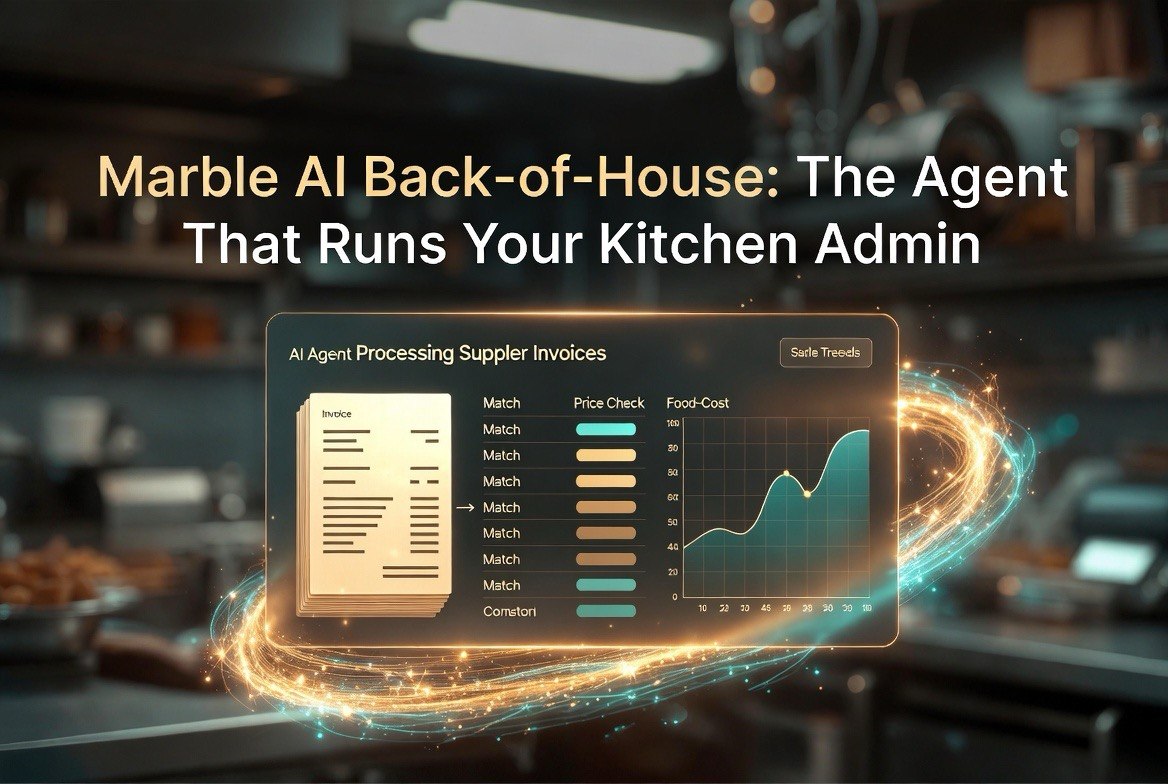
Marble AI Back-of-House: The Agent That Runs Your Kitchen Admin
⚡ Expert Summary: Marble is an AI back-of-house platform that handles the administrative work restaurant owners hate — inventory reconciliation, invoice matching, food-cost tracking, and vendor management — with agents that actually take action, not just flag problems. It’s aimed at independent operators and small groups who can’t afford a dedicated back-office team. Instead of piling more dashboards on you, Marble’s agents do the grunt work: they catch pricing mismatches, surface waste before it hits your P&L, and keep your numbers honest without you babysitting them. If you’ve ever paid a sticker-price invoice you didn’t have time to check, this is aimed directly at you.
Every independent restaurant operator knows the drill. You’re slammed on the line all service, then when the doors close you’re staring at a stack of invoices, a spreadsheet you haven’t touched in a week, and a food-cost number that doesn’t match what you bought. Somewhere between the supplier and the POS, money leaks out — and you don’t have an accountant to find where.
That’s the gap Marble targets. It’s an AI back-of-house platform built around agents that do the work, not a reporting tool that hands you more homework. The pitch is simple: let the software handle the reconciliation, the invoice checking, and the inventory math, so you can get back to running the floor.
What “Agentic Back-of-House” Actually Means
There’s a big difference between restaurant software that shows you a problem and software that fixes it. Most back-of-house tools are the first kind — they generate reports and wait for you to act. Marble leans into the second kind: agentic workflows that move line items, flag discrepancies, and update records automatically.
In plain terms, that means Marble isn’t just telling you “your invoice for produce is $200 higher than last week.” It’s cross-referencing that invoice against your agreed pricing, flagging the specific line item, and surfacing it for one-click action — or matching it against your inventory counts so you see whether the cost is actually justified by what came in the door.
This is the shift that’s quietly reshaping restaurant technology in 2026. Operators don’t need more data; they need less admin. The tools winning attention are the ones that shrink the number of tabs open on your back-office laptop at midnight.
Who Marble Is Actually For
Marble positions itself for the operators who are too big to ignore back-office waste and too small to hire for it. That’s a specific and very real slice of the market:
- Independent restaurant owners running one to a handful of locations, often doing the books themselves or with a part-time bookkeeper
- Small multi-unit operators who’ve felt the pain of scaling — more invoices, more vendors, more spreadsheets, same number of hours
- Kitchen managers who currently own food cost but have no reliable system for tracking it daily
The reason Marble works for these operators is that it targets the tasks that are mechanical but time-consuming — invoice data entry, price checking, inventory count reconciliation. Those are exactly the jobs a staffed back office would do, and exactly the jobs that fall through the cracks when it’s just you.
For a US operator, the pressure here is concrete. Food costs have been volatile, and the margins on the line are thin. A 1–3% leak in food cost from uncorrected invoices, spoilage, or receiving errors is real money — often the difference between a profitable month and a break-even one. Back-of-house software that catches that leak pays for itself fast.
How Marble’s Agents Work
Let me walk through the mechanics in the order you’d actually set it up, because the workflow is where the “agentic” claim lives or dies.
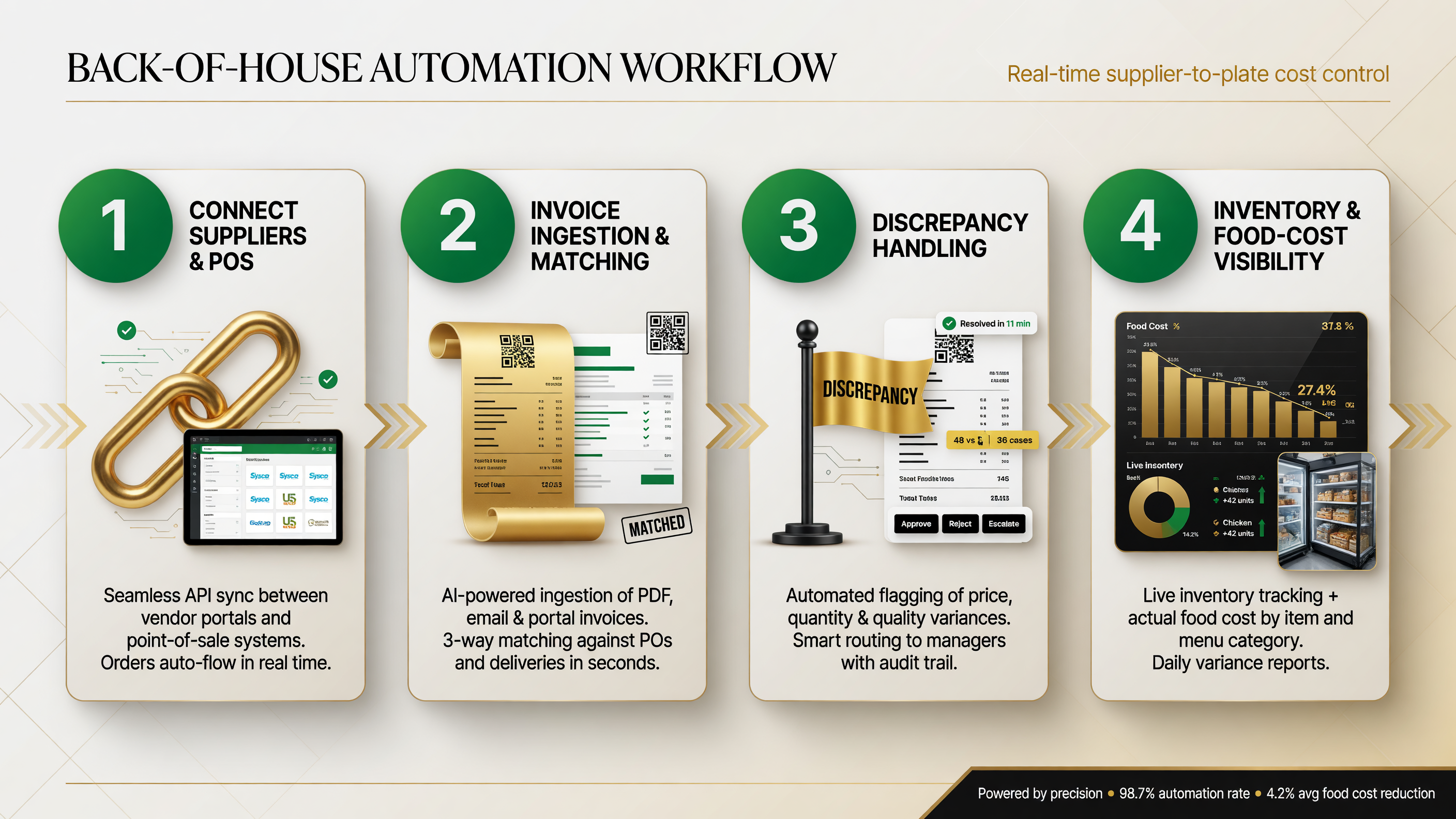
Marble’s agents move from connecting your systems to flagging exceptions and tracking food cost — each step removing a manual task from your back office.
1. Connect your suppliers and POS
You link Marble to your invoicing and your point-of-sale system. It pulls in the data streams that define your back office — what you’re buying, what you’re paying, what you’re ringing up — into one place.
2. Ingestion and matching
Marble’s agents read incoming invoices, match them against your purchase orders and agreed pricing, and reconcile them with what was actually received. Instead of you typing line items into a spreadsheet at 1 a.m., the system does the cross-referencing.
3. Discrepancy handling
When something doesn’t line up — a price hike you weren’t told about, a quantity mismatch, an unapproved charge — the agent flags it and makes it actionable. You approve or investigate the specific line, not the whole invoice.
4. Inventory and food-cost visibility
The platform turns your inventory counts into ongoing food-cost tracking, so you see cost trends in near-real time rather than waiting for a month-end reckoning. Waste and over-ordering show up as patterns, not surprises.
Why Back-of-House Automation Matters More Than Ever
Restaurant operators are famously skeptical of tech that adds work. The tools that stick are the ones that remove steps. Marble’s bet is that AI agents have finally reached the point where they can reliably do back-office reconciliation — the repetitive, rule-based work that’s tedious for humans but well-suited to software.
What changed is reliability. Early “AI for restaurants” demos were exciting but shallow — they described what a system could do but fell apart on real, messy invoice data. The current generation of agentic tools is built on structured, connected workflows rather than free-form chatbot answers. That’s the difference between a toy and a tool that reduces your midnight admin.
Marble vs. Traditional Back-of-House Software
| Capability | Marble (agentic) | Traditional back-of-house |
|---|---|---|
| Invoice reading & matching | Automated by agents | Manual or template-based |
| Price discrepancy detection | Proactive, line-level flags | Only if you spot-check |
| Food-cost tracking | Ongoing, near real-time | Month-end snapshot |
| Human effort required | Review & approve exceptions | Enter & reconcile everything |
| Catches leaking money | Continuously | When you have time to look |
| Best for | Operators short on admin time | Teams with dedicated back office |
The table’s point isn’t that traditional software is bad — it’s that it was built for a world where someone had time to maintain it. The independent operator of 2026 doesn’t have that luxury, which is why the agentic layer is the real value add, not the dashboard itself.
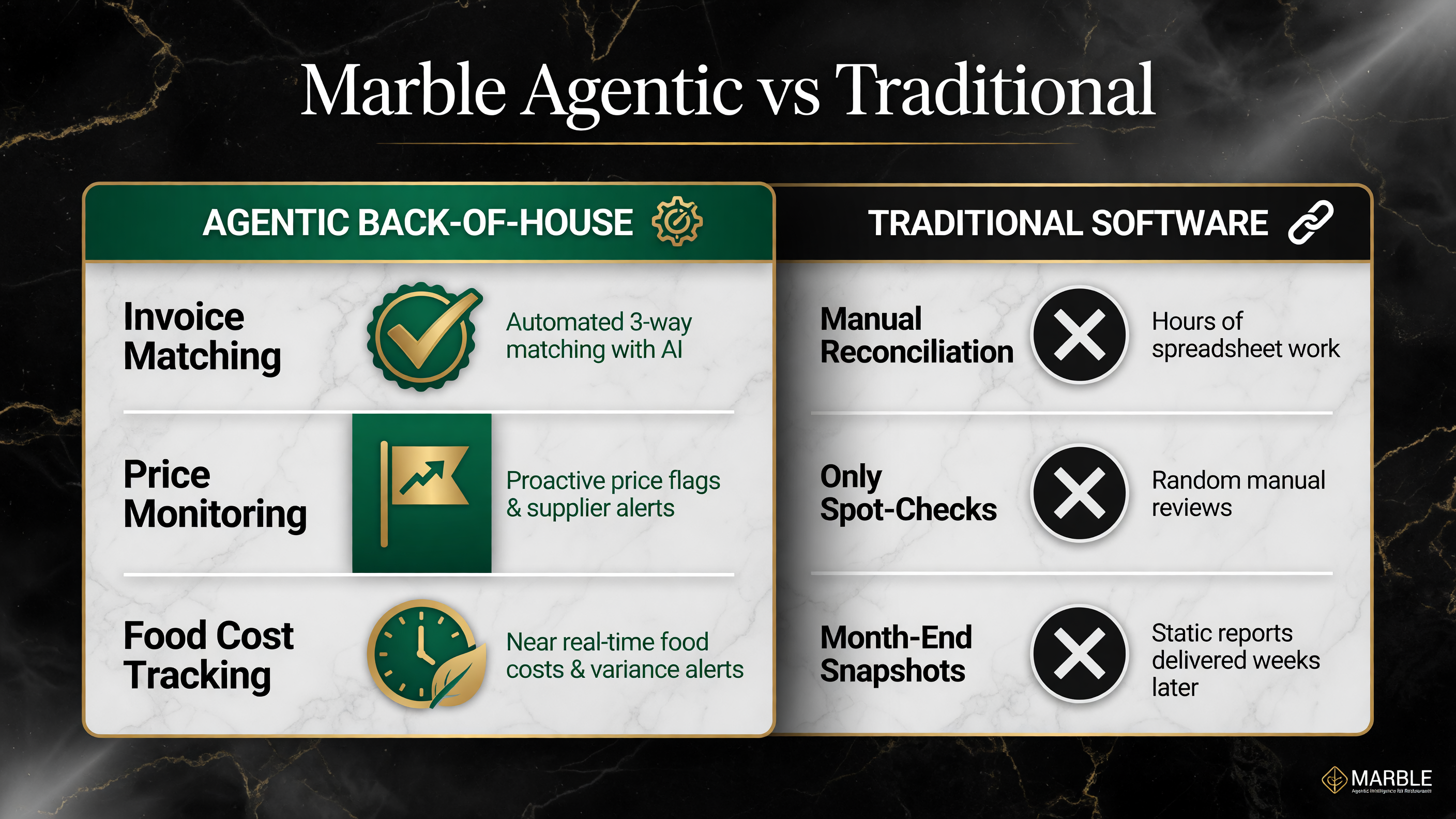
Agentic back-of-house automates the reconciliation work that traditional software leaves to you.
Where Independent Operators Feel It Most
To make this tangible, it helps to walk through the three back-office scenarios that drain the most operator time in an average US kitchen, because those are exactly the jobs agentic back-of-house software targets.
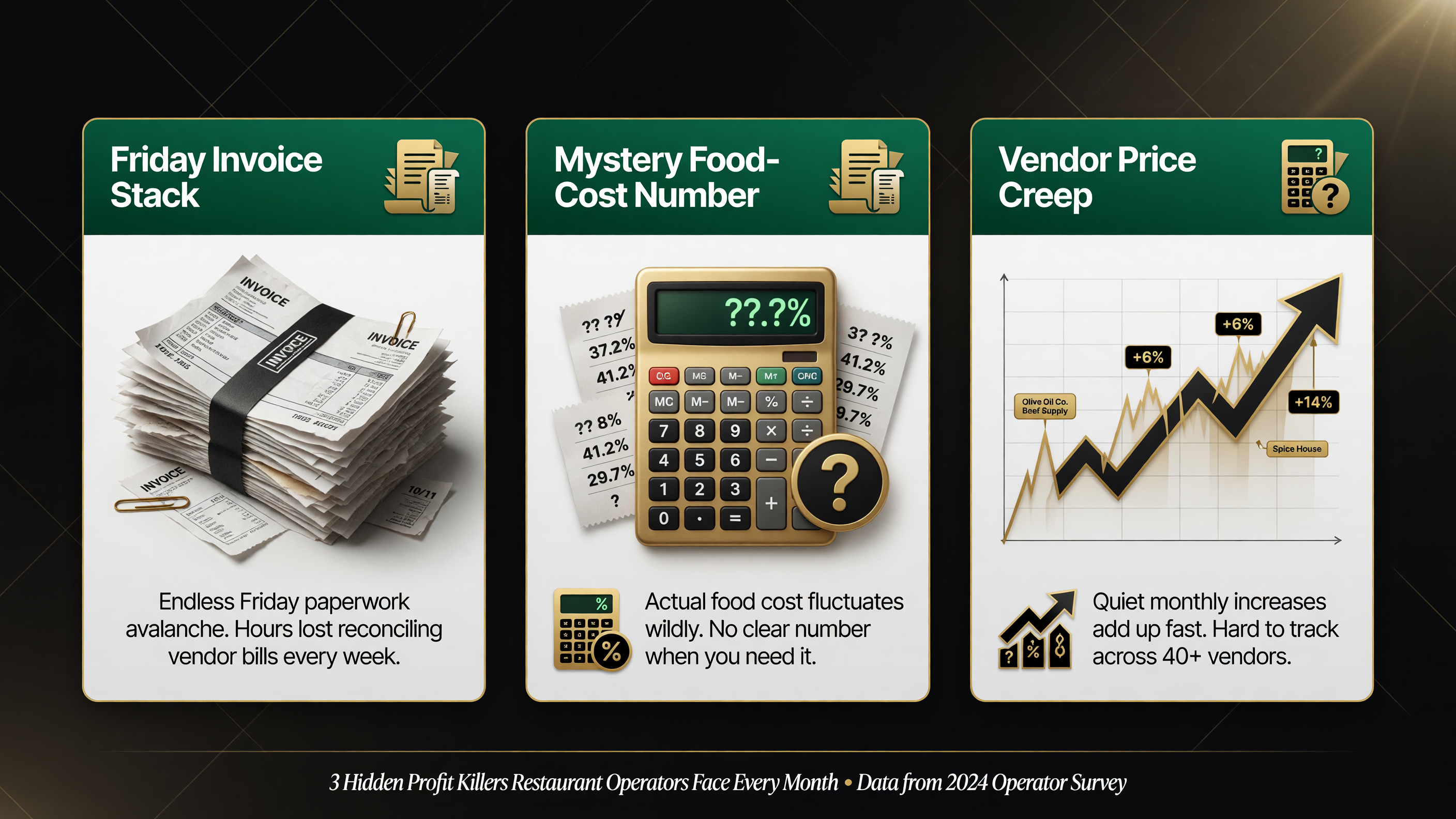
Three places money leaks out of an independent kitchen when nobody has time to chase it.
The Friday invoice stack
Suppliers drop invoices all week, and by Friday there’s a pile. An understaffed operator either rushes through them, paying whatever prices are listed, or lets them slide into next week. Each unchecked line is a potential 2–5% overcharge — and at food-cost margins, that compounds fast. Marble’s agents read and match each invoice against agreed pricing the moment it arrives, so the Friday stack becomes a short list of exceptions instead of a marathon.
The mystery food-cost number
Almost every independent operator has had the month where food cost comes in 3 points higher than expected and nobody can explain why. Without daily tracking, you can’t tell whether it’s spoilage, waste, theft, or vendor pricing — you just feel it in the P&L at month end. Marble surfaces cost trends against inventory counts as they happen, so the mystery becomes a pattern you can actually investigate.
The vendor price creep
Suppliers quietly raise prices more often than most owners realize. You don’t notice a $0.40 jump here and a $0.25 jump there until the totals are ugly. Because Marble cross-references each invoice against your agreed pricing history, a silent price hike becomes an immediate, line-level flag — and a negotiating lever you can take back to the vendor.
The State of Restaurant AI in 2026
It’s worth stepping back, because Marble isn’t arriving in a vacuum. The restaurant tech market has spent the last two years moving from customer-facing gimmicks toward genuine operational software. Fans, POS systems, and phone systems have all added AI layers that actually reduce work rather than just look impressive on a demo.
The through-line is consistent: the AI that sticks is the AI that touches the money. Operators don’t abandon a tool that finds a real 2% leak in food cost, the way they’ll abandon a chatbot that answers menu questions poorly. That’s why the back-of-house category — invoices, inventory, cost — is where the durable wins are landing, and it’s the same reasoning behind Marble’s positioning.
Independent operators are also under structural pressure that makes this software more relevant than it used to be. Labor is expensive and hard to find, so the idea of a back-office person dedicated to invoice reconciliation is out of reach for most single-unit owners. That leaves the owner doing it — which means every hour spent on an invoice is an hour not spent on the floor, on the menu, or on the guests. Software that buys that hour back has a clear, measurable value.
Realistic Things to Watch For
No tool is a silver bullet, and Marble is no exception. Here’s the honest set of considerations before you sign up:
- It depends on clean integrations. The value comes from your supplier and POS data flowing in correctly. If your integrations are messy, the agentic magic gets thinner.
- You still need to review exceptions. Agents reduce the work; they don’t eliminate judgment. You’ll still approve and investigate flags — just a fraction of what you’d do manually.
- Setup takes some discipline. You get out what you put in on the front end, connecting your systems and confirming your pricing data.
Bottom Line
Marble is worth a serious look if you’re an independent operator or small group losing money to back-office waste you don’t have time to chase. It reframes back-of-house software from “another report to read” to “an agent that handles the admin.” For a US restaurant owner watching food costs and margins, that’s the kind of tooling that pays for itself — by finding the leaks you were too busy to find.
The best way to judge it is to look at your own invoices from last month. If you’d have gladly paid a few sticker prices without checking, that’s the exact problem Marble is built to solve.
Frequently Asked Questions
What is Marble back-of-house AI?
Marble is an AI-powered back-of-house platform for restaurants that automates invoice processing, price discrepancy detection, inventory reconciliation, and food-cost tracking using agentic workflows.
How is Marble different from other back-of-house software?
Traditional tools generate reports and wait for you to act. Marble’s agents actively read invoices, match them against agreed pricing, and flag specific discrepancies for one-click action.
Who should use Marble?
Independent restaurant owners and small multi-unit operators who can’t afford a dedicated back-office team and don’t have time to reconcile invoices and track food cost manually.
Does Marble replace my accountant or bookkeeper?
No. It automates the mechanical, repetitive reconciliation work so you (or your bookkeeper) spend less time on data entry and more time on exceptions and strategy.
What does Marble cost?
Marble doesn’t publish a fixed price — it’s typically based on your location count and volume. You’ll want a quote tied to your specific operation.

About Barak Schurr
Barak Schurr built and exited a major ticketing platform, ran global operations at Eventbrite, and now focuses on one question: which AI tools actually help independent restaurant owners run leaner and grow faster. He writes from the operator’s perspective — no vendor spin, no theory, just what’s real in 2026.
Email: [email protected]
More Resources for Restaurant Operators