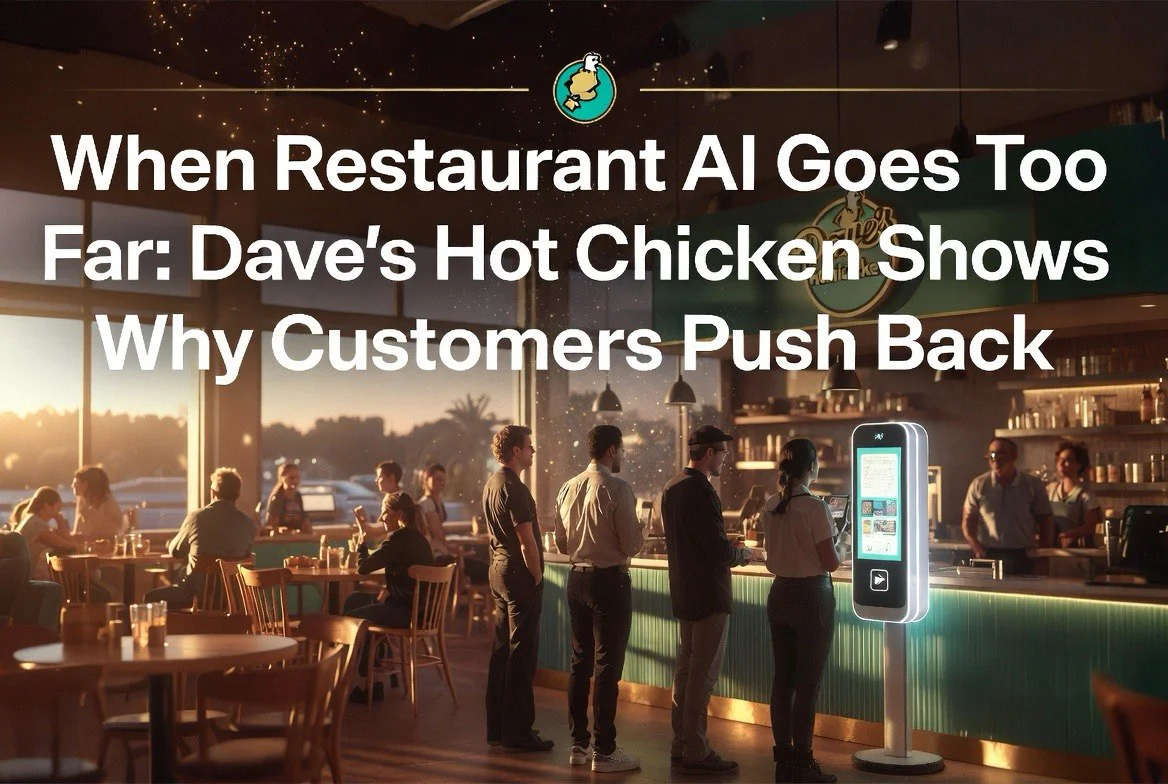
When Restaurant AI Goes Too Far: Dave’s Hot Chicken Shows Why Customers Push Back
⚡ Expert Summary: Dave’s Hot Chicken invested heavily in POS and kitchen display upgrades, but one thing they explicitly won’t touch yet: AI that talks to customers. Their CTO spelled it out clearly — diners don’t want to interact with robots. For independent restaurant owners across the United States, this case study is worth studying. Not because it says to avoid AI, but because it shows exactly where the line between helpful tech and customer-repelling tech sits in 2026.
The AI hype train in restaurants has been running at full speed for the last 18 months. Voice AI drive-thrus. AI phone ordering. Robot arms slinging burgers. Every tech vendor has a demo of a restaurant where a machine handles every customer interaction from start to finish.
But here’s what the demo videos don’t show you: what happens when customers actually encounter these systems in the real world.
Dave’s Hot Chicken, the fast-growing Nashville-style chain with over 150 locations, just gave us the most honest answer any restaurant operator has given this year. Restaurant Dive reported that Dave’s invested successfully in POS and kitchen display system upgrades — technology that works behind the counter to speed up operations. But when it comes to customer-facing AI? The CTO said diners don’t want to talk to robots. The chain is waiting for the technology to mature before adding voice AI to their ordering experience.
That’s not anti-tech. That’s smart operations.
The Pushback Is Real
Dave’s isn’t alone in noticing this. Multiple restaurant operators at the 2026 National Restaurant Association Show discussed the gap between what AI vendors promise and what customers actually accept. The consensus: customers appreciate AI that makes their experience smoother — faster payments, personalized recommendations, shorter wait times. But they resent AI that replaces human interaction they value.
This tracks with consumer survey data. Intouch Insight’s 2025 Drive-Thru Study found that while 63% of consumers were open to AI-assisted ordering, satisfaction scores dropped 22% when customers couldn’t easily reach a human. The tolerance threshold is clear: customers will accept AI as a helper. They will not accept AI as a replacement for the person taking their order.
For a brand like Dave’s, which has built its identity around a specific, high-energy dining experience, automating the front door isn’t just a technical decision. It’s a brand decision. The person taking your order at Dave’s isn’t a cost center to be eliminated — they’re part of the experience customers pay for.
Where Dave’s Is Using AI — And Why It Works
The smartest part of Dave’s approach is what they chose to automate and what they chose to keep human.
Behind the counter: full speed ahead. Dave’s upgraded its POS and kitchen display systems to improve ticket times, reduce errors, and handle the operational complexity of high-volume service. These systems work in the background — customers never interact with them directly. When a POS system cuts a 60-second ticket time to 45 seconds, the customer just notices their food arrived faster. They don’t see the technology.
In front of the counter: wait and watch. Voice AI ordering, automated phone systems, and customer-facing chatbots are all in the “not yet” category at Dave’s. The CTO’s position is clear: the technology isn’t ready to deliver the experience their brand requires, and they won’t risk customer satisfaction for the sake of being early adopters.
This is exactly the right framework for independent operators. The question isn’t “should I use AI?” The question is “where in my operation does AI add value without damaging the customer experience?” If the answer is “back of house and operations” but not “direct customer interaction,” that’s a valid, data-driven decision.
What Independent Operators Can Learn From Dave’s
The Dave’s approach scales down perfectly to a single-location independent restaurant. Here’s what you can take from their playbook:
Automate operations before customer interactions. Before you buy a voice AI ordering system, make sure your POS, KDS, inventory, and scheduling are running efficiently. The operational infrastructure has to be solid before customer-facing AI can do its job. Dave’s invested in the foundation first — and they’re a $1 billion-plus brand. If they can’t skip that step, neither can you.
Know what your customers actually want. Dave’s customers go to Dave’s for the experience. The atmosphere matters. The human interaction matters. If your restaurant is a quick-service concept where speed is the only thing customers care about, voice AI might be a natural fit. If your restaurant is a sit-down operation where hospitality is the product, automating the front door is a mistake.
Be honest about technology readiness. Voice AI has improved dramatically. It still fails on accents, background noise, complex orders, and non-standard requests. Dave’s CTO said they’re waiting for the tech to mature. That’s not code for “we hate innovation.” That’s a realistic assessment of where the technology is today versus what their customers expect.
Test behind the scenes first. Every new AI system should spend its first 30-60 days running in parallel with existing processes before it touches customers. Dave’s approach to POS/KDS upgrades shows the right pattern: implement, test, stabilize, then consider the next layer.
The Cost of Getting This Wrong
The worst-case scenario for a restaurant that deploys customer-facing AI before it’s ready is worse than most operators realize.
A bad voice AI experience doesn’t just lose that one order. It generates a review. That review gets seen by thousands of potential customers. The review mentions “the robot couldn’t understand me” or “I had to repeat my order three times.” That single interaction creates a reputation problem that persists long after the technology is fixed.
Intouch Insight’s 2025 research found that 41% of customers who had a negative experience with ordering technology said they would not return to that restaurant. For an independent operator with a $1 million annual revenue run rate, losing 41% of repeat customers is catastrophic. The math doesn’t require a CFO to understand it.
This is the fundamental asymmetry that Dave’s CTO clearly understands. The upside of early voice AI adoption is marginal — you might save a few labor hours per shift. The downside is existential — you could permanently damage the relationship with a significant portion of your customer base. When the upside is measured in single-digit percentages and the downside is measured in customer churn that compounds monthly, the decision to wait isn’t conservative. It’s mathematically correct for any operator who’s serious about protecting their revenue base.
For independent owners worried that waiting means falling behind: the NRA Show 2026 panel on restaurant AI included leaders from multiple major chains who all said essentially the same thing. Customer-facing AI has tremendous potential, but most current implementations are not delivering the experience customers actually expect. The early adopters are learning lessons the rest of the industry can benefit from without paying the same tuition in lost customers and bad reviews.
Compare that to a kitchen display system upgrade that cuts ticket times by 20%. Customers notice the faster service but never interact directly with the technology. No bad reviews. No reputation damage. No “robot couldn’t understand me” stories on Yelp. The ROI is cleaner because the downside risk is essentially zero.
The Right AI Timeline for Independent Restaurants
Based on the Dave’s case study and broader industry data, here’s a realistic AI adoption timeline for a typical independent restaurant:
Do this now: POS and KDS upgrades. Inventory management AI. Scheduling tools. Back-of-house automation that customers never see. These technologies are mature, proven, and carry minimal brand risk. Every US restaurant should have these in place if they don’t already.
Evaluate within 12 months: AI-driven menu pricing and optimization. AI recommendation engines for your online ordering platform. These touch customers indirectly and improve their experience without replacing human interaction.
Wait and watch: Voice AI ordering. Fully automated phone systems. AI front-of-house agents that replace human staff. The technology is improving rapidly, but as Dave’s experience shows, the gap between functional and actually-good is still wide enough to damage your brand. Revisit every 6 months with a one-week test in a controlled setting.
Matching AI to Your Concept Type
Dave’s Hot Chicken is a fast-casual concept with a young, experience-driven customer base. Their wait-and-see approach on voice AI makes sense for their specific audience. But the same analysis plays out differently depending on your restaurant type.
Quick service: If you run a QSR where speed is the primary customer expectation, voice AI has a stronger case. Drive-thru voice automation from companies like SoundHound or Presto has shown measurable speed improvements in test deployments. The trade-off is clearer here because customers in the drive-thru lane are already optimizing for speed over experience. Dave’s caution still applies — the system has to work reliably — but the risk calculus shifts toward adoption faster.
Fast casual: This is the Dave’s category. The dining experience is part of the product. Customers value the interaction at the counter. Voice AI that replaces that interaction must be demonstrably better than the current experience, not just cheaper for the operator. Wait time is a secondary consideration to hospitality.
Fine dining: Voice AI at the front door of a fine dining establishment would be brand suicide. The entire value proposition of fine dining is human attention and expertise. Back-of-house AI makes sense. Customer-facing AI that touches the guest experience is years away from being appropriate for this segment.
Bar and tavern: The evening crowd is less forgiving of technology failures. A voice AI system that works at 2 PM lunch rush might fail completely at 9 PM with background noise and customers who have had a few drinks. This is the highest-risk deployment scenario for customer-facing AI.
The right approach isn’t a single yes or no on AI. It’s a per-system, per-concept analysis. Dave’s did that analysis honestly and publicly. Every independent operator should do the same.
FAQ
Is Dave’s Hot Chicken against using AI?
No. Dave’s heavily invests in AI for back-of-house operations — POS systems, kitchen displays, and operational efficiency. They’re selective about customer-facing AI, waiting for the technology to mature before deploying voice ordering or automated phone systems.
What AI should independent restaurants implement first?
Start with back-of-house AI that customers never interact with directly — POS modernization, kitchen display systems, inventory management, and scheduling tools. These carry minimal brand risk and deliver measurable operational improvements.
Do restaurant customers actually want AI ordering?
Consumer data is mixed. About 63% of customers are open to AI-assisted ordering, but satisfaction drops significantly when they can’t easily reach a human. The tolerance threshold is higher in quick-service settings and lower in full-service or experience-driven concepts.
What are the risks of deploying restaurant AI too early?
Studies show that 41% of customers who have a negative experience with restaurant ordering technology say they would not return to that restaurant. A bad AI interaction creates negative reviews that persist long after the technology is improved.

About Barak Schurr
Barak Schurr built and exited a major ticketing platform, ran global operations at Eventbrite, and now focuses on one question: which AI tools actually help independent restaurant owners run leaner and grow faster. He writes from the operator’s perspective — no vendor spin, no theory, just what’s real in 2026.
Email: [email protected]
More AI Resources