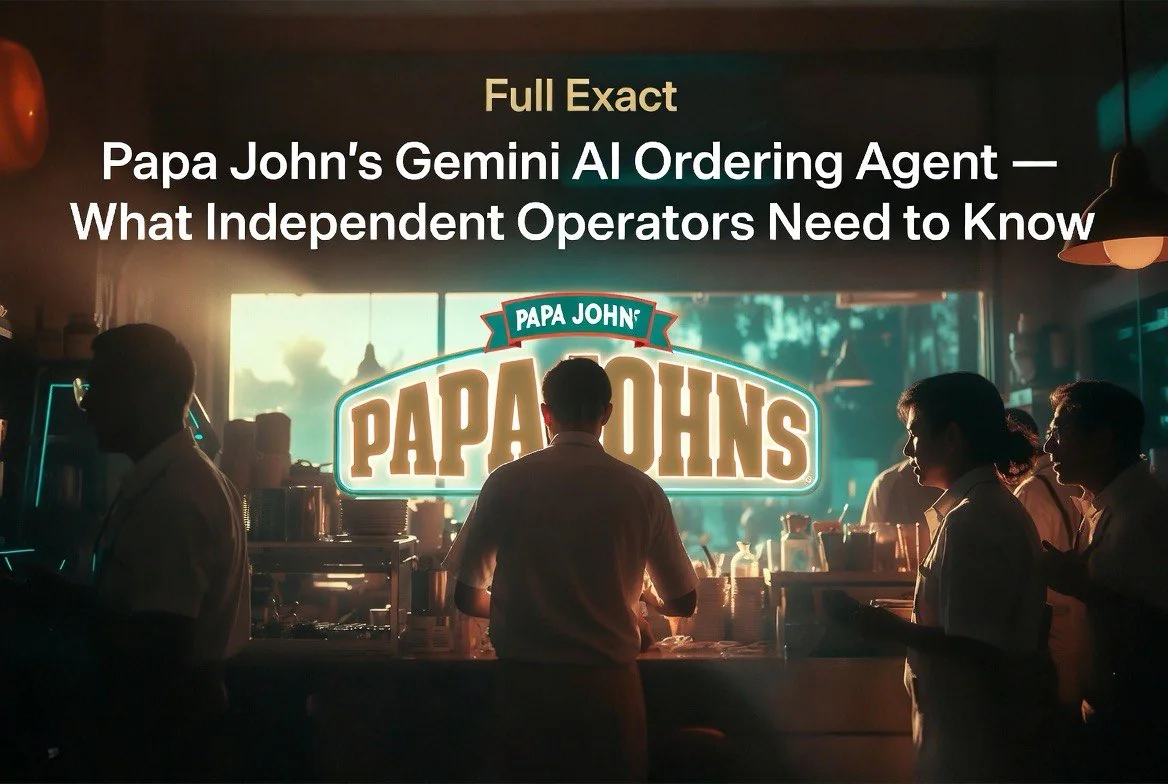
Papa Johns Launches Gemini-Powered AI Ordering Agent — What Independent Operators Should Know
⚡ Expert Summary: Papa Johns became the first restaurant brand to deploy Google Cloud’s new omnichannel AI ordering solution, launching a voice and text agent powered by Gemini. The system handles phone, app, web, kiosk, and in-car orders — guiding customers through group orders, dietary restrictions, loyalty rewards, and past favorites. Independent operators can learn from this without needing Google’s budget.
On July 10, 2026, Papa Johns announced something that should catch every independent restaurant operator’s attention: the first Gemini-powered AI ordering agent deployed across a national restaurant chain.
Built on Google Cloud’s omnichannel food ordering platform, the AI agent takes orders across every channel — phone, app, website, kiosk, and in-car systems. It handles complex group orders, checks for food allergies, applies deals, recognizes loyalty accounts, and even prompts reorders of past favorites.
For independent operators watching from the sidelines, the question is the same one that comes up every time a national chain adopts new technology: “Can I do anything like this without being Papa Johns?”
The answer is more encouraging than you might think.
What the Papa Johns AI Agent Actually Does
Kevin Vasconi, Papa Johns’ Chief Digital and Technology Officer, described the system’s capabilities to Nation’s Restaurant News in practical terms. It’s not about flashy AI demos — it’s about solving specific operational pain points.
“Let’s say you have to order pizza for your kid’s soccer team, and you need to figure out how much to get, preferences, food allergies,” Vasconi said. “The AI agent is built to walk you through all of that. It might ask, ‘How many people are on the soccer team?’ and then come back with suggestions.”
If a child doesn’t like mushrooms, the customer tells the bot once, and it’s reflected in the entire order. No back-and-forth with an overwhelmed phone order taker. No forgotten modifications.
The system handles:
- Voice and text ordering — Customers can speak or type their orders across any channel
- Complex group order management — Suggests quantities based on group size, walks through individual preferences
- Dietary restriction handling — Tracks allergies and preferences per person
- Loyalty integration — Recognizes accounts, applies deals, prompts reorders of past favorites
- Omnichannel deployment — Phone, app, web, kiosk, and in-car ordering all use the same AI engine
Papa Johns expects nationwide rollout by the end of 2026.
Why Google Gemini Matters for Restaurant AI
The choice of Google Cloud’s Gemini platform as the backbone isn’t incidental. Google Gemini brings capabilities that matter specifically for restaurant ordering:
Natural conversation handling. The AI can manage the chaotic back-and-forth of real ordering — interruptions, mid-order changes, questions about sides, requests for recommendations — without breaking the flow. Older voice AI systems required rigid, linear ordering paths.
Multimodal input. Because the system works across voice, text, app, and kiosk, customers can start an order on their phone and finish through their car’s infotainment system. The context carries across channels.
Context retention. The AI remembers past orders, preferences, and loyalty details. It doesn’t start fresh every time. A customer who always orders extra cheese doesn’t need to say it again.
The Bigger Picture: Restaurant AI Is Hitting Critical Mass
The Papa Johns launch is the headline, but it’s part of a broader acceleration in restaurant AI that was visible across multiple announcements in July 2026:
- Presto raised $10 million — The drive-thru voice AI company secured a new funding round, signaling continued investor confidence in automated ordering. Drive-thru AI is no longer experimental; it’s a funded category.
- Bojangles went fully AI drive-thru — The fast-food chicken chain became the first major QSR to roll out all-AI drive-thru ordering, removing human order-takers from the drive-thru lane entirely.
- NCR Voyix launched a new AI suite — Including conversational AI tools and AI-powered loyalty features aimed at mid-market restaurant groups — not just enterprise chains.
- McDonald’s accuracy scales and “Ready on Arrival” — McDonald’s is deploying AI-driven weighing scales that check bag contents against orders, plus geofencing that triggers kitchen prep when app customers approach. CEO Chris Kempczinski reported that “Ready on Arrival” reduces wait times by more than 50% in US restaurants where it’s deployed.
Each of these announcements shares a common thread: the AI is moving from novelty to infrastructure. These aren’t marketing stunts anymore. They’re operational tools being baked into daily restaurant workflows.
What Independent Operators Can Take From This
You’re not looking to deploy Google Gemini across ten locations tomorrow. But the Papa Johns launch confirms several trends that matter for independent operators right now:
-
Voice AI ordering is ready for prime time. If Papa Johns is rolling it out nationally and Presto just raised $10 million, the technology has crossed the reliability threshold. Vendors that serve independent restaurants — Toast, Square, SpotOn — are integrating AI ordering features. If you haven’t looked at what your POS vendor offers for AI order-taking, now is the time.
-
Google Cloud partners are accessible. Papa Johns built this direct with Google Cloud, but Google has partner programs for restaurant technology vendors. If your POS or online ordering platform integrates with Google Cloud’s AI services, you may already have access to similar capabilities without a Fortune 500 IT budget.
-
The omnichannel expectation is here. Papa Johns’ AI doesn’t just handle phone orders — it’s across web, app, kiosk, and in-car. Customers increasingly expect their order to flow seamlessly between channels. If your current setup forces a customer to start over when switching from phone to online, that gap is becoming a competitive disadvantage.
-
Group ordering is a differentiator. The soccer team scenario Vasconi described is real. Every independent operator has dealt with a customer trying to order for 12 people with varying preferences over a noisy phone line. An AI that handles that reduces labor stress and increases order accuracy in one move.
Three Questions for Your Current Setup
Based on where the industry is heading, here are three practical questions every independent operator should ask about their current technology stack:
1. Can your current phone system handle AI order-taking? Many operators still rely on landlines or basic VoIP. If you want to add voice AI, you need a system that supports integration. Ask your POS vendor what’s available.
2. Do your online and phone ordering systems share the same menu database? The Papa Johns AI works across channels because there’s one source of truth for menu items, pricing, and modifiers. If your phone order-taker and your online ordering system work from different menus, you’re creating errors before you even add AI.
3. Are you capturing customer preferences in your system? The biggest advantage of AI over a busy human order-taker is memory. If your POS doesn’t track customer order history and preferences, you lose that advantage regardless of what technology you add.
The Bottom Line
The Papa Johns Gemini AI launch is a clear signal: omnichannel AI ordering has crossed from experimental to operational at the national chain level. For independent operators, the play isn’t to replicate what Papa Johns built — it’s to watch which capabilities flow down to the platforms you already use.
Toast, Square, and SpotOn are all integrating AI features into their existing platforms. The technology that Papa Johns deployed at corporate scale will reach independent restaurants through your POS vendor, likely within 6 to 12 months.
The operators who start asking questions now — about their phone system, their menu database, their customer data capture — will be the ones ready when those features arrive on their dashboard.
What This Means for the Restaurant Tech Landscape
The July 2026 batch of AI announcements — Papa Johns, Presto’s $10M, Bojangles’ all-AI drive-thru, NCR Voyix’s suite — represents a shift worth noting. For the first time, these aren’t pilot programs or “we’re exploring AI” press releases. They’re production deployments with real revenue attached.
NCR Voyix’s new AI suite is particularly relevant for independents. Unlike custom Google Cloud integrations for national chains, NCR Voyix builds for mid-market restaurant groups. Their conversational AI and loyalty tools are designed to bolt onto existing POS infrastructure — the kind of system an independent operator with 1-5 locations might already use. The fact that NCR Voyix is launching AI features in 2026 means the technology has moved from “chains only” to “available through your existing vendor.”
Bojangles’ fully AI drive-thru is the headline-grabbing story, but it’s also the most instructive for what’s coming. A major chain removed human order-takers from the drive-thru entirely and replaced them with AI. If the results hold — order accuracy up, wait times down, labor costs reduced — you can expect every drive-thru chain to follow within 12-18 months. For independents without drive-thrus, the lesson is that AI reliability has crossed the threshold where operators trust it to run customer-facing operations without human backup.
The Labor Connection Restaurant Operators Can’t Ignore
McDonald’s CIO Brian Rice summed up the operational reality driving all of this AI adoption in a Wall Street Journal interview. “Our restaurants, frankly, can be very stressful. We have customers at the counter. We have customers at our drive-thru. Couriers coming in for delivery. Delivery at curbside. That’s a lot to deal with for our crew.”
Every independent operator knows this feeling. The Friday night rush where you’re short-staffed, the phone is ringing, the online order printer is spitting tickets, and a delivery driver is waiting at the curbside pickup shelf. It takes one dropped ball — a wrong order, a forgotten allergy, a too-long hold time — to create a bad review that costs more than a month of AI subscription fees.
McDonald’s “Ready on Arrival” program — which uses geofencing to start kitchen prep when app customers approach — is a particularly clever application. It times production to arrival, not to order placement. A pizza or burger sitting under a heat lamp for 10 minutes is a worse experience than one served immediately. AI can solve that timing problem that human intuition only sometimes gets right.
The staffing shortages that fueled these investments aren’t going away. Industry reports consistently show independent restaurants competing for labor against national chains that can offer higher wages and better benefits. AI ordering doesn’t replace your best server or cook. It replaces the stress points that drive good staff out of the industry — the ringing phone during rush, the 5-minute call from a customer who can’t decide, the order entry errors that ignite the back-of-house.
4 Signs Your Restaurant Is Ready for AI Ordering
Not every independent operation is ready for AI ordering. But if these four conditions describe your restaurant, you should start the conversation with your vendors today:
- Phone orders account for 20% or more of your total volume. That’s the threshold where AI order-taking starts to pay for itself in labor savings alone, since it frees a front-of-house staff member from the phone during rush.
- Your average ticket drops when the phone is busy. If your team rushes through phone orders during peak hours, resulting in smaller tickets or forgotten items, AI handling those calls will increase average order value.
- You frequently deal with group orders or catering. Orders for 10+ items with varying preferences are where AI ordering shines and human order-takers most frequently make mistakes.
- You already have a modern POS with online ordering. If your online ordering and in-store ordering share the same system, adding voice AI to your phone channel is the next step in unifying your operations.
Frequently Asked Questions
What is Papa Johns’ Gemini AI ordering agent?
When was the Papa Johns Gemini AI agent announced?
Can independent restaurants use similar AI ordering technology?
What other restaurant chains are deploying AI ordering in 2026?
What should an independent restaurant do to prepare for AI ordering?

About Barak Schurr
Barak Schurr built and exited a major ticketing platform, ran global operations at Eventbrite, and now focuses on one question: which AI tools actually help independent restaurant owners run leaner and grow faster. He writes from the operator’s perspective — no vendor spin, no theory, just what’s real in 2026.
Email: [email protected]
More AI Resources