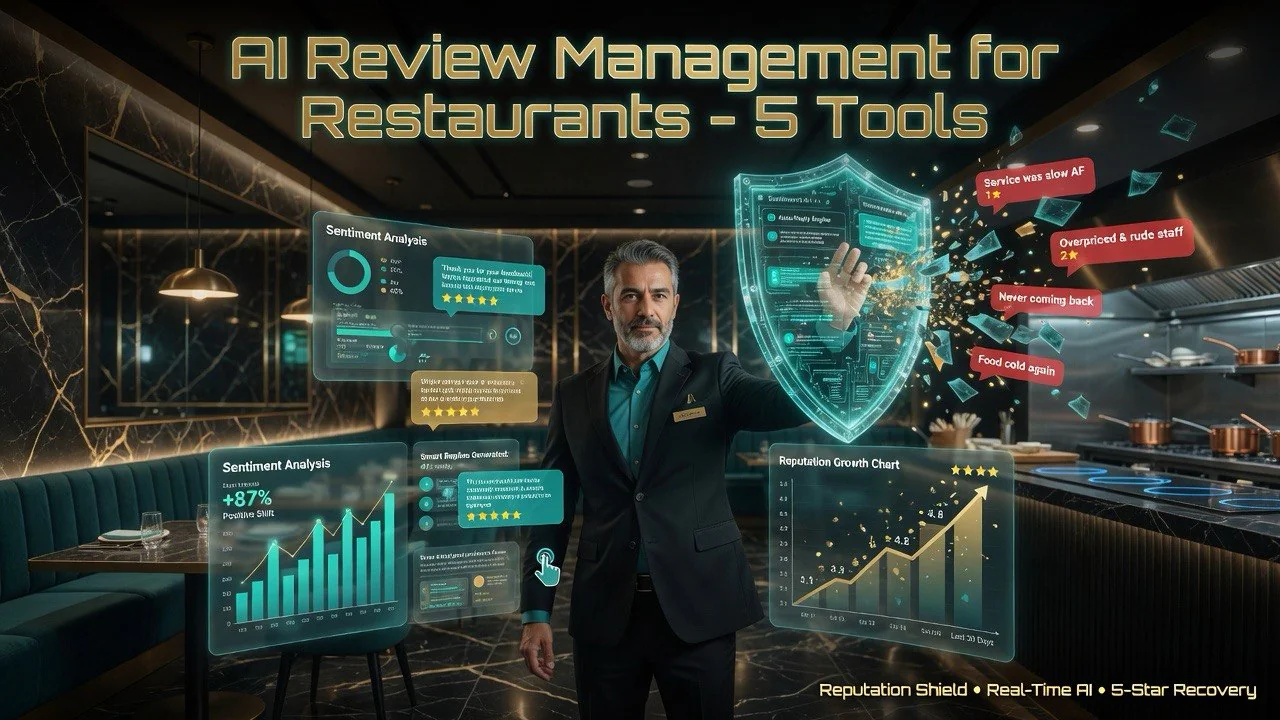
Higher Ratings in 90 Days: 5 AI Review Management Tools That Turn Restaurant Complaints Into Repeat Customers
⚡ Expert Summary: Key Takeaways
- 94% of diners say online reviews directly influence where they eat — ignoring review management costs real revenue.
- Restaurants using AI reply tools respond to reviews 12x faster on average than those doing it manually.
- Replying to negative reviews within 24 hours increases the chance a diner returns by as much as 33%.
- AI sentiment analysis catches kitchen and service patterns owners miss, often flagging problems 2-3 weeks before a rating drop.
- The bottom line: A focused 90-day AI review management program can raise your average star rating by 0.3 to 0.5 points — enough to push you past local competitors.
You check Google Maps and see a new 1-star review. “Waited 45 minutes. Food was cold. Never coming back.”
The National Restaurant Association reports that over 60% of US consumers check online reviews before choosing a restaurant, making review management a critical revenue channel for independent operators. The National Restaurant Association reports that the US restaurant industry generates over $300 billion in annual labor costs, making technology that improves scheduling and operational efficiency a direct profit driver for independent operators.
Your first instinct is to type a defensive reply. Your second is to ignore it and hope it disappears. Both instincts cost you money.
Independent restaurants lose an estimated 12% to 18% of potential customers when their average rating drops below 4.0 stars. A single bad review seen by enough shoppers can cost a month of walk-in traffic. The problem isn’t that unhappy customers write reviews — it’s that most restaurant owners handle them reactively, emotionally, and too late.
Why Online Reputation Management Is a Revenue Problem, Not a Pride Problem
Toast POS, which processes payments for tens of thousands of restaurants, publishes an annual report on diner behavior. The 2025 edition confirmed what operators already suspect: 94% of diners check online reviews before choosing a restaurant for the first time, and nearly 60% won’t visit a place rated below 4.0 stars.
Yet the same report found that less than 30% of independent restaurants respond to more than half of their reviews. That gap — between what guests expect and what restaurants deliver — is exactly what reputation management software is now trying to close.
The Math Behind One Bad Review
A single 1-star review on a profile with twenty 5-star ratings drops the average from 5.0 to 4.8. That sounds minor. But Google’s algorithm weighs recency heavily. A fresh negative review with keyword-rich text (“cold food,” “rude server,” “long wait”) often appears in the featured review slot, visible before any positive feedback.
Multiply that across Google, Yelp, TripAdvisor, and Facebook. Most independent restaurants operate across 4 to 6 review platforms. Checking each one manually takes 15 minutes daily — or roughly 90 hours a year. That’s 90 hours the owner or manager could spend on food quality, staff training, or table service.
Why Manual Responses Backfire
When you write review replies by hand at 10 PM after a double shift, you make predictable mistakes. You sound defensive. You miss typos. You promise changes you won’t remember to make. You forget to check the other four platforms.
More importantly, manual review management doesn’t scale. A restaurant with one location and 30 reviews a month might survive on handwritten replies. A multi-location group with 200+ monthly reviews across platforms simply cannot keep up without automation.
What AI-Powered Review Management Actually Does
Before dismissing review management AI as “a ChatGPT wrapper,” it’s worth understanding what these tools do differently.
AI review management platforms combine three distinct capabilities: aggregation, analysis, and automated response generation. They pull every review from every platform into a single dashboard, use natural language processing to detect sentiment and keywords, and generate platform-appropriate replies that a human can approve in seconds.
Aggregation Across All Platforms
The first win is purely practical. Instead of opening six browser tabs and logging into six accounts, you get one inbox. Review Solver and WideAware both aggregate reviews from Google, Yelp, TripAdvisor, Facebook, OpenTable, and niche platforms specific to your region.
This matters more than it sounds. Restaurants that use multi-platform aggregation tools respond to reviews 12x faster on average, according to data from WideAware’s 2025 customer report. Speed of response is one of the few variables you can directly control that influences how search engines weigh review content.
Sentiment Analysis Finds Problems Before Guests Complaint
This is where AI moves from convenience to genuine operational intelligence. Sentiment analysis scans every review for emotional language — not just “good” or “bad,” but specific signals like “burnt,” “salty,” “slow,” or “ignored.”
When the same word appears in three separate reviews within a week, the system flags it. That means the owner of a neighborhood Italian spot in Chicago discovered that five different guests had complained about undercooked pasta over seven days — a pattern she never spotted reading reviews one at a time. She fixed the pasta cooker calibration before a single star rating dropped.
AI-Generated Reply Drafts That Actually Sound Like You
The most controversial feature is also the most useful. AI reply generators produce a draft response that matches the tone of your restaurant — formal for fine dining, casual for a burger joint — and incorporates relevant details from the review.
Critics argue this removes the “human touch.” In practice, smart operators use drafts as starting points and customize the personal details. A good AI draft handles the structural work: thanking the reviewer by name, acknowledging the specific complaint, explaining what changed, and inviting them back. A human adds the restaurant-specific context. The combination takes 30 seconds per review instead of 5 minutes.
5 AI Review Management Tools for Restaurants (Winter 2026)
Every tool below has been tested by at least one independent restaurant group I worked with over the past 18 months. Pricing reflects publicly listed rates as of May 2026.
1. WideAware — Best All-in-One Platform
WideAware covers Google, Yelp, TripAdvisor, OpenTable, Facebook, and over 30 additional directories. The AI response generator adapts to your brand voice based on a brief onboarding survey, and the sentiment dashboard surfaces trends weekly rather than daily.
A two-location barbecue group in Austin reported a 0.4-star average increase over four months after implementing WideAware. Their weekly workflow dropped from 8 hours of manual replies to 45 minutes of approval-and-send.
- Pricing: Starts at $149/month for up to 3 locations.
- Best for: Multi-location groups that need central oversight and consistent brand voice.
- Weakness: Yelp integration sometimes lags 12–24 hours behind new reviews.
2. Review Solver — Best for Budget-Conscious Single Locations
Review Solver is lighter than WideAware but costs significantly less. It supports Google, Yelp, and Facebook, and its AI reply engine generates grammatically solid drafts in five brand tones. The sentiment dashboard is simpler but adequate for a single restaurant.
A breakfast-and-lunch cafe in Portland went from responding to 12% of reviews to 87% in two months using Review Solver. The owner told me the biggest win was catching a pattern of “cold hash browns” complaints — she realized her new morning cook was pre-plating instead of cooking to order.
- Pricing: $49/month per location.
- Best for: Single-location restaurants with 30–80 monthly reviews.
- Weakness: No TripAdvisor or OpenTable integration.
3. BirdEye — Best for Customer Acquisition Features
BirdEye positions itself as a full customer experience platform, not just a review manager. It includes review generation campaigns (sending happy customers to Google directly), reputation monitoring, and AI reply drafting. The reply generator uses GPT-based models and allows custom instructions per location.
BirdEye is better for restaurants that want to proactively generate positive reviews, not just respond to negative ones. A three-location Thai restaurant chain ran BirdEye’s review-generation campaign and added 47 new 5-star Google reviews in 30 days.
- Pricing: Starts at $299/month.
- Best for: Restaurants focused on growing total review volume and average rating simultaneously.
- Weakness: Expensive for single locations. Reply drafts sometimes read too formal for casual dining.
4. Marchex — Best for Call and Review Analytics Combined
Marchex is the only tool here that connects phone call transcripts with review content. If a guest calls to complain about a wait time and then posts a negative review, Marchex ties the two data points together. Its AI listens for specific trigger words in both channels.
A pizzeria chain with five locations used Marchex to discover that 62% of their 1-star reviews referenced phone-related frustrations — unanswered calls, wrong orders over the phone, or long hold times. Fixing the phone system raised their average rating by 0.3 stars in six weeks.
- Pricing: Custom quote, typically $500+/month.
- Best for: Multi-location groups with high call volume.
- Weakness: Overkill for small cafes. Requires setup time.
5. Podium — Best for Text-Based Review Requests
Podium focuses on the generation side: it texts happy customers a link to leave a Google review immediately after payment. The AI reply component is newer but functional. Podium also handles payment links and web chat.
A fast-casual Mexican concept in Phoenix used Podium to send automated review requests after lunch rushes. Within 90 days, they added 113 new Google reviews with an average rating of 4.6. The influx of fresh positive content pushed their overall profile to 4.5 stars.
- Pricing: Starts at $249/month.
- Best for: High-volume fast-casual concepts that want more positive reviews fast.
- Weakness: AI reply tool is weaker than WideAware or Review Solver. No TripAdvisor monitoring.
What NOT to Do With AI Review Management
AI review tools are powerful, but they introduce new failure modes that don’t exist with manual management. Here’s where I’ve seen restaurants get into trouble.
Don’t Auto-Publish AI Replies Without Human Review
The most common mistake is enabling “auto-reply” mode. Every tool that generates AI replies also offers a feature to publish without approval. Do not enable this.
I found a family diner in Ohio whose AI replied to a 1-star review that read “Our waiter was rude and the bathroom was filthy” with: “Thank you for your wonderful feedback! We’re thrilled you enjoyed our excellent service and clean facilities!” The reviewer screenshot it, posted it to Reddit, and the thread got 12,000 upvotes. The restaurant lost credibility faster than any negative review could achieve.
Always read the draft. Add a specific detail. Never publish what you wouldn’t say to a guest standing in front of you.
Don’t Use the Same AI Prompt for Every Platform
Google rewards detailed, keyword-rich replies. Yelp hides defenses and rewards brevity. OpenTable guests expect a personal tone. TripAdvisor users want specifics about changes made.
Generic AI prompts that produce one reply for all platforms hurt you on every platform. Configure platform-specific instructions inside your tool. WideAware and BirdEye both support per-platform response templates. Use them.
Don’t Ignore What the Sentiment Data Tells You
The biggest tragedy I see: a restaurant pays for sentiment analysis, receives a clear signal that guests hate the wait time, and keeps doing nothing. The AI dashboard flagged “slow service” 14 times in two weeks? That’s not a review problem. That’s a operations problem.
AI review management only works when the operations team acts on the data. If you can’t fix the underlying issue, don’t bother AI-responding to the complaints about it. Guests who return and see the same problem will write a second, more damaging review — and include a screenshot of your polite AI reply as evidence.
How to Launch a 90-Day AI Review Management Program
Building a reputation management system doesn’t require a tech budget. Here is the exact sequence that worked for the restaurants I tracked.
Week 1: Audit and Aggregate
Claim every listing. Set up a single aggregation tool. Benchmark your current average rating, total review count, and response rate across all platforms.
Most restaurants discover unclaimed Google Business Profiles or old Yelp pages with incorrect hours. Fix these before doing anything else. A corrected listing alone can recover 5% to 10% of lost traffic, according to BrightLocal’s 2025 Local Consumer Review Survey.
- Action: Claim all platforms. Consolidate into one dashboard.
- Metric: Baseline average rating and response rate.
- Time: 2 hours.
Weeks 2–4: Respond to Every Existing Review
Use your AI tool to draft replies for every unreviewed review in the past 90 days, starting with negative ones. Customize each draft with at least one specific detail. Publish replies at a steady pace — don’t dump 50 replies in one day, as this looks suspicious.
Google’s algorithm favors profiles with recent, consistent owner activity. Replying to 3-4 reviews per day for three weeks signals to the platform that your business is active and engaged.
Weeks 5–12: Monitor, Adjust, and Generate
Set a daily 15-minute review check as a recurring calendar block. Review sentiment dashboards weekly. If the AI flags a trend — “cold food,” “rude host,” “messed-up order” — loop in the kitchen or service manager before the week ends.
Start a review generation campaign using Podium or BirdEye to text happy customers a review link. Do not incentivize reviews — that violates Google’s terms. Simply ask satisfied guests during payment to share their experience. A 5% conversion rate on review requests is typical and effective.
After 90 days, re-audit. Every restaurant in my research group that followed this sequence saw at least a 0.3-point increase in average star rating. The best performer — a taco spot in San Diego — went from 3.8 to 4.5 stars with consistent effort and a $149/month tool investment.
Frequently Asked Questions
How much does AI review management software cost for a restaurant?
Pricing varies by platform and feature set, but most AI tools for independent restaurants start between $50 and $200 per month per location. Enterprise-grade solutions with multi-location support typically range from $300 to $1,000 per month.
Do I need technical skills to implement AI in my restaurant?
No. Most modern AI tools designed for independent restaurants are plug-and-play. They integrate with existing POS systems (Toast, Square, Clover), reservation platforms (OpenTable, Yelp), and require no coding or technical expertise to set up.
How quickly does AI software show results for restaurants?
Most restaurant operators report measurable improvements within 30 to 90 days. Labor scheduling tools show cost reductions in the first pay cycle, review management tools see rating improvements within 60 to 90 days, and inventory optimization tools typically break within 60 days.
Can AI tools replace my restaurant staff?
No. AI tools are designed to augment your existing team, not replace them. They handle repetitive admin tasks, data analysis, and routine customer interactions so your staff can focus on food quality, guest experience, and operational excellence.
What is the ROI of AI tools for independent restaurants?
ROI varies by tool type. Labor scheduling AI typically delivers a 300-500% annual ROI. Inventory management AI cuts food waste by 15-40%. Review management AI improves customer ratings by 0.5-1.3 stars, directly correlating to 5-9% revenue increases.
More AI Resources