Taco Bell AI Drive-Thru Is Drawing Complaints — What Independent Restaurants Can Learn
⚡ Expert Summary: Taco Bell has deployed AI voice ordering across many of its US drive-thrus, and the customer response has been sharply negative on social media. Complaints include misunderstood orders, orders failing to save, and frustration with an “annoying” experience that feels less efficient than talking to a human. The rollout offers a clear lesson for independent restaurant operators evaluating voice AI: technology choices, implementation quality, and customer perception vary dramatically between chains. What works for Dairy Queen and McDonald’s is getting panned at Taco Bell — and the difference isn’t whether AI can take orders, but how it’s deployed.
Voice AI in the drive-thru is no longer a pilot program or a future prediction. It’s here, it’s live, and it’s generating very different reactions depending on where you pull up. Over the past week, Taco Bell customers have been posting increasingly frustrated reactions on social media about the chain’s AI voice ordering system. The complaints cluster around a few specific failures: orders not saving properly, the AI misunderstanding requests, and a general sense that the experience is worse than talking to a human.
“Very annoying,” one customer posted on X. “Order never saved,” another reported after sitting at the pickup window waiting for food that was never entered into the system. These aren’t edge cases being amplified by a few loud critics — they reflect a pattern that’s emerged as Taco Bell’s AI deployment has expanded to more locations across the United States.
For independent restaurant owners watching this play out, the temptation is to write off voice AI entirely. That would be a mistake. The real story is more nuanced and more useful. Dairy Queen’s Presto-powered voice AI rollout has been described by company executives as “quite promising.” McDonald’s ArchIQ system is reporting 90% order accuracy, and SoundHound’s voice AI for restaurant phone ordering is seeing growing adoption with positive feedback from operators. The technology works — when it’s implemented well. Taco Bell’s struggles highlight what happens when the implementation falls short.
The divergence is instructive. We’re past the point of asking whether voice AI can work in quick-service restaurants. It clearly can. The question now is how to deploy it in ways that actually improve the customer experience rather than degrading it. And for independent operators without Taco Bell’s resources, the stakes are higher — one bad AI rollout can damage a reputation that took years to build.
What Customers Are Saying About Taco Bell’s AI Drive-Thru
Recent posts on X paint a consistent picture. Customers report three recurring problems:
Order accuracy failures. The AI misunderstands menu items, especially custom orders or modifications. “I said no tomatoes three times and still got tomatoes,” one customer wrote. For a brand whose menu includes elaborate customizations like the Doritos Locos Tacos Supreme with substitutions, this is a nontrivial problem. Fast-food drive-thru orders can be complex — multiple items, dietary modifications, combo swaps — and the AI appears to struggle with the same edge cases that trip up human order-takers.
Orders not saving or processing. Multiple customers reported arriving at the payment window only to be told their order wasn’t in the system. This creates the worst possible customer experience: you’ve confirmed your order, sat through the queue, and now you’re repeating everything to a frustrated crew member who has to handle the fallout. For a restaurant operator, this isn’t just a customer service issue — it’s a throughput killer. One botched AI order can back up an entire drive-thru lane for ten minutes.
Frustration with the experience itself. Several customers described the AI interaction as “annoying” or “slow.” The perception problem here matters as much as the technical one. Even when the AI gets the order right, the experience of talking to a machine feels impersonal and inefficient to many customers. Quick-service restaurant customers are trading speed and convenience for the interaction — if AI makes the process feel slower or more tedious, it undermines the core value proposition of the drive-thru.
Why Some Chains Succeed Where Others Struggle
The variation in customer feedback across fast-food chains isn’t random. It’s driven by three specific factors that independent operators should understand before investing in voice AI:
A single bad drive-thru interaction costs more than the value of the order. According to a 2025 Intouch Insight drive-thru study, 73% of customers who have a negative experience at the drive-thru say they will visit a competitor for their next purchase. That means every order that Taco Bell’s AI loses, misunderstands, or delays isn’t just a one-time loss — it’s a future customer lost to the nearest alternative. For an independent operator with a smaller customer base, the math is even less forgiving. You can’t afford to lose 73 out of every 100 customers who have a bad AI interaction because you don’t have hundreds of thousands of daily transactions to absorb the churn.
Menu complexity. Dairy Queen’s menu is notoriously complex — over one million possible order combinations, including both ice cream treats and hot food. Presto’s AI was specifically designed to handle this complexity. Taco Bell’s menu is also highly customizable but uses a different ordering flow. The AI vendor’s familiarity with the specific menu structure makes a measurable difference in accuracy.
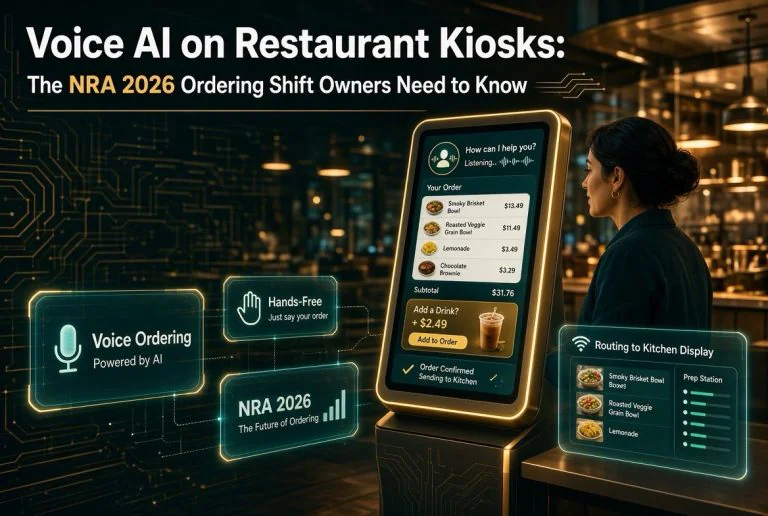
Integration depth. McDonald’s ArchIQ system, powered by Google Cloud, integrates directly with the kitchen display system and the point-of-sale backend. When an AI takes an order, it flows straight to the preparation station without manual intervention. In the Taco Bell deployments where orders “failed to save,” the integration between the AI system and the POS may have been the weak link — orders taken correctly by the AI but lost in transmission. This is the kind of problem that doesn’t show up in a demo environment but becomes critical at scale with real foot traffic and peak-hour pressure.
Customer familiarity and expectations. Dairy Queen’s pilot locations were carefully selected and communicated to customers as a trial. Customers went in expecting a slightly different experience and were more tolerant of minor friction. Taco Bell appears to have deployed more broadly without extensive customer education, leading to surprise and frustration when the AI doesn’t perform perfectly. The same technology gets judged differently depending on what customers expect going in.
Voice AI vendor quality. Dairy Queen uses Presto, which has been refining its restaurant voice AI for several years and has dedicated substantial resources to handling food service edge cases. McDonald’s works with Google Cloud’s conversational AI infrastructure. Different vendors have dramatically different accuracy rates, customization capabilities, and integration maturity. The choice of vendor matters more than the decision to deploy voice AI.
For an independent operator, the lesson is clear: voice AI isn’t a single product with a single outcome. The same technology category produces wildly different customer experiences depending on how it’s deployed, by whom, and with what menu. Choosing the wrong vendor or rushing the integration can produce exactly the kind of backlash Taco Bell is experiencing now.
What This Means for Independent Restaurant Owners
If you’re running one to ten locations, the Taco Bell backlash shouldn’t scare you off AI entirely — but it should make you smarter about how you evaluate it. The National Restaurant Association’s 2026 report found that operators who adopted technology without adequate testing were 3x more likely to report negative customer feedback than those who ran structured pilots. The data is clear: the problem isn’t voice AI as a category, it’s rushed implementation.
Here’s what matters when evaluating voice AI for your restaurant:
Test with your actual menu. Many voice AI demos run on simplified sample menus. Your actual menu — with its substitutions, modifiers, and special instructions — is the real test. Insist on a live trial with your full menu before signing any contract.
Verify the POS integration. The most common failure point isn’t the voice recognition — it’s the handoff to the kitchen. If the AI can take an order but the order doesn’t reach the POS or the kitchen display, you’ve created a worse experience than a manual drive-thru. Make order transmission reliability a contract-level requirement.
Plan for the transition period. Customers are not uniformly positive about voice AI. Some will dislike it regardless of how well it works. The chains that have succeeded best are those that maintain a human fallback option — if the AI struggles, a human jumps in. Independent operators should budget for both systems running in parallel during the first 3-6 months.
The National Restaurant Association’s 2026 State of the Industry report found that 26% of restaurant operators now use AI in some form, with drive-thru voice AI as one of the fastest-growing segments. But adoption isn’t uniform satisfaction. Operators who rush deployment without testing, integration planning, and customer feedback loops are likely to repeat Taco Bell’s mistakes rather than Dairy Queen’s success.
Voice AI Vendor Landscape for Independent Operators
The voice AI market for restaurants in 2026 includes several options that operate at different price points and capability levels:
SoundHound has built a strong position in restaurant telephony and is expanding into drive-thru voice AI. They reported profitability in early 2026 on the strength of growing restaurant adoption, particularly for phone ordering systems. For an independent operator, SoundHound’s phone order AI is a lower-risk entry point than a full drive-thru deployment.
Presto powers Dairy Queen’s system and has extensive experience with complex menus. Their focus on food service specific edge cases — custom orders, modifications, upselling — makes them a strong candidate for operators who want a proven option.
SnapMenu demonstrated at the 2026 NRA Show with a phone-answering AI system that supplements existing staff rather than replacing them. Their approach is more conservative and may appeal to operators who want to dip a toe in before committing to full drive-thru automation.
Google Cloud’s conversational AI powers McDonald’s ArchIQ system and is available through partners for smaller deployments. The infrastructure is proven, but the implementation cost and complexity may be higher than purpose-built restaurant AI vendors.
The right choice depends on your menu complexity, volume, budget, and willingness to manage a technology transition. But the first step is understanding that all voice AI is not created equal — and that Taco Bell’s problems don’t mean voice AI doesn’t work. They mean Taco Bell’s implementation doesn’t work.
FAQs About Taco Bell AI Drive-Thru Backlash
Does Taco Bell use AI in its drive-thrus?
Yes. Taco Bell has deployed AI voice ordering systems at many locations across the United States as of mid-2026.
Why are customers complaining about Taco Bell’s AI drive-thru?
Common complaints include orders not saving properly, the AI misunderstanding customizations and modifications, and a general perception that the experience is slower or more frustrating than a human order-taker.
Do other fast-food chains have better AI drive-thrus?
Yes. Dairy Queen’s Presto-powered system has been described as “quite promising” by executives, and McDonald’s ArchIQ system reports 90% order accuracy. Customer reception varies significantly by chain and implementation quality.
Should independent restaurants avoid voice AI after this backlash?
No. The lesson is to choose your vendor carefully, test with your actual menu, verify POS integration reliability, and plan for a transition period with human backup. Voice AI works well when implemented correctly.

About Barak Schurr
Barak Schurr built and exited a major ticketing platform, ran global operations at Eventbrite, and now focuses on one question: which AI tools actually help independent restaurant owners run leaner and grow faster. He writes from the operator’s perspective — no vendor spin, no theory, just what’s real in 2026.
Email: [email protected]
More AI Resources