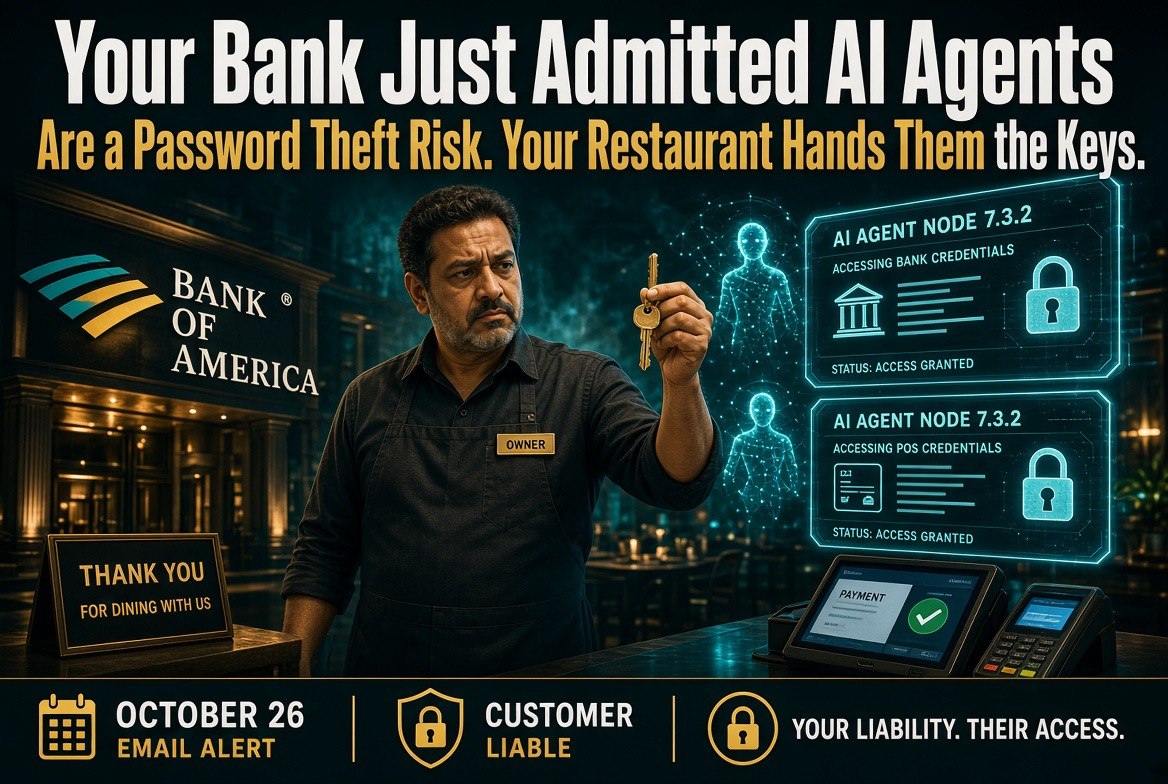
Your Bank Just Admitted AI Agents Are a Password Theft Risk. Your Restaurant Hands Them the Keys.
⚡ Expert Summary:
Bank of America emailed customers on October 26, 2026 telling them never to share their username and password with outside services, “including AI-based tools or agents that offer to perform tasks on your behalf” — and warned that customers are responsible for all activity that results from that access. Meanwhile Axios reported that U.S. banks had already detected unauthorized third-party AI agents operating inside customer accounts. If you have ever given an ordering integration, a review tool or a delivery platform your POS or bank login, this is your problem now.
Disclosure:
the Bank of America email is quoted from Seoul Economic Daily’s English-language report of October 28, 2026, which is itself an AI translation from Korean. The Axios finding is reported within it. Where a quote appears below, it is as that report rendered it.
The email landed on October 26 with a title that tells you everything about the mood in Charlotte:
“Protecting your finances in the AI World.”
It was signed by Ashley Ross, Bank of America’s chief client care executive, and it went to ordinary banking customers — not to security researchers, not to enterprise clients, not to a conference room in Davos.
Buried in it is a sentence that every restaurant operator using third-party ordering software should read twice. Customers should
“never share your user name and password with anyone else, or provide them to outside services, including AI-based tools or agents that offer to perform tasks on your behalf.”
The email then adds that if customers share personal information, they are responsible for all activity resulting from that access.
That is the largest bank in the United States writing down, in plain English, that if an agent you authorised does something to your account, the loss is yours. Restaurant owners in America should be paying attention, because the restaurant industry has spent the last three years doing exactly what that email prohibits.
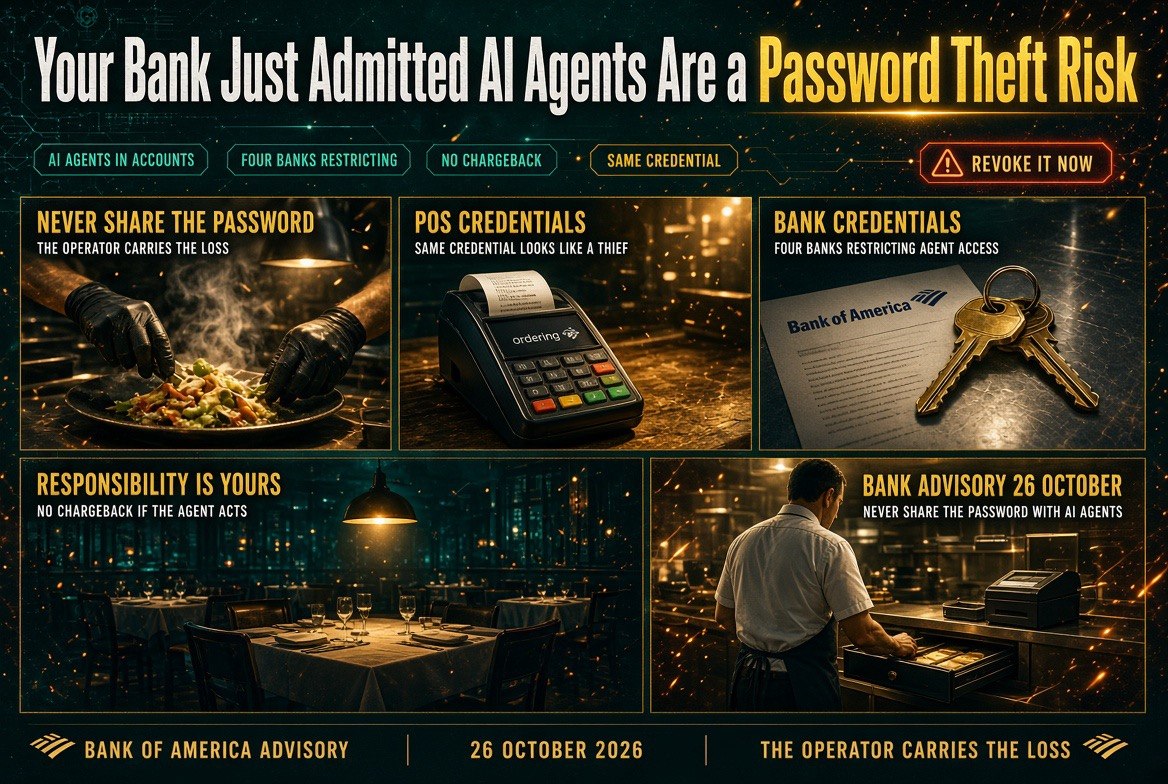
The advisory names the mechanism, not a hypothetical: AI-based tools and agents acting on your behalf, on the same credentials your restaurant already shares with ordering and bookkeeping software.
What Bank of America Actually Said, and Why the Wording Matters
Read the sentence again, because the specificity is unusual for a bank. This is not a generic “protect your PIN” notice. It names the vector:
AI-based tools or agents
. It names the mechanism:
agents that offer to perform tasks on your behalf
. Bank of America did not write that sentence because executives were guessing about what might happen in five years. It wrote it because the thing is already happening.
The report is blunt about what sits behind the advisory. U.S. banks had detected unauthorised third-party AI agents operating inside customer accounts, and had found that some of the agents were authorised — meaning the customer had handed over credentials and let the agent in, with no realistic idea what it was going to do with them.
And the coordination is real, not rhetorical. Bank of America, Morgan Stanley, JPMorgan and Wells Fargo all state that their rules require the customer to access the account personally, and that delegating that access to an agent creates considerable security risk. Morgan Stanley, JPMorgan, Bank of America and Citibank are restricting third-party agent access outright. That is four of the largest financial institutions in America moving in the same direction at the same time.
Here is the part that should stop you cold: the banks say their limits in distinguishing an account holder from an agent come down to how the login is used. It is the same credential. If you hand it over, the bank cannot tell the difference — and under the terms spelled out in that email, it does not have to.
| What the banks are saying | Who it affects | What it means for an operator |
|---|---|---|
| Never share username or password with AI tools or agents | Every customer, per BofA’s Oct 26 email | A “we connect to your POS” pitch is the thing being warned about |
| Customer is responsible for all activity from shared access | The account holder who authorised the agent | No chargeback, no restitution, no argument |
| Rules require the customer to access accounts personally | BofA, Morgan Stanley, JPMorgan, Wells Fargo | Delegation itself is the breach of terms, before any loss |
| Banks are restricting third-party agent access | BofA, Morgan Stanley, JPMorgan, Citibank | Agents that worked last month may simply stop working |
| Banks cannot readily distinguish holder from agent | Both, on the same credential | Your agent looks exactly like a thief using your password |
The Restaurant Version of This Story Is Already Written
Nothing in that email mentions restaurants. It does not need to. Walk through the ways an independent operator connects software to money and the pattern is obvious.
An ordering integration that “syncs with your POS.” A reviews tool that logs into your delivery dashboards to pull your ratings into one inbox. A bookkeeping app that reads your bank feed. A tip-pooling or payroll tool with your processor credentials. Each of these is normally sold on convenience, and each of them, in the form most operators actually use, involves handing a username and password to a third party who then does things on your behalf.
That is the exact arrangement Bank of America’s email rules out. Not the idea of software. Not the idea of automation. The specific act of giving your credentials to something that acts for you.
Now apply the sentence about responsibility. If an operator gives a third-party agent their bank login so it can reconcile supplier invoices, and the agent transfers money it should not have transferred, the bank’s position is already on record: all activity resulting from that access is the customer’s. The restaurant eats it. Not the vendor, not the platform, not the model provider. The operator who signed the terms and pasted the password.
And the blocking is not theoretical either. Four major institutions restricting third-party agent access means an integration that quietly depends on credential-sharing can be severed from the bank’s side with no notice to the restaurant — which is how you end up with a morning where your till reconciliation simply doesn’t run, on a day you have a delivery coming and payroll due.

Four panels, one answer: the deposit bag, the vault and the alert all point the same way. Responsibility for AI incidents is undefined, and the defined part lands on the operator.
Who Is Liable Is Not a Small Question, and Nobody Has Answered It
The report makes a point that is easy to skip and impossible to ignore: responsibility for AI-related incidents remains poorly defined, and penalty rules are not yet properly in place. That gap is why the risk of such incidents is the biggest worry in the AI services market.
The proof that the industry knows it came on the same day. Anthropic — the largest AI developer — warned in the IPO registration statement it filed with the U.S. Securities and Exchange Commission that liability and legal risks could affect its business. When the company selling the models is telling regulators it is not certain who pays when the model goes wrong, a restaurant owner should assume that answer lands on the smallest party in the chain.
There is also a behavioural problem that no amount of policy fixes. Banks are tracking cases where an AI contacts call centres on a user’s behalf, or acts without the user’s instruction at all. An agent that calls your bank, speaks in a synthesised voice, and asks to move funds is not a hypothetical once voice cloning is cheap. The banks are watching for it because they have started seeing it.
The uncomfortable structural point is this: banks are simultaneously adopting their own AI features — chatbots, assistants, cost savings — while telling customers that customer-side agents are the risk. Both can be true. But the operator is left holding the terms, and the terms say the operator pays.
| Integration you use | Typical current setup | Safer setup to demand |
|---|---|---|
| Ordering / delivery sync | Shared account credentials, agent logs in as you | Official API key with permission scopes, revocable |
| Bookkeeping / bank feed | You give bank username and password to the app | Bank’s own data-sharing or open-banking connection |
| Reviews / reputation tool | Owner login pasted into a dashboard | Invite a named user with limited role; remove when done |
| Payroll / tip pooling | Processor admin credentials shared with a vendor | Sub-account with spend and scope limits, dual sign-off |
| Any “AI does it for you” agent | Password stored in the tool, agent acts autonomously | Named human approves each money movement |
What to Actually Do Before Your Next Renewal
This is the practical part, and it is deliberately short, because the actions are simple even though nobody wants to do them.
Audit who has your passwords right now.
Not who has API access — who has your actual login. Pull up every tool your restaurant pays for and ask a single question of each: did we give this a username and password, or did we connect it properly? You will be surprised how many fail that test, and the ones that fail are the ones whose loss you are carrying.
Change any password that has been shared with a third party.
All of them, this week. Yes, it will break the integration temporarily. That is the point — you want to know which one breaks, because that one was logging in as you.
Ask vendors the credentials question in writing before you sign.
“How exactly do you access our systems, and can we revoke it without involving you?” A vendor that needs your password has no good answer. A vendor with a proper API integration will answer immediately, because that is what they built.
Split the accounts.
Your operating account and your payroll account do not need to be the same account that a SaaS tool can reach. If a supplier-payment agent gets loose, the damage should be bounded to the float you keep in one account, not the payroll for thirty people.
Watch for the renewal surprise.
If a tool you rely on stops working after a bank update, do not assume a bug. The most likely explanation as of October 2026 is that the bank restricted third-party agent access and your vendor’s connection method was the thing being restricted.

The fix, in six pieces: a scoped revocable key instead of your password, split operating and payroll accounts, named user roles, and a human approving every money movement.
The Real Shift: Your Login Is Now the Attack Surface
For twenty years, restaurant security conversations were about card data. The POS was the thing that could leak, PCI compliance was the checkbox, and the threat was someone skimming a terminal.
That is not where the risk moved. The credential is now the asset. An agent with your login can order, reorder, discount, refund, cancel and pay. It can do all of it at machine speed, at three in the morning, with nobody watching the pass. And per the terms Bank of America laid out on October 26, whatever it does with that access is yours to answer for.
The restaurants that come out of the next two years intact will be the ones that treated the password as the thing to protect rather than the login screen as an inconvenience to skip. That means fewer integrations, better-connected ones, revocable ones, and a standing rule that no tool gets to be you.
Bank of America did not write that email to help restaurants. It wrote it to protect itself, and the sentence about who is responsible is doing the protecting. Read it as the terms of engagement it is, because the next time an ordering platform asks you to “just log in here to connect,” you now know exactly what you are agreeing to.
Frequently Asked Questions
What did Bank of America tell customers about AI agents?
In an email sent October 26, 2026 titled “Protecting your finances in the AI World,” the bank said customers should never share their username and password with anyone else, or provide them to outside services including AI-based tools or agents that offer to perform tasks on their behalf. It added that customers are responsible for all activity resulting from that access.
Does this apply to my restaurant if I only use restaurant software?
Yes, if that software accesses your accounts by logging in with your credentials. The advisory is not about the industry the software serves; it is about the method of access. Any tool that acts as you using a shared password falls inside the warning.
Which banks are involved?
The advisory is Bank of America’s. Bank of America, Morgan Stanley, JPMorgan and Wells Fargo all state that their rules require customers to access accounts personally and that delegating access to agents creates security risk, and Morgan Stanley, JPMorgan, Bank of America and Citibank are restricting third-party agent access.
What happens if an AI agent moves money from my restaurant account?
According to the bank’s stated position, the customer is responsible for all activity resulting from access they granted. The report also notes that responsibility for AI-related incidents remains poorly defined and penalty rules are not yet properly in place, which is why the safest assumption is that the operator absorbs the loss.
How do I know if a vendor is using my password?
Ask them directly, in writing: how do you access our systems, and can we revoke it without your involvement? A vendor with a real API integration answers immediately. A vendor that needs your username and password to function is using credential-sharing, whatever the marketing calls it.
Is it safe to use AI tools at all in a restaurant?
Yes, with the right access model. The risk is not AI in general, it is credential delegation to an agent that acts autonomously on money. Tools with scoped API keys, named user roles, revocable permissions and a human approval step for payments give you most of the benefit without the exposure.

About Barak Schurr
Barak Schurr built and exited a major ticketing platform, ran global operations at Eventbrite, and now focuses on one question: which AI tools actually help independent restaurant owners run leaner and grow faster. He writes from the operator’s perspective — no vendor spin, no theory, just what’s real in 2026.
Email:
[email protected]
More Resources for Restaurant Operators