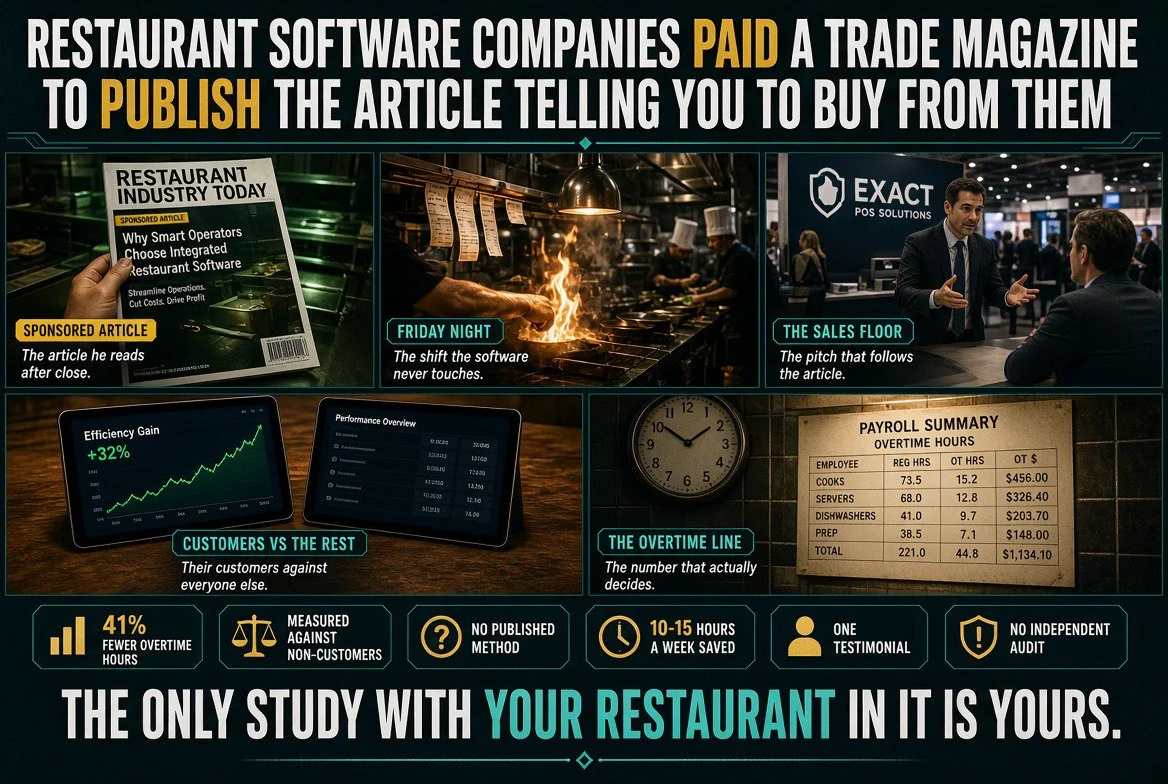
Restaurant Software Companies Paid a Trade Magazine to Publish the Article Telling You to Buy From Them
⚡ Expert Summary: The restaurant AI article operators were reading last week carried a vendor’s name at the top as sponsored content, and its headline numbers came from that vendor comparing its own customers to people who do not buy from it. That is not a study. It is a sales document with a magazine’s logo above it. And it lands on operators who are already being cold-called by the same companies that paid for the article — while nobody in the chain has any reason to tell them what the AI actually did to the Friday night.
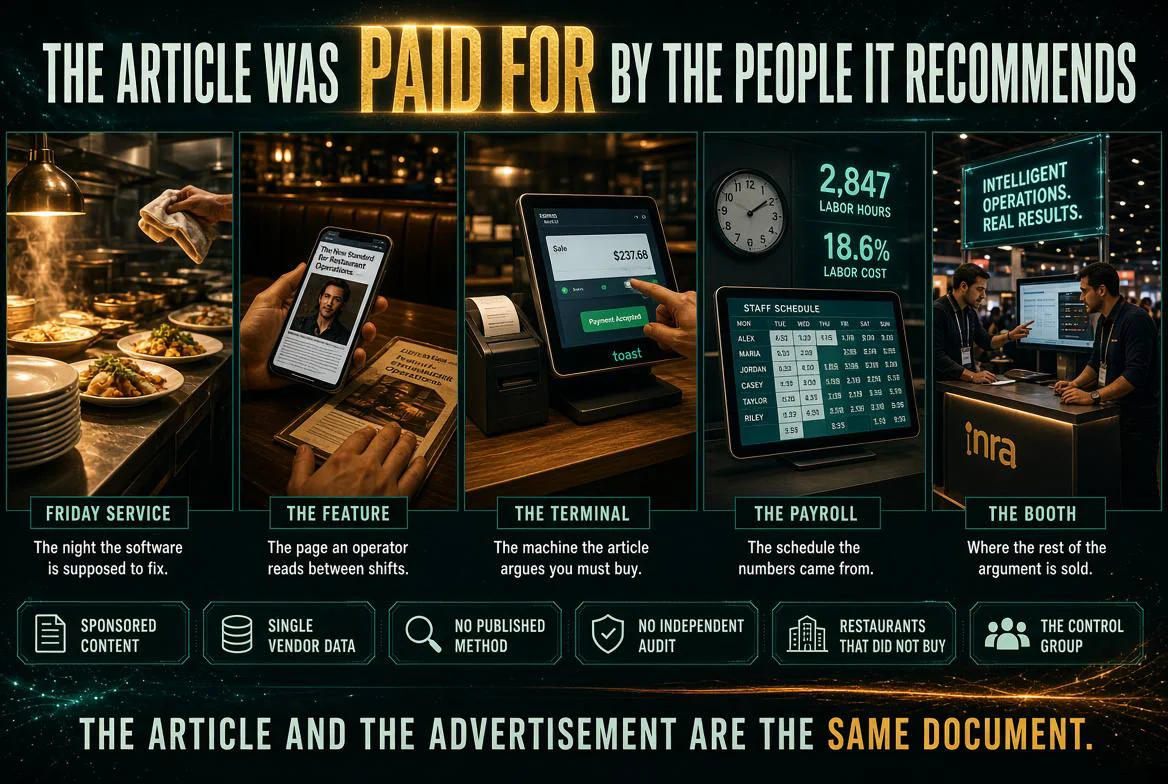
Last week an operator somewhere read an article titled around how to choose restaurant AI tools, what operators prioritise in 2026. He read it on a trade magazine he trusts. It had a byline slot and a date and a proper layout.
At the top of that page, in the sponsored content frame, sat the name of a restaurant software company.
He kept reading, because it looked like reporting. And the numbers inside it proved, among other things, that restaurants using this company’s product run fewer overtime hours than restaurants that do not.
That is not a finding. That is a comparison between a company’s customers and the people who declined to become its customers, run by the company, published by a magazine the company paid.
The Article and the Advertisement Are the Same Document
Sponsored content is a legitimate business model. Trade publications have thin margins and vendors have marketing budgets, and the arrangement is disclosed, which is more than most of the internet manages.
But disclosure is not the same as a firewall, and an operator scrolling on a phone at 11pm after close does not stop to read the label. He sees the magazine’s masthead. He reads the piece as the magazine’s judgement. The whole reason the vendor paid for that slot instead of running a banner ad is that readers extend trust to editorial and withhold it from advertising.
The status line at the top of a page is doing an enormous amount of work for six words of small type.
And this is not one vendor being cheeky. It is the pattern across the category. Restaurant software companies buy the editorial real estate that decides which restaurant software companies look credible, and then the trade press wonders why operators are cynical about every AI announcement.
The Numbers Are the Tell
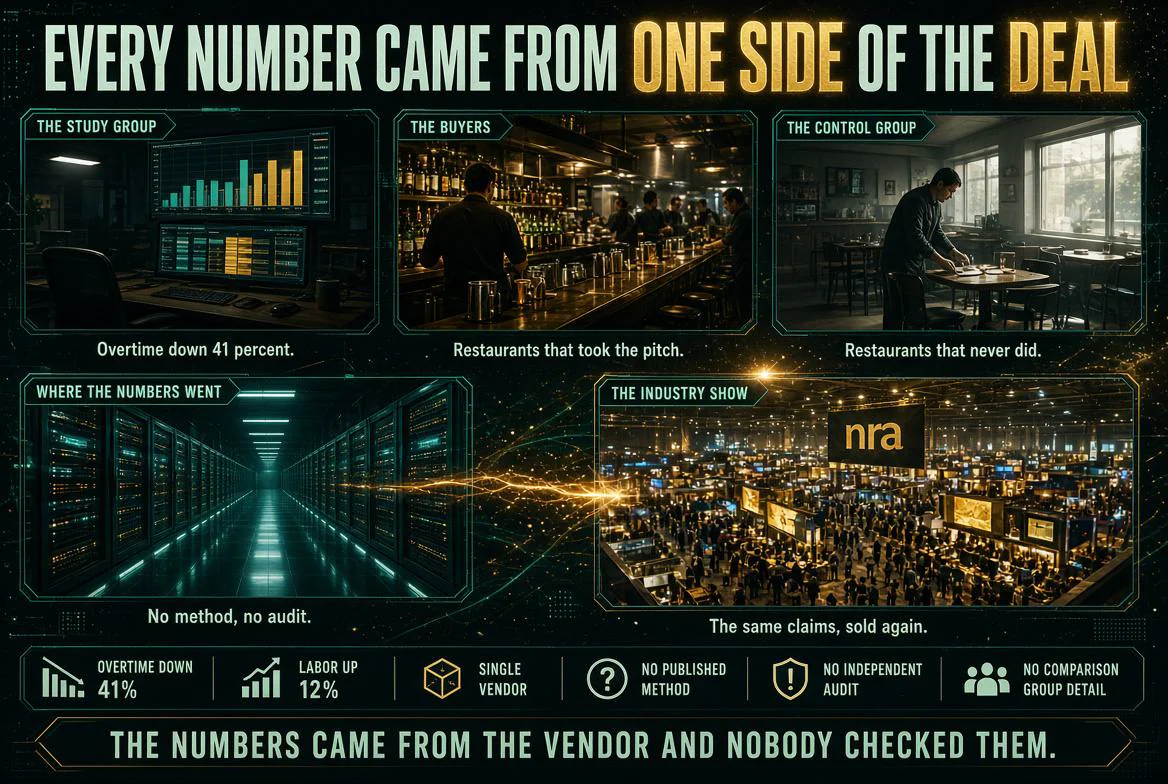
Look at what the sponsored piece actually claimed. Forty-one percent fewer overtime hours per employee, measured against non-customers of the same product.
Read that comparison again. It is not customers before and after. It is customers versus everybody who did not buy. The two groups were already different before the software ever loaded — different size, different volume, different management, different willingness to spend on technology. The software is the badge of the difference, not necessarily its cause.
The testimonial in the same piece is a director of operations saying ten to fifteen hours a week saved. One person, one restaurant group, no baseline published, no method, no before-and-after data anyone outside the company can inspect.
| What was claimed | What it was measured against | What an operator can verify |
|---|---|---|
| 41% fewer overtime hours per employee | Restaurants that do not use the product | Nothing — no cohort, no period, no local control group |
| 10 to 15 hours saved per week | One named director of operations | Her word, with no baseline shifts published |
| “What operators prioritise in 2026” | A vendor’s survey frame | The question wording, which is never printed |
| AI saves labour | Vendors with payroll software to sell | A second source with no stake — rarely exists |
None of that makes the product bad. It makes the evidence worthless. Those are two different sentences and operators deserve both said out loud.
Who Is Actually Billing Whom
Here is the structure underneath the awkwardness.
An operator buys a POS. The POS company now sells AI scheduling, AI marketing, AI voice ordering, AI inventory. The same company that owns the transaction record also owns the analysis of the transaction record, and now sells the operator recommendations based on it.
Those recommendations get written up as thought leadership. The thought leadership gets placed in trade magazines as sponsored content. Operators read it as editorial. Some share it in operator groups as if it were research. Then a rep calls about the exact module the article conveniently concluded everyone needs.
Nobody in that chain is a villain. Nobody has to lie. Every link is a rational commercial decision. The output for the operator is a market where the only available evidence about restaurant AI is produced by the people selling restaurant AI.
The One Independent Number in the Room
There is at least one figure in this window that did not come from a vendor selling into a restaurant’s stack, and it is more interesting than the vendor statistics.
A delivery platform’s 2026 trends report found AI-native startups leading after-6pm orders at 62%, against banking at 48% and pharma at 38%, and spending roughly six dollars more per order.
That is a platform studying its own order book, which has its own bias, but it is measuring behaviour rather than surveying intentions. And it says something the vendor content never will: the AI-heavy industries are the ones whose people order late and spend more because nobody is cooking.
Which is a labour story wearing a delivery costume. Which is the story restaurant AI is supposedly about.
| Source of the claim | What it measures | What it is worth to you |
|---|---|---|
| Sponsored vendor feature in a trade magazine | Its own customers against non-customers | Marketing, and priced as marketing |
| Vendor testimonial from a named operator | One person’s estimate of hours saved | A lead, not evidence — go ask her yourself |
| Platform trends report on its own orders | Actual purchases by industry, after 6pm | Behaviour, not intentions — the stronger kind of data |
| Your own two weeks of shifts | Your overtime, your covers, your waste | The only study with your restaurant in it |
Look at the bottom row again, because that is the whole argument. The only evidence that has ever reliably predicted anything for an independent restaurant is the restaurant’s own numbers, held for long enough to see a pattern.
Why the Free Trial Lies Too
Even the operator who ignores the articles and tests properly gets fooled, and it is worth understanding how.
A new AI scheduling tool goes live and everyone behaves differently for two weeks, because it is new and because the manager is watching it. Overtime drops. Everyone attributes the drop to the software.
Three months later the novelty is gone, the manager is back to running the floor, and the rota looks like it did before — except now the software has a case study and an operator has a subscription.
This is not a trick anyone designed. It is what happens when a change is measured during the only period it was ever going to look good. The trial is the vendor’s best fortnight and your most attentive one, and nobody in the room wants to say that out loud.
What an Operator Should Demand Before Signing
Contract-level, concrete, and cheap to ask for. A vendor who refuses any of it has told you something.
Baseline first. Write down your own numbers before the tool goes live: overtime hours per week, labour percentage, covers per labour hour, waste percentage. Four figures, one sheet. You cannot evaluate anything without them and the vendor certainly will not supply them.
Ask for the cohort definition. When a vendor says customers beat non-customers, ask what a customer is, how long they had been one, and whether the comparison controlled for size and volume. If the answer is a slide with no method on it, the number is decoration.
Get the pilot terms in writing. Thirty to sixty days, with an exit that does not require a call, and a written commitment that live data can be extracted if you leave. Data lock-in is the real cost of restaurant software, and the AI is a footnote next to it.
Ask who else in your city uses it. Not for a reference call the vendor arranges, but for a phone number the vendor does not choose. One honest conversation with a similar-sized operator beats every sponsored article in the category.
Insist on your own review at ninety days. Compare against the four figures you wrote down. If you cannot tell the difference, cancel, and do it before the renewal date rather than after.
What the Article Does Not Say
In fairness to the piece, and to the vendor, here is what is missing rather than misrepresented.
There is no independent audit of the overtime claim. There is no published methodology behind the operator survey, no sample size, no regional split, and no control for the obvious confounder — that restaurants buying new AI scheduling tools may simply be better managed than restaurants that do not.
There is also no vendor anywhere in this category publishing a study that found its own product made no difference. That absence is not proof of misconduct. It is proof of what this literature is for, which is not measurement.
The Friday Night Nobody Writes About
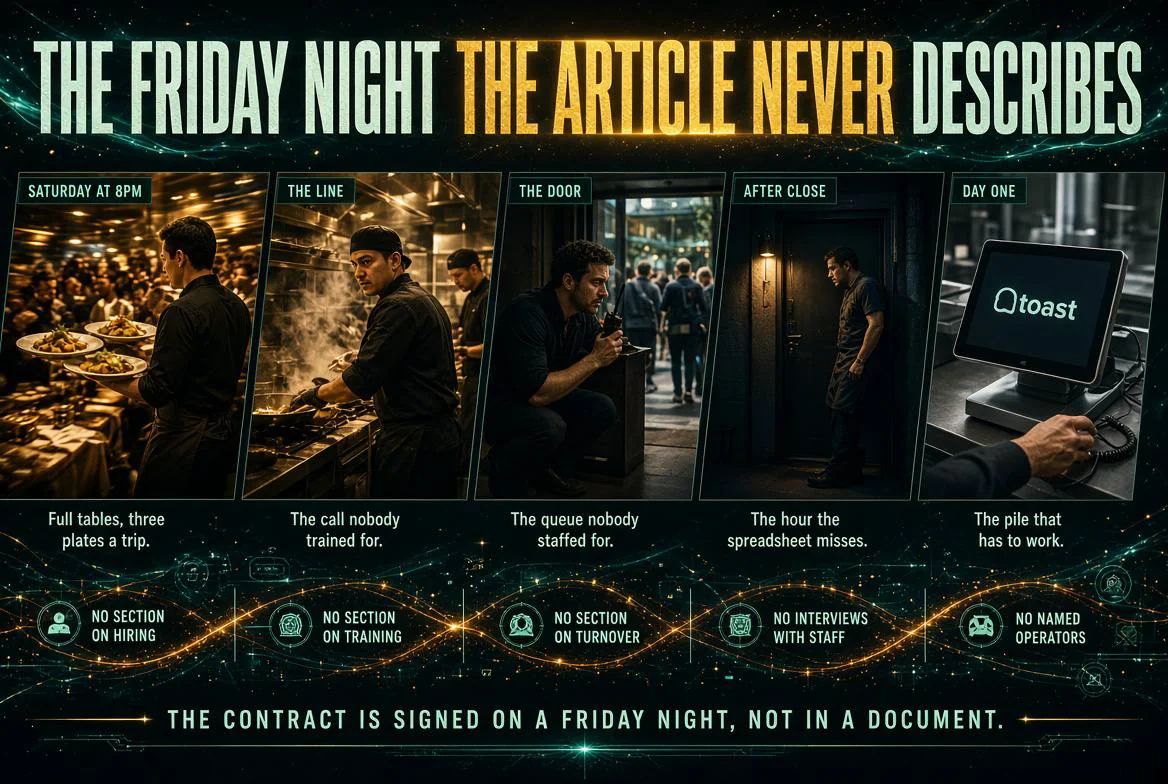
Here is what the sponsored article cannot capture, and the reason this matters beyond media ethics.
An AI scheduler that produces a compliant rota in four minutes saves a manager real time. It has done nothing about the fact that a server quit on Thursday and the Saturday book is forty covers heavier than the rota accounts for. The manager will still be on the floor at midnight. The overtime will still happen.
The software did its job. The job was never the problem.
That is not an argument against restaurant AI. It is an argument for measuring the right thing. An operator’s actual constraint is not the four hours a week spent writing a rota. It is that the industry’s labour model requires a permanent cushion of overtime and goodwill to survive a busy Saturday, and no scheduling product removes that.
Which means the meaningful question about any restaurant AI tool is not how many hours it claims to save. It is whether it lets you run the same service with less cushion, and whether you can prove that from your own numbers in a quarter rather than taking a stranger’s word for it in a sponsored article.
The Part Worth Being Angry About
The framing will be that sponsored content is normal and disclosed and operators are smart enough to tell.
Some are. Most are working a sixty-hour week and reading whatever is on the phone at close. The trade press knows exactly what that phone moment is worth — that is why the slot is priced the way it is and why vendors buy it instead of banners.
What operators are owed is not fewer vendor articles. It is one thing the whole category refuses to provide: a number that was not produced by someone with an invoice attached to the answer.
Until that exists, treat every restaurant AI statistic the way you would treat a menu written by the supplier who wants to sell you the fish. Read it. Then go look at the product yourself.
Frequently Asked Questions
Is sponsored content in trade magazines dishonest?
No, it is disclosed advertising. The problem is that it is shaped and laid out to read like reporting, so the trust an operator extends to the magazine gets transferred to a vendor’s marketing claim.
Does a 41% overtime reduction claim mean anything at all?
It means customers of that product report less overtime than non-customers. It does not establish that the product caused it, because the two groups already differ in size, volume and management before the software arrives.
How do I test a restaurant AI tool properly?
Record four numbers before the tool launches — overtime hours, labour percentage, covers per labour hour, waste percentage. Pilot for 30 to 60 days with an exit clause. Compare against your own baseline at 90 days, not against a vendor chart.
Should I refuse to buy from companies that publish sponsored studies?
No. Judge the product, not the marketing. But discount the marketing to zero when you evaluate, and replace it with your own measurement.
Why does everyone in restaurant AI seem to be selling something?
Because the companies with access to restaurant operating data are the ones selling software into that operation. Independent research into restaurant AI exists mostly as anecdote from operators, which is why your own numbers are the strongest evidence available to you.
What is the biggest risk of switching to a new AI scheduling tool?
Data lock-in on exit, not the software itself. Ask in writing whether you can export your live data if you cancel, and get the answer before the trial ends rather than after.
Does this mean restaurant AI is overhyped?
It means the evidence offered for it is mostly controlled by the sellers. Some tools genuinely work — scheduling compliance, inventory forecasting, voice ordering — and you will only know which ones by measuring them in your own restaurant.

About Barak Schurr
Barak Schurr built and exited a major ticketing platform, ran global operations at Eventbrite, and now focuses on one question: which AI tools actually help independent restaurant owners run leaner and grow faster. He writes from the operator’s perspective — no vendor spin, no theory, just what’s real in 2026.
Email: [email protected]
More Resources for Restaurant Operators