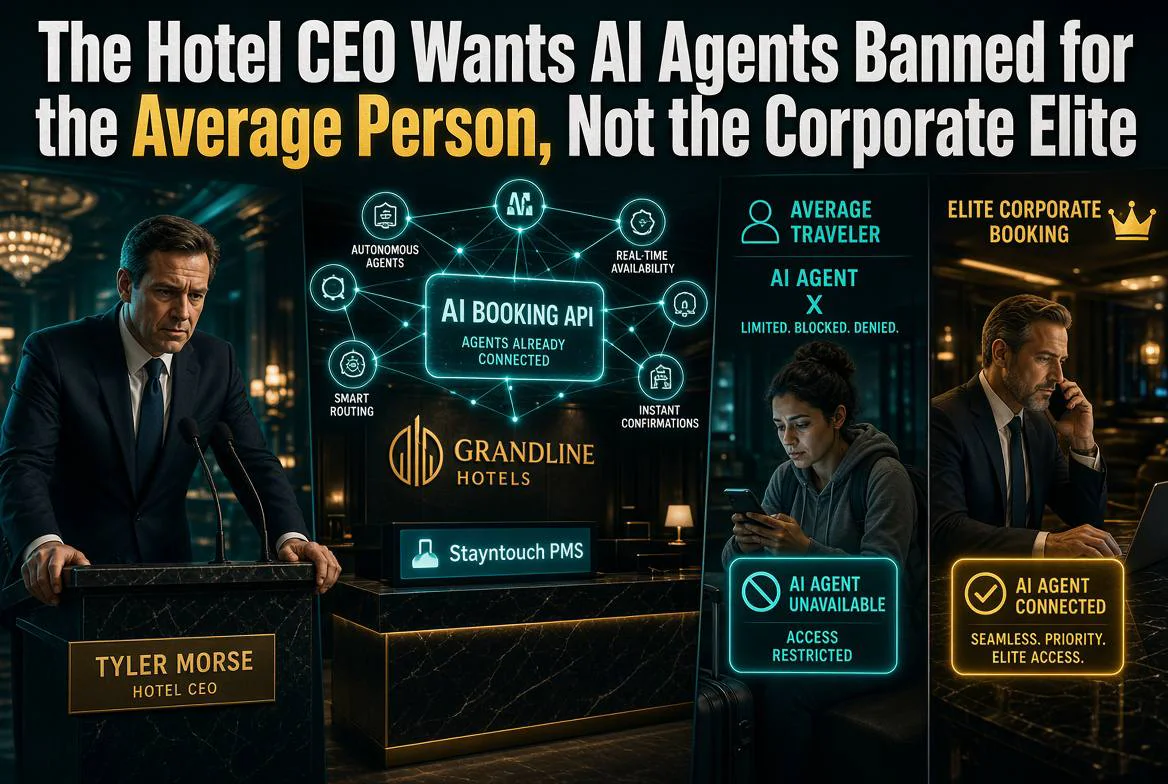
The Hotel CEO Wants AI Agents Banned for the Average Person, Not the Corporate Elite
⚡ Expert Summary: On November 11, 2026, MCR chairman and CEO Tyler Morse told the Skift Commerce Summit he wants to ban AI booking agents from his hotels, because software never impulse-buys an upgrade. MCR owns Stayntouch, the cloud property management system, which sells a Booking Engine API that third-party AI agents already use to complete reservations — plus its own AI messaging that auto-upsells breakfast and parking. The ban is not a security policy. It is a price negotiation over distribution, and Morse said so himself: “Trust is purchased.”
Fifty weeks of the year, hotel technology conference stages are a polite parade of products nobody can quite explain. Then somebody says the quiet part and the room forgets its manners.
On November 11, at the Skift Commerce Summit in New York, Tyler Morse — chairman and CEO of MCR, the third-largest owner-operator of hotels in the United States — said he wants to ban AI agents from booking his rooms. Skift’s Sean O’Neill reported the reason plainly the next day: software resists the sales pitches that persuade human travelers to splurge.
Morse put it better than any analyst could.
“Humans are susceptible to sales pitches,” he said. “You want to see the picture of the pretty beach and say, ‘You know what, honey, let’s go.'”
An AI assistant, he imagined, would answer: “Listen honey, you can’t afford this.”
That is a genuinely good line. It is also, in the same week, the strangest position in American hospitality — because the man delivering it owns a company that sells the open door.
What MCR Actually Owns Beyond the Hotels
MCR is not only a hotel owner. In August 2020 it bought Stayntouch, a cloud-native property management system, from China’s Shiji Group for $46 million — a deal forced through after a March 2020 presidential order required Shiji to divest on national-security grounds. MCR pledged a further $10 million investment in 2021. Morse became Stayntouch’s chairman and said at the time: “StayNTouch is the best property management system on the market.”
In December 2021, MCR bought Optii Solutions, an Austin-based housekeeping and operations platform.
Both are still MCR subsidiaries. There has been no sale, no spin-out, no divestiture, as of mid-November 2026.
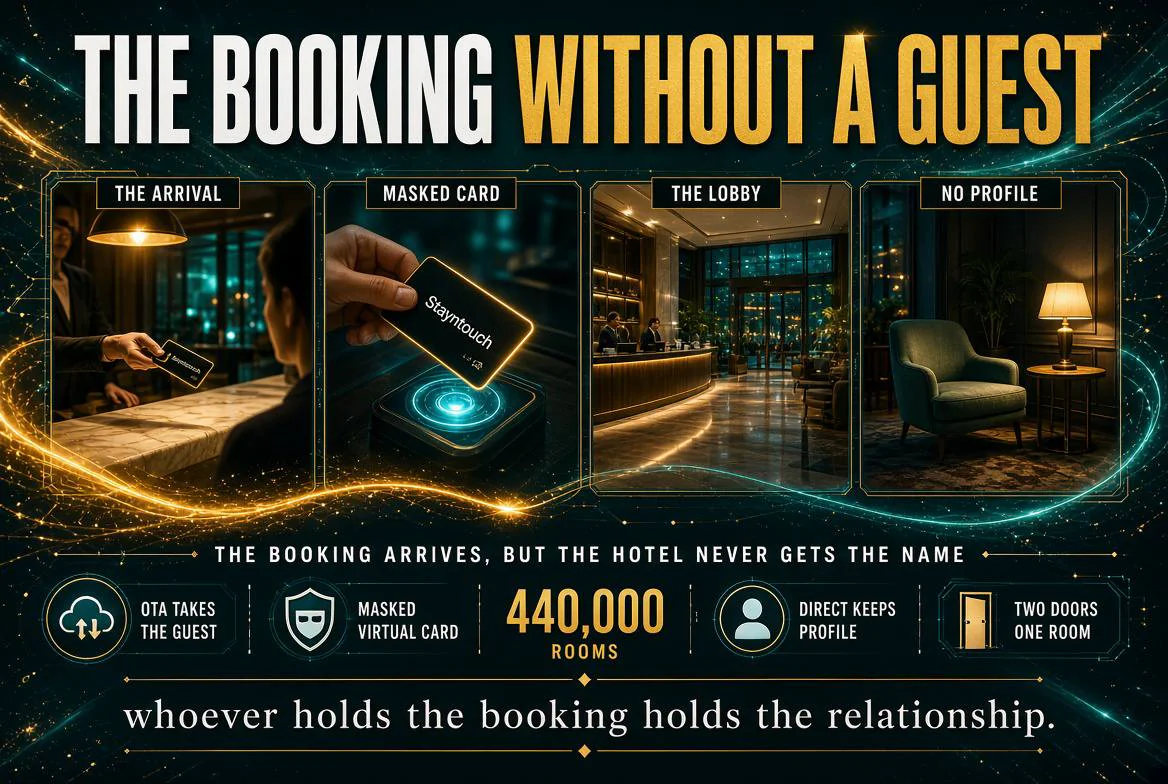
Stayntouch manages more than 440,000 rooms daily across properties in 100 countries, according to the HotelMinder partner directory. Stayntouch’s own product documentation puts its largest single-property deployment at 730 rooms and its largest group deployment above 7,000 rooms, with a 97% customer retention rate and more than 1,400 integrations included at no extra cost.
That is not an incidental side holding. It is a distribution business sitting inside the very reservation flow Morse wants to wall off.
The Booking Engine That Already Lets the Agents In
Here is the detail that reorganizes the whole story.
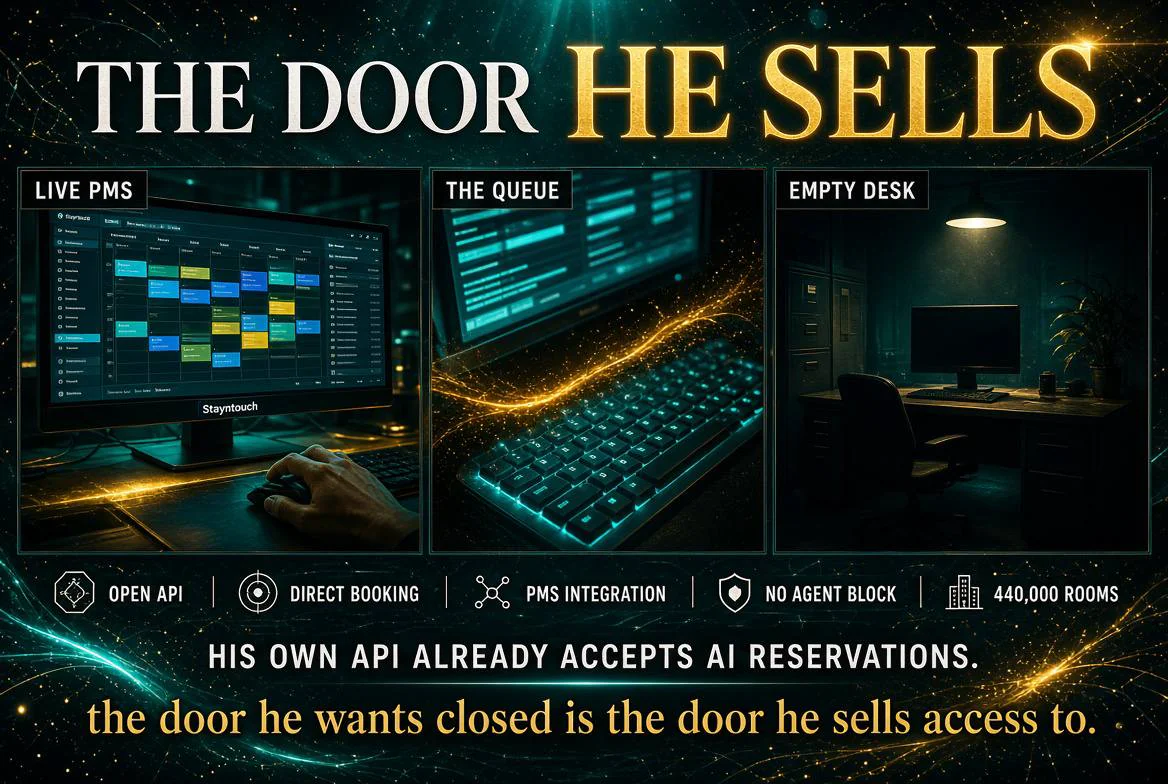
Stayntouch publishes a two-way Booking Engine API. Third-party AI agents use it to query live availability, photographs and rates, and to complete a room reservation directly into the property management system. This is not a roadmap item or a pilot. It is a shipped integration.
Quinta, the AI guest-messaging product from Quicktext, connects to it. Its conversational agent — named Velma — “accesses room availability, pictures, and prices” and can “book rooms automatically” over WhatsApp, Facebook and web chat, according to the company’s own partner documentation.
So a traveler can, today, ask a bot to book a stay at a Stayntouch property and have that reservation land in the hotel’s PMS without a human at the hotel touching it. The pipe that Morse says he wants to close is a pipe his own company maintains, documents and supports.
It gets sharper. Stayntouch launched AI guest messaging at ITB Berlin in February 2026, fully embedded in the cloud PMS. Nicki Dehler, Stayntouch’s senior vice president of product, described the pitch: “It gives hotel teams the tools to work smarter, delight guests, and achieve measurable business results.”
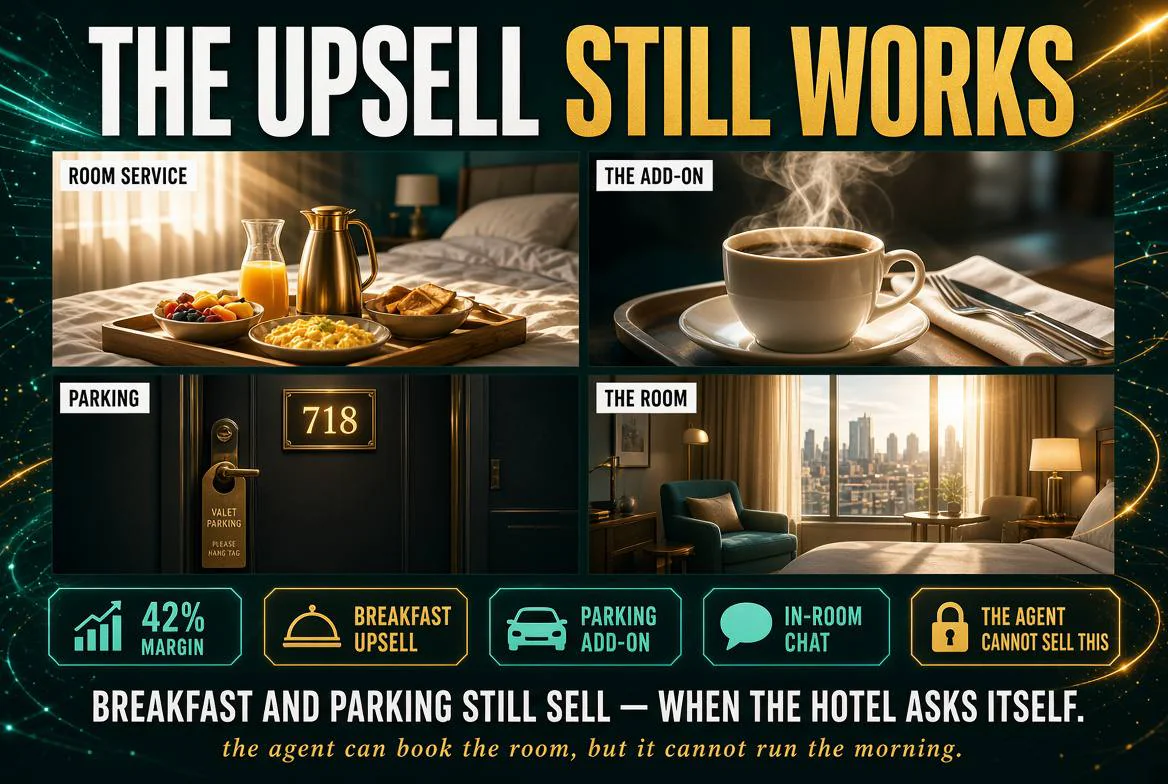
The vendor’s claims include resolving up to 95% of routine guest inquiries without staff intervention, saving more than 25 hours per 100 bookings, and — most relevant to this argument — “turn[ing] conversations into revenue with automated upsell links that let guests add breakfast, parking, and other amenities directly to their reservation.”
Stayntouch’s own marketing copy from October and November 2026 says a cloud PMS “adds revenue capabilities such as automated upsells, direct booking, day-use inventory, and automatic charge posting,” and that upgrade offers and add-on packages appear “while guests are choosing a room, when purchase intent is highest.”
The company’s corporate position on artificial intelligence is not ambiguous either: “Companies that do not embrace advanced, general-purpose AI will be rapidly eclipsed by those that do.”
And MCR’s housekeeping arm is in the same lane. Optii integrated VSR Network Technologies’ VAIA — described as “conversational agentic AI solutions for hospitality” — in June 2026, routing automated AI-handled guest requests straight into Optii’s operational workflows.
He’s Not Against AI. He’s Against the Customer Having an Agent.
This distinction is the entire story, and it is where most coverage of Morse’s remarks has gone wrong.
Morse is not a Luddite. His portfolio sells AI to hotels. What he objects to is a specific arrangement: the guest arriving with an agent of their own, standing between the hotel and its own upsell.
AI owned by the hotel upsells beautifully. AI owned by the traveler negotiates.
Booking Holdings’ Q3 2026 earnings call makes the first half of that unarguable. Management reported travelers using Agoda’s AI Assistant generated an average booking value approximately 20% higher than non-users and converted at roughly twice the rate. Priceline’s Penny showed the same pattern. Booking.com’s daily AI trip-search visitors jumped 10x quarter over quarter.
Expedia’s numbers point the same way. CEO Ariane Gorin reported record third-quarter attach rates for the Expedia brand and said guests using the post-booking activity agent were twice as likely to buy an ancillary within seven days.
So the technology does not kill upsells. It executes them better than a static web page and a tired front-desk pitch ever could — provided the hotel owns the conversation.
The threat Morse names is not that agents refuse to buy breakfast. It is that an agent working for the traveler will compare, question, decline the resort fee and ask why a Tuesday night costs $200.
The Numbers Show Almost Nobody Is Booking Through Them Yet
Here is the awkward part for everyone selling AI distribution: the external agent channel is, at present, statistically nothing.
On Uber’s Q3 2026 earnings call on November 4, executives disclosed that third-party AI agents arranged four rides across the entire third quarter. On food delivery, agents fulfilled roughly 500 Uber Eats orders during Halloween week, against approximately 320 million total rides and deliveries that same week — about one agent order per 640,000 transactions. Uber’s own description was “very, very early and very limited traction.” Total Q3 gross bookings were $59.8 billion.
Booking Holdings CEO Glenn Fogel and CFO Ewout Steenbergen told analysts they “haven’t seen anything in terms of numbers change” from external agentic channels. Hyatt CEO Mark Hoplamazian, answering Bank of America analyst Shaun Kelley on October 29, called agentic bookings “very small” but expected them to grow quickly. Expedia’s Gorin said agentic traffic “remains small” though high-intent, and that it is too early to tell whether it is incremental or cannibalizing existing paid channels. Airbnb disclosed no external agent volume at all and is targeting its own agent for the first half of 2027.
Consumers are no more enthusiastic than the operators. Agoda’s 2027 Asia Travel Pulse survey of 3,395 travelers across 11 markets found 53% plan trips using AI — but only 7% would let an agent book, and just 6% fully trust one to book autonomously.
Which raises the question the ban cannot answer: if the channel is worth four rides a quarter, why is the third-largest owner-operator in America calling for a wall?
Because the Ban Was Never About Volume. It’s About the Toll.
Morse told the room exactly what he was worried about, and it was not security.
“Trust is purchased,” he said. He predicted hotel suppliers will have to buy placement from a small handful of dominant AI platforms, the way brands once learned to pay Google for the top of a results page.
That is a distribution-pricing complaint wearing a technical costume. And it is already coming true in places Morse did not have to imagine: Agoda inventory is bookable inside Meta’s Muse in Singapore and Japan, which means a hotel can pay an OTA commission and an AI platform placement fee on the exact same room.
Terence Ronson, founder and managing director of hospitality consultancy Pertlink, wrote the cleanest verdict in Hospitality Net on November 12: “Morse has the diagnosis right and the prescription wrong. No hotel can ban its way out of distribution. If you shut the front door, the agent goes round the side.” His conclusion: “A ban is not a strategy. A guest list is.”
Dan Taylor of Travel Industry Marketing Insights made the structural point that kills the analogy to airlines. United updated its distribution policy against unauthorized AI booking agents on November 11 — the same day Morse spoke — but United has route monopolies. A hotel has the hotel across the street. Blocking an agent does not stop the booking. It redirects it.
Then there is the franchise problem. MCR operates dozens of Marriott- and Hilton-branded properties. The central reservation systems and distribution agreements on those buildings belong to Marriott and Hilton, neither of which has banned anything. Morse acknowledged the arrangement onstage with unusual candor, describing asset-light franchisors as “the smart ones” and himself as “the dumb one.”
And the enforcement problem is not hypothetical. A Skift audit of 50 hotel brand websites found only 10 even mention AI crawlers in their robots.txt files. An agent operating inside a guest’s authenticated browser session, or simply telephoning the front desk, is not distinguishable from that guest at the booking engine. Morse conceded as much in his own panel remarks, reported by Hospitality Net: “Everyone is going to ban the agents” — then, “I can’t figure out how to do it.”
Side by Side: Hotel-Owned AI vs. Traveler-Owned AI
| Factor | Hotel-Owned AI (Stayntouch-style) | Traveler-Owned Agent (ChatGPT, Muse, Gemini) |
|---|---|---|
| Who runs the conversation | The property, inside its own PMS and booking engine | The guest, inside a platform the hotel does not control |
| Who owns the guest record | Hotel retains the profile in its own PMS and CRM | Platform or OTA holds the relationship; hotel receives a masked card |
| Upsell outcome | Automated links at highest purchase intent; Agoda AI users booked ~20% higher value | Agent compares and negotiates; fee and upgrade resistance |
| Who gets paid | Hotel charges the card directly | Potentially OTA commission plus AI platform placement fee on one room |
| Can the hotel refuse it | Not applicable — it is the hotel’s own system | Practically no: OTA pass-through, phone calls, authenticated sessions |
Read that table honestly and Morse’s position becomes coherent rather than hypocritical. A PMS owner has an obvious commercial interest in every booking routing through a booking engine he operates — and an obvious interest in resisting a gatekeeper that intercepts the guest before his upsell flow ever renders.
Which is a fair business argument. It is just not a ban. It is a demand for a toll-free lane, made by a man who owns one of the toll booths.
The Guest Record Is What He’s Really Protecting
Strip the conference language away and Morse’s fear reduces to a single asset: the guest profile.
Who owns that profile depends entirely on which door the booking came through, and the difference is not academic.
When an agent reaches a hotel through an OTA — Meta’s Muse driving Expedia inventory, ChatGPT invoking a Booking.com or Expedia app — the OTA charges the guest’s card, holds the customer relationship, and passes a masked virtual card into the hotel’s property management system. The hotel gets a room night and a payment. It does not get a person.
When the agent reaches the hotel through the hotel’s own booking engine, the hotel charges the card, sends the confirmation, and keeps the profile — the email, the stay history, the preference for a high floor that makes the next upsell possible.
That is the whole game. A property management system is not really software for managing rooms. It is the system of record for who your guests are, and whoever sits between the guest and that record controls what the hotel can sell them next time.
Which is why the ban framing collapses the moment you ask what it would actually accomplish. It would not stop AI from booking rooms. It would only stop AI from booking them through a channel where the hotel keeps the data — pushing guests toward the OTA path where the hotel loses it.
What the Research Says About Where the Traffic Actually Goes
The intellectual vacuum in Morse’s position is not that he is wrong about gatekeepers. It is that the gatekeeper problem is far worse than a ban can address, and it has already been measured.
AGR Research, founded by Andrew Paul, ran 900 AI answers across 10 destinations — querying ChatGPT, Google AI Mode and Gemini — with fieldwork collected on November 11, 2026, the same day Morse spoke.
Of the AI answers that named a specific hotel, 536 of 899 contained no link to any hotel website at all. Seventy-eight percent carried zero citations to a hotel site. And in Google AI Mode, 95.7% of the citation links pointed back to Google’s own properties.
Read those three numbers as a hotel owner and the ban becomes beside the point. The visitor is not arriving at your booking engine at all. They are reading a summarised answer assembled by a platform that cites itself. You cannot ban your way into a link you were never given.
| Distribution Channel | Still a Trickle in 2026? | Who Owns the Guest Afterwards |
|---|---|---|
| External AI agents (ChatGPT, Muse, Gemini) | Yes — Uber: 4 rides in Q3; ~500 Eats orders in Halloween week | Usually the platform or OTA |
| Hotel-owned AI messaging and upsell | No — shipping at scale since Feb 2026 | The hotel, in its own PMS and CRM |
| AI search answers naming a hotel | Growing fast — 60% carry no hotel link | Google, per its own 95.7% self-citation |
| Metasearch paid placement | Mature — hotels already pay to defend brand terms | Contested; OTA margins absorb the bid |
| Direct booking through own engine | Mature | The hotel |
There is a second, quieter number that should worry a hotel owner more than any bot. Agoda’s 2027 Asia Travel Pulse survey, covering 3,395 travelers across 11 markets, found that 53% plan to use AI for trip planning — but only 7% would let an agent complete the booking, and just 6% fully trust an agent to book on its own.
So the wall Morse wants guards a door that almost nobody has walked through. Four Uber rides in a quarter. Five hundred food orders in a week against 320 million total transactions. Booking Holdings’ Glenn Fogel and Ewout Steenbergen told analysts they had “haven’t seen anything in terms of numbers change.” Hyatt’s Mark Hoplamazian called agentic bookings “very small.” Expedia’s Ariane Gorin said the traffic “remains small” and that it is too early to tell whether it is incremental or cannibalising.
You do not spend a conference keynote building a wall against four rides a quarter unless the thing you are actually protecting is pricing power you can see coming.
Follow the Precedent: When Hotels Fought the Last Intermediary
This has happened before, twice, and both times the ending was decided by the same economics.
TripAdvisor launched Instant Booking in 2014. Major chains resisted, publicly and loudly, on the grounds that it commoditised them and handed a third party the guest relationship. Then in July 2015 Marriott signed, once the terms on who owned the customer and what the commission looked like were settled. Wyndham, Hyatt, Choice and Best Western followed. The product itself was largely wound down by 2017 — but the hotels had already taught the intermediary that they would eventually sign.
Google Hotel Ads is the cleaner lesson. Hotels resisted, then discovered they could not outbid the OTAs, who were carrying a 15% to 25% commission cushion they could spend on placement and still profit. The OTAs took the auction. Hotels now pay Google a cost-per-click simply to defend the search results for their own brand names.
Every hotel in America has already accepted the exact arrangement Morse says he fears. That is not an argument against him. It is evidence that a banquet speech does not change an auction.
The Franchise Problem Nobody Put on the Slide
MCR operates dozens of Marriott- and Hilton-branded properties. On those buildings, the central reservation system, the distribution agreements and the rate parity obligations belong to Marriott and Hilton, not to MCR. Neither brand has banned anything.
Morse was unusually candid about this on stage, describing asset-light franchisors as “the smart ones” and himself as “the dumb one.” It is a good joke, and behind it is a real structural limit: a franchisee cannot unilaterally refuse a distribution channel its franchisor recognises, and the franchisor has every reason to keep channels open and keep earning loyalty fees on bookings it did not have to source.
Then there is the plumbing. A Skift audit of 50 hotel brand websites found that only 10 even mention AI crawlers in their robots.txt files. An agent running inside a guest’s own authenticated browser session is, to a booking engine, indistinguishable from that guest. An agent that picks up the phone and dials the front desk is indistinguishable from any other caller. Morse said the quiet part himself, per Hospitality Net: “Everyone is going to ban the agents” — followed by the honest admission, “I can’t figure out how to do it.”
That is not a policy under development. That is a position being announced before its mechanism exists.
The Customers Who Bought the Opposite Product
There is one group of people whose testimony should settle what Stayntouch actually is, and it is not analysts. It is the operators who bought it.
Mark Creger, chief revenue officer of Embergrove Hospitality Group, described in September 2026 why his company runs on Stayntouch — and the answer was integration: “By having Stayntouch as the PMS hub, and then surrounding that hub with best-in-class systems like our CRS, CRM, and revenue management system, we’re able to be nimble, flexible.”
That is a customer of Morse’s software company describing a system built to plug external tools into the reservation flow. Which is the definition of the door Morse now says he wants shut.
Kyle McCaig, MCR’s own director of technology service delivery, framed the internal philosophy in a case study the company published: the work is “solving the problems with technology and automation, as opposed to replacing people with technology and automation.” Fair enough. Nobody in this story is replacing anyone with a robot. The question is who gets to answer the guest: the hotel’s software or the guest’s.
What Would Actually Protect the Hotel Margin
If the goal is the guest record and the upsell, a wall is the weakest available instrument. Three things work better and all three are already in the product line.
The first is owning the answer surface rather than blocking the intermediary. If 60% of AI answers naming a hotel carry no link to a hotel website, the reply cannot be to refuse the channel. It has to be structured, machine-readable inventory, rate and amenity data that a model can quote without inventing it — and a brand presence that a summarising model will cite because nobody else has published the raw answer.
The second is making direct the easiest path for an agent, not the hardest. An open, well-documented booking API that does not require a partnership call is what stops an OTA from being the default. Stayntouch has the plumbing. The strategic error would be restricting it exactly when agents start using it.
The third is pricing the fees before someone prices them for you. As of mid-November 2026 there is no public rate card for AI placement in hotel distribution. The models under discussion are cost-per-click per invocation, mirroring Google Hotel Ads, hybrid free-plus-boosted listings, and enterprise software mounting fees. The hotels that help define that contract shape will pay less for it than the hotels that refuse until a fee schedule appears.
The Speech Was the Pricing Signal
This is the least flattering reading of November 11 and it is the one that survives every fact in the file.
Morse’s hotels are already distributed through a system he partly owns, and that system already supports AI agents doing the booking. His messaging product already upsells breakfast and parking through automated chat, claiming it resolves up to 95% of routine guest inquiries and saves more than 25 hours per 100 bookings. His company’s own position paper says firms that do not embrace general-purpose AI will be “rapidly eclipsed.”
He is not confused about any of this. He is negotiating early, in public, from the only stage that generates a headline, about a fee structure that does not exist yet.
It is worth being precise about what that means for a hotel general manager reading this. Nothing Morse said is a policy you have to follow. No MCR property has implemented a ban. No franchisor has adopted one. As of November 15, 2026, there is no mechanism, no date, no enforcement system and no walk-back either — and neither Morse nor MCR nor Stayntouch has issued any clarification, correction or policy filing since the remarks.
What there is, is an owner-operator with 150 hotels and a software company with 440,000 rooms under management telling the market where he intends to stand when the tolls arrive. The wall is not the point. The positioning is.
The Real Choice for Independent Hotels
A 40-room independent property on a coastal highway does not have Morse’s leverage and does not need his plan. Here is what actually changes this quarter.
If a guest asks an AI assistant to find a hotel and book it, the independent has two options. Be in the dataset the assistant reads, with clean structured rate and amenity data that survives summarisation — or be absent, and lose the booking to whichever chain defined its answer surface early. There is no third option where a ban protects you, because a small property has no route monopoly and no franchisor defending its distribution.
The practical checklist is not glamorous. Confirm rate and availability data is exposed in a machine-readable format the hotel controls. Confirm the booking engine accepts API reservations without a bespoke contract. Confirm guest messaging can answer a question about parking without a human at 11pm. Confirm a real human still signs off on anything over a few hundred dollars.
That is what distribution looks like in 2026. It is not a wall and it is not a toll. It is being legible to software that is already doing the reading.
Morse was asked the right question and gave an honest answer about the wrong lever. The channel is four rides a quarter and the survey says 93% of travellers will not let an agent book. Neither of those facts matters, because the direction is set by the economics of who owns the guest record, and that fight has already been lost twice by hotels that waited for the terms to be settled by someone else.
Terence Ronson of Pertlink put the choice in one line: “A ban is not a strategy. A guest list is.” The only thing a wall around an open API accomplishes is keeping your own customers on the other side of it.
Frequently Asked Questions
Did any hotel company actually ban AI booking agents?
No. Tyler Morse said publicly that he wants to ban AI agents from his hotels. No MCR property has implemented a ban, and no franchisor has announced one. Morse himself conceded at the same event that he cannot yet figure out how to enforce it.
Does MCR still own Stayntouch and Optii?
Yes, as of November 15, 2026. MCR bought Stayntouch from Shiji Group for $46 million in August 2020 after a presidential divestment order, and acquired Optii Solutions in December 2021. Neither has been sold or spun out.
Can third-party AI agents already book rooms at Stayntouch hotels?
Yes. Stayntouch ships a two-way Booking Engine API that lets outside AI agents check availability, rates and photos and complete reservations into the PMS. Quicktext’s Quinta agent, Velma, uses it to book rooms automatically over WhatsApp, Facebook and web chat.
Why would a hotel owner want to block AI booking agents?
Because an agent working for the guest compares, asks about fees and resists upsells, while hotel-owned AI optimises revenue. Morse put the concern plainly: humans are susceptible to sales pitches, and an assistant might tell the traveller they cannot afford the upgrade.
How many hotel bookings are actually made by AI agents?
Almost none so far. Uber disclosed four agent-arranged rides in the third quarter of 2026 and roughly 500 agent-placed Uber Eats orders during Halloween week against about 320 million total transactions. Hotel companies have reported the channel as small and early.
What is the AI placement fee hotels are worried about?
A charge from an AI platform to surface or place a hotel’s inventory in its answers. Models being discussed include cost-per-click per invocation, hybrid free listings with boosted paid placement, and enterprise software mounting fees. As of mid-November 2026 there is no public rate card.
What should a small hotel do instead of building a wall?
Make itself legible to the models: clean machine-readable rate and amenity data, a booking engine that accepts API reservations without a bespoke contract, guest messaging that can answer basic questions, and human sign-off on high-value bookings. Refusing the channel just lowers visibility without stopping the booking.

About Barak Schurr
Barak Schurr built and sold a major ticketing platform, ran global nightlife operations at Eventbrite, and now spends his time figuring out which AI tools actually move the needle for independent restaurant and hotel operators — and which ones are just noise. No hype. No fluff. Just what works.
Email: [email protected]
More AI Resources for Your Business