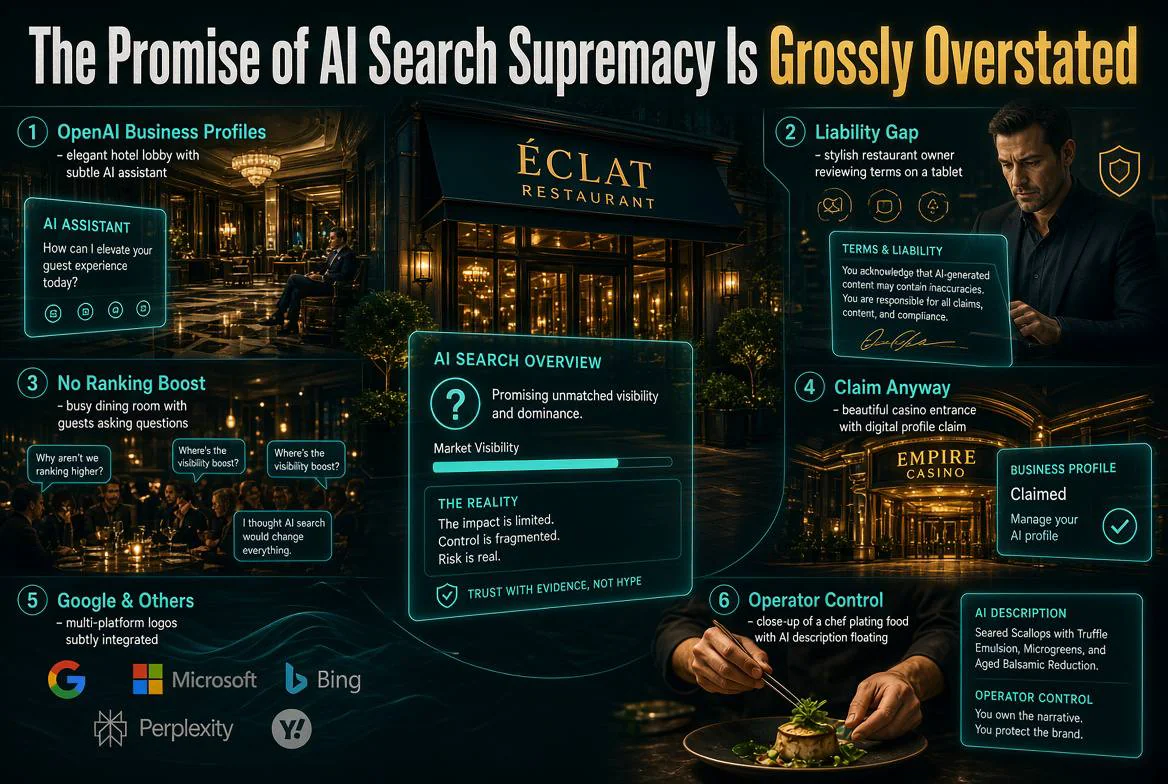
The Promise of AI Search Supremacy Is Grossly Overstated
⚡ Expert Summary: AI search is being sold to restaurants, hotels, casinos and travel operators as a channel they can own. OpenAI’s new business profiles, live since 10 November, cap OpenAI’s liability at what you paid them — nothing, on a free profile — while Section 9 makes you indemnify them for anything the system generates about your business. Google, Microsoft, Meta and Perplexity already do the same thing, so this is the architecture of the whole layer. Claim the profile anyway: an unclaimed venue gets described by strangers. But decide which legal entity clicks accept, and read the two clauses first.
For eighteen months now, someone has been selling you the same pitch. AI search is the new front door. Guests no longer browse twenty tabs; they ask one question and take one answer. If you are the answer, you win. If you are not, you are invisible. Buy the visibility package, claim the profile, optimise for the assistant.
The pitch is not stupid. It is just unfinished. What nobody selling it will tell you is that the answer is not yours to own, and this week the paperwork finally made that explicit.
On 10 November, OpenAI opened “Businesses in ChatGPT” as a US-only beta. You can claim your business. You can submit a description. You get a dashboard with 28 days of views and engagement. And to do any of it, you accept the Business Terms, last updated 1 November.
Two sections in that document are the whole story, and almost nobody in the trade press read them.
The Promise Was Simple: Own the Answer
Section 10: What They Owe You If They Get It Wrong
Here is the sentence that matters, from Section 10 of OpenAI’s Business Terms, verbatim:
“TO THE MAXIMUM EXTENT PERMITTED BY LAW, THE TOTAL LIABILITY OF OPENAI AND ITS AFFILIATES AND LICENSORS FOR ANY CLAIM ARISING OUT OF OR RELATING TO THESE TERMS OR YOUR USE OF THE SERVICES, REGARDLESS OF THE FORM OF THE ACTION, WILL NOT EXCEED THE AMOUNT PAID BY YOU TO OPENAI FOR THE SERVICES IN THE TWELVE MONTHS PRECEDING THE EVENT GIVING RISE TO THE CLAIM.”
Read it against what a claimed profile costs. Nothing. The beta is free. So the cap on what OpenAI owes you, if an AI answer sends a guest to the wrong address, invents a closure that never happened, publishes a price you stopped charging, or attributes a health-code violation to the wrong restaurant, is zero dollars. Not a reduced figure. Not a negotiated settlement. Zero, because zero is what you paid.
And Section 9 runs the other direction. You agree to “defend, indemnify, and hold harmless OpenAI, its affiliates, and their respective directors, officers, employees, and agents” from any third-party claim concerning your use of the service, including “any data or content you submit or that is generated by the Services based on your input.”
So: if the system generates something about your business that gets you sued, you indemnify them. If the system damages your business, they owe you what you paid, which is nothing. Both clauses sit in the same document you click through in four seconds to get a free listing.
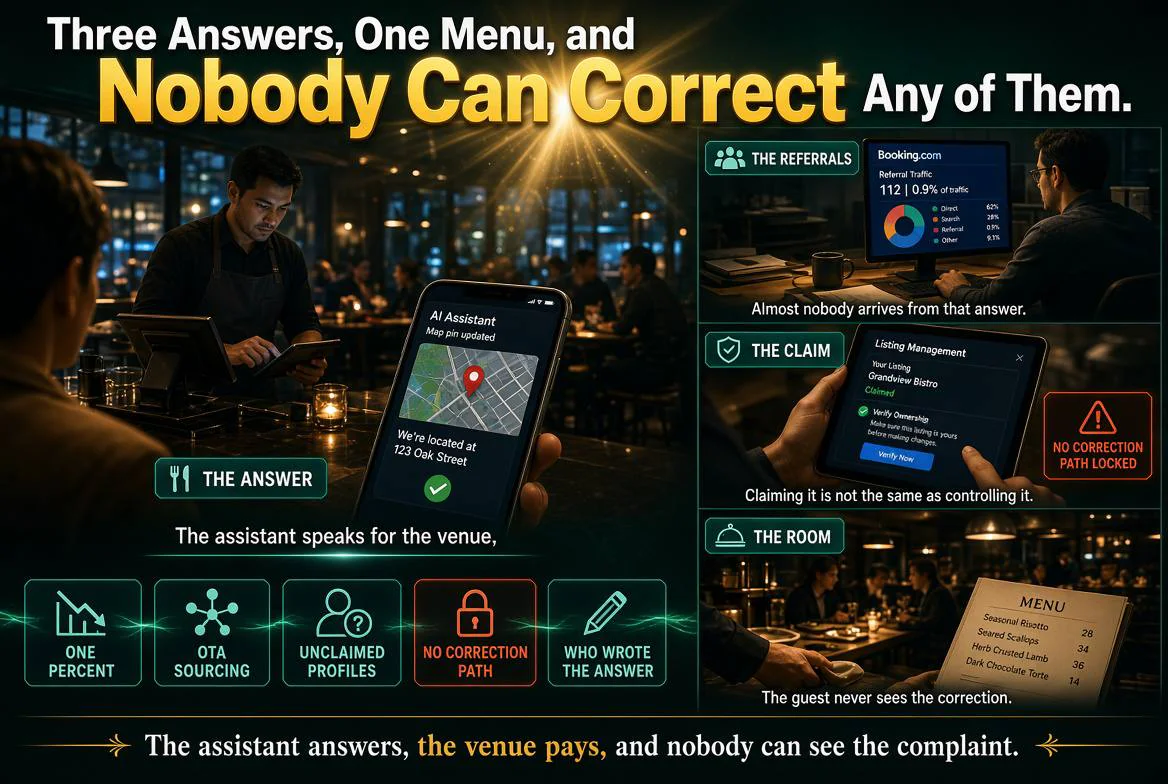
Is This New, Or Is This Just How It Works?
Before this becomes a story about one company, check the others. I pulled the comparable terms for every platform that could plausibly be answering a guest’s question about your venue, and the pattern is not OpenAI’s invention. It is the house style of the entire layer.
| Platform | Can you claim it? | Liability cap (their words) | Indemnity on you |
|---|---|---|---|
| OpenAI (ChatGPT) | Yes — US beta, from 10 Nov 2026 | “will not exceed the amount paid by you… in the twelve months preceding the event” | Section 9 — full defence and indemnity |
| Google (Business Profile, feeding AI Overviews / Gemini) | Yes — via Google Business Profile | “limited to the amount you paid us to use the Services (or, if we choose, to supplying you the Services again)” | Section 9 — full indemnity |
| Microsoft (Bing Places, feeding Copilot) | Yes — via Bing Places for Business | “shall not exceed the amount paid by you… during the twelve (12) months prior… or $100.00, whichever is less” | Section 15 — full indemnity |
| Meta (AI in WhatsApp / Instagram / Facebook) | No AI-specific claim mechanism | “OUR LIABILITY SHALL BE LIMITED TO THE FULLEST EXTENT PERMITTED BY APPLICABLE LAW” | Section 4 — indemnify for commercial use |
| Perplexity | No claim programme exists | Greater of $100 or what you paid in twelve months | Full defence and indemnity |
That table is the argument. The terms are not predatory because they are unusual. They are predatory because they are universal, and every one of them caps liability at roughly the price of a coffee while putting unlimited defence costs on your side of the table.
What Happens When There Is No Profile To Claim
Here is where the categories AITR covers stop being a single story and become four different problems.
Restaurants. Fine dining, casual, multi-unit, ghost kitchen — the claim mechanism is the same and so is the exposure. But restaurants have a complication hotels do not: menu data. A description is prose. A menu is prices, allergens, hours, availability, and substitutions. Feed a system an allergen position and it repeats it back with the confidence of a doctor. Section 10 caps the answer at zero. Section 9 hands you the defence of the resulting claim.
Hotels. The asset being summarised is more expensive per error than anywhere else in the category. A rate, an availability claim, a pet policy, a resort fee — an AI answer that gets any of those wrong costs real money before anyone notices, and the operator has no view into which source the assistant used. Google’s terms are explicit that you control the source data, not the summarisation. “Partial” is the honest word, and partial control over a price quotation is not control.
Casino, gaming and entertainment venues. No claim mechanism exists at all. Perplexity has none. Meta has no AI-specific one. These operators are being summarised by systems that crawled them, and there is no form to fill in and no dashboard to check. When a guest is told an offer expired, or a show time changed, or that a venue admits under-21s, the operator finds out by being told at the door. The terms are silent on AI output specifically, which is worse than unfavourable — silence means the question has never been priced.
Travel, booking and ticketing. The layer is being built on top of platforms that already carry their own indemnities. Tripadvisor, Booking.com and Expedia each require you to indemnify them, each cap their own liability at fees earned in the preceding twelve months, and each are silent on whether their content gets reused in generated answers. Stack those three on top of an assistant’s terms and an operator is four contracts deep with no visibility into any of them.
The Same Terms, Four Different Businesses
Because AITR covers restaurants, hotels, gaming venues and travel operators, the same contract lands differently depending on what you sell. This is where the category matters.
| Category | What gets summarised | Can you claim it? | Cost of one wrong answer |
|---|---|---|---|
| Restaurants | Hours, menu, prices, allergen positions, offers | Yes — ChatGPT (US beta), Google Business Profile, Bing Places | An allergen error is a health event, not a lost booking |
| Hotels | Rates, availability, resort fees, pet and cancellation policy | Yes — but Google’s terms control source data, not the summarisation | Revenue leaks for days before anyone notices |
| Casino, gaming, entertainment | Show times, admission rules, offers, age policy | No — Perplexity has no programme, Meta has no AI-specific one | Guest finds out at the door; you find out when they arrive |
| Travel, booking, ticketing | Inventory, availability, terms, fees | Partially — platform terms are silent on AI output | Four contracts deep with visibility into none of them |
The Agency Problem Nobody Has Written About
The clearest warning this week came from Simone Puorto in Hospitality Net on 13 November, and it is not about AI quality at all. It is about who signed the contract:
“Many agencies are already claiming profiles using their personal accounts, without realizing that this binds them to terms meant for individual users, not for companies. This creates a mess where the operating company is technically not bound by any of the terms of service accepted by the agency on behalf of the individual account.”
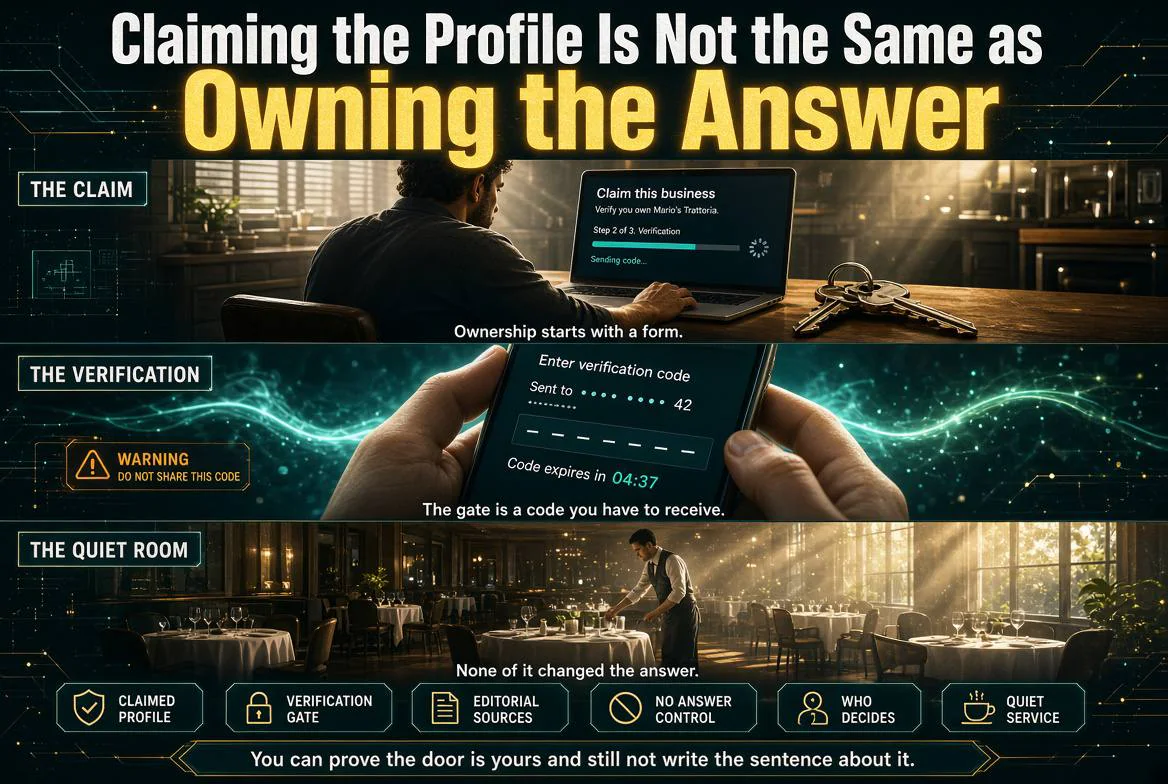
Read that twice. The agency handling your AI visibility signed up on a personal login. Which means the entity that accepted the indemnity is a person, not your business. Your operating company is not party to the agreement, has no rights under it, and no standing to enforce anything in it — while a human being who works for your vendor is now personally exposed to Section 9. If the arrangement works, nobody notices. If it goes wrong, the contract is between OpenAI and somebody’s Gmail account that nobody is thinking about.
Puorto’s four-item preparation list is the only practical checklist I have seen published this week: comprehensive digital assets, an optimised content library, integrated booking and CRM systems, and a legal and compliance review of the terms before anyone clicks accept. That last item is the one that never happens. It is also the only one that costs nothing to do.
What Claiming Actually Gets You
The hardest thing to find in the announcement is a clear statement of benefit. The closest OpenAI comes is this, from the launch post:
“Businesses that create profiles will have greater control over how they are presented in ChatGPT, allowing them to highlight key information, offers, and accurate details.”
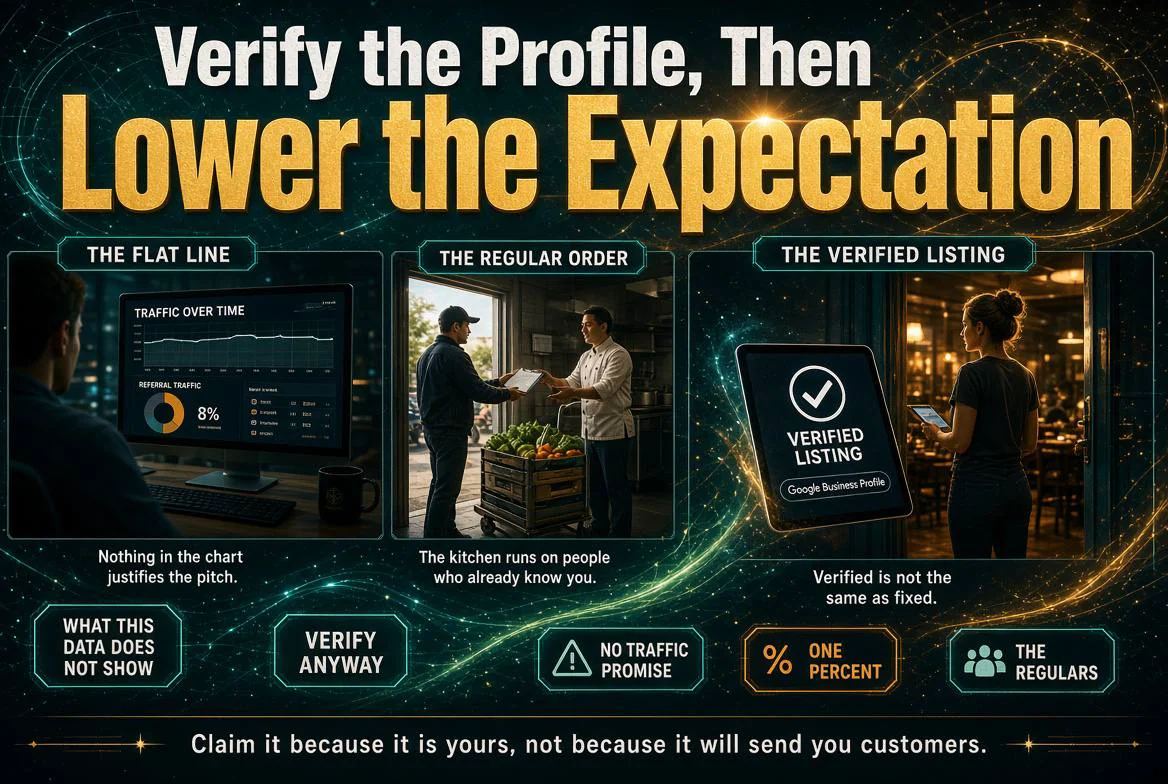
Control over presentation. Not ranking. Not placement. Not priority. Anyone selling you an “AI search supremacy” package is selling you something the primary source does not claim, and the honest trade summarisers say so — HotelHand’s 15 November write-up states plainly that “claiming your profile does not inherently boost your ranking within ChatGPT results in the same way that SEO works for traditional search engines. The primary benefit is control over the information presented.”
So the product is: a form, a dashboard with 28 days of numbers, and the ability to correct your own description. That is real value. It is also nowhere close to what the pitch deck promises, and the gap between the two is where operator money is currently going.
The Verification Step Is The Real Barrier
Claiming a profile is not a signup form. Per LocalIQ’s 13 November breakdown, verification runs DNS, corporate email, or phone first — then a Persona identity check requiring a government-issued ID from the individual claiming the profile plus the business registration documents proving the entity’s legal standing.
For a multi-unit group, that means one named human uploading their passport to claim three venues. For a single independent site, it means having your registration documents in a retrievable form, which many operators running a good restaurant and a bad filing cabinet do not. This is the stage where claims stall, and every stalled claim is a venue being summarised by a system with no input from the people who run it.
Why This Month, And Why It Will Accelerate
The US-only restriction is doing more work than it looks. The beta is limited to US-based businesses, with everyone else on a waitlist. Categories that trade internationally — hotels, travel, entertainment venues — are therefore being summarised with zero participation opportunity and no timeline. If your venue is in Bangkok, Lisbon or Mexico City, you are currently being described in a US-only product you cannot claim, by terms you have not accepted, with liability capped at a number that does not include you.
The intelligence layer is being built over the top of the discovery layer, and the operators underneath are finding out that the new front door has a landlord who lives somewhere else.
The Honest Position On What This Data Does Not Show
This is where I have to be blunt with you, because the sources are blunt with me.
There is no published figure establishing what share of bookings, covers, room nights or ticket sales AI assistants currently drive in any of these categories. I looked. Consultants are quoting percentages. Those percentages do not trace back to a primary document I can read, and I am not putting a number in this piece I cannot defend to the person who wrote the report. If someone shows you a precise market-share figure for AI assistant bookings this week, ask them for the document. The silence is the finding.
What the record does support is narrower and more useful. A claim mechanism now exists, and it accepts a liability cap of zero and puts an unlimited indemnity on you. Google and Meta and Microsoft and Perplexity all do substantially the same thing, so this is not one company behaving badly. No platform will tell you what an unclaimed profile looks like versus a claimed one. And the human who clicked accept on your behalf may not be your company.
What To Do Before You Claim Anything
Not “don’t claim it.” Claim it — an unclaimed profile is a description of your business written by someone who has never been inside it. But do these four things first, and none of them cost money.
One. Decide which legal entity accepts the terms before anyone clicks. If the answer is a vendor’s personal account, stop the process and start it again under a company account you control.
Two. Export your own source of truth — hours, menus, prices, allergen positions, offers — into one document, dated. When an answer is wrong, you need to prove what was correct at the time the assistant said otherwise, and a dashboard showing 28 days of views does not do that.
Three. Screenshot the assistant’s answers about your venue monthly. Not because it changes the terms, but because it is the only evidence you will ever have, and zero liability caps do not stop reputational damage.
Four. Read Section 9 and Section 10 of every platform whose answers touch your business. It takes twenty minutes. It is the only part of this entire AI search project where the operator has full information and the vendor is the one hoping you skip it.
Frequently Asked Questions
Can I claim my business profile in ChatGPT?
Yes, if your business is based in the United States. OpenAI opened the “Businesses in ChatGPT” beta on 10 November 2026. Businesses outside the US can join a waitlist, but there is no published date for expansion.
Does claiming a profile improve my ranking in ChatGPT answers?
OpenAI does not claim that it does. The launch post says businesses “will have greater control over how they are presented,” which is a statement about presentation, not ranking or placement. Third-party write-ups say the same thing plainly: the benefit is control over the information presented.
What does the liability cap in OpenAI’s Business Terms actually mean for my restaurant or hotel?
Section 10 caps OpenAI’s total liability at the amount you paid them in the twelve months before the event giving rise to the claim. A claimed profile in the beta is free, so that cap is zero dollars. If an AI answer damages your business, the amount owed under that clause is nothing.
What am I agreeing to when I accept the Business Terms?
Section 9 requires you to “defend, indemnify, and hold harmless” OpenAI and its affiliates against third-party claims arising from your use of the service, including content the service generates based on your input. That puts the cost of defending a claim on your side of the table.
Can my marketing agency claim the profile on my behalf?
They can, and many already have — but often on a personal login rather than a company account. When that happens the individual accepts the terms, not your operating company, which leaves your business outside the agreement entirely while the person who clicked accept carries the indemnity.
Is this only OpenAI, or does every platform work this way?
Every platform I checked. Google Business Profile, Microsoft’s Bing Places terms, Meta’s platform terms and Perplexity’s terms all cap the platform’s own liability at a nominal amount while requiring you to indemnify them. This is the architecture of the AI answer layer, not one company’s behaviour.
What does verification require?
Ownership is confirmed by DNS, corporate email or phone first, then a Persona identity check requiring a government-issued ID from the person claiming the profile plus the business registration documents proving the entity’s legal standing.
Is there any published data on how much of my bookings AI assistants drive?
Not that I could verify against a primary source. Consultants quote percentages for AI-assisted bookings, but those figures do not trace back to a document I can read. Treat any precise market-share number for this channel with suspicion until someone shows you the report behind it.

About Barak Schurr
Barak Schurr built and exited a major ticketing platform, ran global operations at Eventbrite, and now focuses on one question: which AI tools actually help independent restaurant owners run leaner and grow faster. He writes from the operator’s perspective — no vendor spin, no theory, just what’s real in 2026.
Email: [email protected]
More Resources for Restaurant Operators