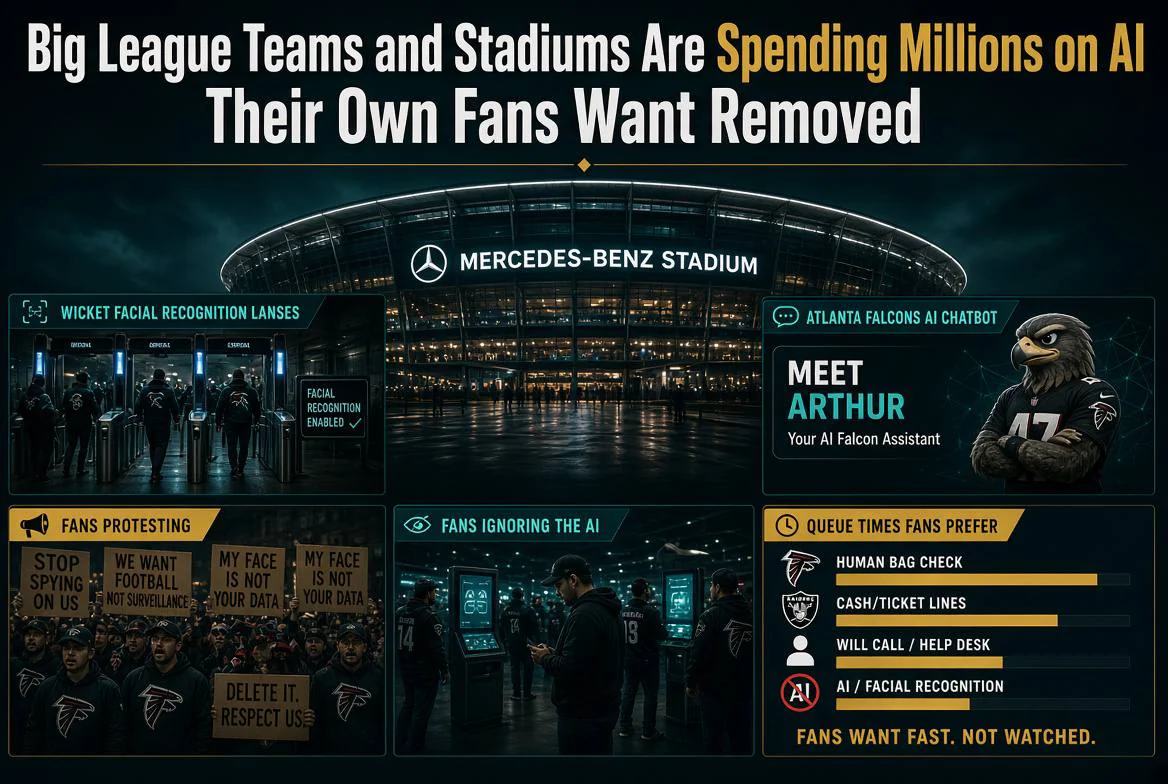
Big League Teams and Stadiums Are Spending Millions on AI Their Own Fans Want Removed
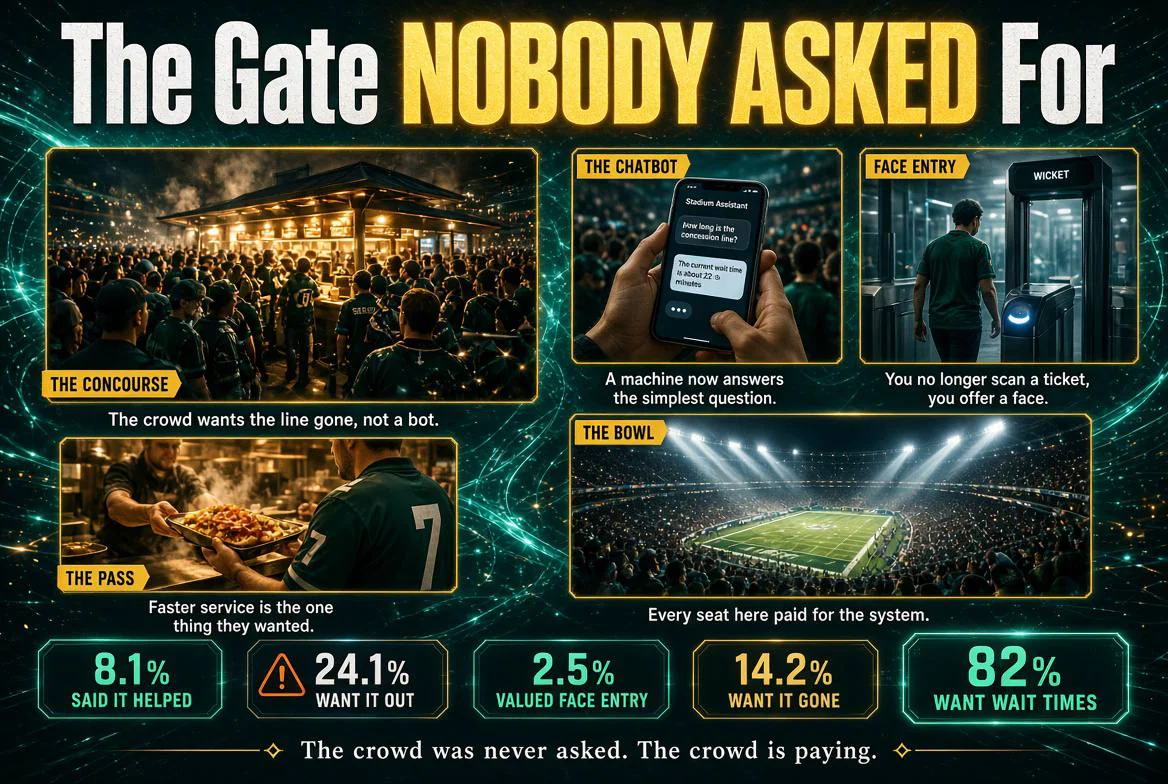
⚡ Expert Summary: American stadiums and arenas are buying AI chat assistants and facial-recognition gates at $350,000 to $1.2 million a venue, plus 15 to 20 percent of that cost every year in software fees. In Alchemer’s 2026 Fan Experience Report Card, only 8.1 percent of fans said an AI chat assistant improved their visit while 24.1 percent would eliminate it, and 2.5 percent valued facial recognition while 14.2 percent want it gone. The feature fans actually want, predictive wait times, is wanted by 82 percent.
The most expensive piece of technology in a modern stadium is the one the crowd did not ask for.
Somewhere in the last three seasons, the American venue stopped being a building with seats and became a software product with a roof. Mercedes-Benz Stadium put an AI assistant called Arthur in the Atlanta Falcons app. Climate Pledge Arena in Seattle runs a guest chatbot across its digital channels. Allegiant Stadium in Las Vegas added generative AI chat into the Raiders app. The Sphere has conversational robots in its atrium.
At the gate, four NFL and MLB venues now use Wicket facial-recognition lanes: MetLife Stadium, Citi Field, Nationals Park and Lincoln Financial Field. You do not scan a ticket any more. You present your face.
Then came the survey. Alchemer asked 1,064 US fans who had attended a professional or college sporting event in the previous twelve months what they thought of the technology now standing between them and their seat. The answer was not close.
| Feature | Fans Who Say It Helped | Fans Who Want It Removed |
|---|---|---|
| AI chat assistant | 8.1% | 24.1% |
| Facial recognition entry | 2.5% | 14.2% |
| Digital ticketing | 29.7% | Not asked |
| Mobile ordering | 27.3% | Not asked |
| Predictive wait times | 82% want it | Almost nobody |
Read that table as one sentence and the pattern is unmissable. The three tools that remove a physical line score between 27 and 82 percent. The two that replace a human conversation score between 2.5 and 8.1 percent. Fans are not anti-technology. They are pro-queue-abolition and anti-being-spoken-to-by-a-bot.
The Feature Nobody Is Selling
Eighty-two percent of fans want predictive wait times. That is the highest number in the entire survey and it is not the thing any venue is advertising. They want to know how long the parking garage will take to empty, how long security will take, which concourse restroom has a line. That is an operations problem, and solving it costs almost nothing compared with the hardware being installed instead.
The venues built the hard thing. The crowd wanted the easy thing.
There is a second split in the same data that any operator will recognise. Fans trust AI to answer a stadium question — 54.8 percent of them — and almost none trust it to resolve a ticket dispute, at 17.6 percent. The industry handed the machine the part where a wrong answer costs nothing and kept the part where a wrong answer costs a lawyer.
What a Face at the Gate Actually Costs
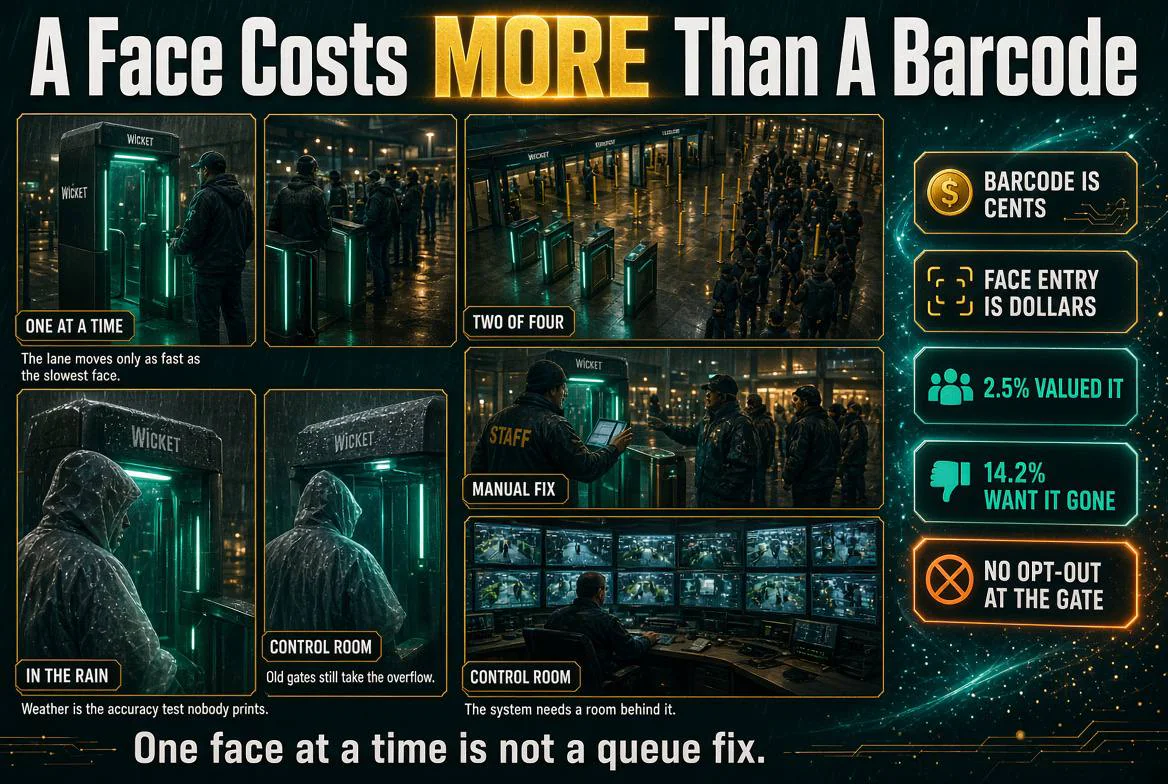
Facial recognition is not an app update. According to Sports Business Journal’s 2025 infrastructure cost guide, full deployment of optical recognition hardware, edge processing and licensing across a 60,000-seat stadium runs $350,000 to $1.2 million up front, with annual software maintenance at 15 to 20 percent of that capital cost. On the top end, that is $240,000 a year in maintenance alone.
Now put that against the fan number. 2.5 percent valued it. 14.2 percent want it removed. The venue is spending seven figures, and committing to a recurring fee forever, on a feature that the people paying for the tickets actively dislike.
| Deployment | Upfront Cost | Annual Maintenance |
|---|---|---|
| Biometric entry, low end | $350,000 | $52,500 to $70,000 |
| Biometric entry, high end | $1,200,000 | $180,000 to $240,000 |
| Fan support for the feature | 2.5% valued it | 14.2% want it gone |
The vendor pitch is a throughput number, and it is a real one. Wicket chief executive Todd Kehrli has said facial ticketing cuts gate entry to under two seconds per fan, roughly doubling throughput per lane against a barcode scanner. That is a genuine operational gain, and it is the case a stadium technology director will make to their ownership group.
What the pitch does not carry is the consent problem, and that is where the seven figures become a liability rather than an asset.
The Accuracy Curve Nobody Prints On The Box
Here is the number that should be in every one of these procurement meetings. Speaking on a panel before the G2E conference in Las Vegas in September, technology executive Jim Outman described how these systems actually arrive. As reported by the Las Vegas Sun, Outman said the technology is accurate about 40 percent of the time when first introduced at a property, depending on the quality and consistency of the video — and that within six months, accuracy hits 90 percent.
Forty percent. The system is wrong more often than it is right on the day it is switched on, and the venue pays full price for that version. The six months in between are not free: they are staffed by humans overriding the machine, apologising to guests, and quietly re-teaching a model on their own time.
Outman was describing casino table-game surveillance rather than turnstiles, and the discipline matters — it is a different deployment with different stakes. But the shape of the curve is the same curve an operator inherits in any vision-based system, and no venue buying facial entry this season is publishing its own equivalent number.
The gate does not only fail on accuracy. It fails on consent, and the two failures land on different people.
The Fan Who Was Never Asked
Watch what the industry says when it defends this. A stadium technology vice president, quoted in Stadium Tech Report in November 2024, framed the deployment as a throughput obligation rather than a replacement: “We aren’t deploying AI to replace the human element on the concourse; we are deploying it because throughput demands that a fan gets back to their seat before the next quarter begins. If the bot gives bad directions or the scanner hesitates, we’ve failed.”
It is a good quote, and it concedes the whole argument. The operator is promising the machine will not fail. The fan never got to say whether they wanted a machine in the first place. And 24.1 percent of them have now said out loud that they want the chat assistant removed entirely.
The comparison to how this lands elsewhere is instructive. In Europe, GDPR and the EU AI Act classify biometric data as a category requiring explicit consent, which restricts unconsented facial scanning at entertainment venues. In the United States, a ticket is a contract, and the terms on it are set by the venue. The fan is not a customer with a preference. The fan is a data subject in a building that has decided the trade is acceptable on their behalf.
| Factor | What the Venue Buys | What the Fan Gets |
|---|---|---|
| Throughput | Under two seconds a fan | A faster gate, if it works |
| Consent | Wrapped into the ticket terms | No alternative offered |
| Data | A face template per entry | Told nothing about retention |
| Support voice | A chatbot in the app | Wanted human, got FAQ |
| Complaint route | None published | Only 17.6% would trust AI to settle it |
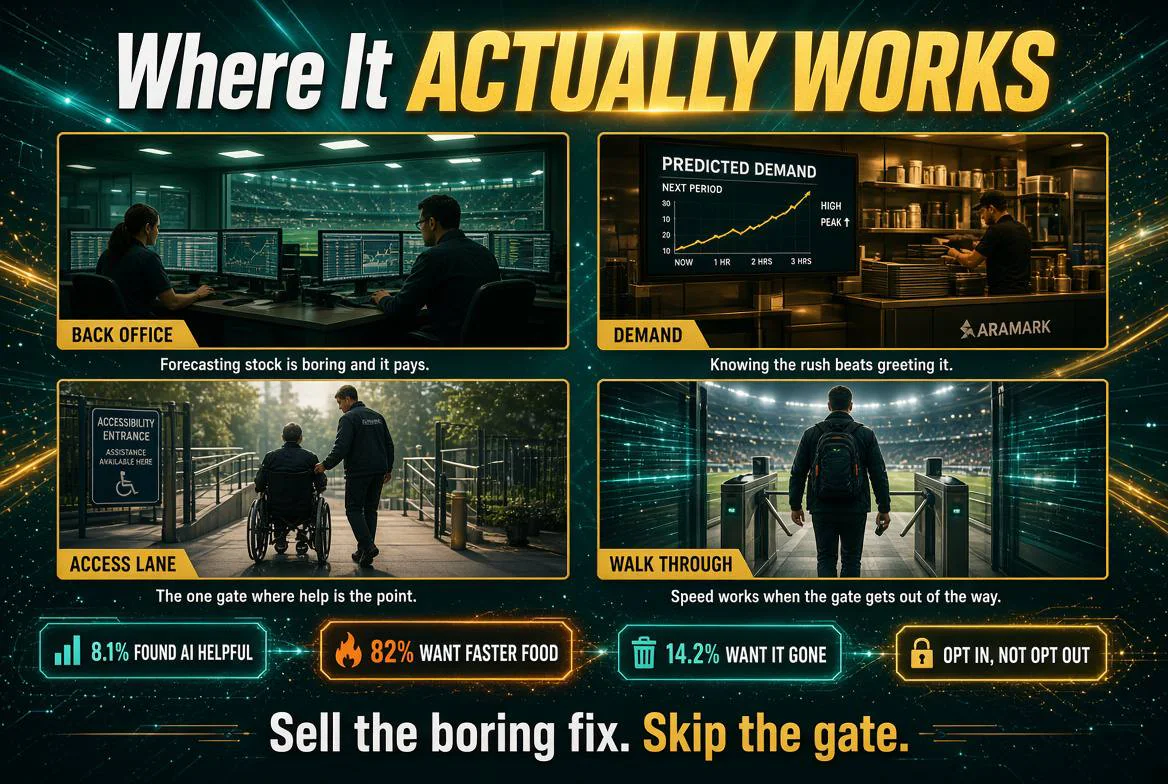
Where It Works, And Why That Matters
The honest case against my own argument is that this technology demonstrably works when it is aimed at the right problem. Mercedes-Benz Stadium has reported that moving concession stands to digital ordering cut average transaction times from over two minutes to under 45 seconds, with a 16 percent increase in per-capita food and beverage spending. Nobody in that concourse is mourning the queue.
That is the tell. When the automation eats a line, fans say so, loudly, in the survey — 29.7 percent credit digital ticketing, 27.3 percent credit mobile ordering, 82 percent want predictive wait times. When the automation eats a conversation, they want it gone. The industry has spent the last three years buying the second thing.
For an operator reading this with a capital budget, the implication is uncomfortable and useful: send the next seven figures at the queue, not at the concierge. Predictive wait times are cheaper to build than biometric gates, and 82 percent of your customers already told you they want them.
The Bottom Line
No major venue has publicly reversed a guest-facing AI deployment. Not one. The pullbacks the industry has seen were in cashierless checkout, where error rates and receipt disputes became visible in the P&L. The chatbot and the face scanner have not been pulled anywhere, because the cost of the backlash is paid by the fan and the cost of the system is paid by the operator, and those two ledgers never meet.
That is the whole story. The people paying for the automation were never asked what they wanted from it, and the people selling it were never told the crowd had already answered.
Frequently Asked Questions
What percentage of fans want stadium AI removed?
In Alchemer’s 2026 Fan Experience Report Card, 24.1 percent of fans said they would gladly eliminate an AI chat assistant, compared with 8.1 percent who said it improved their experience. For facial recognition entry, 14.2 percent want it gone and 2.5 percent valued it.
Which stadiums use facial recognition entry?
MetLife Stadium, Citi Field, Nationals Park and Lincoln Financial Field run Wicket-derived facial authentication lanes. MLB parks have also adopted the league’s Go-Ahead Entry program on designated gates.
How much does facial recognition cost a stadium?
Sports Business Journal’s 2025 cost guide puts full deployment at $350,000 to $1.2 million for a 60,000-seat venue, with annual software maintenance running 15 to 20 percent of that capital cost.
What do fans actually want from stadium AI?
Predictive wait times, at 82 percent interest — the most wanted feature in the survey. Fans want to know how long parking exits, security lines and restrooms will take, and they embrace digital ticketing at 29.7 percent and mobile ordering at 27.3 percent because those remove a physical line.
How accurate is AI in a stadium or casino on day one?
Technology executive Jim Outman, speaking at a pre-G2E panel reported by the Las Vegas Sun, said the technology is accurate about 40 percent of the time when first introduced at a property, reaching 90 percent within six months.

About Barak Schurr
Barak Schurr built and exited a major ticketing platform, ran global operations at Eventbrite, and now focuses on one question: which AI tools actually help independent restaurant owners run leaner and grow faster. He writes from the operator’s perspective — no vendor spin, no theory, just what’s real in 2026.
Email: [email protected]
More Resources for Restaurant Operators