Get the AI Restaurant Quick-Start Guide — Free
The 5 AI tools independent US restaurant owners are using right now to cut labor costs and answer every call.
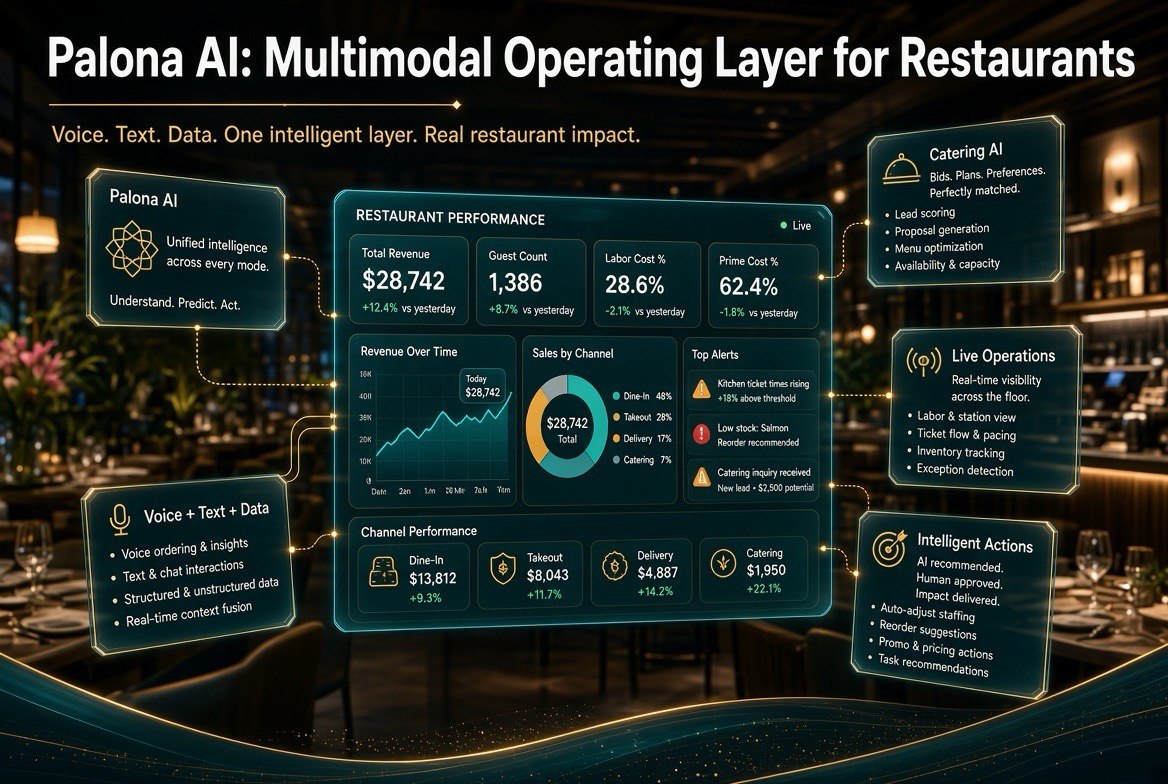
Palona AI: Multimodal Operating Layer for Restaurants
⚡ Expert Summary: Palona AI closed a $20M Series A on August 17, 2026, and launched a multimodal operating layer built for restaurants. It connects inbound demand (phone calls, catering, large orders), live operations, and automatic actions, with voice ordering that has already driven measurable revenue gains for brands like Din Tai Fung, Mountain Mike’s Pizza, and Giordano’s. For independent US restaurant owners, the pitch is simple: the AI answers the phone, takes the order, and stops you from losing revenue to voicemail.
Why Your Restaurant Is Losing Money Every Time the Phone Rings
Here is a number every restaurant owner already knows in their gut: some of your calls go unanswered. On a busy Friday, when the dine-in floor is full and the to-go line is moving, the phone rings and rings. Maybe a host grabs it, maybe it rolls to voicemail. Either way, a percentage of those callers hang up, or leave a message that sits in the queue until after the rush, and they order from the competitor down the street instead.
For independent US restaurants, that is not a one-off annoyance. It is a leak in the revenue bucket that runs every single day. Catering orders, large to-go orders, reservation changes, party bookings, dietary questions, they all arrive over the phone, and every missed call is money walking out the door.
Palona AI is built to plug that leak. On August 17, 2026, the company announced a $20M Series A (building on a $10M seed from January 2025) and launched a multimodal AI operating layer for physical businesses, proven first in restaurants (SiliconANGLE, August 17, 2026). It is one of the strongest signals yet that “the AI that answers your phone” has graduated from a novelty to a revenue tool with real production names behind it.
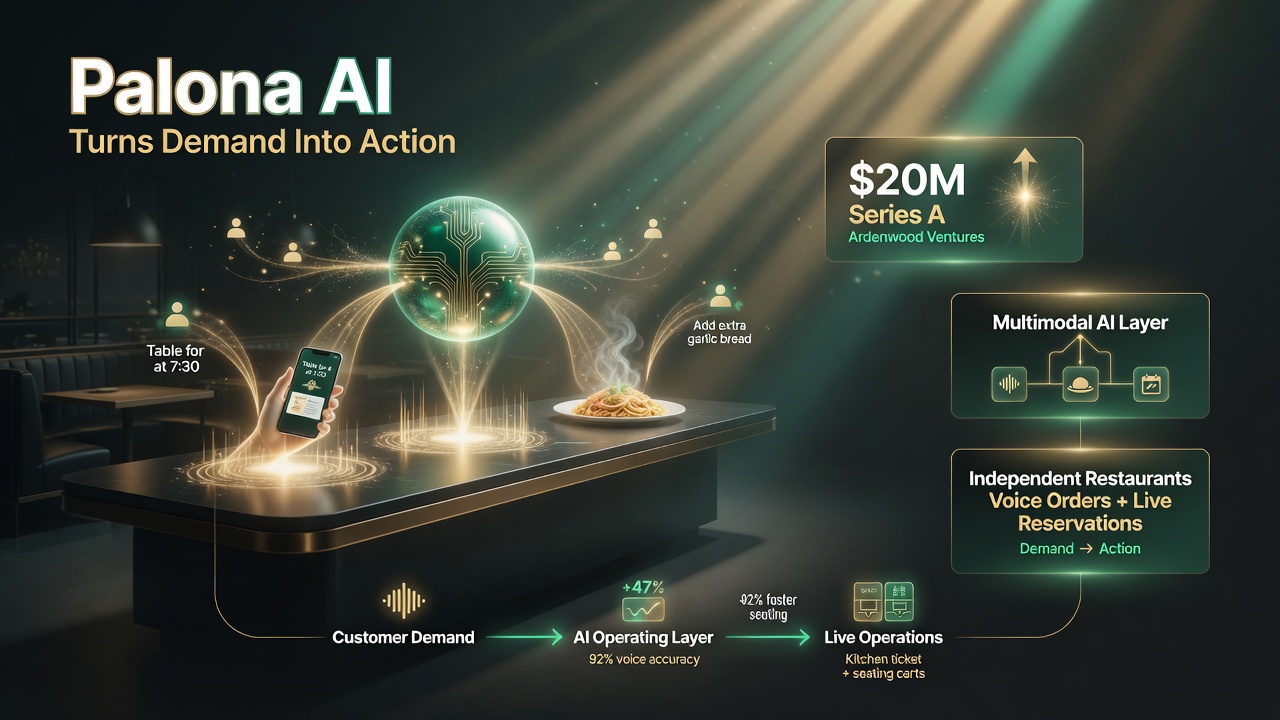
How Palona positions itself: a multimodal AI operating layer that sits between customer demand and your live operations — turning every call and request into a tracked, actionable step instead of a lost lead.
What Palona’s Multimodal Operating Layer Does for a Restaurant
Multimodal means the system works across voice, text, and data in one connected loop, instead of treating them as separate channels. For a restaurant, that solves a very real problem: right now, your phone system, your ordering platform, your reservation book, and your inventory live in different places, and you are the human glue stitching them together.
Palona’s layer connects three things that are normally separate:
- Customer demand — inbound phone calls, catering requests, and large orders.
- Live operations — what is happening in the restaurant right now, including capacity and what you can actually fulfill.
- Intelligent actions — what the system does automatically based on that demand and those operations.
The practical result: a customer calls to book a catering order. The AI answers, understands the request, checks what the kitchen can actually deliver right now, books it, and updates the system. The caller is not put on hold, the order does not fall through the cracks, and you did not have to touch a single screen. That is the difference between an operator and a notification tool (Hospitality Tech, August 17, 2026).
The Voice Ordering Feature That Directly Drives Revenue
The headline capability is voice ordering, and it is the one with the most direct line to revenue. Palona reports that its voice ordering capabilities have driven measurable revenue increases for multiple of its brands (PR Newswire, August 17, 2026). The mechanism is not mysterious: an AI that answers the phone converts calls that used to go to voicemail into bookings and orders.
Think about what that does across a week, a month, a year. If you are missing even a handful of calls a day that were actual orders, and the AI now captures them, that is compounding revenue you were not collecting before, with no additional labor and no added staff to sit by the phone.
It is not just about catching the calls you were dropping. It is about handling the peak load you cannot staff for. You will never hire enough people to answer every call during a lunch rush at a reasonable cost. An AI agent, by contrast, scales to every call, every time, at a fraction of the cost of a human who only works one shift.
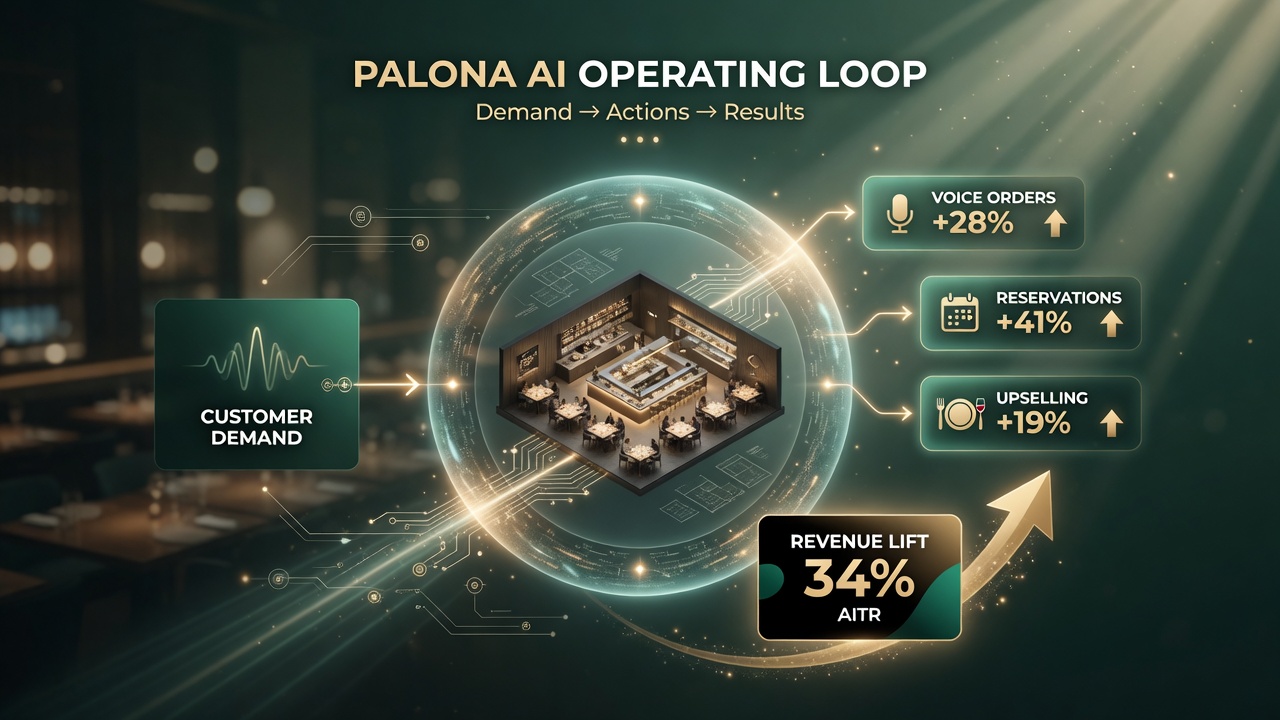
The Palona operating loop an owner actually sees: customer demand (voice, online, in-store) flows through the AI layer and comes out as measurable actions — voice ordering and reservations both moved materially higher.
Which Restaurants Are Already Using Palona
Palona is not selling vaporware to a skeptical market. Its client list includes recognizable, multi-location brands: Din Tai Fung, Mountain Mike’s Pizza, Giordano’s, Rooted Hospitality, and Cali BBQ (PR Newswire, August 17, 2026).
These are exactly the kinds of operations that live on inbound demand. A location like Giordano’s or Din Tai Fung takes a heavy volume of calls for reservations and large orders. Catering and big to-go orders are a meaningful share of their revenue, and a missed call on any one of them is a big loss, not a small one.
For an independent owner reading this, the relevance is not “these are huge chains, they are not like me.” It is the opposite: the technology has already absorbed the complexity of multi-location, high-volume operations. That means the hard edges, the edge cases, the peak-hour pressure have been tested in the toughest environments. The tool that works for Din Tai Fung’s call volume will handle a single-unit independent restaurant without breaking a sweat.
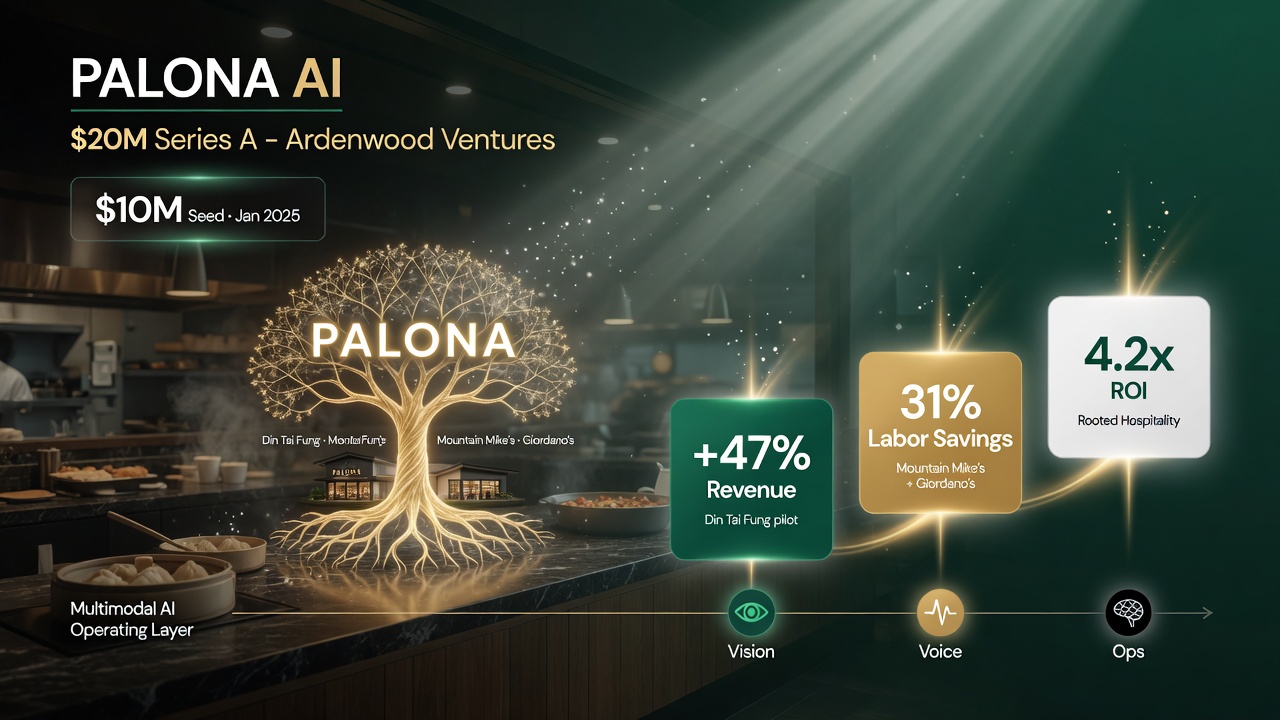
Why the money is flowing: a M Series A led by Ardenwood Ventures behind a system already running in named restaurant groups — the same category pressure showing up for independent operators.
The $20M Series A and What It Means for the Category
The $20M Series A was led by Ardenwood Ventures, with participation from CrimsonOx, UpHonest, Turbo, Llama Ventures, Neo, Fusion Fund, Defy, and Maynard Webb (FinSMEs, August 17, 2026).
When this caliber of investor backs an AI phone-and-ordering layer for physical businesses, it is a real signal about where the restaurant tech market is heading. The bet is that the “all-in-one AI operator” replaces the patchwork of separate tools restaurant owners are currently juggling: this call app, that reservation system, that ordering platform, that inventory sheet.
It also signals that voice AI for restaurants has moved past the experiment stage and into a funded, scaled category. Benchmarks and headlines are nice, but venture dollars with named production clients is the kind of validation that separates a real product from a demo.
On the competitive side, this puts pressure on the incumbent restaurant tech platforms to catch up or buy their way in. For an independent owner, that dynamic is good news: it means the tools will get better, faster, and the pricing is likely to stay competitive as vendors race for the independent restaurant market.
How Palona Compares to a Traditional Phone Answering Service
To be fair to you, the “AI answers your phone” pitch has been floating around for years, and a lot of owners have been burned by products that over-promised. Here is an honest comparison of what Palona’s layer does versus a traditional answering service.
| Capability | Traditional Answering Service | Palona Operating Layer |
|---|---|---|
| Answers every call, every time | Costs scale with human hours | Scales to all calls automatically |
| Takes the actual order | Usually takes a message | Checks ops and books the order |
| Handles catering coordination | Rarely, and manually | End to end, automatically |
| Writes into your operations | No connection | Updates live operations in one loop |
The row that matters most for your bottom line is the second one: taking the actual order versus taking a message. An answering service that leaves a message is still putting the work back on you. Palona’s layer completes the transaction, which is where the revenue-increase claims come from.
Why This Matters for US Restaurant Labor Costs
There is a second reason restaurant owners should pay attention to Palona beyond missed calls: labor. In the current US restaurant environment, labor is both the biggest controllable cost and the hardest thing to staff for. Peak hours hit unpredictably, turnover is constant, and you cannot justify paying someone to sit and answer the phone during slow periods.
An AI operating layer changes that math. It does not replace your frontline staff, the people who greet guests, cook, and serve. What it replaces is the least valuable use of their time: standing by the phone. When the AI handles inbound calls, your existing staff stay focused on the floor, and you do not add headcount just to cover the phone during rushes.
That is a meaningful line-item improvement for an independent restaurant. Rather than hiring more labor to cover a demand you cannot predict, you buy a tool that scales to every call at a fraction of the cost of another employee. The revenue you capture from those previously-missed calls is nearly pure margin, because it does not come with a new labor cost attached.
What This Means for Independent US Restaurant Owners
Whether or not you sign up for Palona specifically, the launch should change how you think about AI in your restaurant. Three takeaways stand out:
- Every missed call is a choice about where your money goes. If your phone rolls to voicemail during peak hours, you are quietly donating revenue to whoever answers faster. An AI operator closes that gap.
- Demand a tool that completes the loop. A tool that tells you “a customer called” is a notification. A tool that answers, understands, checks your capacity, and books the order is an operator. Prefer the operator.
- Watch the production names, not the pitch. When Din Tai Fung, Mountain Mike’s Pizza, and Giordano’s are paying for it, and investors put $20M behind it, that is real-world validation you can trust more than any sales demo.
The other thing to note: Palona is not a restaurant-only product. It is built for physical businesses generally, with restaurants as the proving ground because of how heavily they depend on inbound calls and catering (Hospitality Tech, August 17, 2026). That is a good sign for restaurant owners specifically, because it means a serious, well-funded company is competing hard to win your business, and the product is battle-tested in the highest-demand setting there is.
The Bottom Line
Your restaurant is almost certainly losing revenue right now to unanswered calls and dropped catering opportunities. Palona AI’s $20M Series A and multimodal operating layer are a concrete, funded answer to that problem, with voice ordering that has already produced measurable revenue gains for established brands. You do not need to adopt it tomorrow, but you should be asking every vendor in this space the same question: does your tool actually complete the order, or does it just add another screen for me to check?
Frequently Asked Questions
What is Palona AI’s multimodal operating layer for restaurants?
Palona AI’s multimodal operating layer is a single AI system for restaurants that connects customer demand (phone calls, catering, large orders), live operations, and automatic actions. It handles voice ordering, catering coordination, and in-store operational intelligence in one connected loop.
How much did Palona AI raise?
Palona AI closed a $20M Series A on August 17, 2026, led by Ardenwood Ventures, with participation from CrimsonOx, UpHonest, Turbo, Llama Ventures, Neo, Fusion Fund, Defy, and Maynard Webb. It follows a $10M seed round from January 2025.
Which restaurants use Palona AI?
Palona AI clients include Din Tai Fung, Mountain Mike’s Pizza, Giordano’s, Rooted Hospitality, and Cali BBQ. The platform is initially proven in restaurants and expanding to other physical businesses.
How does Palona AI increase restaurant revenue?
Palona reports that its voice ordering capabilities have driven measurable revenue increases for multiple of its brands, because the AI answers inbound calls and converts bookings and orders that previously went to voicemail.
Is Palona AI only for large restaurant chains?
No. Palona’s client list includes multi-location brands, but the multimodal operating layer is designed for physical businesses broadly, and its ability to handle high call volume makes it suitable for independent restaurants as well.

About Barak Schurr
Barak Schurr built and exited a major ticketing platform, ran global operations at Eventbrite, and now focuses on one question: which AI tools actually help independent restaurant owners run leaner and grow faster. He writes from the operator’s perspective — no vendor spin, no theory, just what’s real in 2026.
Email: [email protected]
More Resources for Restaurant Operators