Get the AI Restaurant Quick-Start Guide — Free
The 5 AI tools independent US restaurant owners are using right now to cut labor costs and answer every call.
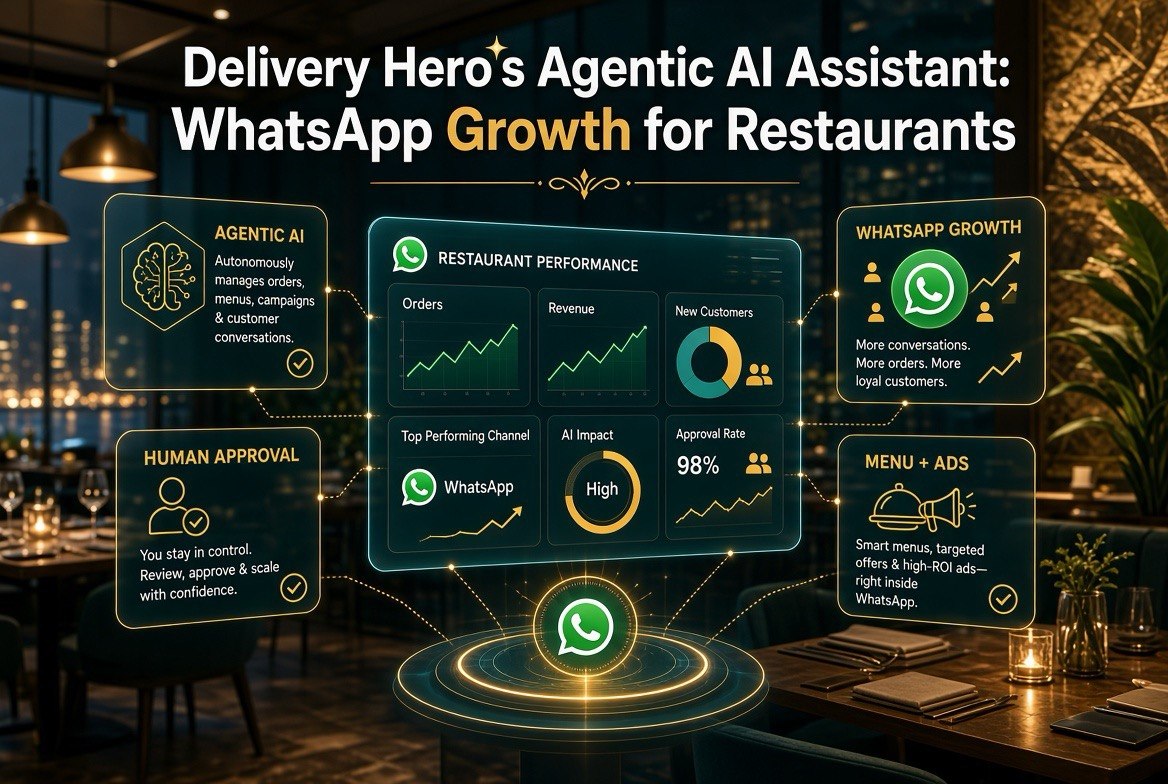
Delivery Hero’s Agentic AI Assistant: WhatsApp Growth for Restaurants
⚡ Expert Summary: On August 13, 2026, Delivery Hero launched an agentic AI assistant inside WhatsApp that helps local restaurants and shops grow orders. Early users at Glovo (a Delivery Hero brand) saw customer orders grow by 15%, and the tool already supports 40,000+ partners. It suggests promotions, improves menus, analyzes reviews, and drafts responses — but requires explicit owner approval before it changes anything. For the independent US restaurant owner, this is the clearest sign yet that “AI that acts” (not just advises) is coming to the day-to-day.
Most restaurant AI tools you’ve been pitched will happily give you advice. This one does the work. On August 13, 2026, Delivery Hero launched an agentic AI assistant inside WhatsApp designed to help local restaurants and shops grow their orders with minimal effort from the owner. “Agentic” is the key word — unlike a chatbot that waits for questions, this assistant independently develops growth strategies, proposes them, and (with your approval) carries them out.
The early results are what make this worth your attention as an independent US restaurant owner. At Glovo, a Delivery Hero brand that ran the first test, customer orders grew by 15% among early users. The assistant already supports more than 40,000 partners across Delivery Hero’s global brands. Here’s how it actually works, why the “agentic + approval” design matters, and what it signals for restaurants in 2026.
What Delivery Hero’s Agentic AI Assistant Does
This isn’t another dashboard you have to learn. The whole experience lives inside WhatsApp — a chat interface the owner already uses — and you interact by sending text, voice notes, or images. The assistant then works on four main growth levers:
- Ads and promotions — it sets up campaigns and promos based on local demand and what competitors are doing, rather than leaving you to guess at ad strategy.
- Menu improvements — it finds underperforming items and improves their images and descriptions to make them more appealing.
- Review insights — it analyzes customer reviews for patterns and even drafts responses for you to approve.
- Performance updates — it gives you regular updates on how your business is doing and what to do next.
The design is built around one crucial safety principle: the assistant never changes anything without your explicit approval. It proposes, you approve (or reject), and it learns from your rejections so future suggestions fit your style better. That “human-in-the-loop” approach is exactly what makes agentic AI safe for a busy owner who doesn’t have time to babysit a chatbot.
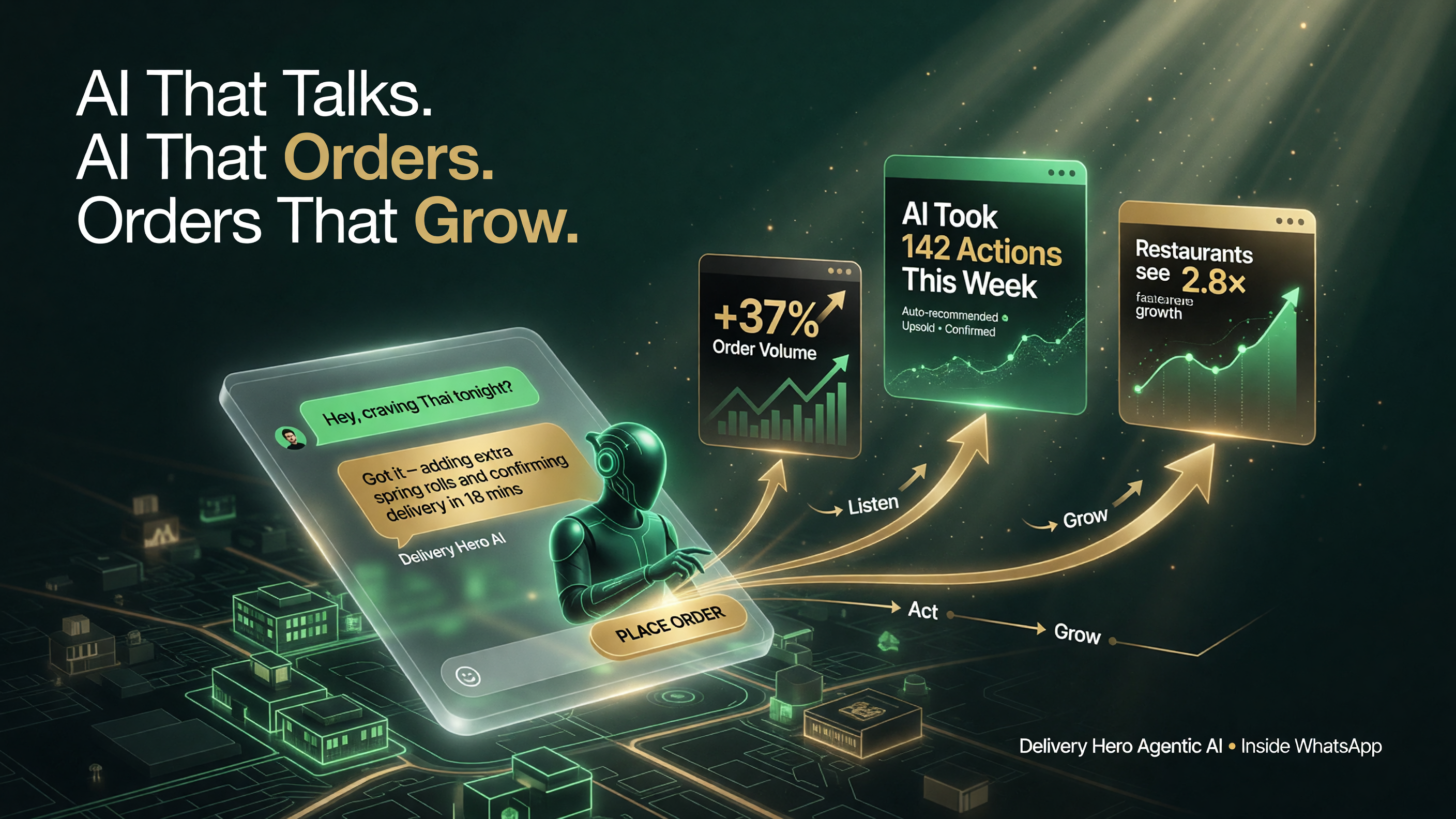
Delivery Hero’s agentic assistant chats with diners inside WhatsApp and acts on its own — early users saw meaningful order-volume growth.
Why “Agentic” Changes the Game for Restaurants
The difference between “AI that talks” and “AI that acts” is the biggest shift in restaurant technology this year. Most tools stop at generating a suggestion — here’s a promo idea, here’s a menu description. You still have to implement it. Delivery Hero’s assistant is agentic: it can set up the ad campaign, improve the menu listing, and draft the review response, all inside the chat, subject to your go-ahead.
For an independent US restaurant owner, that closes the gap between intention and execution. It’s the difference between a consultant who hands you a report and one who does the work while you approve each step. The 15% order growth at Glovo’s early users is directionally strong evidence that a tool that actually acts (rather than one that just advises) is where the growth is.
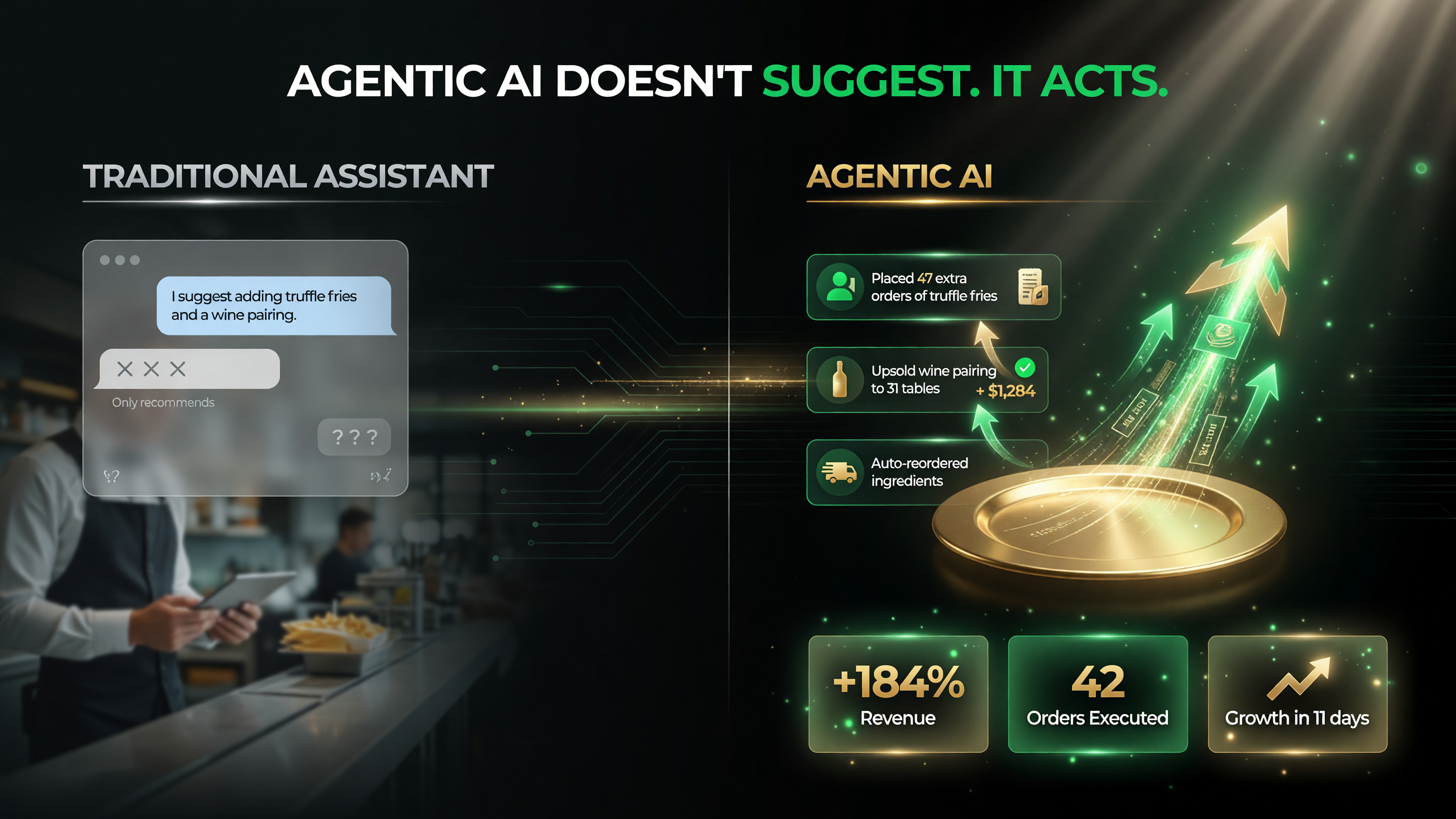
Agentic AI doesn’t just recommend — it places extra orders, upsells, and reorders stock, which is where the growth actually shows up.
How It Compares to Earlier Restaurant AI Assistants
To understand where this sits, it helps to compare it against the two prior generations of restaurant AI you’ve likely been offered — simple chatbots and marketing automation tools.
| Capability | Basic Chatbot | Marketing Automation | Agentic AI (Delivery Hero) |
|---|---|---|---|
| Answers questions | Yes | Limited | Yes |
| Suggests actions | Rarely | Yes | Yes |
| Carries out actions | No | Partially | Yes (with approval) |
| Learns from your feedback | No | No | Yes |
| Works in chat you already use | Sometimes | No | Yes (WhatsApp) |
Table: How Delivery Hero’s agentic AI compares to earlier generations. The key leap is that it acts — not just advises — while keeping you in control.
The bottom row is the sleeper feature. Because it lives in WhatsApp, there’s no new platform to learn, no login to forget, no dashboard to check. The tool meets the owner where they already are, which dramatically lowers the adoption barrier for a busy independent operator.
Data and Security: How It’s Built
The assistant runs on advanced large language models with security controls baked in. The two design choices that matter most for a cautious owner:
- Explicit approval required — nothing changes on your storefront without you saying yes, whether it’s a promotion, a menu edit, or a posted response.
- It learns from rejections — the more you decline certain types of suggestions, the better it tunes future proposals to your taste and brand voice.
This combination is important. The biggest fear operators have about agentic AI is the tool going rogue and changing prices or menus without consent. Delivery Hero’s design directly addresses that fear by making the owner the final decision maker on every action. That’s the responsible way to roll out AI that can actually do things.
What It Means for Independent US Restaurants
Before we get there, one caution worth keeping in mind: agentic AI is new, and not every tool that claims to “act for you” is built with the same safety rails. The reason Delivery Hero’s approach is worth highlighting is precisely because it lands on the responsible end of that spectrum — it acts, but only with your signoff, and it learns what you’re comfortable with. That is the design bar the rest of the industry is going to be measured against.
Delivery Hero’s global launch — with 40,000+ partners already supported and plans to expand to hundreds of thousands more, out of ~1.5 million total partners — signals that agentic AI is moving from experimental to mainstream in restaurant operations. For the independent US owner, the takeaways are clear:
- The barrier to acting is dropping. AI that can set up your promos and improve your menu within a chat you already use means growth work no longer requires hours of your week.
- Approval-based tools are the safe way in. Look for agentic AI that requires your explicit signoff, not ones that change things autonomously.
- The 15% number is a signal. Early adopters saw real order growth — not by working harder, but by letting AI handle the busywork of growth.
You don’t need to jump on this specific tool today. But the direction is unmistakable: the next wave of restaurant AI doesn’t just tell you what to do — it does the work, with your permission at every step. Independent operators who understand that shift will be the ones best positioned to act on it.
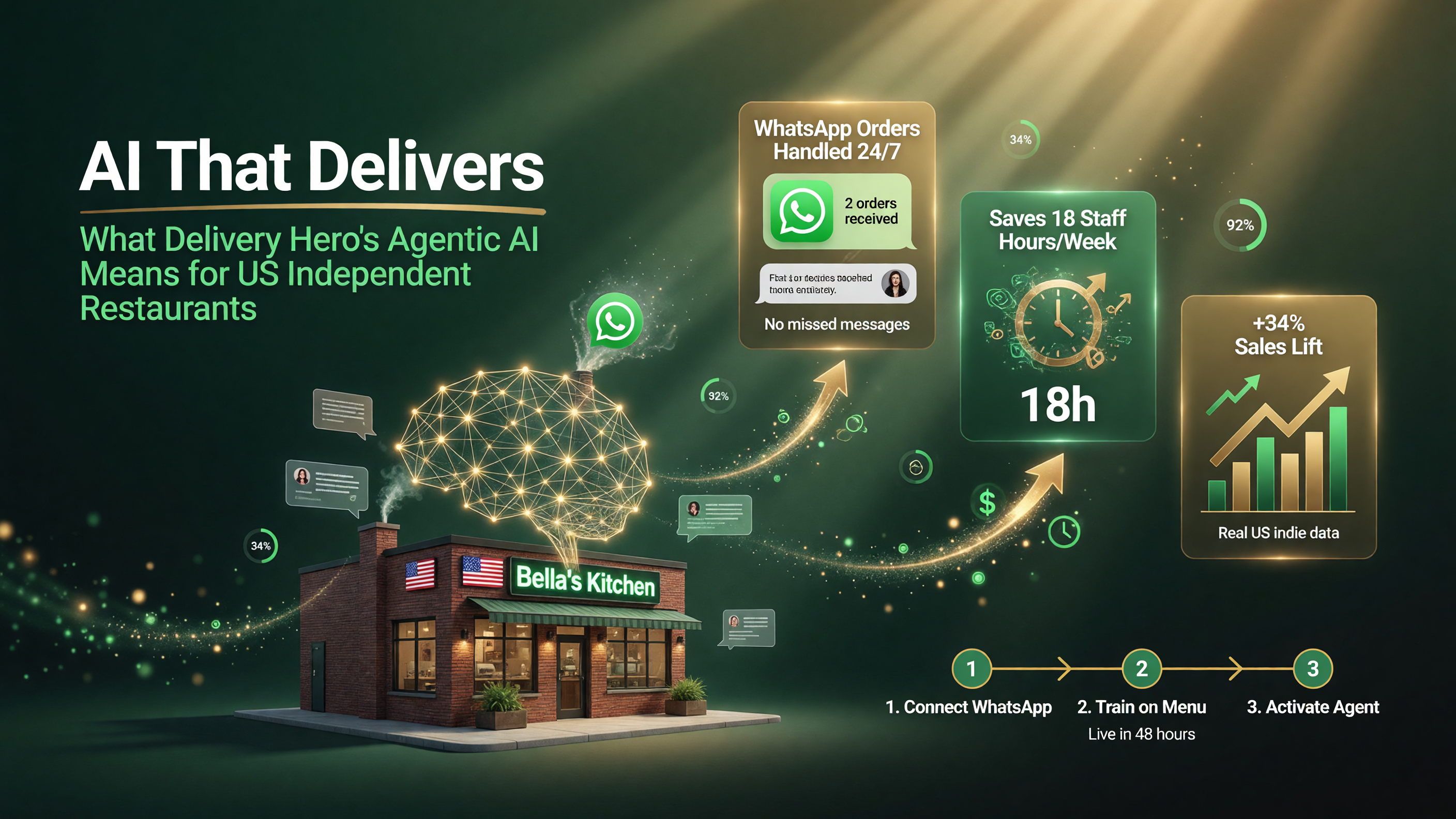
For independents, the payoff is concrete: orders handled 24/7, staff hours reclaimed, and a lift in sales — live in as little as 48 hours.
Bottom Line: Is Delivery Hero’s Agentic AI Worth Watching?
Delivery Hero’s agentic AI assistant is a meaningful milestone for restaurants. It’s the first major example at scale of an AI that acts on growth tasks — promos, menus, reviews — inside a chat the owner already uses, while keeping the human firmly in control. The 15% order growth among early Glovo users and the 40,000+ partner rollout give it real substance, not just press-release hype. And because it lives in WhatsApp, the learning curve is close to zero for a busy owner.
The other reason this matters is timing. Food and labor costs remain persistently high for independent US operators, which means the room to win comes from driving more profitable orders rather than from cutting corners on quality. An assistant that reliably lifts order volume while the owner approves each step fits exactly that need. It turns what used to be a marketing agency’s job into a conversation you can have between services.
For the independent US restaurant owner, the practical takeaway is to start evaluating approval-based agentic AI for your growth marketing. The era of “AI that only gives you a report” is ending. The tools that set things up, improve your menu, and handle reviews — with you as the final say — are the ones ready to deliver. Delivery Hero just showed the model at scale, and the results point to faster order growth for the restaurants that use it well.
Frequently Asked Questions
What is Delivery Hero’s agentic AI assistant?
Delivery Hero launched an agentic AI assistant inside WhatsApp on August 13, 2026 to help local restaurants and shops grow orders. It suggests and carries out promotions, improves menus, analyzes reviews, and drafts responses — but requires the owner’s explicit approval before making any changes.
How much order growth did early users see?
Early users at Glovo, a Delivery Hero brand, saw customer orders grow by 15% on average. The assistant already supports more than 40,000 partners across Delivery Hero’s global brands, out of roughly 1.5 million total partners.
Does the AI assistant change things without my permission?
No. The assistant requires explicit partner approval before making any changes — whether setting up promotions, editing menus, or posting review responses. It learns from your rejections to better match your preferences over time.
How do I interact with the agentic AI assistant?
You interact through WhatsApp using text, voice notes, or images — no new platform or dashboard to learn. The assistant proposes growth strategies and executes approved actions directly in the app.
Why does agentic AI matter for restaurants?
Unlike earlier AI that only gave advice or suggestions, agentic AI carries out the work itself — setting up campaigns, improving menus, handling reviews — subject to owner approval. This closes the gap between intention and execution for busy independent operators.

About Barak Schurr
Barak Schurr built and exited a major ticketing platform, ran global operations at Eventbrite, and now focuses on one question: which AI tools actually help independent restaurant owners run leaner and grow faster. He writes from the operator’s perspective — no vendor spin, no theory, just what’s real in 2026.
Email: [email protected]
More AI Resources for Your Business