Mindway AI Scores 16.5 Million Gamblers a Month and None of Them Know It
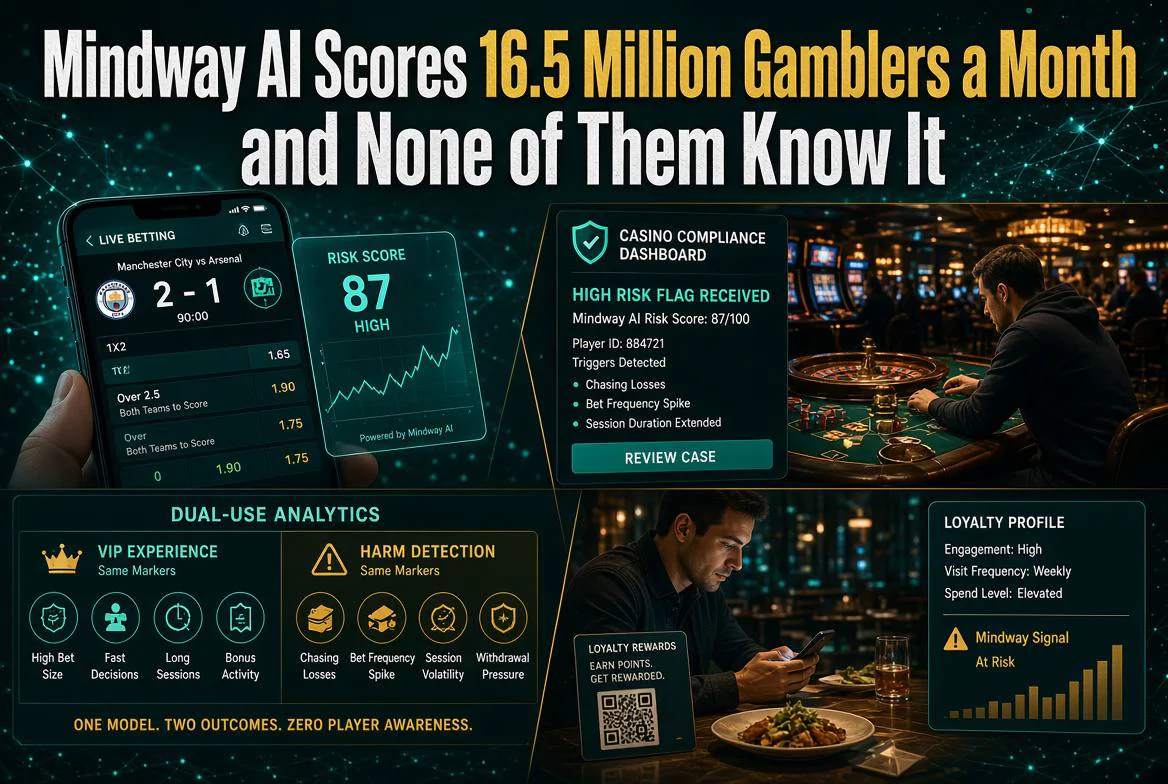
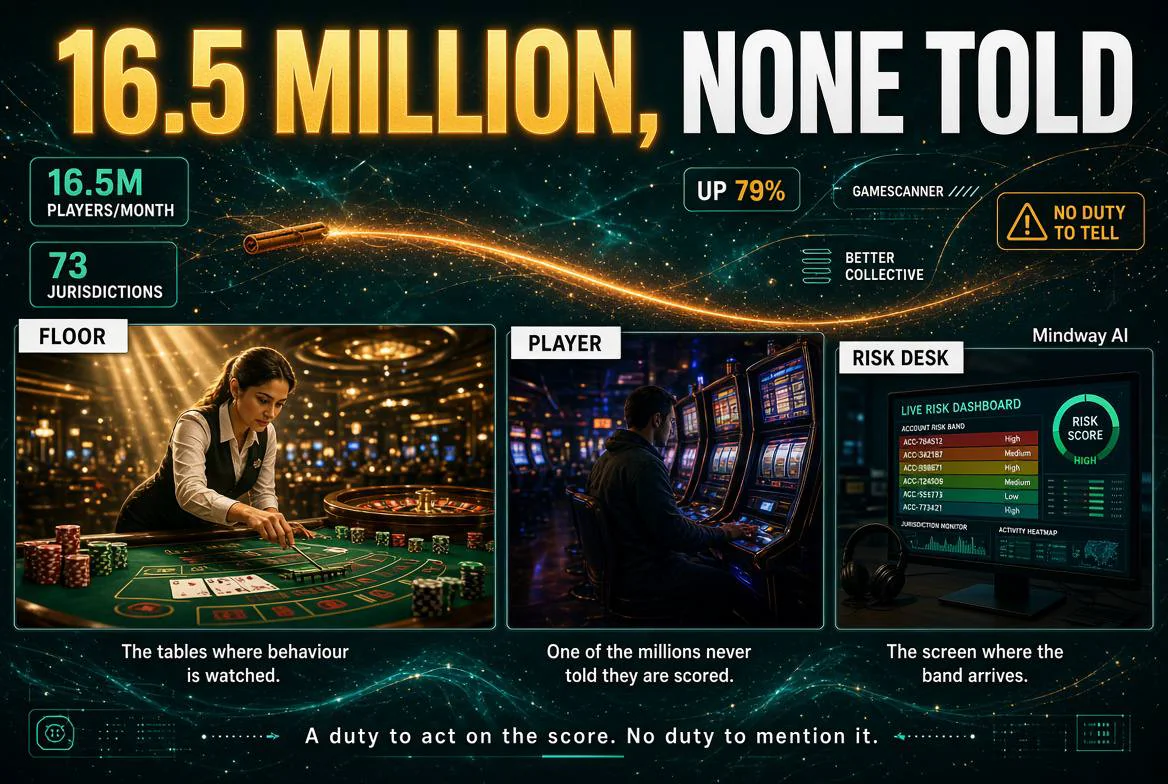
⚡ Expert Summary: Better Collective disclosed on 12 November 2026 that its Mindway AI subsidiary now scores the behaviour of 16.5 million players a month across 73 jurisdictions — up 79% since 2025. The software reads deposits, session length, bet-size escalation and loss-chasing, then hands the operator a risk band. The regulator requires the operator to act on that band. No regulator in any of those 73 jurisdictions requires the operator to tell the player they were scored at all. That is the whole system in one sentence: a duty to act, no duty to tell. For restaurant and hospitality operators reading this because you run loyalty data and guest profiles, the design question is the same one the gambling industry answered badly — and you are about to answer it.
Somewhere in the last year, a machine assigned you a number. It was not a credit score, and nobody asked your permission. It read how often you deposit, how long you stay, what time of night you play, whether your stake size climbs, whether you chase a loss. It turned that into a risk band, and it put that band in front of the company you were losing money to.
You have never seen it. There is no page in your account that shows your score. No email tells you it exists. If you are American, in the United States this happens inside legal sportsbooks and casino apps; if you are in the UK, Australia or across Europe, it happens inside the licensed operators you trust with your card details.
The only person in the transaction who does not get the readout is the person the readout is about.
16.5 Million a Month: What That Number Actually Counts
The figure comes from a corporate disclosure, not an audit. On 12 November 2026, Better Collective reported that Mindway AI’s flagship product, GameScanner, “now monitors 16.5 million active players monthly across 73 jurisdictions” — up 79% since 2025. The company’s own description of the product is that it “empowers operators to proactively detect early signs of potentially harmful gambling behavior.”
Read the number carefully, because it is doing two jobs at once. It counts active player accounts processed through operator integrations — not wagers, not every customer an operator has. The growth came from integrations with Amelco, Gaming1 and Super Technologies. And note what it is being used to prove: that the system reaches sixteen and a half million people, and that the same sixteen and a half million people are the population whose behaviour is being scored.
It is a safety number. It is also a scale number. Those are not the same sentence, and the industry says them interchangeably.
| Disclosed figure | Value | What it counts |
|---|---|---|
| Players monitored monthly | 16.5 million | Active player accounts processed through operator integrations |
| Growth since 2025 | 79% | Year-on-year increase in monitored accounts |
| Jurisdictions | 73 | Regulated markets where the scoring runs |
| Jurisdictions requiring the player be told | 0 | No law in the record requires disclosure of an automated risk score to the customer |
| Source | Better Collective | Corporate disclosure, 12 November 2026 |
What the Software Reads, In the Vendor’s Own Words
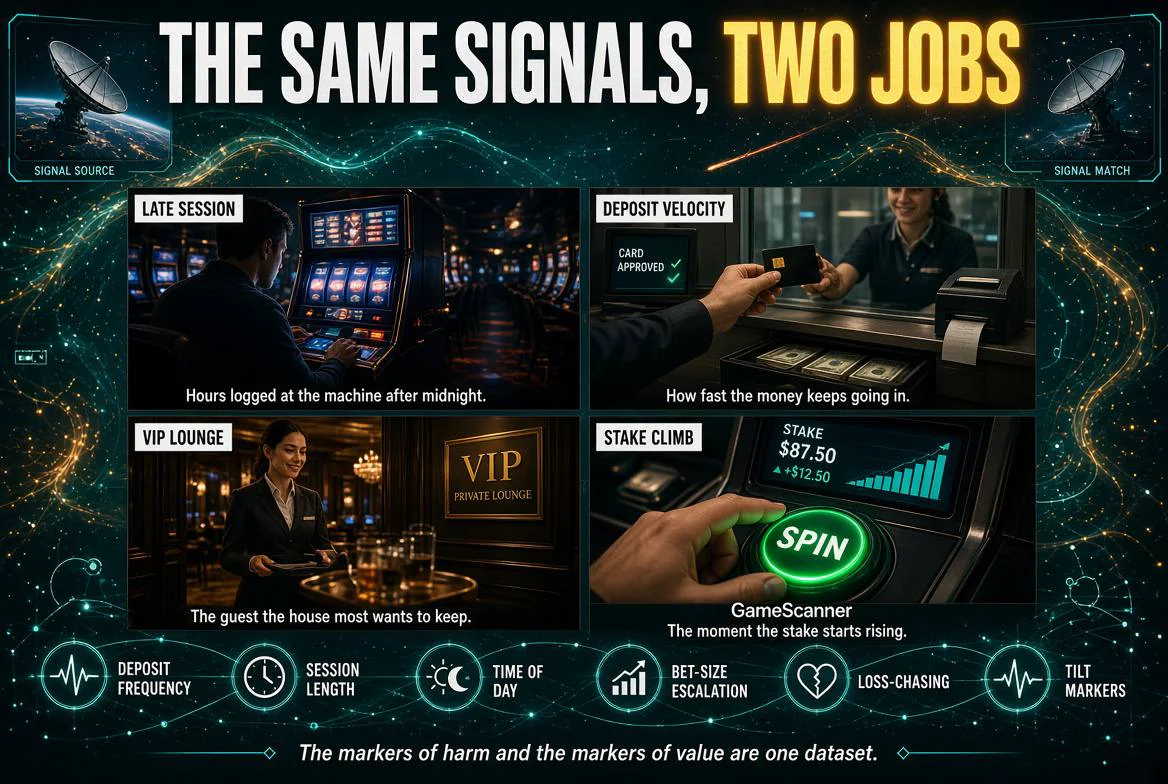
GameScanner is described by its maker as ingesting deposit frequency, session length, time-of-day patterns, bet-size escalation, loss-chasing behaviour and emotional-wagering markers people in the trade call tilt. It outputs a continuous risk score, risk bands or tiers, automated operational flags, and mandatory-intervention triggers. It combines algorithmic scoring with clinical and addiction-psychology profiling.
That is a serious piece of behavioural science, and it is not a fraud detector. It is not looking for a stolen card or a bot. It is reading a human being’s pattern of loss and estimating how much trouble they are in.
Which is precisely why the next part matters.
The Duty to Act, and the Duty That Does Not Exist
Here is the load-bearing fact of this entire story, and it is an absence rather than an event.
The score goes to the operator’s compliance, risk and support dashboards. It does not go to the player. No jurisdiction in the record requires an operator to disclose to a customer that they were algorithmically profiled, or that an automated risk score was assigned to them, or what that score was.
What regulators do require is action. The UK Gambling Commission requires operators to run automated remote customer interaction systems that detect markers of harm at scale, and holds them accountable when those systems fail to catch runaway losses. Malta and EU regulators have been pushing governance guidance on AI and machine-learning models in iGaming — bias, model transparency, and the rule that automated player-protection tools cannot be overridden by commercial departments. Operators across the UK and EU have been fined repeatedly in the last two years for failing to interact with accounts showing obvious automated red flags. Those rulings treat the failure as corporate negligence.
Every one of those obligations runs one way. The operator must message, must interact, must block, must sometimes close the account. Not one of them creates a right for the player to know that a model is watching, what it concluded, or that it flagged them last Tuesday and nothing happened.
So the system has a duty to act on a flag and no duty to tell the person the flag exists. An operator can be fined for ignoring a red flag. There is no penalty anywhere for never mentioning that the flag was raised.
The Dual-Use Problem, Stated Honestly
The obvious objection is that the same telemetry has two commercial uses, and only one of them is protective. The markers that identify harm — deposit velocity, chasing behaviour, long sessions, late-night play — are the same markers that identify a valuable customer. Reporting and academic literature on VIP management has made that point repeatedly. I am not going to pin it to a specific article I cannot date and URL, because that is how a good argument gets destroyed in the comments: the claim is sound and well documented in the compliance literature; the individual citation is not something I will fabricate.
What can be said precisely: the same behavioural signature supports both uses, and no operator has published a model, an audit or a controls document proving the two are separated. Compliance sources are candid that high-value losing customers have historically been insulated from aggressive responsible-gambling intervention in order to protect revenue, and that UK Commission pressure has been tightening those controls. That is the honest version. The industry’s answer is procedural separation — different teams, different permissions, governance committees. It is not a published proof.
For anyone outside gambling, this is the part to steal. If you run a restaurant group with a loyalty programme, you already hold deposit-like data: visit frequency, spend escalation, time of day, the guest who comes in four nights a week. The moment you score that for “churn risk” and for “high-value retention,” you have built the same dual-use machine with better manners and no regulator watching.
What Happens to the Players the Model Gets Wrong
Now the counter-evidence, because a piece that only tells one side is not worth reading.
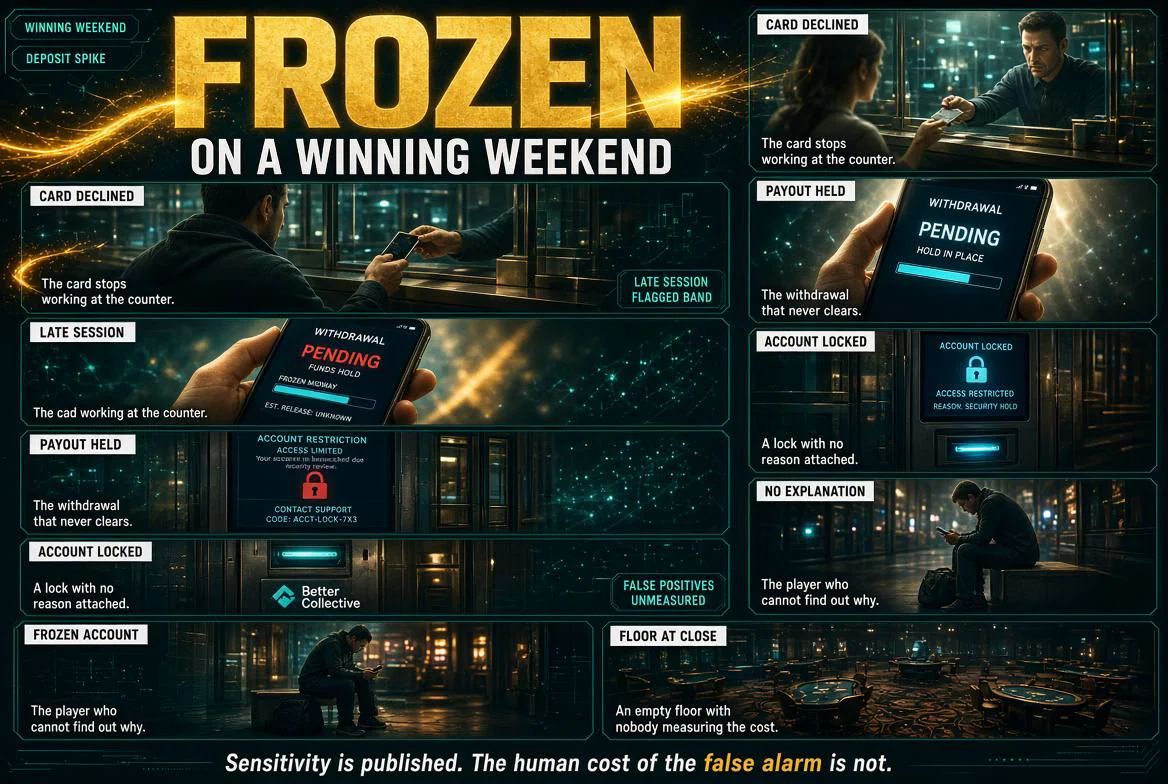
Recreational players get flagged. A winning weekend, a deposit spike after a bonus, one late-night session — any of those can move a score into a band that triggers an intervention. And the consequences are not gentle: a frozen account, a source-of-wealth request asking you to document where your money came from, a withdrawal that will not process. For a player with their own cash sitting in the account, that is a serious problem with no obvious remedy.
Redress is thin. Operators rely on terms-of-service clauses that let them restrict or close accounts at their sole discretion — those terms appear on every major US and UK sportsbook. Disputes go to alternative dispute resolution bodies, which are not courts, and the burden of proving you did not look like a problem gambler falls on you.
| Scenario | What the system does | What the player experiences |
|---|---|---|
| Genuine loss-chasing | Flags the account, triggers an interaction | A message from the operator — sometimes effective, never explained |
| Winning weekend, deposit spike | Score rises; may land in a flagged band | Frozen account, source-of-wealth demand, delayed withdrawal |
| Late-night session after a bonus | Pattern matches tilt markers | Restriction with no stated reason |
| Player asks why | No obligation to disclose the model or the score | Terms-of-service answer; ADR at best |
The Steelman, and What It Does Not Measure
The strongest defence of these systems deserves stating properly, because it is not wrong. Machine learning catches loss-chasing hours or days before a human agent would notice it. Peer-reviewed evaluations of these tools show high sensitivity at identifying extreme escalation — players whose behaviour is visibly deteriorating. On its own terms, the technology works: it finds real harm earlier than staff could.
Then look at what those evaluations measure. Sensitivity. How many of the genuinely harmed cases the model catches. What they do not measure is the false positive rate’s human consequences: how many recreational players were frozen out, how much of their own money was held, how long they waited, and what happened when they complained to an ADR body staffed by people who will never see the model either.
Nobody has published that number. Not the vendors, not the operators, not the regulators. The industry measures what it catches and does not measure who it caught wrongly — and the people in the second group are the ones who cannot see the score that put them there.
The Same Software Pointed Somewhere Else
Two things happened in the same week as that disclosure, and together they show the range of this technology.
On 8 November 2026, Casino.org’s Philip Conneller reported that Turkish police used an AI system named AVCI to track illegal betting networks across 39 provinces. Investigators identified 306,000 potentially incriminating messages across 47 groups. Raids targeted 194 suspects, 169 were detained, and 121 were jailed pending trial. That is the same class of software — behavioural pattern detection across a population — pointed at crime rather than at customers. Nobody in that case is arguing the targets should have been told they were being scored.
On 9 and 10 November, a US House subcommittee chaired by Representative Burgess Owens of Utah, with opening statements from Representative Michael Baumgartner of Washington, examined college sports betting: student welfare, player harassment, and college player-prop bets, with operators pressed on marketing practices. Same software class again, new subject, and the question in the room was whether the industry’s own detection systems are doing what they claim.
And on 12 November, the Hippodrome Casino in London became the first casino to deploy Tangam Systems’ full AI Assistant and Reporting suite — natural-language analysis and automated reporting folded into table-games operations. Also a vendor claim, first-party, published the same day as the number that frames this piece. The casino floor at G2E in Las Vegas that week was full of player tracking and table optimisation. Nobody published what any of it found out about the players.
What This Means If You Are Not In Gambling
You probably are not reading this because you run a casino. You are reading it because you run something with customers and data, and you have been told that scoring them is personalisation.
Here is the transferable lesson, and it is uncomfortable: the gambling industry built the most sophisticated behavioural risk-scoring infrastructure in consumer business, and it built it so that the only party who never sees the model is the person the model is about. That was not a conspiracy. It was the natural result of a system where the regulator asked for action and never asked for disclosure, and where every commercial incentive pointed the same direction.
If you are building guest scoring — churn prediction, high-value detection, “at-risk regulars” — you are making the same architectural choice by default unless you deliberately make the opposite one. Show the customer their standing. Say what you score. Give them a way to see it and a way to argue with it. It costs you a support queue, and it saves you from being the story someone writes in five years.
The closing irony is almost too neat. In 73 jurisdictions, 16.5 million people a month are scored by a system whose entire purpose is to protect them from harm. Operators can be fined for failing to act on what it says. No operator anywhere can be fined for never telling the player the flag went up, and the score, the band and the model stay where they have always been: on the house’s side of the screen.
For more on AI systems making decisions about people without their knowledge, see our coverage of AI agents as a password-theft risk in restaurants, and browse the full restaurant AI category for the rest of the operator stack.
Frequently Asked Questions
What is Mindway AI’s GameScanner?
GameScanner is behavioural risk-scoring software sold to gambling operators. It reads deposit frequency, session length, time-of-day patterns, bet-size escalation, loss-chasing and tilt markers, then produces a continuous risk score and automated intervention flags for the operator’s compliance team.
Do casinos have to tell players they were flagged?
No. In none of the 73 jurisdictions covered by Better Collective’s disclosure is an operator required to disclose to a customer that they were algorithmically profiled or assigned a risk score. Regulators require the operator to act on a flag, never to reveal it.
How many players does the system score?
Better Collective disclosed on 12 November 2026 that GameScanner monitors 16.5 million active players monthly across 73 jurisdictions, up 79% since 2025. The figure counts active player accounts processed through operator integrations, not wagers or total customer rosters.
What happens to a player who is wrongly flagged?
Typically a frozen or restricted account, a source-of-wealth request, or a refused withdrawal. Operators rely on terms-of-service clauses allowing them to restrict or close accounts at their sole discretion, and disputes go to alternative dispute resolution rather than a court.
Is the same data used to find VIP customers?
The same behavioural markers — deposit velocity, chasing, long sessions — support both harm detection and high-value customer identification. No operator has published a model or audit proving the two uses are separated, and compliance sources acknowledge that high-value losing customers have historically been insulated from aggressive intervention.
Does this apply outside gambling?
The architecture does. Any business scoring customers on behaviour — restaurant loyalty programmes included — faces the same choice about whether the person being scored ever gets to see the score. Gambling is the version with a regulator; most other industries have none.

About Barak Schurr
Barak Schurr built and exited a major ticketing platform, ran global operations at Eventbrite, and now focuses on one question: which AI tools actually help independent restaurant owners run leaner and grow faster. He writes from the operator’s perspective — no vendor spin, no theory, just what’s real in 2026.
Email: [email protected]
More Resources for Restaurant Operators