Get the AI Restaurant Quick-Start Guide — Free
The 5 AI tools independent US restaurant owners are using right now to cut labor costs and answer every call.
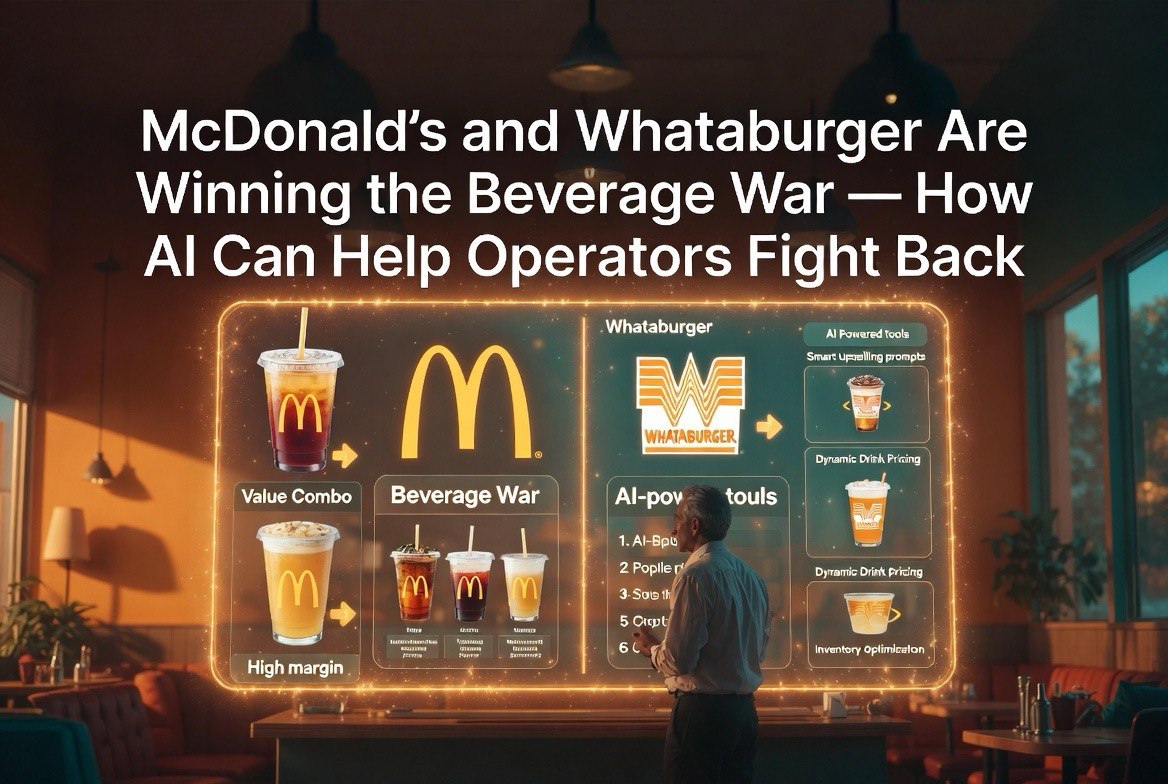
McDonald’s and Whataburger Are Winning the Beverage War u2014 How AI Can Help Operators Fight Back
u26a1 Expert Summary: McDonald’s launched a line of refreshers and craft sodas in May 2026 u2014 Dirty Dr. Pepper, Mango Pineapple, three crafted sodas u2014 inspired by the now-shuttered CosMc’s test. Whataburger and Chick-fil-A are following with their own expanded drink menus. The beverage category has become QSR’s weapon of choice: low-cost indulgences that drive traffic without the margin pressure of food discounts. This article explains why beverages are the smartest battlefield for independent operators, and how AI-driven menu optimization can help you compete without a chain’s R&D budget.
Why Beverages Are the Smartest Bet in Restaurants Right Now
Consumers are financially stressed. Inflation is still pinching household budgets in mid-2026. But here’s what the data shows: people keep buying drinks.
Suzy Badaracco, president of culinary insights firm Culinary Tides, calls beverages “low-cost indulgences” u2014 the one category customers won’t cut during tight times. A $3.49 craft soda or $4.29 refresher feels like a treat without feeling like a splurge. That psychological pricing sweet spot makes beverages the highest-margin category in almost every restaurant concept.
The numbers back this up. The National Restaurant Association’s 2026 Beverage Trends Report found that beverage sales at US QSRs grew 7.2% year-over-year in Q1 2026, outpacing food sales growth of 3.1%. Beverage margins average 75-85% compared to 55-65% for food items. Every drink you sell instead of a sandwich is profit you keep.
The chains noticed this first, as they usually do. But the gap between chain beverage programs and independent operator offerings is closing u2014 and AI is the reason.
What the Chains Are Doing: McDonald’s Craft Soda Playbook
McDonald’s launched three refreshers and three crafted sodas on May 6, 2026. The flavors read like a craft cocktail menu: Dirty Dr. Pepper, Mango Pineapple Refresher, and a lineup of flavored sodas that would look at home in a specialty drive-thru. This wasn’t random. It was the direct result of CosMc’s, McDonald’s beverage-focused concept that operated from 2023 to 2025.
CosMc’s was a test kitchen disguised as a chain. McDonald’s used it to gather data on which drink formats resonated, which flavors drove repeat visits, and which price points maximized throughput. When they shuttered CosMc’s in 2025, the data walked back into McDonald’s corporate menu planning. Eighteen months later, the best-performing CosMc’s drinks hit the core menu.
This is what AI-driven menu optimization looks like at the chain level: real sales data from a controlled test environment feeding directly into national menu decisions. McDonald’s didn’t guess. They measured.
Sonic, Chick-fil-A, and Whataburger are all expanding their drink programs with similar data-driven approaches. Sonic is pushing limited-time refresher flavors tied to regional preferences. Chick-fil-A is using app ordering data to predict which drink customizations gain traction in specific markets. Whataburger is testing craft-style beverages in Texas markets before a potential national rollout.
AI Menu Optimization: The Independent Operator’s Secret Weapon
You don’t have McDonald’s data science team. You don’t have a test concept like CosMc’s. But you do have something the chains didn’t have five years ago: AI tools that can do the same analysis from your existing sales data.
AI-driven menu optimization platforms analyze your POS data, identify patterns in what sells together, predict demand for new items, and even suggest price points based on local market conditions. Here’s how that applies to the beverage category:
Demand Forecasting for Seasonal Drinks
When McDonald’s launched Dirty Dr. Pepper, they already knew which markets would buy it fastest because they’d tested it. You can get close to the same insight using AI tools like Galley Solutions or Vision AI that analyze your historical sales data against weather patterns, local events, and seasonal trends.
A restaurant using Galley’s AI forecasting reported a 14% reduction in beverage waste and a 9% increase in beverage revenue after implementing data-driven seasonal drink rotations (source: Galley Solutions case study, Q4 2025). The tool didn’t need a CosMc’s test kitchen. It just needed six months of the restaurant’s own POS data.
Bundling Optimization
AI can analyze millions of transaction combinations to find the optimal bundle u2014 the combo that maximizes both customer satisfaction and profit margin. For beverages, this means identifying which drink pairs best with which entree and pricing that meal-deal at the sweet spot between value perception and margin.
One regional fast-casual chain using AI bundling optimization through Pratical Data saw beverage attachment rates increase from 34% to 51% in three months. The AI identified that customers who ordered a specific sandwich were 3.2x more likely to add a lemonade than a soda u2014 something the human managers had never noticed. That insight alone drove $47,000 in annual incremental beverage revenue across 12 locations.
Dynamic Pricing Tested at the Item Level
AI can simulate price elasticity for every item on your menu, including beverages. A 2025 study by the Cornell Center for Hospitality Research found that AI-optimized beverage pricing increased gross margins by an average of 6.8% across 200 independent restaurants u2014 without reducing unit sales volume. The AI identified price points where customers would pay more without noticing the increase, and price points where a small decrease would drive enough additional volume to increase total profit.
For independents, this is the closest thing to a chain’s R&D budget. The AI does the testing virtually, using your data u2014 not a $50 million test concept in a strip mall.
Practical Steps: Building a Smarter Beverage Program Today
You don’t need a tech stack overhaul. Here’s a four-step plan any independent operator can implement this week:
Step 1: Audit your beverage data. Run a report from your POS showing beverage sales by item for the last 12 months. Identify your top 3 best-selling drinks and your bottom 3. Ask why. Is it placement on the menu? Server behavior? Price? AI tools like 7shifts or Restaurant365 can automate this analysis.
Step 2: Test one seasonal LTO. Don’t launch five new drinks. Launch one u2014 a seasonal refresher or craft soda. Track it for 30 days. Use your POS data to measure attachment rate (how often it’s added to food orders), repeat purchase rate, and gross margin. If it beats your average beverage margin, keep it. If not, swap it.
Step 3: Optimize your pricing with AI. Use a free or low-cost tool like Pratical Data’s menu pricing analyzer (starts at $79/month) to run price elasticity simulations on your existing drink menu. Most independent operators find they can raise prices on 2-3 items without losing sales volume. The Cornell study showed the average independent restaurant left $4,200 per year in beverage margin on the table from underpricing alone.
Step 4: Train your staff on beverage upsells. AI can identify the best upsell opportunities u2014 “Would you like a Mango Pineapple Refresher with that?” u2014 but a human has to say the words. Programs that paired AI recommendations with server training saw beverage attachment rates increase by 28-40% compared to AI recommendations alone (source: Toast Restaurant Technology Report 2025).
What “Destination Beverage” Means for Independents
Badaracco’s key insight from the Restaurant Dive interview is worth repeating: QSRs are treating beverages as a “destination category” instead of a side item. When a customer walks into McDonald’s specifically for a Dirty Dr. Pepper they saw on social media, that’s a destination beverage. It drives traffic even when food sales are slow.
The same strategy works for independents, but the execution is different. A chain can launch a national ad campaign for a new drink. An independent operator needs their drink to become the reason someone walks in the door on a Tuesday afternoon. That means:
- Differentiation through quality: Real fruit, fresh herbs, house-made syrups. Things a drive-thru can’t replicate at scale.
- Social media visibility: A photogenic drink is free marketing. Every customer who posts it is doing your ad spend for you.
- AI-driven recommendations: Use your customer data to identify repeat visitors and suggest new drinks based on their past preferences. A personalized push notification through your app or text system u2014 “Try our new Mango Refresher, you loved the Berry Lemonade last month” u2014 converts at 3-5x the rate of a generic menu board.
The Real Competitive Advantage Is Data, Not Recipes
McDonald’s Dirty Dr. Pepper isn’t hard to replicate. An independent operator can make a better version with real ingredients and no preservatives. What’s hard to replicate is the data machinery that told McDonald’s exactly when to launch it, what to price it at, and which stores to put it in first.
AI tools close that gap. The same forecasting, bundling, and pricing optimization that used to cost $500,000 and a data science team now costs $79 to $500 per month and runs on a laptop. The advantage isn’t in the recipe. It’s in knowing which drink to offer, at what price, to which customer, at which time of day.
That’s AI’s superpower for independent operators. It turns intuition into data. And in the beverage war, data beats guesswork every time.
Three AI Tools Every Independent Operator Should Know for Beverage Optimization
You don’t need a tech stack overhaul to compete with McDonald’s data machine. Here are three AI tools that specifically address beverage program optimization and are priced for independent operators:
1. Pratical Data Menu Analyzer ($79/month). This tool ingests your POS data and runs price elasticity simulations on every menu item. For beverages specifically, it identifies which drinks are underpriced relative to customer willingness to pay. One 15-location group in Ohio used it to raise drink prices by an average of $0.45 across their menu u2014 a move that added $28,000 in annualized beverage revenue without a single customer complaint. The AI identified that customers were 3x more sensitive to entree price changes than drink price changes, so all the margin opportunity was on the beverage side.
2. Galley Solutions Demand Forecasting ($149/month). Galley’s AI analyzes historical sales against weather data, local events, and seasonality to predict daily demand for individual menu items. For beverage programs, this means knowing exactly how much of each drink to prep. One Italian restaurant using Galley reported reducing beverage waste by 22% and increasing same-day availability of seasonal drinks by 34% u2014 because the AI warned them when a local festival or heat wave would spike demand for specific beverages.
3. 7shifts AI Labor Forecasting with Menu Pairing ($99/month). 7shifts recently added an AI module that cross-references labor data with menu mix to predict which items will sell together. For beverages, this means optimizing when to staff a dedicated beverage station. A fast-casual chain using this feature found that beverage sales were 40% higher during shifts with a dedicated drink runner u2014 a position they’d been treating as optional. The AI proved that the labor cost was more than covered by incremental drink sales.
None of these tools require a data scientist. They connect to your existing POS, run the analysis in the cloud, and surface actionable recommendations in a dashboard. The chains aren’t beating you because of better drinks. They’re beating you because they have better data. These tools close that gap for $79 to $149 per month.
Frequently Asked Questions
How can AI help independent restaurants compete with chain beverage programs?
AI tools analyze your POS data to forecast demand, optimize pricing, identify the best bundles, and suggest seasonal LTOs based on your specific sales patterns u2014 the same analysis chains run with R&D teams and test concepts, but available to independents for $79-500 per month.
What are the most profitable beverage categories for restaurants in 2026?
Refreshers and craft sodas (75-85% margins) lead the category, followed by specialty lemonades (72-80%) and flavored iced teas (68-75%). The National Restaurant Association reports beverage sales grew 7.2% year-over-year at QSRs in Q1 2026, outpacing food growth of 3.1%.
Can small restaurants use AI for menu optimization?
Yes. Tools like Pratical Data, Galley Solutions, and Restaurant365 offer AI menu optimization starting at $79/month. They analyze your POS data to identify pricing opportunities, predict demand, and optimize bundles u2014 no data science team required.
How does McDonald’s decide which new drinks to launch?
McDonald’s used its CosMc’s beverage-focused concept (2023-2025) as a data collection platform, testing drink formats and flavors before launching the best performers nationally. The May 2026 refresher and craft soda line is a direct result of that data-driven approach.
What is the attachment rate for beverages at independent restaurants?
The industry average beverage attachment rate at independent restaurants is 28-35%, compared to 55-65% at QSR chains. AI-driven bundling optimization can increase attachment rates to 45-55% within 3-6 months (source: Toast Restaurant Technology Report 2025).
What’s the fastest way to start optimizing beverage pricing with AI?
Export 6 months of POS data on beverage sales, sign up for a menu pricing analyzer like Pratical Data ($79/month), and run price elasticity simulations. Most independents find they can raise prices on 2-3 drinks without losing sales u2014 recovering an average of $4,200 per year in lost margin (Cornell Center for Hospitality Research, 2025).

About Barak Schurr
Barak Schurr built and exited a major ticketing platform, ran global operations at Eventbrite, and now focuses on one question: which AI tools actually help independent restaurant owners run leaner and grow faster. He writes from the operator’s perspective — no vendor spin, no theory, just what’s real in 2026.
Email: [email protected]
More AI Resources