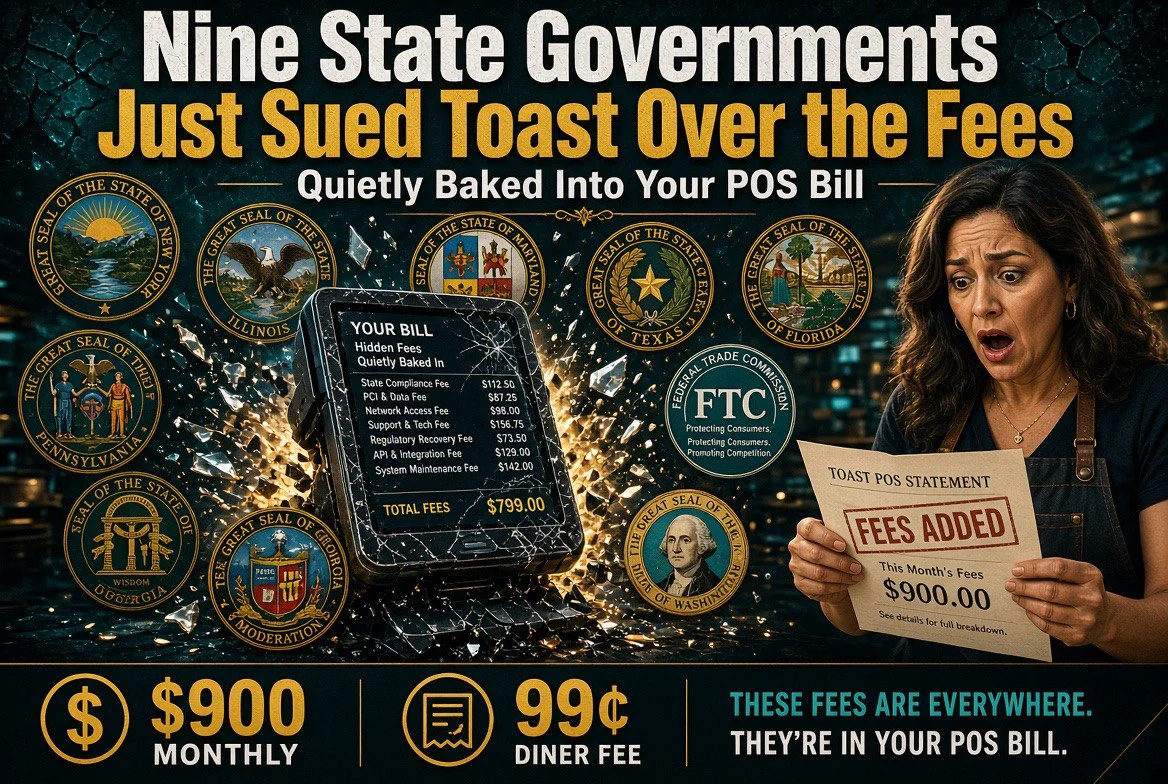
Nine State Governments Just Sued Toast Over the Fees Quietly Baked Into Your POS Bill
⚡ Expert Summary: On 29 October 2026, the FTC and the attorneys general of nine state governments — not eight, as most coverage reported — sued
Toast in the Northern District of California over fees buried in restaurant POS contracts. The average auto-renewing subscription at issue is
$900 a month, which is $10,800 a year before a single card is processed, and the suit alleges Toast collected a
99-cent fee from diners on online orders over $10 and kept it. Toast says it “strongly disagrees” and calls the action unprecedented. The fees were never the accident. The contract was designed around them.
Read the plaintiff list slowly, because it is the part of this lawsuit that predicts the ending.
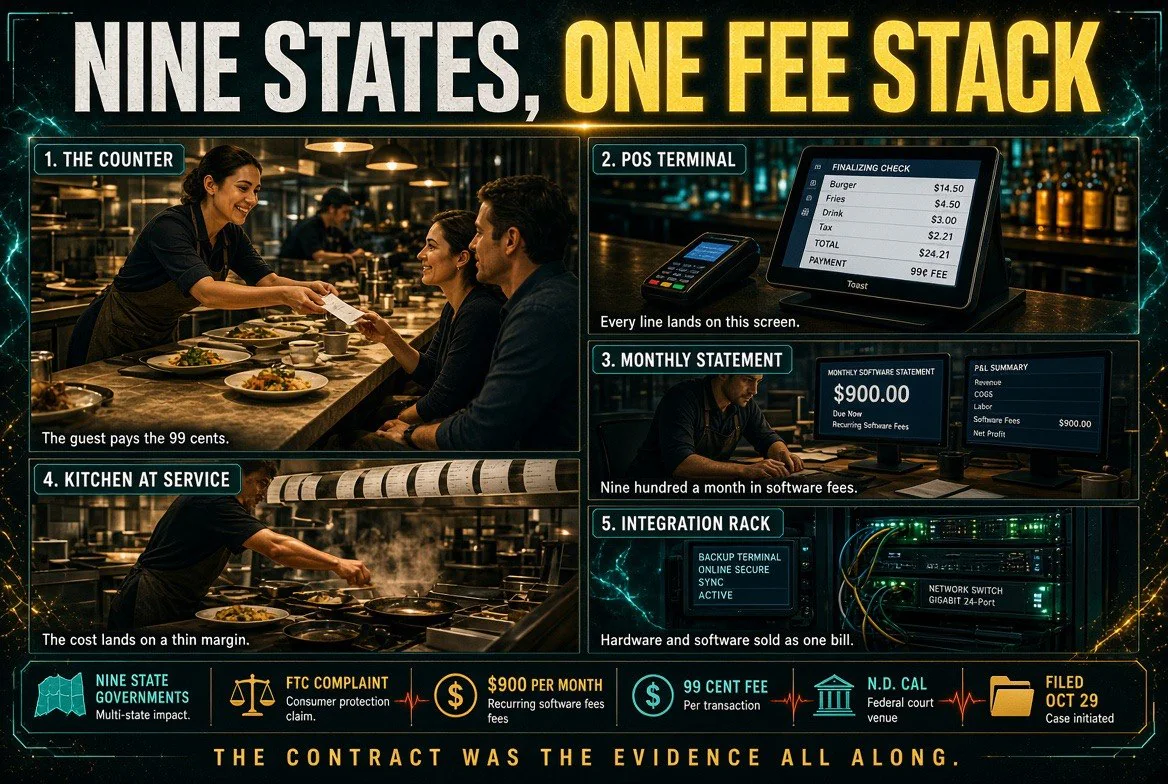
The Federal Trade Commission filed on 29 October 2026. Alongside it went the People of the State of California, through the Los Angeles County Counsel and the San Francisco City Attorney; and the attorneys general of Colorado, Florida, Illinois, Iowa, Nebraska, Oklahoma and Utah.
Count the states. Colorado, Florida, Illinois, Iowa, Nebraska, Oklahoma, Utah — that is seven. Add California, which filed through two city offices under its own authority, and Utah’s neighbors stop mattering: the complaint names nine state governments and two city legal offices.
Nine state governments do not coordinate a consumer protection action against a mid-size software company on a whim. Nine attorneys general sign onto the same complaint when their own constituents’ complaints have piled up in the same shape for long enough that the pattern stops looking like individual bad luck and starts looking like a business model.
And the shape was always the same. A restaurant owner signs what looks like a fair rate. Eighteen months later the merchant statement has three lines nobody can explain, the contract auto-renewed without a conversation, and cancelling costs more than staying. The complaint against Toast is that version of events, written by lawyers with subpoena power and internal documents.
What follows is what the suit actually alleges, what Toast says back, what the money means for a restaurant running three percent net margin — and why the 99-cent fee buried in the middle of the filing deserves more of your attention than the cancellation maze everyone is going to write about.
What the Complaint Says Toast Did
The filing landed in the U.S. District Court for the Northern District of California. The core allegations, stripped of legal framing:
Auto-renewing subscriptions without meaningful consent. Restaurants were enrolled in recurring software subscriptions that renew automatically, at an average cost the complaint puts at $900 a month, with the renewal terms not clearly disclosed at the point of sale.
Unauthorized add-ons. Products and services added to accounts that operators say they did not order and did not know they were paying for — the classic mechanism by which a $299 monthly software bill becomes a $900 one over two years of quiet accretion.
A cancellation process built to be abandoned. Early termination fees, multi-step cancellation paths, and a support organization the complaint alleges was not the round-the-clock operation the marketing promised.
Hardware marketed as free that was not. Terminals and hardware positioned as no-cost in the sales conversation while carrying conditions operators say they were never told about.
The 99-cent diner fee. On online orders above $10, a 99-cent charge was collected from the consumer — and, per the complaint, retained by Toast rather than passed to the restaurant.
That last item is the one to sit with. It is not a billing dispute between a vendor and a customer. It is a fee collected from
your
diners, on
your
orders, on top of the commission structure you already negotiated, with the proceeds going to the software company. If you never noticed it, that is the point — it is 99 cents, which is small enough to survive a customer’s attention and large enough to accumulate into something real across a few million online orders.
| What the Suit Alleges | What You Were Told | What the Complaint Says Happened |
|---|---|---|
| Software subscription | A monthly plan at the quoted rate | Auto-renewing subscriptions averaging $900 a month, with renewal terms not clearly disclosed |
| Add-on products | Optional upgrades you choose | Products and services added to accounts operators say they never ordered |
| Cancellation | Cancel any time | Early termination fees and a multi-step process the complaint calls designed to trap operators |
| Hardware | Free terminal | Marketed as free while carrying conditions operators say were never disclosed |
| Support | 24/7/365 availability | A 24/7/365 operation customers allege they could not actually reach |
| Diner fee on online orders | Not disclosed to the operator | 99 cents collected from the diner on orders above $10 and retained by the vendor |
Why Nine State Governments, Not One Agency
An FTC action alone is a federal problem with a federal timeline. Nine state governments signing on is something else entirely, and it is the detail most coverage will skip.
State attorneys general bring these cases for three reasons, and all three apply here.
First, they have their own consumer protection statutes, which sometimes reach further than federal law and are enforced on a faster clock. When the FTC’s own authority is contested — and it will be, since Toast’s defense rests on which law governs — a state claim can survive where the federal one gets narrowed.
Second, restitution is a state remedy. Attorneys general can seek refunds for their residents directly, which is why a nine-state complaint reads less like a regulatory action and more like a class of restaurants getting a lawyer they did not have to hire.
Third, the political economics of restaurant fees are unusually clean. Nobody defends a 99-cent charge taken from a diner at a small business and kept by a vendor. The optics are so bad that the only viable defense is procedural: the law does not apply to negotiated business contracts.
Which is exactly what Toast said.
Toast’s Defense Is Narrow, and It Is the Industry’s Defense Too
Toast did not roll over. In a statement issued the same day the suit was filed, the company said it “strongly disagrees” with the allegations, will “vigorously defend” itself, and called the action “unprecedented.”
Strip the adjectives and the technical defense is one sentence: the consumer subscription law the FTC is invoking does not govern contracts negotiated between businesses.
It is a real argument. The Restore Online Shoppers’ Confidence Act was written in 2010 for online consumer transactions, aimed at the era of negative-option billing on websites. Whether a $900-a-month restaurant software subscription signed by an owner with a sales representative counts as a consumer transaction is a genuinely contested legal question, and Toast is entitled to test it.
But look at what the argument concedes. If the contract is not a consumer transaction, then the 99-cent fee taken from a diner is not covered by the defense either — a diner is a consumer by any definition, and that charge was collected from them, not from the restaurant. The defense that protects the subscription does nothing for the fee collected at the table.
That is the wedge, and it is why this case will not resolve as cleanly as a software vendor might hope. The same filing contains a business-to-business claim, where Toast’s defense is strong, and a business-to-consumer claim, where it is close to nonexistent.
The $900-a-Month Number Is the Whole Argument
Most operators will read the cancellation section of this complaint and feel understood. The number that should actually stop them is the average subscription:
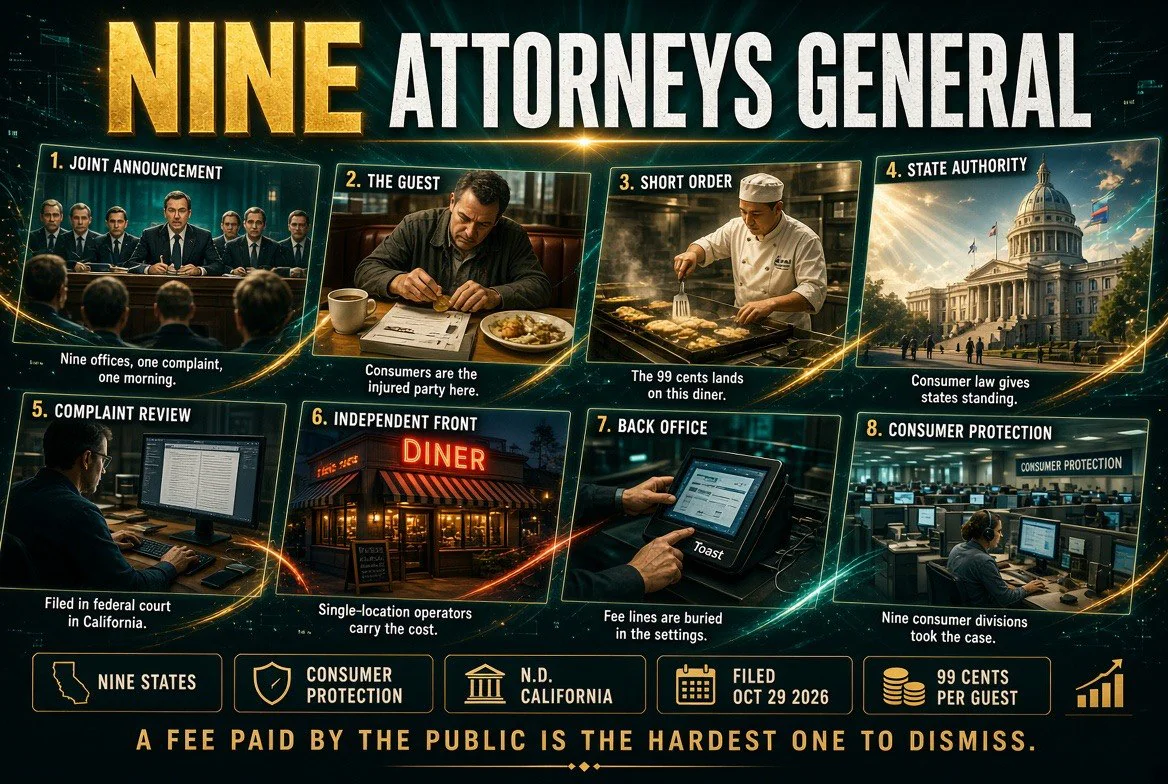
$900 a month.
That is $10,800 a year in restaurant software before you process a single card.
Put that against restaurant economics. An independent full-service restaurant running a healthy three to five percent net margin needs between $216,000 and $360,000 in additional annual revenue to cover a $10,800 software bill — revenue that has to be earned on top of the revenue already funding rent, labor at 28 to 35 percent of sales, food cost, insurance and debt service.
Now add the AI layer, because it is being sold into the same contract structure and arrived in the same two-year window.
Toast’s own AI products are tiered subscriptions on top of the base platform. The marketing agent suite is priced as its own monthly tier. Nothing about that is fraudulent — vendors are entitled to charge for products that work. But it means the operator signing up for an AI assistant in 2026 is stacking a new recurring line item onto a billing relationship that a federal regulator just described, in a court filing, as opaque.
| Cost Line | Monthly | Annual |
|---|---|---|
| Average subscription at issue in the suit | $900 | $10,800 |
| Revenue needed to cover it at 3% net margin | $30,000 | $360,000 |
| Revenue needed to cover it at 5% net margin | $18,000 | $216,000 |
| Diner fee on 3,000 online orders above $10 | $2,970 collected from diners | $35,640 |
| Net margin on a $1.2M restaurant at 4% | $4,000 profit | $48,000 |
Look at the fourth row next to the fifth. A restaurant doing a million two with a solid four percent net margin earns $48,000 in profit a year. The average subscription in this lawsuit is $10,800 — 22.5 percent of every dollar that restaurant keeps. The diner fee on three thousand online orders is $35,640, nearly three-quarters of the profit, collected from the customers who chose to order directly rather than through a third-party app.
That is the arithmetic that turns a fee dispute into an industry problem. The vendor’s revenue does not scale with the restaurant’s margin. It scales with the restaurant’s volume, which means the fee structure is designed to grow in exactly the years the operator is busiest and most able to pay. Which is also exactly when they have the least time to audit a statement.
The 99 Cents Nobody Defends
Here is why the diner fee matters more than the cancellation maze, structurally.
Cancellation complaints are a customer service story. A vendor can fix a cancellation flow in a quarter and call the whole thing a process improvement. Auto-renewal language can be rewritten, add-on authorization can be tightened, hardware terms can be clarified on the invoice. Every one of those allegations is survivable with policy changes and a settlement fund.
The diner fee is different, because it is a revenue line that was collected from people who were not party to the restaurant’s contract.
If the complaint’s characterization holds, the mechanism was straightforward: an online order above $10, a 99-cent charge presented to the diner, and the proceeds retained by the software company rather than passed through to the restaurant whose food was ordered. From the diner’s side, that 99 cents looks like a restaurant fee — which means the restaurant absorbed the reputational cost of a charge it did not receive. From the restaurant’s side, it is an invisible line on a statement most operators never itemize.
That is the bit that should keep a restaurant owner up at night, and it has nothing to do with whether Toast wins the case. It is the realisation that your POS company can bill your customers directly, on your behalf, in a transaction you process, without your signature on that specific charge. Whether it is legal is for a judge. Whether it is acceptable is your call, and it is a call most operators have never been asked to make.
Ask the question now, in writing, to whoever holds your POS contract: does any fee in this agreement get charged to my guests rather than to me, and do I receive it? The answer, either way, tells you what you actually signed.
How This Compares to the Rest of the POS Field
Toast is the case with a complaint number. It is not the only vendor with a stacked pricing model, and pretending otherwise would be dishonest.
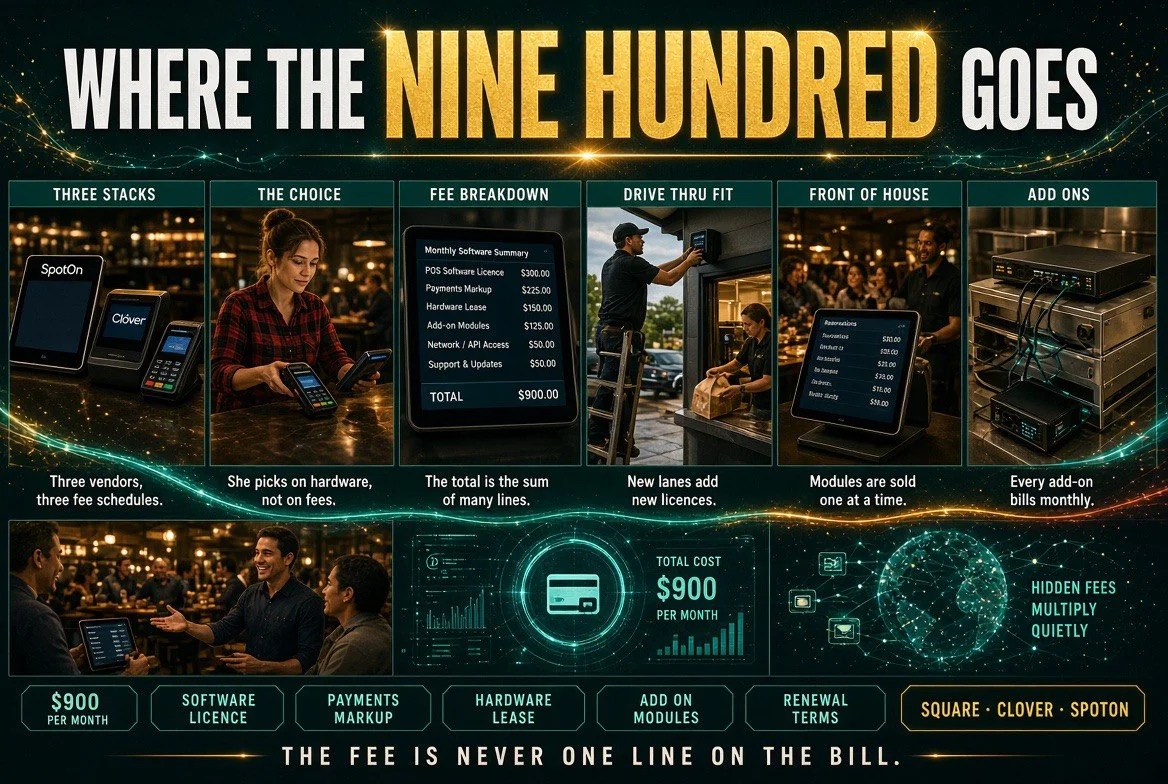
Every major restaurant platform in the United States sells a base subscription, then layers modules on top: marketing tools, loyalty, online ordering, labor scheduling, and now AI. The difference between vendors is not whether they tier — they all tier. The difference is whether the base price you were quoted in the sales conversation is the number that lands on the invoice eight months later, and whether you can leave without paying for the privilege.
That is the test, and it is a test you can apply to
SpotOn,
Olo,
Square,
Clover and
Toast this week, before you sign anything and ideally before your next renewal date.
Three questions determine your exposure:
What is the all-in monthly number, in writing, including every module I will need to operate? Not the base. The stack. Ask the sales representative to put the total in the email, not the base rate in the proposal and the modules in the appendix.
What is the exact termination formula, and what happens to hardware if I leave? The early termination fee in a multi-year agreement is often three to six months of the remaining subscription. Get the formula, not the adjective “reasonable.”
Does any charge in this contract get collected from my guests? This is the new question, and it is the one this lawsuit has made mandatory. Convenience fees, service fees, platform fees, technology fees on a guest’s receipt — find out which ones exist in your agreement and who keeps them.
The operators who ask those three questions before signing will never appear in a complaint like this one. Not because the vendor is nicer to them, but because the answer changes the contract.
What Happens Next, and What It Means for Your Renewal
Nothing happens fast. Litigation against a public company that has publicly committed to a vigorous defense moves on a calendar measured in quarters. The early procedural fights will be about which law governs, not whether the conduct occurred, and the discovery phase will take a year before a single document becomes public.
Which means the practical question for an operator is not “what will the court do.” It is “what do I do at my renewal date, which is coming before any of this resolves.”
Three things are worth doing now, and none of them require a lawyer.
Pull your merchant statement and read every line. Not the summary page — the full itemized statement. Highlight every line that is not the rate you were quoted. Most operators find at least three they cannot explain, and the ones bundled into the platform fee are usually the largest.
Find your contract and read three clauses. The auto-renewal date, the termination formula, and the add-on authorization language. If you cannot find the contract, request a copy in writing this week. A vendor that cannot produce your contract on request is telling you something.
Check your guest receipts. Order from your own online ordering page, above the free-item threshold, and look at what the customer is charged versus what you receive. You will learn more from that one test order than from any sales deck, and it takes four minutes.
And if you are currently evaluating an AI module for your restaurant — a marketing agent, a voice ordering system, a scheduling tool — ask the same three questions about the AI contract that you should have asked about the POS contract, because the AI tier is being sold into the identical structure that produced this lawsuit. Our breakdown of
why 38.6% of restaurants bought AI and only 3.2% trust it explains the gap between purchase and belief, and
NCR’s three-month AI rebuild of Aloha is the clearest example of a legacy POS vendor repricing its own platform layer. For the wider question of what restaurant AI actually costs against what it recovers,
our analysis of the 3% problem is the place to start. Everything we publish on restaurant technology lives in our
restaurant AI category.
Frequently Asked Questions
Which states sued Toast?
Nine state governments joined the action: Colorado, Florida, Illinois, Iowa, Nebraska, Oklahoma, Utah, plus California, which filed through the Los Angeles County Counsel and the San Francisco City Attorney. The complaint was filed with the Federal Trade Commission in the U.S. District Court for the Northern District of California on 29 October 2026.
How much does the average Toast subscription cost?
The complaint describes auto-renewing subscriptions averaging $900 a month, which is $10,800 a year before card processing. For an independent restaurant at a 3 percent net margin, covering that software cost requires roughly $360,000 in additional annual revenue.
What is the 99-cent fee in the lawsuit?
The complaint alleges a 99-cent charge was collected from diners on online orders above $10, with the proceeds retained by the vendor rather than passed to the restaurant. Because it is charged to the guest rather than the operator, it rarely appears as a line item an owner would notice on a statement.
How is Toast defending the case?
Toast said it “strongly disagrees” with the allegations, will “vigorously defend” itself, and called the action “unprecedented.” Its core legal argument is that the federal consumer subscription law the FTC invokes does not apply to contracts negotiated between businesses.
Should I cancel my POS contract over this lawsuit?
No — a pending lawsuit is not proof of wrongdoing and Toast has not been found liable. The useful action is an audit: read your itemized merchant statement, locate the auto-renewal date and termination formula, and confirm whether any fee in your agreement is collected from your guests rather than from you.
Does this affect restaurant AI products?
Indirectly, yes. AI features at restaurant technology vendors are typically sold as additional subscription tiers layered on the base platform, so the same contract structure that the complaint describes as opaque is the structure into which AI modules are now being sold. Operators evaluating an AI module should apply the same three contract questions.
What This Means for Your Restaurant
The temptation is to read this lawsuit as a Toast problem. It is a contract problem, and Toast is the company the regulators happened to reach first.
The fee structure under attack is not exotic. Base subscription, auto-renewal, modular add-ons, early termination penalty, and — the new one — a convenience charge collected at the guest’s expense. Every major platform in the restaurant technology market runs some version of that stack. The reason nine state governments signed one complaint is that they found a company whose version of it generated enough complaints to build a case.
So the honest takeaway is not “leave Toast.” It is that the contract you signed is a financial instrument, and for most operators it is the least examined document in the business. You will spend more time negotiating a produce supplier than you spent on the agreement that lets a vendor bill your customers directly.
Read the statement. Find the contract. Order from your own online page and look at the receipt. Three tasks, under an hour, and they will tell you whether you are holding a software subscription or a structure designed around fees you were never shown.
That is the whole lesson of the filing, and it cost nine state governments a year of investigation to make it public.

About Barak Schurr
Barak Schurr built and exited a major ticketing platform, ran global operations at Eventbrite, and now focuses on one question: which AI tools actually help independent restaurant owners run leaner and grow faster. He writes from the operator’s perspective — no vendor spin, no theory, just what’s real in 2026.
Email:
[email protected]
More Resources for Restaurant Operators