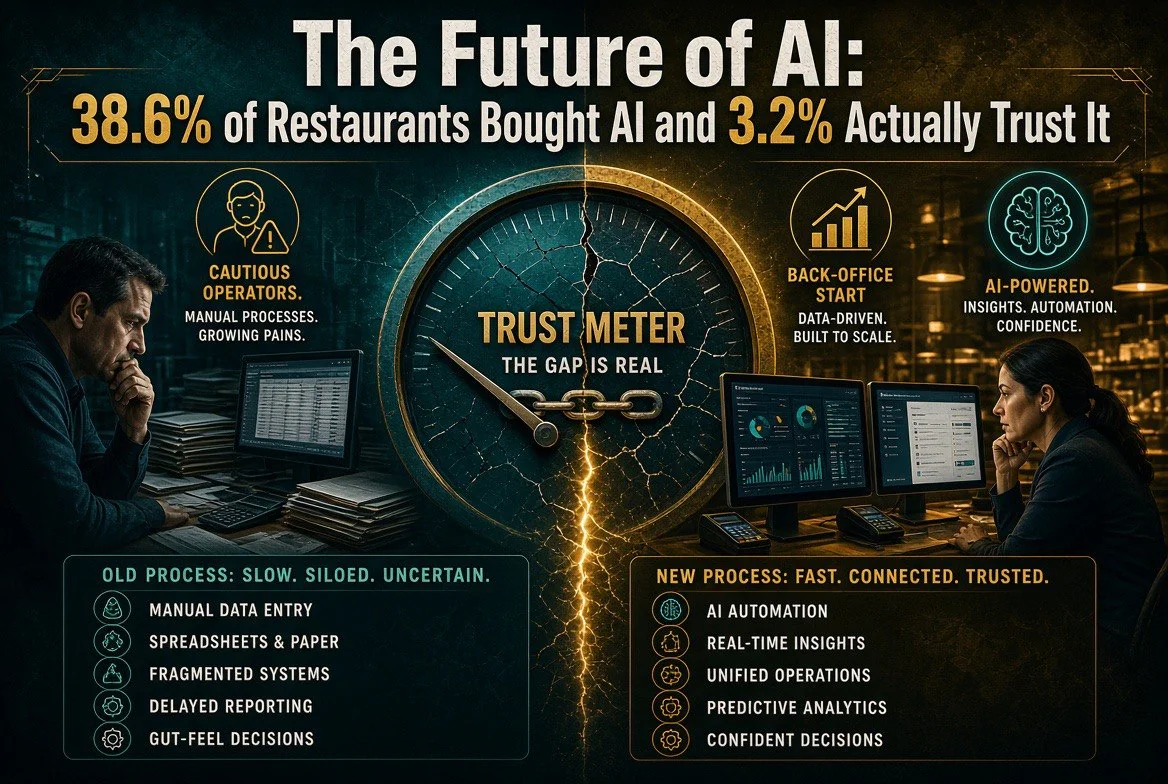
The Future of AI: 38.6% of Restaurants Bought AI and 3.2% Actually Trust It
⚡ Expert Summary: The National Restaurant Association surveyed operators and found 38.6% now use AI somewhere in their business. Only 3.2% run it companywide. And the number that should stop you cold: 42.4% of operators are cautious about it, against 26.2% who are excited. That gap is not a training problem or a budget problem. It is a trust problem, and it is the reason most restaurant AI installs die quietly in month four.
You bought the system. You never trusted it.
That is the story buried inside the National Restaurant Association’s new “Research Insight: Digital Innovation – The Future of Restaurant Technology,” released November 5, 2026. It surveyed 212 operators between June 18 and July 18, 2026, and backed the numbers with eight executive interviews across quick-service and full-service.
The headline stat sounds like progress. 38.6% of restaurants are using AI in some form. Nearly four in ten. That is real adoption.
Then you read the next line. Only 3.2% have it running companywide.
Thirty-eight point six percent bought in. Three point two percent committed. The other 35.4% are running a demo that nobody owns.
The Number That Explains Every Dead AI Install
Here is the breakdown of where that 38.6% actually sits.
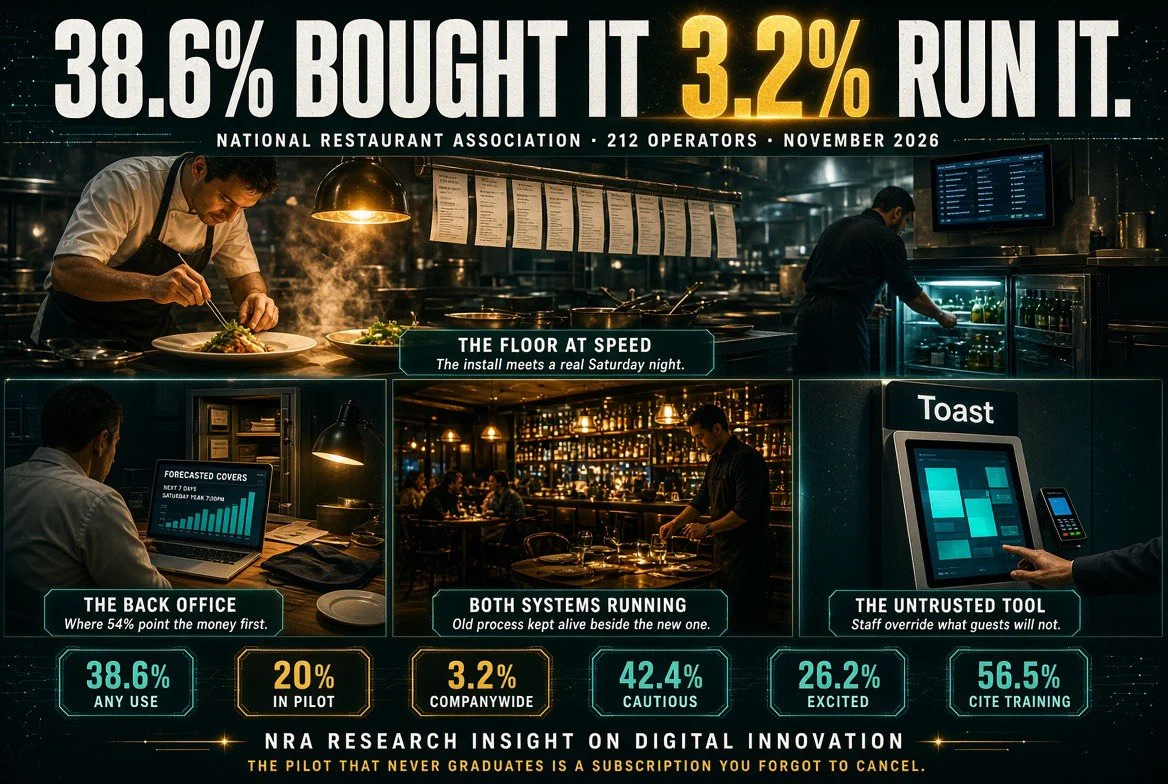
38.6% use AI in some capacity anywhere in the business. 20% are in pilot phase. 3.2% run it companywide.
Do the subtraction. That leaves 15.4% of all operators in an awkward middle ground — live in one place, absent everywhere else. And the 20% in pilots are not a success story either. A pilot that never graduates is a subscription you forgot to cancel.
Now the sentiment numbers, which are the actual diagnosis.
26.2% of operators say they are excited about AI. 42.4% say they are cautious.
Cautious beats excited by more than sixteen points. In a margin business where labour runs 28–35% of revenue, that is not surprising. Operators have been sold a lot of software that promised to fix the floor and instead added a login.
But look at what caution costs you. A cautious operator buys the tool, keeps the old process, and runs both. That is double the work for half the benefit. It is also the exact state 35.4% of the market is sitting in right now.
| Finding | Result | What It Means On Your P&L |
|---|---|---|
| Any AI use | 38.6% | Bought, not deployed |
| In pilot phase | 20% | Paying for something unproven |
| Companywide | 3.2% | Actually getting the return |
| Excited about AI | 26.2% | Will push through the friction |
| Cautious about AI | 42.4% | Will run the old system in parallel and lose |
What Is Actually Stopping You
The Association’s findings on barriers are the most useful part of the report, because they are not abstract. They are things you can price.
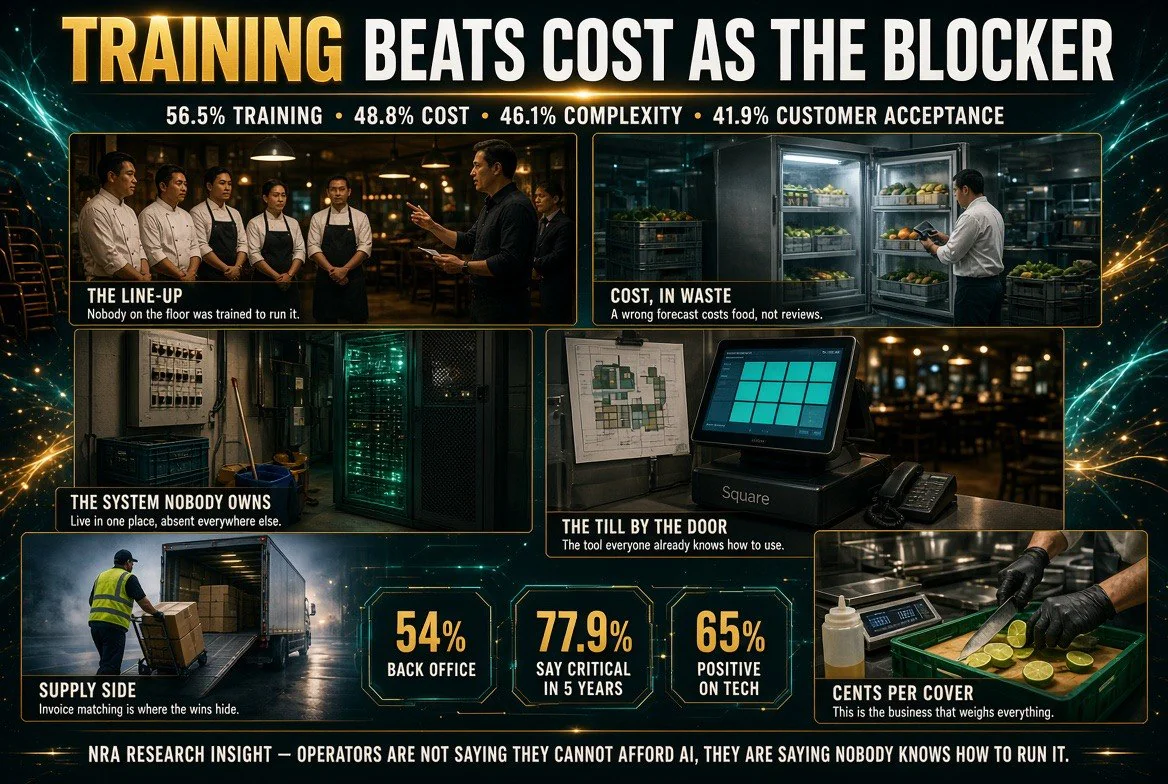
56.5% of operators cite training and education as the obstacle. 48.8% cite cost. And when asked about specific adoption barriers, 46.1% name complexity, 43.5% name cost, and 41.9% name customer acceptance.
Read that list again. Training is the number one barrier, ahead of money.
That is a remarkable finding in a business that measures everything in cents per cover. Operators are not saying they cannot afford AI. They are saying nobody on their team knows how to run it, train it, or fix it when it breaks at 7:40pm on a Saturday.
Which makes sense. Your assistant manager learned your POS in three shifts because the POS is a tool with a keyboard. An AI system that needs clean data, a defined owner, and a feedback loop is a different animal. It needs a process, not just a password.
The 41.9% who cite customer acceptance is the quiet one. It shows up in servers who ignore the tablet, hosts who override the reservation algorithm, and managers who keep taking phone orders by hand because they do not trust the voice agent to get a modification right. If your staff believe the system will embarrass them in front of a guest, they will quietly disable it. And nothing in your dashboard will tell you.
Where Operators Are Actually Pointing It
The report has a clear answer on where the money is going, and it is not the floor.
54% of operators name back-office functions as their primary AI front.
That is the correct read of the risk. Back-office does not touch the guest. A forecasting model that misjudges Thursday’s covers by 8% costs you prep waste, not a table. An invoice-matching tool that misses a line item costs you a phone call to a supplier, not a one-star review.
Operators are putting AI where a mistake is survivable. That is rational, and it is also why the pilot number is 20% and the companywide number is 3.2% — back-office wins are invisible. Nobody posts a photo of a saved food-cost percentage. So the tool never earns internal champions, and it never expands.
And the confidence is there, even if the adoption is not. 77.9% of operators say technology and AI will be at least moderately critical to their business in five years. 65% say technology has had a positive effect on hospitality overall.
They believe it. They are just not deploying it. That is not skepticism about the technology. It is skepticism about the implementation, and the report puts a number on it.
| Factor | The Cautious Operator (42.4%) | The Committed Operator (3.2%) |
|---|---|---|
| Rollout scope | One tool, one location, no owner | Companywide, one system, named owner |
| Staff position | Still running the old process in parallel | Old process retired on a set date |
| Training | A login and a PDF | Shift-level training, repeated at every hire |
| Where it runs | Scattered, usually front of house | Back office first, then floor |
| Measurement | Nobody checks the numbers | Same metric, reviewed weekly |
| Result after 12 months | Subscription paid, behaviour unchanged | Cost line moved or the tool is cancelled |
Why 42.4% Is Right to Be Cautious
Before you read the rest of this as a pitch to buy more software, hear the counter-argument, because the cautious majority has a legitimate case.
Restaurant AI has a bad track record in the field. Voice agents that mishear a modification and cost you a remake. Forecasting tools trained on somebody else’s market. Inventory systems that need a manager to do data entry for an hour a night, which means the data is wrong by week three.
The Association’s own numbers support the caution. If training and education is the top barrier at 56.5%, that means vendors are shipping tools with no adoption path. The buyer gets a dashboard and a monthly invoice. The seller gets a logo on a website.
So no, the 42.4% are not backwards. They are pattern-matching. They have been burned, or they have watched a competitor get burned and learned cheaper.
The problem is that caution and inaction look identical on a P&L. Both leave you paying 28–35% of revenue in labour while your competitor finds a way to run the same covers with two fewer people on the schedule.
What Actually Moves You From 38.6% to 3.2%
The gap between “using AI” and “running AI” is a management gap, not a technology gap. Five things separate the two groups, and none of them require a new vendor.
1. Name one owner. Not a committee. One person — usually your GM or your controller — who is accountable for the tool’s number. If two people own it, nobody does. The 35.4% in limbo almost always fail this test first.
2. Pick one number before you buy. Food cost percentage. Labour hours per cover. Ticket time on a Friday. No-show rate. One number, written on the invoice, reviewed weekly. If the tool cannot move that number, cancel it inside 90 days and stop paying for opinions.
3. Retire the old process on a date. This is where cautious operators lose. If the handwritten prep sheet still exists, the AI forecast is decoration. Set the date, take the clipboard away, and accept one bad week as the tuition fee.
4. Train at the shift, not the launch. The 56.5% training barrier is not solved by an onboarding session in month one. It is solved by a two-minute check at the start of every shift and the same training at every new hire. Turnover in this industry is relentless. Your training has to survive it.
5. Start back office, then earn the floor. The 54% of operators aiming at back-office are right. Prove the system on invoices, forecasting and scheduling first, where a mistake costs money and not a guest. Then take it to the floor with a track record behind you and staff who already trust the numbers.
That is the entire distance between 38.6% and 3.2%. Not better models. A named owner, one metric, a retirement date, shift-level training, and a back-office beachhead.
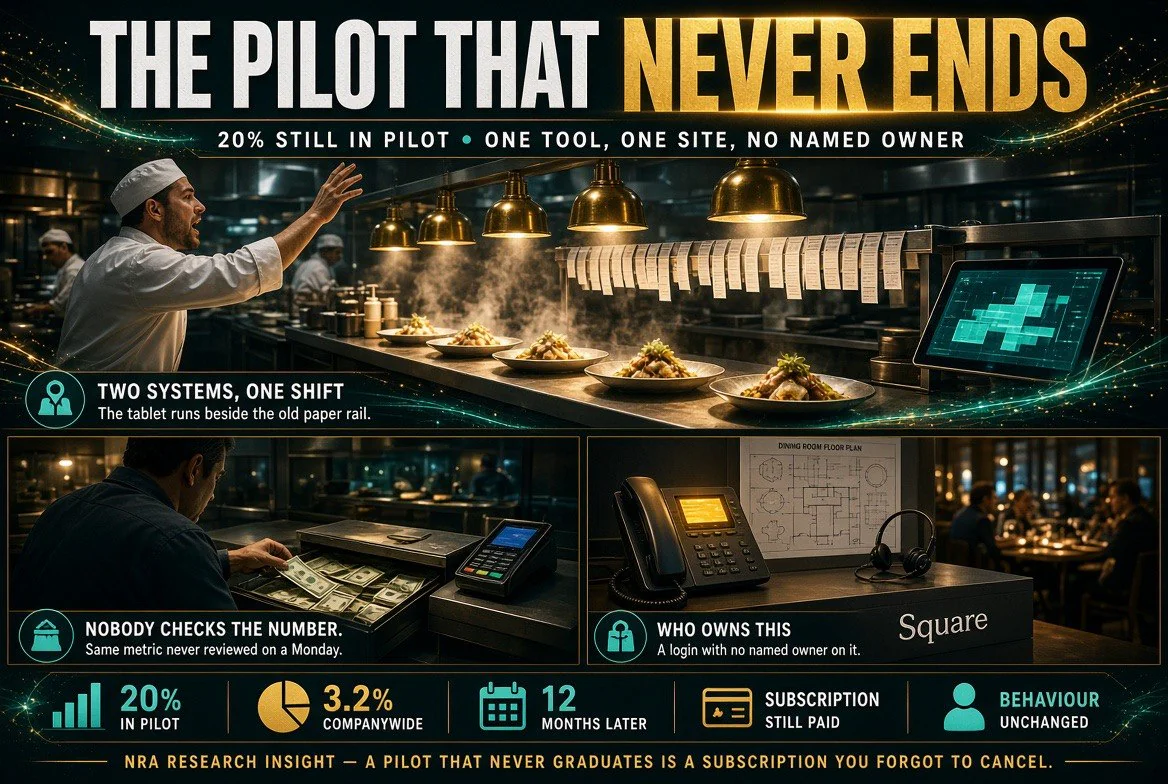
The Pilot That Never Ends
Twenty percent of operators are in pilot phase. That sounds like a healthy pipeline. It is more often a trap, and it has a shape you will recognise.
Month one: the vendor sets it up, your team is curious, and the dashboard shows something interesting. Month two: a busy stretch hits, everyone reverts to the old process because it is faster under pressure, and the tool keeps collecting data nobody reads. Month three: the invoice arrives, nobody can name the person who owns it, and it quietly becomes a line item.
By month six you are paying for a pilot that has no end date and no verdict. That is how 20% of the market sits in permanent testing while 3.2% takes the actual money.
The fix is a deadline, decided before the pilot starts. Ninety days, one metric, one owner, and a written answer at the end: roll it out, or cancel it. The answer is allowed to be cancel. A killed pilot is a cheap result. An eternal pilot is the expensive one, because you pay the subscription and the parallel process both.
What the Training Number Is Really Telling You
56.5% cite training and education as the barrier. Read it as a hiring problem and it changes everything.
Restaurant turnover means the person who was trained on your AI tool in March is working somewhere else by August. Whatever knowledge lived in that person’s head left with them. If your training was a single onboarding session, the tool’s competence walked out with the same person.
That is why the operators who close the gap do two things no vendor will do for them. They build the training into the shift — a two-minute check at the start of service, run by the shift lead, every day — and they attach it to every new hire without exception. The tool does not become a specialist skill. It becomes part of opening the restaurant, like turning on the lights.
Compare that to a launch-day session with a vendor rep and a laminated card that ends up in a drawer. Same software. Different outcome. The 56.5% is not a knowledge gap in the market. It is a retention gap in your own four walls.
The Five-Year Number Is the One to Watch
77.9% of operators say technology and AI will be at least moderately critical to their business in five years. 65% say technology has already had a positive effect on hospitality.
Those two numbers together tell you the market has already decided. The question is not whether restaurants will run AI. It is which operators will be running it when the labour market tightens again, and which will be reading about it.
Right now, on the Association’s own data, that is 3.2% versus everyone else.
The 38.6% bought the ticket. The 3.2% took the ride. And the 42.4% who are cautious are paying the subscription anyway — just without the return.
If you are in that cautious group, you are not wrong to be. You are just late to the part that matters, which is not the buying. It is the retiring of the old way of working.
Frequently Asked Questions
How many restaurants actually use AI in 2026?
38.6% of operators surveyed by the National Restaurant Association use AI in some capacity. Only 3.2% run it companywide, and 20% are still in pilot phase.
Why are so many restaurant operators cautious about AI?
42.4% say they are cautious versus 26.2% who are excited. The top barrier is training and education at 56.5%, followed by cost at 48.8%. Operators are more worried about implementation than about the technology itself.
Where should a restaurant start with AI?
Back office. 54% of operators name back-office functions as their primary AI front, which makes sense because mistakes there cost money rather than a guest experience. Forecasting, invoicing and scheduling are the safest first targets.
What is the biggest barrier to restaurant AI adoption?
Training and education, cited by 56.5% of operators. Complexity follows at 46.1%, cost at 43.5% and customer acceptance at 41.9%. Money is not the number one problem.
How big was the National Restaurant Association survey?
It surveyed 212 operators, fielded between June 18 and July 18, 2026, using a mixed sample and eight executive interviews across quick-service and full-service restaurants. It was released November 5, 2026.
Does customer acceptance really block restaurant AI?
41.9% of operators name customer acceptance as an adoption barrier. In practice this shows up as staff overriding the system in front of guests, which quietly disables the tool without any error appearing in a dashboard.

About Barak Schurr
Barak Schurr built and exited a major ticketing platform, ran global operations at Eventbrite, and now focuses on one question: which AI tools actually help independent restaurant owners run leaner and grow faster. He writes from the operator’s perspective — no vendor spin, no theory, just what’s real in 2026.
Email: [email protected]
More Resources for Restaurant Operators