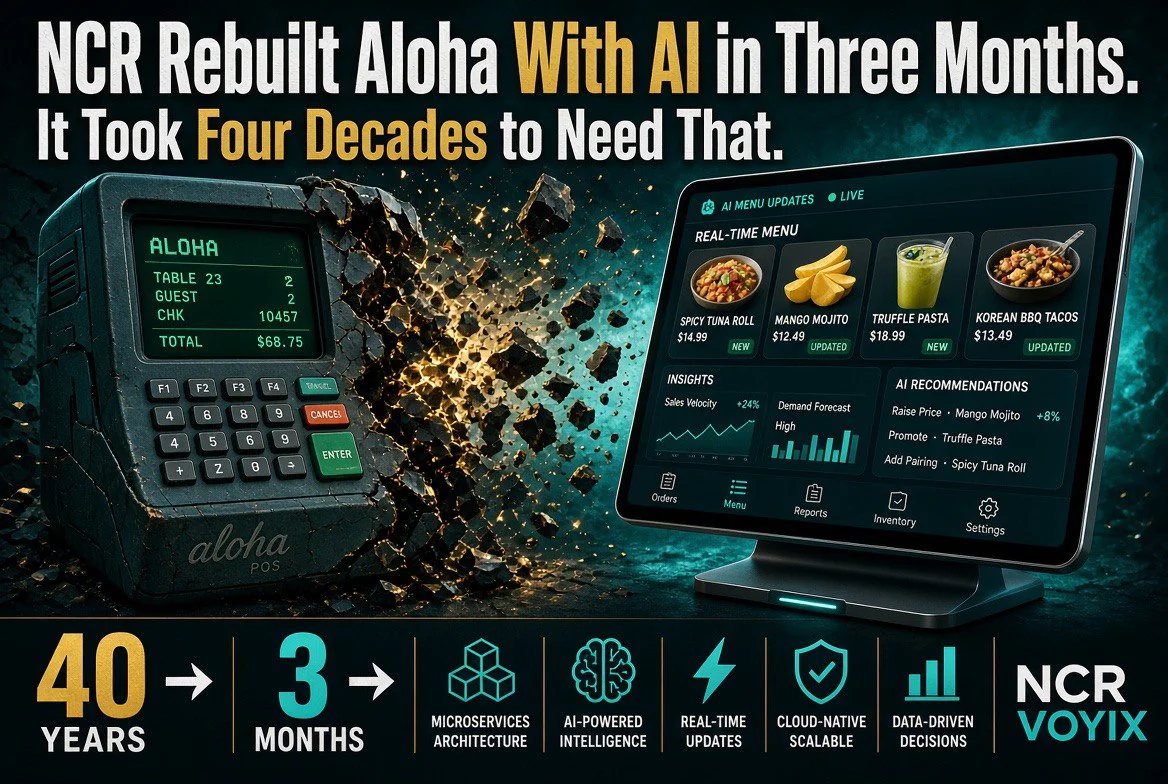
NCR Rebuilt Aloha With AI in Three Months. It Took Four Decades to Need That.
⚡ Expert Summary: NCR Voyix rebuilt its entire restaurant software library — some of it forty years old — in under three months using AI coding tools, and the first live Aloha Next install is running at a single Bruster’s ice cream shop in Bridgewater, Pennsylvania. Chipotle and First Watch have signed on. The uncomfortable detail for independent operators is that the same inflexibility NCR is now selling against costs you up to nine months of waiting for a menu change — and whether the fix reaches your store depends entirely on whether a chain negotiates it first.
Jim Kelly has a car metaphor and he is not letting go of it. “It was like driving a 1980s or ’90s car,” NCR Voyix’s CEO said of his own company’s restaurant software. “It’s not what you would expect in 2026.”
He is describing the system that processes orders at American restaurant counters — Aloha, the point-of-sale software that began life at National Cash Register in 1884 and has been the quiet backbone of the industry’s transaction layer for decades. Some of the applications in NCR Voyix’s library are forty years old. And the honest admission buried in the middle of the story is the one nobody in the vendor world says on the record: making a change to that software could take nine months for a large chain. For a receipt font. For a menu edit.
That is the part independent operators already know in their bones, and it is the part that matters more than the architecture diagram.
What Aloha Next Actually Is
NCR Voyix calls it Aloha Next, and the technical claim is straightforward: the system has been moved from a monolithic architecture — one self-contained block of code where everything touches everything — onto microservices, where separate independent services talk to each other and can be updated independently.
The practical difference is measured in time. Under the old model, Kelly said, a large chain could wait nine months or more for a software change. Under microservices, an update can ship in as little as a day without disrupting the rest of the system. His example is deliberately mundane: change the font size on a receipt while the register is still processing orders and taking payments.
The mundane example is the right one, because that is where restaurant technology actually hurts. Nobody opens a restaurant because they want to wait three quarters for a tax line to appear on a receipt. But that is the shape of the problem across the industry, and it has been the shape of it for a very long time.
What microservices unlocks — and what NCR Voyix is explicitly selling — is the AI layer. Kelly said Next makes it possible for restaurants to use cameras to monitor supply levels and update menus and prices in real time. Those capabilities need a system that can respond to a model’s output without a nine-month change request, which an aging monolith structurally cannot do.
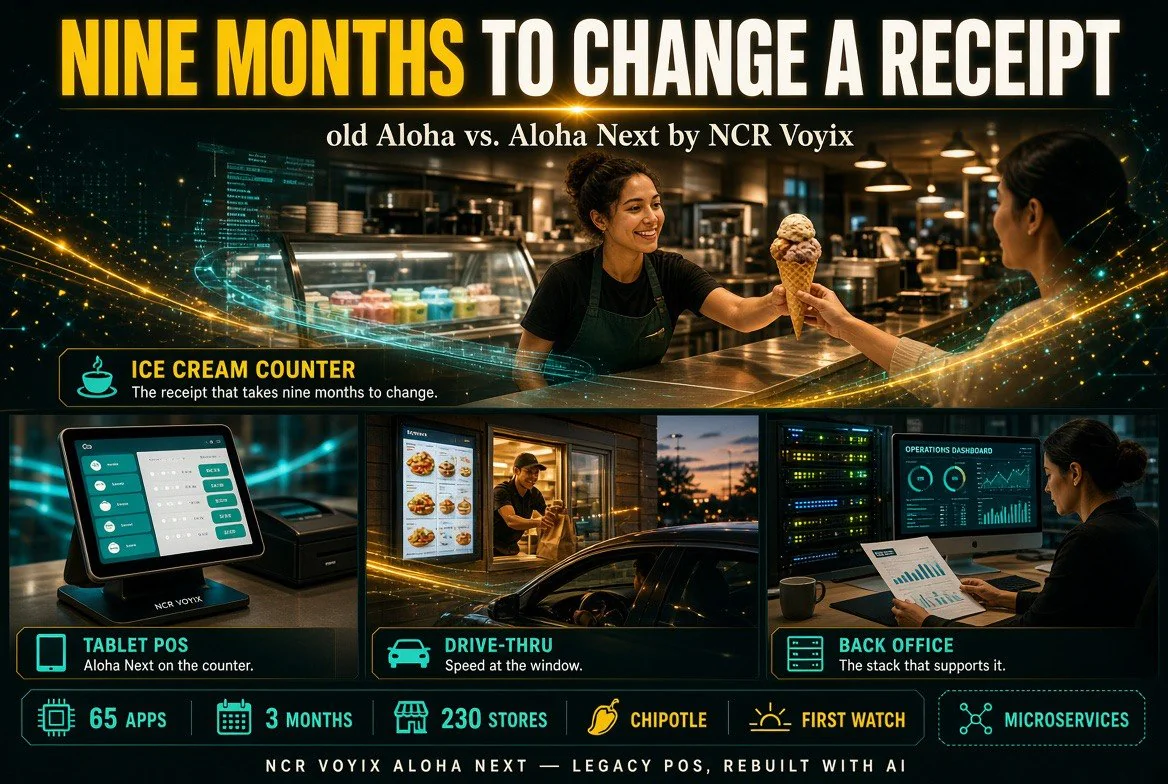
Bruster’s Real Ice Cream in Bridgewater, Pennsylvania is the first live Aloha Next install — a proof of concept before a pilot, before 230 stores by the end of next year.
The Three-Month Number Is the Story
Here is the detail that should stop anyone who has ever tried to modernize a legacy codebase.
NCR Voyix had been working for several years on moving its software to microservices, and it was not going well. “Getting from old to new was still a very manual effort that we just weren’t doing very well,” Kelly said. “The speed of which the market wanted new, from 2024 and into early ’25, we were not able to keep up.”
Then, after some nudging from its board, the company put AI coding tools on the job. Combined with the knowledge of its longest-tenured employees, NCR Voyix modernized its entire app library — roughly 65 applications, including Aloha — in under three months.
Read that again against the nine-month figure for a single change under the old system. The company that could not ship a receipt tweak inside a year rebuilt its entire portfolio in a quarter, because it finally had a tool that could read and rewrite its own forty-year-old code.
That is the actual headline in this story, and it is not really about restaurants. It is about a generation of vertical software — the unglamorous systems running restaurant counters, dental offices, auto shops, and independent grocers — that has been quietly calcifying for decades because rewriting it by hand was economically impossible. AI coding tools just changed that arithmetic for everyone at once.
Where It Is Actually Running
The first live Aloha Next install is not at a chain. It is at a single Bruster’s Real Ice Cream location in Bridgewater, Pennsylvania — a proof of concept, ahead of a pilot, ahead of a rollout across all 230 Bruster’s stores by the end of next year.
Sean Krings, Bruster’s senior vice president of operations and IT, described the old system’s failure mode in language any operator will recognize. “We got to the point where we’re thinking, this is getting more complicated than it is efficient,” he said. The chain had been using Aloha since 2016 and was actively exploring other options when NCR Voyix presented Next.
Two details from Bruster’s matter more than the vendor press release does. First, the price of Next will be comparable to the old system, and because it is not tied to specific hardware, Bruster’s avoids a hardware refresh — the capital expense that usually kills a POS migration before it starts. Second, when Bruster’s brought Next to its franchisee council, the operators pushed the brand to move faster rather than slower.
That second one is worth sitting with. Franchisees are the most reliably technology-averse constituency in the restaurant business, and they are the ones asking for the upgrade. When that flips, it usually means the old system’s cost has finally exceeded the new system’s risk.
The Chain-First Pattern, and Why It Should Bother You
Look at the deployment list. Bruster’s — 230 stores. Chipotle. First Watch, which signed a multi-year agreement in late October to put Aloha Next across nearly 600 restaurants. Sbarro, nearly 300 US locations.
Every named deployment is a multi-unit operation with procurement leverage. That is not a coincidence and it is not villainy — it is how enterprise software has always rolled out. But it produces a specific, predictable outcome for the independent operator running one or two locations: you get the new platform last, at list price, after the chains have absorbed the migration risk and negotiated the terms.
The old Aloha, meanwhile, does not stop working. It just stops improving. That is the quiet trap in every legacy platform migration: the vendor’s engineering attention moves to the new product, the old one receives security patches and nothing else, and the operator who cannot justify a migration in this fiscal year quietly falls a decade behind the operators who could.
| Factor | Legacy Aloha (Monolithic) | Aloha Next (Microservices) |
|---|---|---|
| Time to ship a change | Up to nine months or more for a large chain | As little as one day, without disrupting the rest of the system |
| Hardware dependency | Tied to specific terminals; refresh is a capital event | Not tied to specific hardware; broader payment options including drive-thru line |
| AI and camera features | Structurally blocked — no way to update in real time | Camera-based supply monitoring, real-time menu and price updates |
| Staff retraining | Baseline workflow already known | Front end described as virtually the same as the old system |
| Pricing | Existing contract | Comparable to the old system, per Bruster’s, plus no hardware change |
| Access for a single-unit operator | Still supported, still running, no longer improving | Announced to chains first; independent availability not yet published |
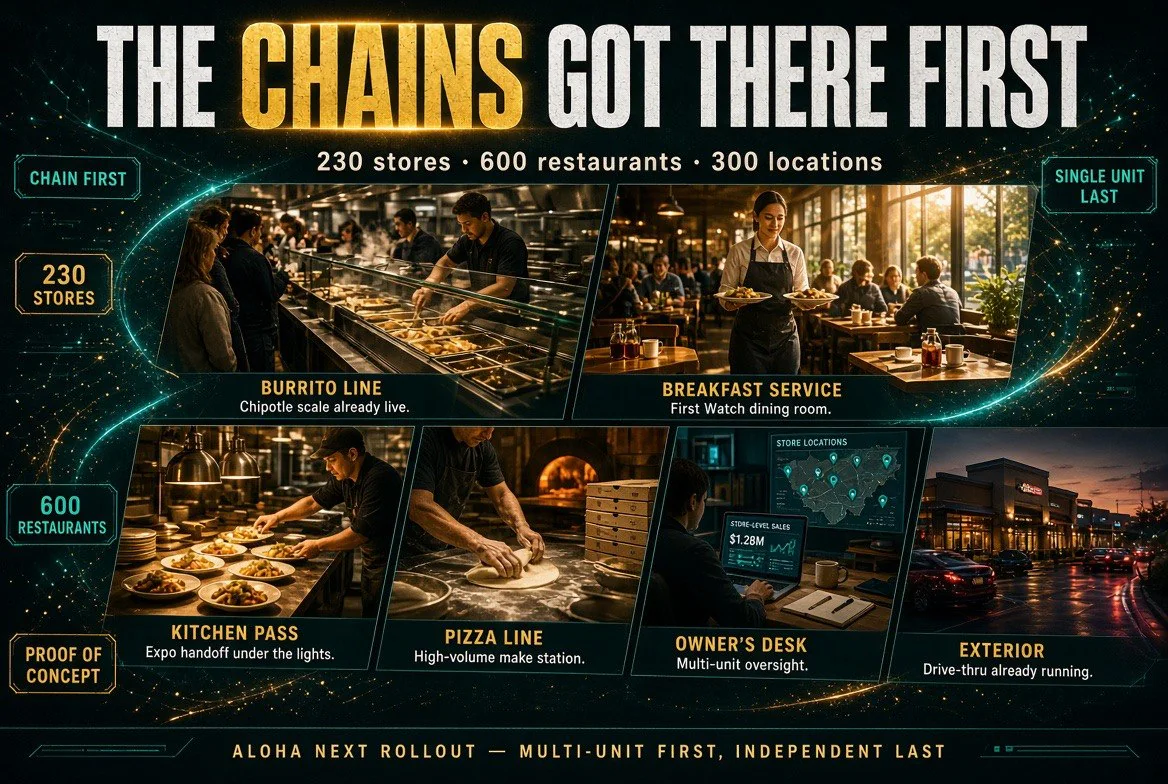
Bruster’s, Chipotle, First Watch and Sbarro are all on the announced rollout — every named deployment so far is a multi-unit brand with procurement leverage, which is exactly how enterprise restaurant software has always shipped.
What the Vendor Gets Out of It
NCR Voyix is not doing this out of sentiment about ice cream. The company split from NCR Corp. two years ago — the restaurant-and-retail side became NCR Voyix, the ATM business became NCR Atleos — and in the process it shifted its identity from a hardware company to a software company. Its stock has fallen 69% over five years, and a software company with forty-year-old code is not a software company anyone wants to own.
Kelly is meeting with a different customer almost every day of the week through the end of the year to talk about Next. He described the reaction when early versions were demoed: disbelief. “Where did this come from?” he recalled people asking. “We’ve been watching you peddle the same old stuff for years and years and years.”
That is a competitor-grade insult delivered by a customer to a CEO who is repeating it on the record, which tells you exactly how low the bar had gotten. The transformation is real, but the reason it lands as a surprise is that the industry had stopped expecting anything.
The Part Where Operators Should Ask Better Questions
Aloha Next solves a real problem. It also arrives with the standard vendor migration playbook attached, and every operator who has lived through a POS migration knows how the third act usually goes.
Ask what “comparable pricing” means at contract renewal in year three, not year one. Ask who owns the data the cameras collect — supply levels and menu performance are operational intelligence, and the standard NCR Voyix educational agreement already bans using covered data for training, but a restaurant contract is a different document entirely. Ask whether the AI-driven pricing capability creates a system where the vendor can suggest prices alongside the vendor processing the transaction, and who sees those suggestions.
And ask the migration question directly: what happens to my current Aloha install, my current data, and my current integrations on the day the roadmap officially moves to Next? Bruster’s negotiated that answer before signing. A single-location operator negotiating alone usually does not.
| Migration Question | What the Announced Deals Show | What an Independent Should Demand in Writing |
|---|---|---|
| Timeline | Bruster’s runs a single proof-of-concept store, then a pilot, then 230 stores by end of next year | A dated, per-store conversion schedule — not a program announcement |
| Cost exposure | Comparable pricing plus no hardware refresh at Bruster’s | Term of the pricing guarantee and the renewal escalator, in numbers |
| Operational continuity | Front end described as virtually identical to reduce disruption | A documented rollback path if a service conversion disrupts a Friday night |
| Data rights | Camera and menu data enable AI features; ownership not publicly addressed | Explicit clause on who owns transaction and operational data, and where it goes |
| Legacy support | Old Aloha continues to run for existing customers | Published end-of-support date for the platform you are on today |
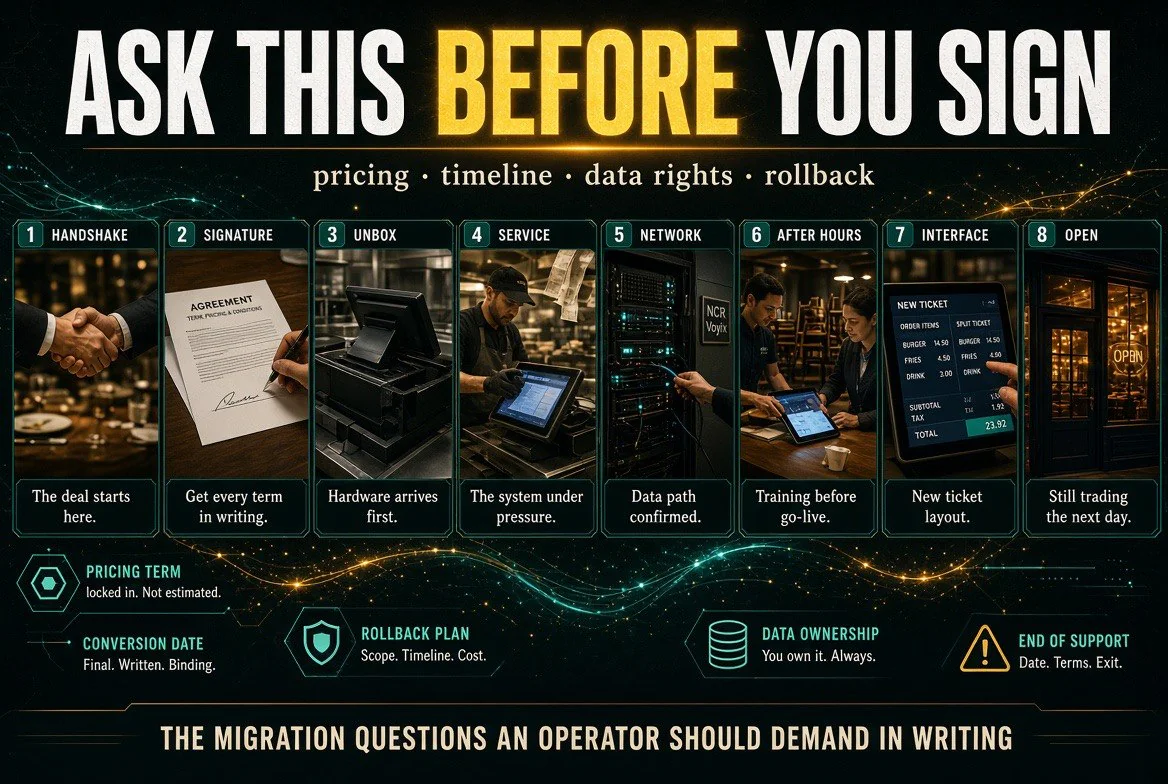
Bruster’s negotiated pricing and hardware terms before signing. A single-location operator negotiating alone usually does not — which is why the terms need to be in the contract, not in the sales deck.
The Honest Counter-Argument
The case against getting worked up about this is decent. NCR Voyix did not raise prices on Bruster’s, did not force a hardware refresh, and reportedly kept the interface familiar enough that staff workflows barely change. Compared with the average restaurant tech migration, this is close to a best-case scenario.
The vendor also has a legitimate defense on the AI question. Camera-based supply monitoring and real-time menu pricing are not price-gouging mechanisms by definition; they are the same capabilities that let an operator stop 86-ing items mid-service because nobody told the kitchen. A system that can see the walk-in is fuller than the forecast is a system that can send a smarter order.
And the nine-month figure is described from the perspective of large chains. A single-location restaurant with a simple menu was never waiting nine months to change a receipt font; it was waiting on a support ticket. The pain scale is not the same.
All of that is true, and none of it changes the structural point: the platform that processes the majority of American restaurant transactions just announced which customers it built the future for, and it listed them by store count.
What This Means for the Operator Reading It
Three practical moves, none of them urgent enough to be panic and none of them optional.
First, find out where you are in NCR Voyix’s queue. Not whether Aloha Next exists — whether your specific store is on a conversion schedule, and whether your rep will put that schedule in writing. If the answer is a roadmap slide, you have your answer.
Second, price the migration now, on your timeline, not during a hardware failure. The operator who converts because a terminal died on a Saturday night negotiates from the worst possible position. The operator who converts in a quiet January negotiates from the best one.
Third, if you run a second POS or a set of delivery integrations, ask the microservices question in your own language: can this system accept a new integration without nine months of professional services? That single capability is what separates a platform that will grow with your restaurant from one that will need replacing again in five years.
Why This One Matters Beyond the POS Aisle
Strip the restaurant details out and this is a story about how legacy software gets rescued in 2026. A company with roughly 65 applications, some written before the people using them were born, rebuilt the whole portfolio in a quarter — not by hiring an army of engineers, but by pointing AI coding tools at its own codebase while keeping the people who understood the old system in the room.
That combination is the part worth remembering. The AI tools did the volume. The longest-tenured employees provided the judgment about what the code was supposed to do. Neither would have worked alone: the tools without the veterans produce a fast, confident rewrite of the wrong thing, and the veterans without the tools produce what NCR Voyix had for several years — a modernization project that could not keep up with the market.
Every independent restaurant runs on software built by someone else, somewhere else, often a long time ago. The good news in this story is that the rewriting of that software is now economically possible. The uncomfortable news is that the first wave of it goes to the customers with the most leverage, and the rest of the market inherits the second wave.
Kelly’s car metaphor is the tell. Nobody is nostalgic for a 1990s car once they have driven something with a working radio and a camera. The question for an operator is only whether they get the keys this year or watch the chains drive past.
Frequently Asked Questions
What is Aloha Next?
It is NCR Voyix’s next-generation restaurant point-of-sale platform, rebuilt from the original Aloha monolith onto a microservices architecture. It was launched for the first time in the wild at a single Bruster’s Real Ice Cream location in Bridgewater, Pennsylvania, and is being deployed to chains including Chipotle and First Watch.
How much faster is Aloha Next than legacy Aloha?
NCR Voyix CEO Jim Kelly said changes to the old software could take nine months or more for a large chain, while the microservices architecture allows updates in as little as a day without disrupting the rest of the system.
Did NCR Voyix use AI to rebuild its own software?
Yes. After several years of stalled modernization, NCR Voyix applied AI coding tools, combined with the expertise of its longest-tenured employees, and modernized its entire library of roughly 65 applications in under three months, according to Kelly.
Does Aloha Next cost more than the current Aloha?
Bruster’s SVP Sean Krings said pricing for Aloha Next will be comparable to the old system, and that the chain will save money by not having to change hardware because Next is not tied to specific terminals.
Can independent restaurants get Aloha Next?
NCR Voyix has announced deployments with multi-unit brands first, including Bruster’s, Chipotle, First Watch, and Sbarro. A published conversion timeline for single-location operators has not been announced, so operators should ask their account representative for a written schedule rather than assume availability.
Will my current Aloha system stop working?
NCR Voyix has indicated existing Aloha customers continue to run the current platform. The question for operators is the end-of-support date on that platform and how engineering attention shifts to the new product, which is the standard pattern in any legacy software migration.

About Barak Schurr
Barak Schurr built and exited a major ticketing platform, ran global operations at Eventbrite, and now focuses on one question: which AI tools actually help independent restaurant owners run leaner and grow faster. He writes from the operator’s perspective — no vendor spin, no theory, just what’s real in 2026.
Email: [email protected]
More Resources for Restaurant Operators