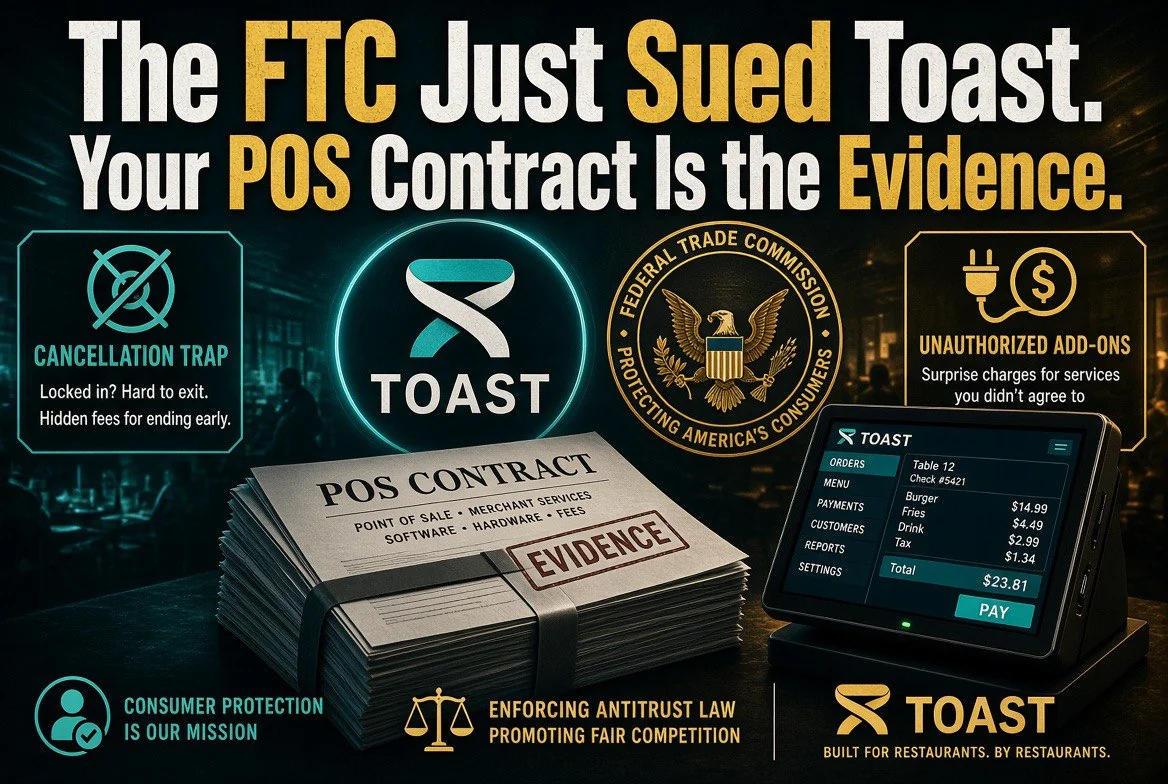
The FTC Just Sued Toast. Your POS Contract Is the Evidence.
⚡ Expert Summary: On October 29, 2026, the Federal Trade Commission and eight states sued Toast in the U.S. District Court for the Northern District of California, alleging hidden fees, unauthorized add-ons, a cancellation process designed to trap operators, and a 99-cent consumer fee Toast kept for itself on online orders above $10. The lawsuit says restaurants are enrolled in auto-renewing subscriptions averaging $900 a month. Toast says it will “vigorously defend” itself and argues the law the FTC used does not apply to negotiated business contracts. For independent operators, the practical lesson is not about Toast specifically — it is that the fee schedule buried in your POS agreement is now the thing regulators are reading.
Every independent restaurant owner has signed a POS contract they did not fully read. They signed it on a Tuesday, between shifts, because the reps were nice, the hardware looked clean, and the sales pitch promised free terminals and support at any hour.
On October 29, 2026, the Federal Trade Commission and eight state plaintiffs filed a lawsuit that reads like a description of that Tuesday. The complaint against Toast alleges hidden fees, unauthorized charges, add-ons nobody consented to, a cancellation maze, and a 99-cent fee collected from diners that Toast kept for itself while operators took the blame. Toast says the allegations are wrong and that it will fight them.
This is not a story about one bad vendor. It is a story about the entire restaurant software stack — the POS, the payment processor, the payroll module, the add-on marketing suite, the loyalty program — being sold as a bundle of subscriptions nobody can untangle, and about what happens when a federal agency decides to read the fine print for you.
What the FTC and the States Actually Allege
The complaint, filed in U.S. District Court for the Northern District of California, was brought by the FTC alongside the People of the State of California through the Los Angeles County Counsel and the San Francisco City Attorney, and the attorneys general of Colorado, Florida, Illinois, Iowa, Nebraska, Oklahoma and Utah. Eight states, two cities, one agency.
The core allegations, in plain operator language:
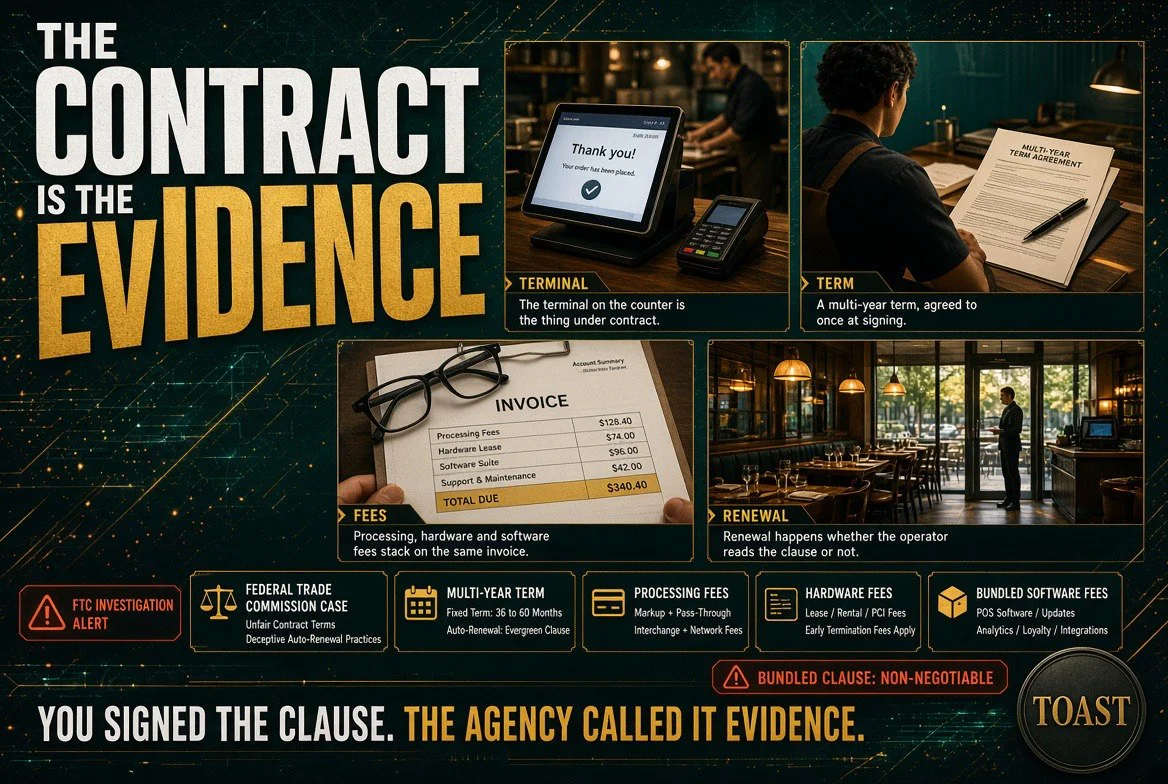
Auto-renewing subscriptions that operators cannot easily exit. The lawsuit says restaurant agreements require enrollment in auto-renewing subscriptions averaging $900 per month, with the price set by how many terminals and add-on services a business bundles in.
Add-ons charged without consent. The complaint says Toast customers frequently complain they were enrolled in and billed for subscription add-ons they never agreed to.
A cancellation process built to wear you down. The filing describes the cancellation path as “nonintuitive, time-consuming, far from simple, and requires the involvement and cooperation of multiple teams within Toast” — and says that when operators do get out, many are hit with “unexpected high-dollar early termination fees” or continued charges.
Free hardware that was never free. Toast marketed products at $0 under certain pricing plans and promised “24/7/365” support. The plaintiffs state flatly: “In fact, none of Toast’s hardware is $0, and Toast customers frequently claim that they cannot get customer support at any hour of the day.”
A 99-cent fee that came out of your customer’s pocket. Until July 2023, Toast collected a 99-cent fee from diners ordering online on orders above $10 — beyond the fees it already charged the restaurant. The fee was tested in some markets from September 2021. The plaintiffs allege Toast never made clear that Toast, not the local restaurant, kept the money.
The FTC’s Bureau of Consumer Protection director, Christopher Mufarrige, framed the case in terms that will sound familiar to anyone who has audited their own merchant statement: “Toast failed to honor a number of its promises and instead imposed hidden fees, unauthorized charges and subscription traps that drained the hard-earned profits of businesses just trying to serve their customers.”
Toast’s Defense, and Why the Legal Question Matters to You
Toast did not roll over. In a statement issued the same day, the company said it “strongly disagrees” with the allegations and will “vigorously defend” itself, calling the action “unprecedented.”
The company’s technical defense is narrow and worth understanding, because it is the same defense every restaurant software vendor would raise: the FTC brought the case partly under the Restore Online Shoppers’ Confidence Act, the 2010 federal law governing auto-renewing subscriptions. Toast argues that no court has applied ROSCA to negotiated business-to-business agreements, and that the law does not apply here.
Toast also says the FTC “disregarded the information we provided showing the extent to which our restaurant customers negotiate their contracts,” and that the company has been cooperating with the investigation since mid-2025 while trying to reach a resolution short of litigation.
Strip the lawyering and there is a real question underneath: does a restaurant owner who negotiates a contract count as a consumer, or as a business that should have known what it signed? That question has nothing to do with AI and everything to do with who bears the risk in a restaurant technology deal. If courts accept Toast’s reading, business-to-business subscription software stays largely outside consumer protection law — which means the contract is the only protection an operator has.
| Allegation | What the FTC Says Happened | What You Should Check in Your Own Contract |
|---|---|---|
| Hidden fees | Charges beyond the quoted subscription rate that operators did not expect | Every line on your merchant statement that is not the headline rate — PCI fees, batch fees, statement fees, minimums |
| Unauthorized add-ons | Enrollment and billing for subscription add-ons without consent | Which add-ons are opt-out versus opt-in, and who on your staff can authorize a new one |
| Free hardware | Terminals marketed at $0 under certain plans were not actually $0 | Whether the hardware cost is recovered through a higher processing rate or a term commitment |
| 24/7 support | Customers claim they cannot reach support at any hour | Whether support hours and response times are written into the agreement or just promised verbally |
| Cancellation barriers | A multi-step process requiring multiple internal teams to complete | The exact cancellation clause: notice period, method, and whether it must be in writing |
| Early termination fees | High-dollar exit charges and continued billing after cancellation | The termination formula and whether it is a flat fee or the remaining contract value |
| Consumer-facing fee | A 99-cent fee on online orders above $10 that Toast kept, undisclosed | Any per-order fee passed to your guests, and who the beneficiary is |
That table is the most useful thing in this article, and it is not really about Toast. It is a checklist. If you run any POS — Square, Clover, Lightspeed, SpotOn — those seven rows are the seven places the money leaks.
The $900-a-Month Number Is the Story
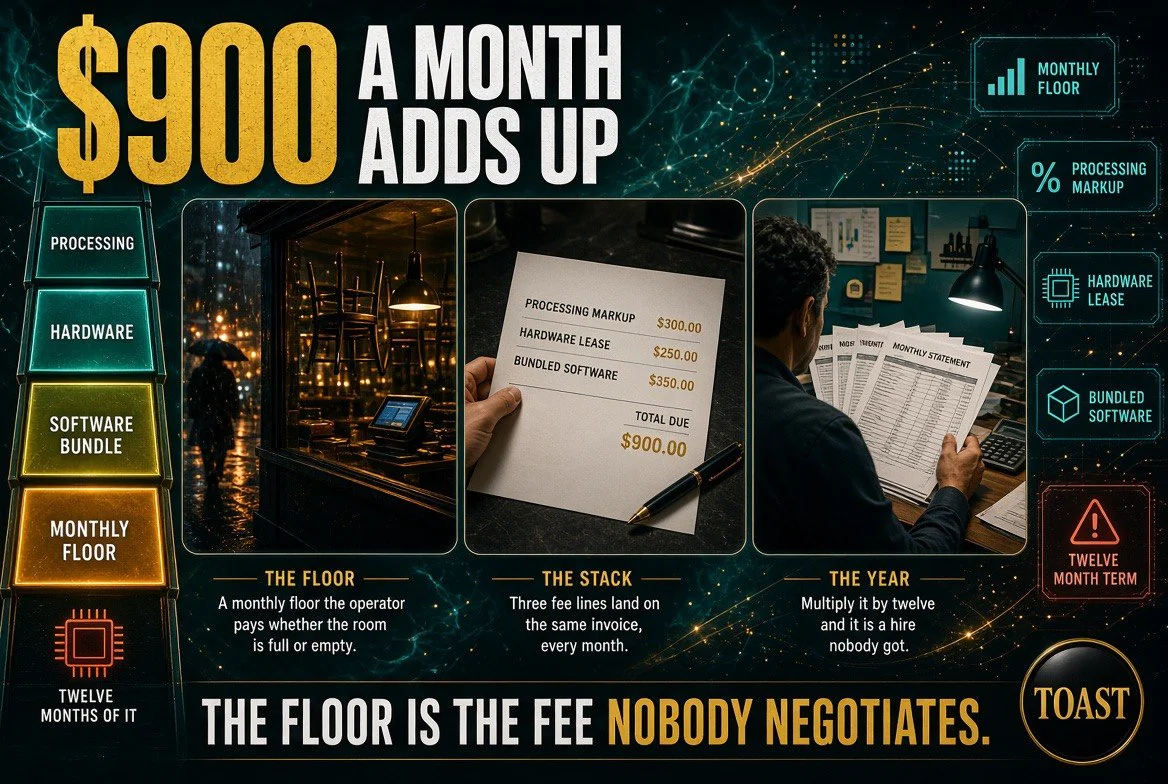
Most coverage of this lawsuit will focus on the cancellation maze, because that is the part that feels unfair. The number that should actually stop an operator cold is the average subscription cost: $900 a month.
That is $10,800 a year in software before you process a single card. For an independent restaurant running 3 to 5 percent net margins, $10,800 in annual software cost requires somewhere between $216,000 and $360,000 in additional revenue to cover — revenue you have to generate just to stand still on the same line item.
Here is what that looks like across restaurant sizes, using the FTC’s own average as the anchor:
| Restaurant Profile | Annual Software Spend at $900/mo | Revenue Needed to Cover It at 3% Margin | Revenue Needed at 5% Margin |
|---|---|---|---|
| Counter-service, 1 location | $10,800 | $360,000 | $216,000 |
| Full-service, 1 location | $10,800 | $360,000 | $216,000 |
| Two locations | $21,600 | $720,000 | $432,000 |
| Four locations | $43,200 | $1,440,000 | $864,000 |
Read that table twice. A four-location operator paying the FTC’s cited average is spending more than $43,000 a year on point-of-sale software — and covering it requires somewhere between $864,000 and $1.44 million in sales depending on margin. That is a meaningful chunk of the business, and it is exactly the number that nobody negotiates because the contract is signed once and then auto-renews into the background.
Toast, for context, says nearly 200,000 business locations run on its platform. The company reported $60.7 billion in payments processed in the June 2026 quarter alone, up 22 percent year over year, with net income up 93 percent to $154 million on $290 million in revenue. This is not a struggling vendor shaking down small operators to survive. It is a very profitable public company whose subscription line is one of the reasons.
Where AI Fits — and Why It Makes the Fees Worse
You might reasonably ask what any of this has to do with restaurant artificial intelligence. The answer is that AI is the newest layer being sold into the exact same contract structure — and it is arriving at the exact moment operators are least able to audit it.
Look at how restaurant AI is being packaged in 2026. Toast’s own AI products are sold as tiered subscriptions: its marketing agent suite starts at $699 per month on its own tier, and its labor agent suite starts at $60 per month plus $9 per employee per month — roughly $240 a month for a 20-person restaurant. Those are reasonable prices in isolation. Stacked on top of a $900 base subscription, they are the difference between a software bill of $10,800 a year and one north of $22,000.
And here is the part that should worry operators most: AI features have outcomes that are genuinely hard to verify. A scheduling agent’s 41 percent overtime reduction claim is vendor-reported beta data, not an audited figure. A marketing agent’s lift is attributed by the vendor’s own dashboard. A voice agent’s order accuracy is measured by the company selling the voice agent. This is not an accusation of dishonesty — it is a structural problem. When the vendor supplies both the tool and the scoreboard, the scoreboard is not evidence.
The FTC lawsuit matters in that context because it establishes a standard: promises have to be true, fees have to be disclosed, and cancellation has to be possible. If a 99-cent undisclosed fee and a “24/7/365” support line that does not answer are actionable, then an AI feature that does not deliver its advertised function is not a product disappointment — it is potentially the same category of violation.
That is why this is a restaurant AI story. The AI is not the villain here. The contract structure the AI is being sold through is.
What Independent Operators Should Actually Do This Week
Pull your merchant statement and read it line by line. Not the summary page — the full statement with every fee itemized. Highlight every line that is not the rate you were quoted. Most operators find at least three they cannot explain.
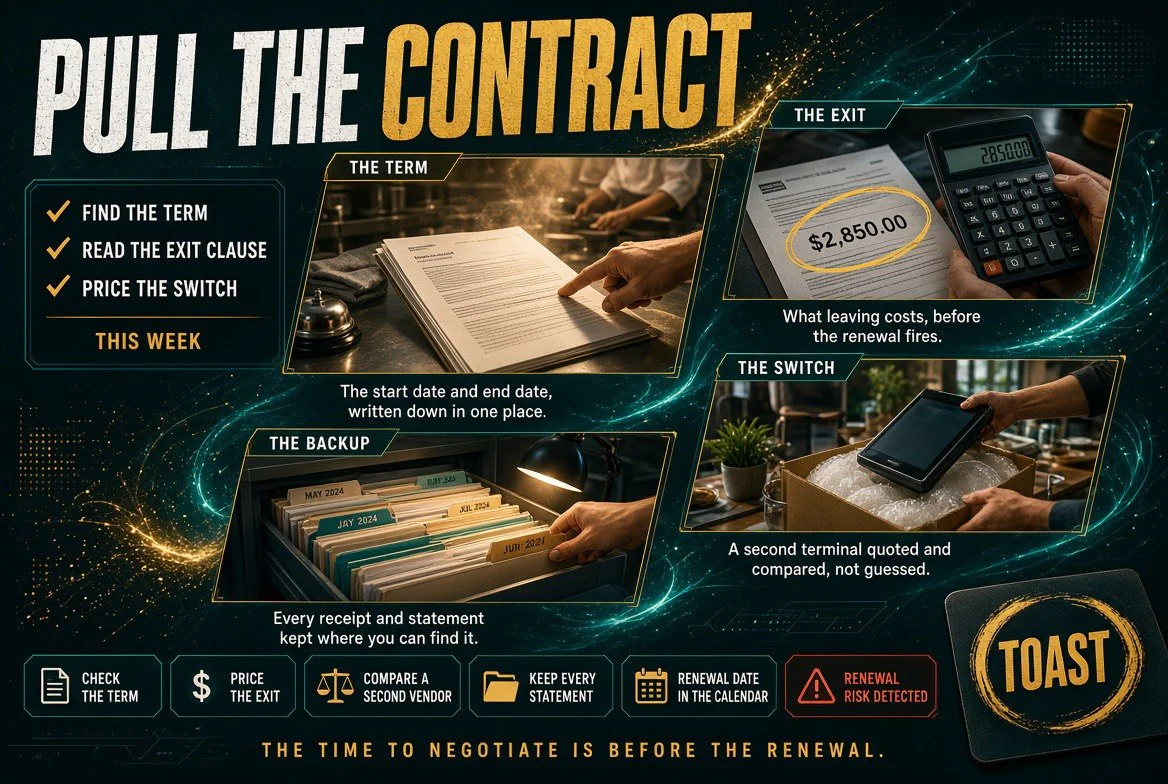
Find your contract and locate three clauses: the auto-renewal date, the termination formula, and the add-on authorization language. If you cannot find the contract, ask the vendor for a copy in writing this week. That request alone tells you something.
Audit your add-ons against what you use. Pull the last six months of invoices and list every module being billed. Anything you cannot match to a feature your staff actually uses is a cancellation candidate, and cancelling an add-on is far easier than cancelling the whole account.
Test your own support line. Call your POS support number at 11 p.m. on a Saturday and time how long it takes to reach a human. Whatever you experience is what your closing manager experiences every time the network drops during a dinner rush.
Do not buy an AI tier until you have a baseline. Before adding any AI subscription, measure the specific cost it claims to reduce — overtime hours, food waste, phone order capture, marketing-attributed revenue. Four weeks of baseline data turns a vendor promise into a testable claim, and a testable claim is the only thing that protects you if the pitch turns out to be marketing.
Negotiate the renewal, not the entry. The moment before auto-renewal is the only moment you have real leverage. Put the renewal date in your calendar ninety days out, with the fee audit attached to it. Operators who renegotiate on a schedule consistently pay less than operators who call in a panic after a bad quarter.
| Before You Sign or Renew | The Question to Ask in Writing | Why It Matters |
|---|---|---|
| Total monthly cost | “What is the all-in monthly cost including every fee, at this terminal count, in writing?” | The quoted rate and the billed rate are rarely the same number |
| Hardware ownership | “If hardware is $0, how is the cost recovered — rate, term, or both?” | Free hardware is financed somewhere; find out where before you sign |
| Add-on consent | “Can any add-on be activated without a signed order from me?” | Unauthorized add-ons are the most common complaint category in the FTC filing |
| Cancellation path | “What exactly do I do to cancel, and what does it cost if I do it on day 400?” | A cancellation you cannot execute is not a cancellation right |
| AI feature claims | “What baseline and methodology produced the performance number in your pitch?” | Vendor-reported results from beta cohorts are marketing, not proof |
| Support commitment | “What are the written support hours and response times, and what is the credit if you miss them?” | A promise with no remedy attached is not a commitment |
What Happens Next
Nothing fast. Litigation against a public company with a stated intent to fight moves on a calendar measured in quarters, not weeks. Toast reports third-quarter results imminently, and analysts will ask about the case. The company has already said it believes the consumer-subscription law it is accused of violating does not apply to negotiated business contracts — which means the early procedural fights will be about which law governs, not whether the conduct happened.
For operators, the outcome of the case is less important than the disclosure it has already forced. The complaint puts specific numbers on the record: a $900 average monthly subscription, a 99-cent fee that was kept by the vendor, hardware marketed as free that was not, support promised around the clock that customers say does not answer. Those are now facts in a federal filing, and every operator negotiating a restaurant technology contract in 2027 can point at them.
The larger shift is that restaurant software has spent a decade becoming invisible — embedded, bundled, auto-renewing, priced per terminal per module per month until nobody can reconstruct the total. Regulators just turned a light on. The operators who benefit are the ones who read their own statement before the FTC has to do it for them.
Frequently Asked Questions
What is the FTC lawsuit against Toast about?
The FTC and eight state plaintiffs allege Toast imposed hidden fees, enrolled restaurants in auto-renewing subscriptions without proper consent, made cancellation deliberately difficult, charged early termination fees, marketed hardware as free when it was not, promised 24/7/365 support that customers say they could not reach, and collected a 99-cent fee from diners on online orders above $10 that Toast kept without clear disclosure.
How much does the average restaurant pay Toast per month?
The lawsuit states that restaurant agreements require auto-renewing subscriptions averaging $900 per month, with the cost determined by how many terminals and add-on services a business bundles in. At that rate, a single-location operator spends roughly $10,800 a year on software before processing fees.
Is the Toast FTC lawsuit about AI?
Not directly — the complaint concerns fees, subscriptions and cancellation. But it matters for restaurant AI because AI features are being sold into the same contract structure as tiered add-on subscriptions. The lawsuit establishes that vendor promises about fees, support and product performance have to be true, which applies equally to AI feature claims.
What is Toast’s response to the lawsuit?
Toast says it strongly disagrees with the allegations and will vigorously defend itself, calling the action unprecedented. The company argues that courts have not applied the Restore Online Shoppers’ Confidence Act to negotiated business-to-business agreements and that it does not apply here. Toast also says it has cooperated with the FTC since mid-2025 and that the agency disregarded evidence of how extensively restaurant customers negotiate their contracts.
Should an independent restaurant cancel its Toast subscription over this?
Not reflexively. Switching POS systems costs far more in disruption, retraining and downtime than most operators expect. The better first step is auditing your actual statement line by line, cancelling add-ons you do not use, and putting your renewal date in the calendar so you negotiate from a position of preparation rather than urgency.
Which states joined the FTC’s lawsuit against Toast?
California joined through the Los Angeles County Counsel and the San Francisco City Attorney, alongside the attorneys general of Colorado, Florida, Illinois, Iowa, Nebraska, Oklahoma and Utah. The case was filed in the U.S. District Court for the Northern District of California.
What should I check in my own POS contract?
Seven things: every fee line on your merchant statement, which add-ons are opt-in versus opt-out, how free hardware cost is recovered, the written support hours and response commitments, the exact cancellation method and notice period, the early termination formula, and any per-order fee passed to your guests with the named beneficiary.

About Barak Schurr
Barak Schurr built and exited a major ticketing platform, ran global operations at Eventbrite, and now focuses on one question: which AI tools actually help independent restaurant owners run leaner and grow faster. He writes from the operator’s perspective — no vendor spin, no theory, just what’s real in 2026.
Email: [email protected]
More Resources for Restaurant Operators