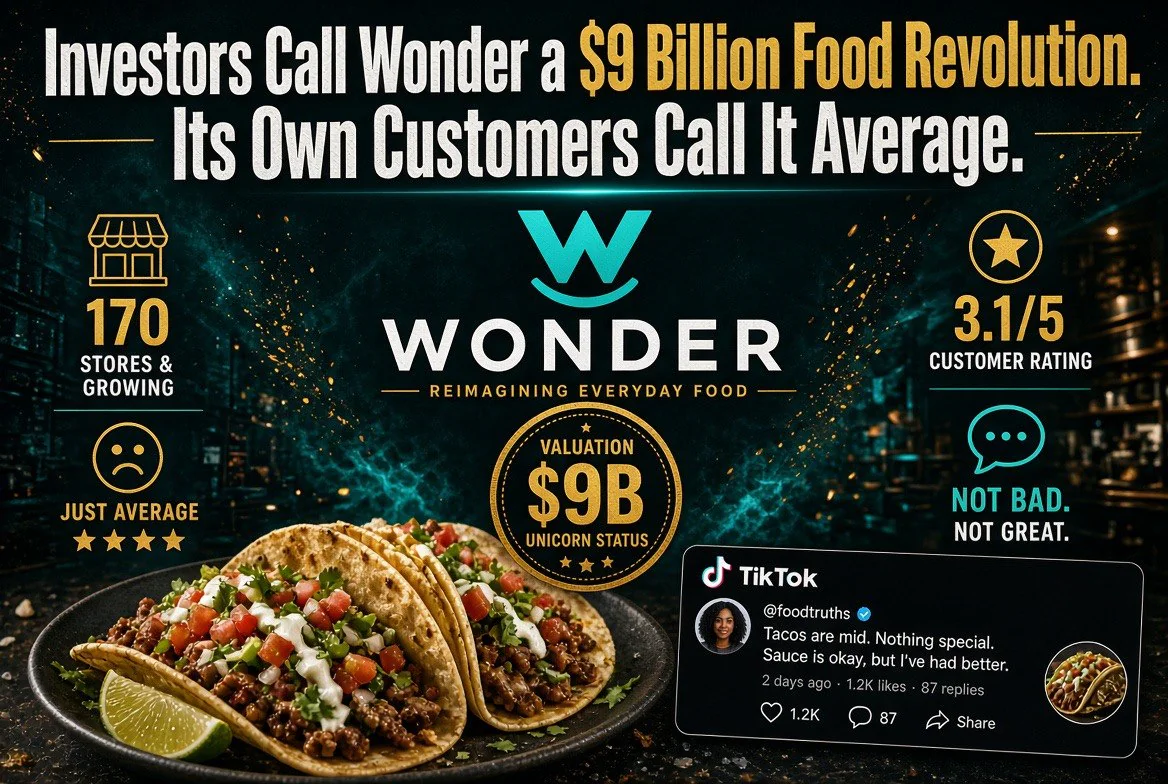
Investors Call Wonder a $9 Billion Food Revolution. Its Own Customers Call It Average.
⚡ Expert Summary: Wonder has raised $3.3 billion, hit a $9 billion valuation, opened 170 storefronts and is eyeing an IPO. It has also been operating at a financial loss since buying Blue Apron and Grubhub, and the most quoted customer verdict on its food comes from a TikTok that called it “just average” after paying $16 for three tacos. The gap between those two facts is the whole story. Wonder’s model works for investors because it is vertical integration dressed as a food hall: commissary kitchens, electric finishing equipment, licensed celebrity names, no gas lines, no open flame. It works less well for diners who expected a restaurant. For an independent operator, the useful question is not whether Wonder wins. It is which parts of its machine you can copy without buying the overhead.
CNBC published a video this week titled “Why Investors Love Wonder.” Nine hundred thousand views later, the comment section underneath it reads like a focus group that was never invited to the pitch.
Investors love the math. Diners keep describing the food as fine, which in a business selling dinner is the worst possible review.
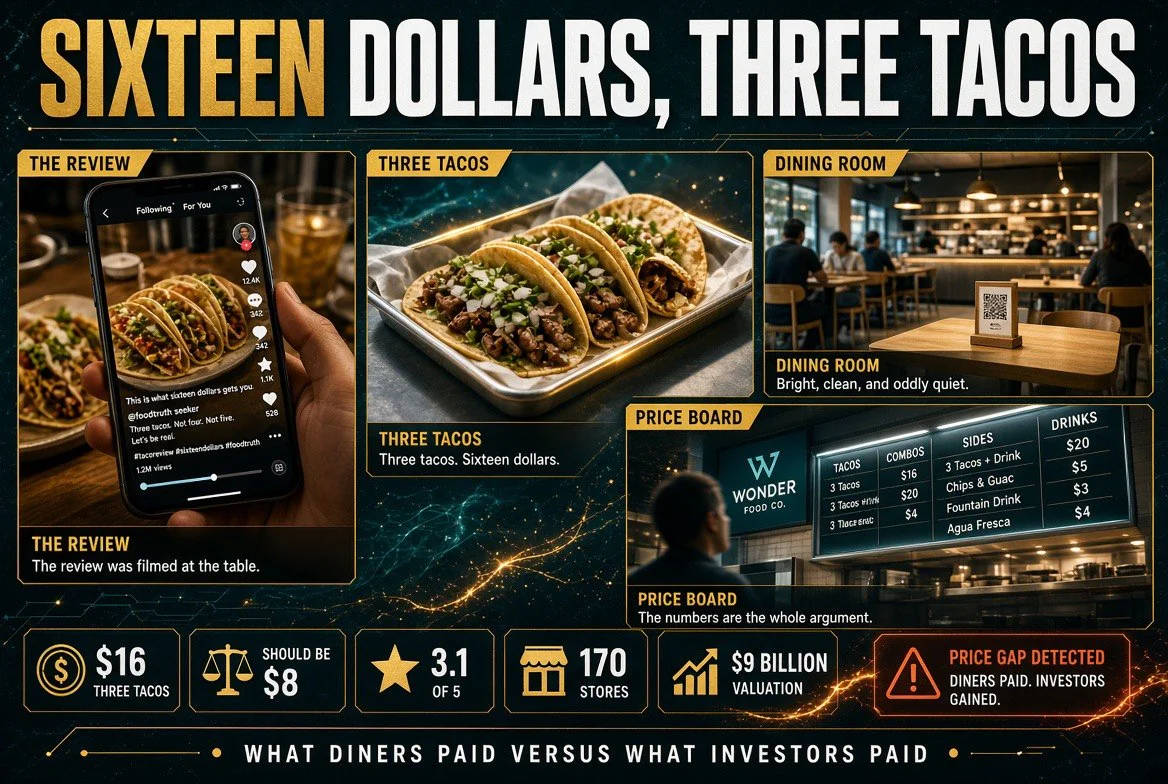
Both things are in the same CNBC package, four paragraphs apart. The company raised $3.3 billion. A man in Philadelphia paid $16 for three tacos and said they should have cost $8.
What Wonder Actually Is, Minus the Vocabulary
Marc Lore founded Wonder in 2018. The first version was sprinter vans fitted with mobile kitchens, driving to customers’ homes and cooking in the driveway. That lasted roughly two years before the trucks were phased out.
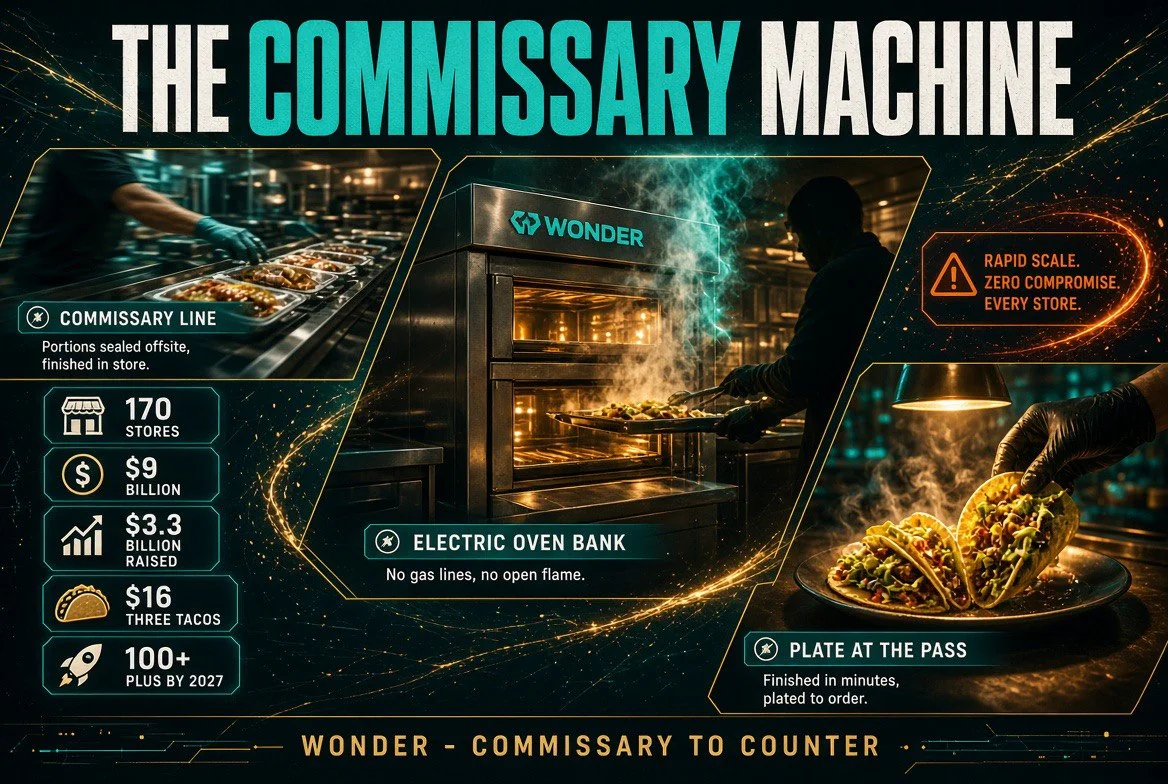
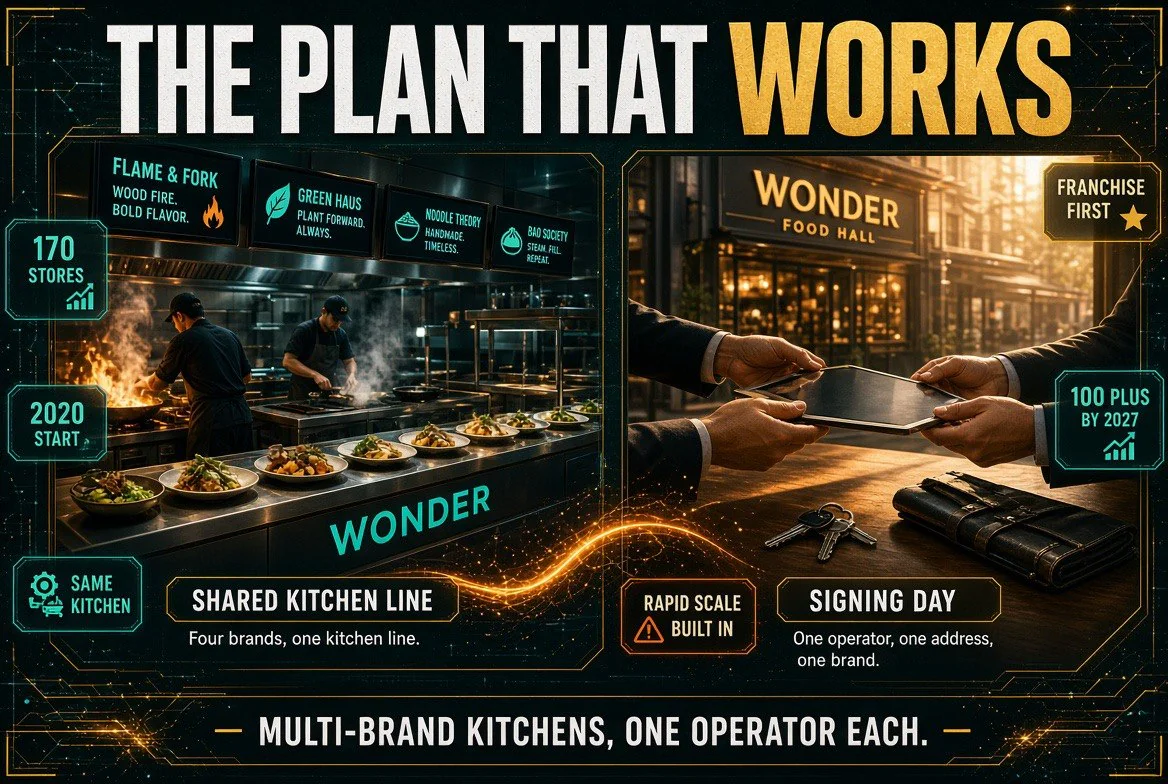
What replaced them is a storefront model. Food is prepared at commissary kitchens, transported to each location, and finished on site by employees who “unseal, cook and finish” the menu items. The locations are all-electric, without gas or venting, which lets Wonder move into a space quickly and cut renovation costs and red tape.
That last detail is the whole business model in one sentence. No gas means no flue, no hood, no fire suppression, no gas inspection, no hood cleaning contract. It is a real operational advantage, and it is also a hard ceiling on what the kitchen can do. You cannot char, smoke, or work a live flame if there is no flame.
The menu comes from more than two dozen “restaurants” operating under one roof, including Dabba Indian Kitchen, Tejas Barbecue and Pop Salad. Celebrity chefs including Bobby Flay, Michael Symon and Marcus Samuelsson receive up-front payments and equity in Wonder for the use of their names on some of those concepts.
Wonder has never called itself a ghost kitchen. It has called itself “a new kind of food hall,” then “a modern food court,” and has now settled on “a vertically integrated food technology platform.” Three names, one operation.
The Numbers Investors Are Actually Buying
Wonder has raised $3.3 billion to date. Investors include DoorDash, Alphabet’s venture arm GV, and Gwyneth Paltrow. A Series D round earlier this year put the pre-money valuation at $9 billion.
For scale: that is just under what Subway sold for two years ago.
Wonder has spent more than $1 billion on acquisitions, not counting deals where financial terms were never disclosed. The purchases include Grubhub, which Just Eat Takeaway sold for a modest $650 million, delivery and logistics provider Relay, meal-kit provider Blue Apron, and several New York restaurant concepts.
Lore’s read on why people keep funding it is refreshingly blunt. “Everybody eats,” he told CNBC. “It’s defensible from AI.”
That is not a food thesis. It is a market-size thesis. And it explains the whole pitch, because “everybody eats” describes the total addressable market, not a single satisfied customer.
| Metric | What Wonder Reports | What It Does to an Operator’s Decision |
|---|---|---|
| Total raised | $3.3 billion | A war chest you cannot match, so do not compete on capital |
| Valuation | $9 billion pre-money, Series D | Built on a loss-making business, so the pressure to cut costs will land on quality |
| Acquisitions | Over $1 billion spent | Grubhub and Blue Apron were distressed assets bought for scale, not for margin |
| Footprint | 170 storefronts in three years | A real operating record, and the most credible part of the story |
| Profitability | Operating at a loss since the acquisitions | The automation case must deliver, because the alternative is a price rise |
Read that table from the bottom up. The last row is why the automation story exists at all. Wonder is not automating because automation is elegant. It is automating because the company is running at a loss and needs its unit economics to change before a public market starts asking questions.
The Customer Verdict Is In the Same Article
CNBC did not hide the skepticism. It quoted it directly.
A TikTok from a 27-year-old in Philadelphia, reviewing three tacos in late 2025, put it this way: “It’s OK, but it’s just average. My expectations were already in the gutter — it’s not as bad as I thought it was going to be, but it’s still not great. And I paid like $16 for this, but it should have been no more than $8.”
“Average” is a worse word for a food business than “bad,” because bad is fixable and average is a value problem. A diner paying $16 for three tacos is running a comparison against every taqueria within a mile, and Wonder loses that comparison on the only metric that matters at that price point: does this taste like $16.
CNBC also acknowledged the wider pattern: some consumers are skeptical about Wonder specifically, and posts on social media decry the company’s food quality and its venture capital funding.
Lore’s response is worth quoting in full because it is genuinely the right thing to say. Wonder collects thousands of reviews every day, rating taste, temperature and portion size on a scale from one to ten. Board meetings start with the taste scores. “We’re maniacally focused on food quality,” he said. “We’re constantly iterating on the meals that score lower, and see over time, the last 12 months, our taste scores have improved, our Google reviews have improved.”
That is a real feedback loop, and it is more than most chains of this size can claim. The problem is what the loop can reach. You can tune a portion or a seasoning level inside a ten-point scale. You cannot tune your way to char, smoke, or a thing cooked to order in a pan.
The Part That Is Actually Good, and I Will Defend It
The strongest fact in CNBC’s piece is not about investors. It is about retention.
Based on transaction data from Indagari, Wonder’s weighted average retention rate — how likely a diner is to come back — and lifetime value were both higher than Cava and Sweetgreen.
That is not a marketing claim. It is a third-party read on repeat behavior, against two of the best-performing fast-casual brands in the country. And GV’s Dave Munichiello makes the argument underneath it: Wonder made this model work in the hardest market in the country to stand it up, New York, where diners have every alternative available.
Wonder also has a genuine structural advantage no independent can copy. Owning Grubhub means customers ordering through the Wonder app pay no delivery fees, and menu prices are not marked up to absorb commission. For an independent operator paying a delivery platform a cut on every order, that is an enormous advantage on the final line of the receipt, and it is the one place Wonder’s pitch is unanswerable.
Multi-concept ordering matters too. A family of four can order Indian, barbecue and a salad from one kitchen and pay one delivery fee. No single independent can offer that, and pretending otherwise makes the rest of this critique easier to dismiss.
The Path to a Public Listing Runs Through a $16 Taco
Wonder hired a chief financial officer in March, Gabrielle Scheibe Rabinovitch, previously at Worldpay, as the company prepared to go public. Lore declined to give CNBC a timing, though he has told Fortune the company would be “ready and prepared to go public early next year.”
On the record, his reason is straightforward: “The mission is really why I want to go public and raise the capital that it’ll take to build that kind of generational business, also to have a public currency to be able to do more M&A. But I can’t talk about timing.”
Translation: the IPO is not an exit, it is a funding round with a ticker. That is not a criticism, it is the honest read of what he said, and it tells you what the public market will be asked to believe. That a business running at a loss, holding distressed delivery and meal-kit assets, can automate its way to margin before patience runs out.
Renaissance Capital’s Avery Marquez gave CNBC the sober version of the risk: investors have grown less tolerant of startups pursuing growth at all costs, and unprofitable companies have to show they are taking steps toward profitability, or that growth will continue long after the IPO.
That is the bar. Not “does the food taste good” — although it should be — but “can you prove the machine gets cheaper as it gets bigger, while customers keep coming back.”
What Is Coming, and Why It Matters to an Independent
Two initiatives are in the pipeline, and both point at the same thing.
Wonder Create launches November 17. Influencers, entrepreneurs and brands pay $10 a month to start their own “restaurant” running out of a Wonder location, and earn a portion of the revenue from orders. Artificial intelligence helps them build the brand: name, logo, pricing and recipes. Lore wants it to democratise restaurant ownership minus the capital, the overhead and the kitchen oversight.
MEL is a proprietary AI platform that can take a customer’s health information — data from an Oura ring or a Whoop tracker, even blood biomarkers — and plan breakfast, lunch and dinner. It is not available to customers yet.
Read those two together and the strategy is legible. Wonder is trying to become the platform underneath other people’s restaurants, not just the restaurant itself. The $10 a month is not the business. The business is being the kitchen, the delivery network and the data layer for brands it does not have to build.
For an independent operator, that is the actual competitive threat. Not that Wonder will cook better than you. That it will let somebody else’s brand — an influencer with an audience you cannot reach — sell food through a kitchen that already exists, at a price that already has no delivery fee baked in.
The Five Things Worth Copying, and the One That Is a Trap
Strip out the valuation talk and Wonder is an operations company. Some of what it does is genuinely instructive, and none of it needs $3.3 billion.
| Wonder’s Move | Copy It if You Are Independent | Leave It Alone |
|---|---|---|
| All-electric, no gas, no venting | Only if you are opening a second site in a leased box with no hood | Never trade your flame for a faster build-out |
| Taste scored on a 1-10 scale daily | Yes, immediately, tonight. Ask every table one number | Nothing. This one is free and it is the best thing they do |
| Multi-concept ordering, one fee | Partner with one neighbouring concept for family orders | Building your own second brand before site one is profitable |
| Owning the delivery pipe | Push repeat guests to direct ordering with a real incentive | Buying a delivery company, obviously |
| Celebrity names on the menu | A local name with a real local following, if the food is theirs | Paying for a name the kitchen cannot honour |
The trap is the first row, and it is worth being precise about why. No gas is not a culinary choice, it is a real-estate choice. It means a space can open in weeks instead of months, without a hood, without a flue, without a gas inspection. Wonder’s own explanation is that it lets the company move quickly and cut down on renovations and red tape.
That works if your product is assembled and finished. It fails if your product is cooked. An independent who copies the electric build-out because it is cheaper will find out in the reviews, and by then the lease is signed.
The Thing That Should Worry Independent Operators Most
It is not the food. It is the data.
Wonder collects taste, temperature and portion scores on thousands of orders every day. It owns Grubhub, so it sees what people order when they are not ordering from Wonder. It has a wellness platform that wants your wearable data. And in November it will let third parties build brands on top of all of it.
No independent has anything close to that feedback loop. You find out a dish is underperforming when your regulars stop ordering it, which is weeks later and never quantified. Wonder finds out before the plate leaves the pass.
The cheap version of that advantage is available to anyone. Ask every table one question — rate tonight one to ten — and write down the number. Log it by dish. Look at it weekly. That is the entire mechanism, and it costs nothing but the nerve to hear the answer.
The Honest Bottom Line
Wonder is a real company with a real operational achievement: 170 stores in three years, a model that works in New York, retention numbers that beat Cava and Sweetgreen, and one genuine structural advantage in owning its own delivery pipe.
It is also a business running at a loss, holding acquisitions bought at distressed prices, charging $16 for three tacos that a customer said should cost $8, and asking a public market to fund the gap on the promise that automation fixes the economics.
Both things are true at once, and the arguments on either side are stronger when they admit it.
For an independent operator, the useful takeaway is not “Wonder is coming for you.” It is narrower and more actionable: copy the feedback loop, copy the direct-ordering push, copy the multi-concept convenience with a neighbour — and do not copy the build-out. The kitchen is the only thing your customer can taste, and no amount of capital makes up for a flame you gave up to save three weeks on a lease.
Frequently Asked Questions
How much has Wonder raised and what is it worth?
Wonder has raised $3.3 billion to date, from investors including DoorDash, Alphabet’s venture arm GV, and Gwyneth Paltrow. A Series D round earlier this year put its pre-money valuation at $9 billion, which is just under what Subway sold for two years ago.
Is Wonder a ghost kitchen?
Wonder has never called itself one. It has described itself as a new kind of food hall, then a modern food court, and now a vertically integrated food technology platform. The production method is centralized: food is prepared at commissary kitchens, transported to each location, and finished on site. Unlike the ghost kitchens that flamed out after the pandemic, Wonder has physical storefronts with front-of-house seating.
Is Wonder profitable?
No. Since buying Blue Apron and Grubhub, Wonder has been operating at a financial loss, as previously reported by The Information. Its plan to reach better unit economics relies on automation, drone delivery and scale, though the company acknowledges the groundwork will not be cheap.
Why do some customers say the food is only average?
Independent reviews and social posts repeatedly describe the food as fine but unremarkable, and often not worth the price. A widely quoted TikTok review of three tacos put it at “just average” and said the $16 price should have been closer to $8. Wonder responds that its internal taste scores and Google reviews have improved over the last twelve months and that quality should improve with scale.
What is Wonder Create?
A subscription launching November 17 that lets influencers, entrepreneurs and brands pay $10 a month to start their own restaurant based out of a Wonder location and earn a portion of order revenue. Artificial intelligence helps build the brand, including name, logo, pricing and recipes.
Do customers actually come back to Wonder?
Yes, according to third-party data. Based on transaction data from Indagari cited by CNBC, Wonder’s weighted average retention rate and lifetime value were both higher than Cava’s and Sweetgreen’s.
Should an independent restaurant copy Wonder’s model?
Copy the feedback loop, where every order is scored on taste, temperature and portion size, and push repeat guests toward direct ordering. Do not copy the all-electric, no-gas build-out. That choice exists to speed up real estate moves, and it removes the flame and technique a full-service kitchen depends on.
About Barak Schurr
Barak Schurr is a serial entrepreneur who built and exited a major ticketing platform before turning his attention to AI and content. He runs three AI-focused research sites and writes about the tools, workflows, and strategies that let independent restaurant owners compete with the chains — without a corporate budget.
Email: [email protected]
More AI Restaurant Resources