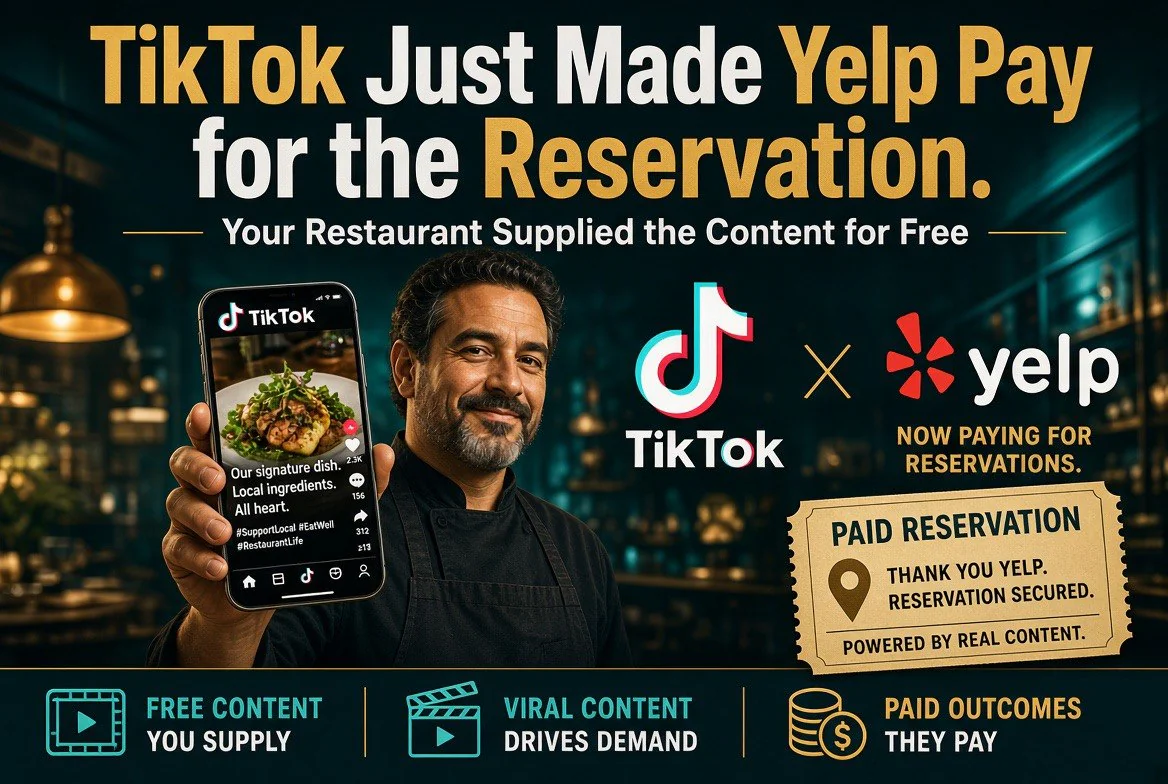
TikTok Just Made Yelp Pay for the Reservation. Your Restaurant Supplied the Content for Free.
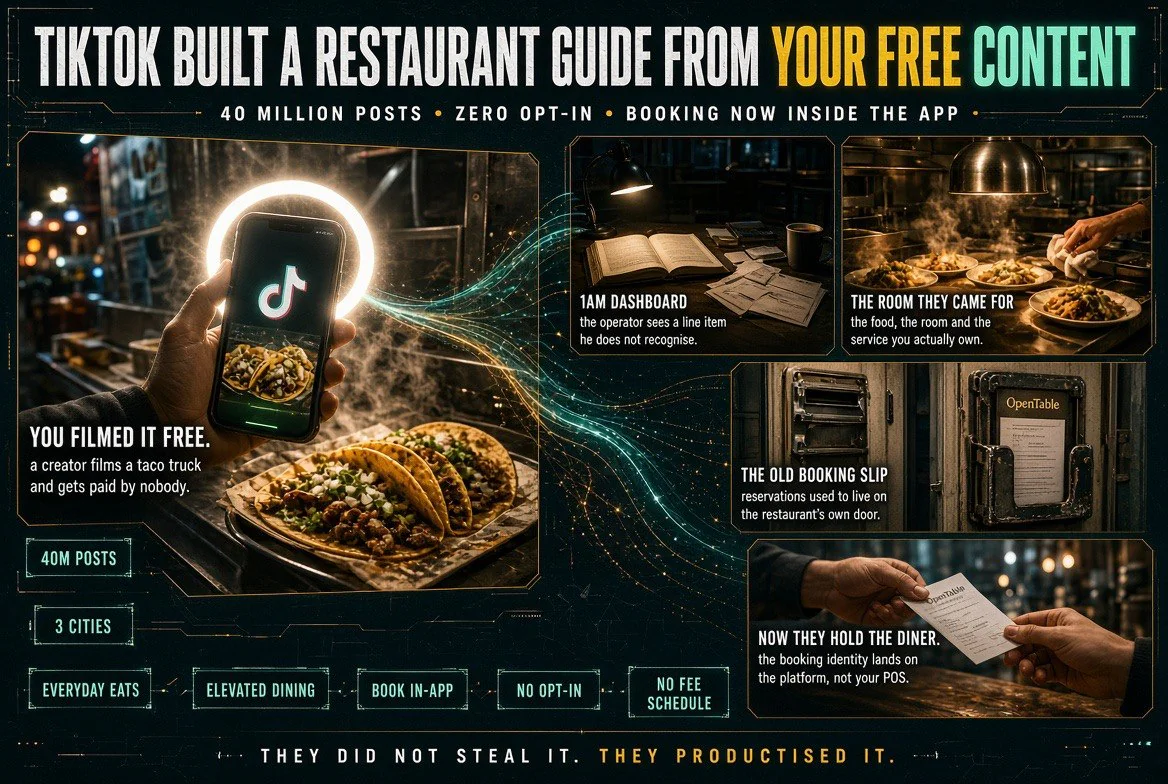
⚡ Expert Summary: On Wednesday, TikTok launched Must Eat, a restaurant guide built from 40 million food posts and comments, live in New York, Los Angeles and San Francisco. It filters by cuisine, price, rating and location, it splits lists into “Everyday Eats” and “Elevated Dining,” and at selected restaurants it takes the booking through OpenTable without the diner ever leaving the app. Every pick in that guide exists because a creator walked into a restaurant and filmed it. Nobody paid for that content. TikTok is now monetizing the discovery layer that independent operators built for it, in exactly the way Yelp did — and the booking, the data and the customer relationship land on TikTok’s side of the transaction, not yours.
I have watched this movie before, and it ends with a restaurant owner in a back office at 1 a.m. refreshing a dashboard that shows him where his diners came from, seeing a line item he does not recognize, and being told that is the price of visibility.
Here is the sequence. A platform builds an audience. Restaurants discover that the audience matters. They start chasing it — filming the dishes, buying the ring light, hiring the kid who can edit, mentioning the platform in every conversation with every customer. Then the platform converts that unpaid ambition into a directory: a structured way to browse, rank and book. And the moment the directory exists, the restaurant’s relationship with its own diner becomes something the platform can route, measure, and charge for.
TikTok has now reached step four. And unlike Yelp, which asked restaurants to go build pages themselves, TikTok started with the content already on its servers — roughly 40 million posts and comments of it.
What Must Eat Actually Is, and What Is Quietly Strange About It
Must Eat is a community-driven guide, not a review site. It does not ask diners to score anyone out of five. It reads what people are already saying in TikTok videos and comments, compiles restaurant recommendations, and organises them into browsable lists.
The mechanics as reported: it draws on more than 40 million posts and comments. Users browse by city, then filter by cuisine, price, rating and location. Recommendations split into Everyday Eats, for casual restaurants and neighbourhood favourites, and Elevated Dining, for occasions and celebration nights. Selected restaurants can take reservations in-app through the OpenTable integration. It rolls out in three US cities first — New York City, Los Angeles and San Francisco — reachable through the search bar, the Local feed, restaurant pages, and location links attached to videos.
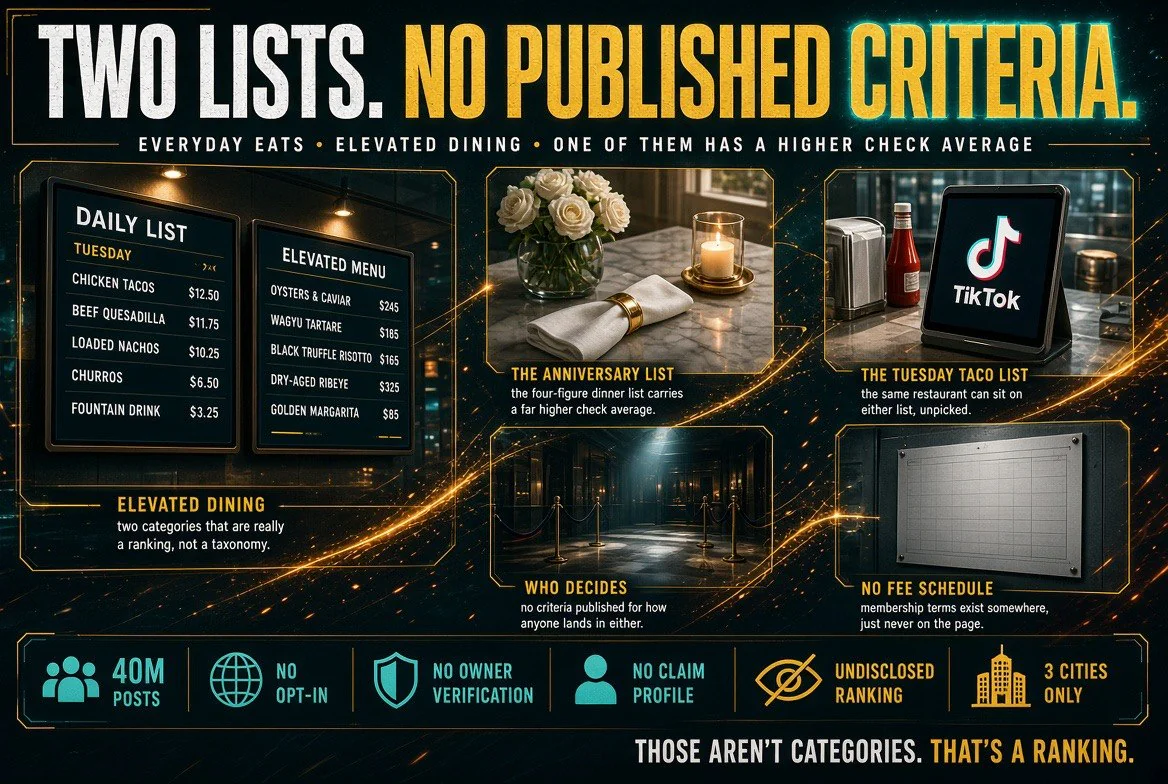
Now read that list again and notice what is missing. There is no opt-in described. There is no owner verification described. No fee schedule, no claim-your-profile flow, no disclosure of how a restaurant lands in “Elevated Dining” instead of “Everyday Eats.”
That last one should bother every operator reading this. Those two categories are not a taxonomy. They are a ranking. “Elevated” is the list diners go to when they are spending four figures on anniversary dinner, and “Everyday” is the list they use for Tuesday tacos. One of those has a materially higher check average. TikTok has created a two-tier placement, populated it from organic creator behaviour, and published no criteria for how a restaurant ends up in either.
The Uncompensated Creator Problem Nobody Is Naming
Here is the part of this story that the coverage is skipping because it is inconvenient for a launch narrative.
TikTok’s guide works because creators filmed restaurants for free. A restaurant did not commission that content. A creator did not invoice TikTok for the discovery data their video became. The platform collected both, and the guide is the product.
Restaurant operators, for their part, have spent three years being trained to chase exactly this outcome. Every article about viral food content, every agency deck about TikTok marketing, every “how we got 40 million views on a quesadilla” case study has told the independent operator that TikTok attention converts into tables. And it does. That is precisely why the guide will work.
But look at what the operator actually owns at the end of it. You own your food, your staff, your lease, and your margin. TikTok owns the review-free ranking that decides who sees you, the in-app booking that owns the diner identity, and the analytics that tell you how you performed on their surface. You have supplied the raw material — the dish, the room, the service, the viral moment — and you do not own the directory entry built from it.
This is not a reason to delete the app. It is a reason to be cold-eyed about what a platform relationship actually is. TikTok did not steal anything. It did what every distribution layer eventually does: it turned other people’s unpaid work into a product, then centralised the transaction.
| Factor | TikTok Must Eat | Yelp | Google Maps |
|---|---|---|---|
| What drives the ranking | Creator and user posts plus comments | Written customer reviews, star rated | Review volume, relevance, proximity |
| Who produced the content | Viral creators and commenters, unpaid by you | Diners and the business itself | Diners, plus owner-supplied listings |
| Owner can see the criteria | No published criteria | Partially, opaque ad layer | Partially, opaque local pack |
| Booking at launch | OpenTable in-app, selected venues | Third-party reservation links | Reserve with Google partners |
| Coverage right now | NYC, LA, San Francisco only | National | National |
| Where the diner relationship lands | TikTok account and OpenTable | Yelp account | Google account |
That last row is the one that costs money for the next five years. Every platform that owns the booking owns the diner’s identity, which means it owns the ability to bring that diner back — or to sell a competitor the chance to intercept them.
OpenTable Wins Either Way, Which Tells You Something
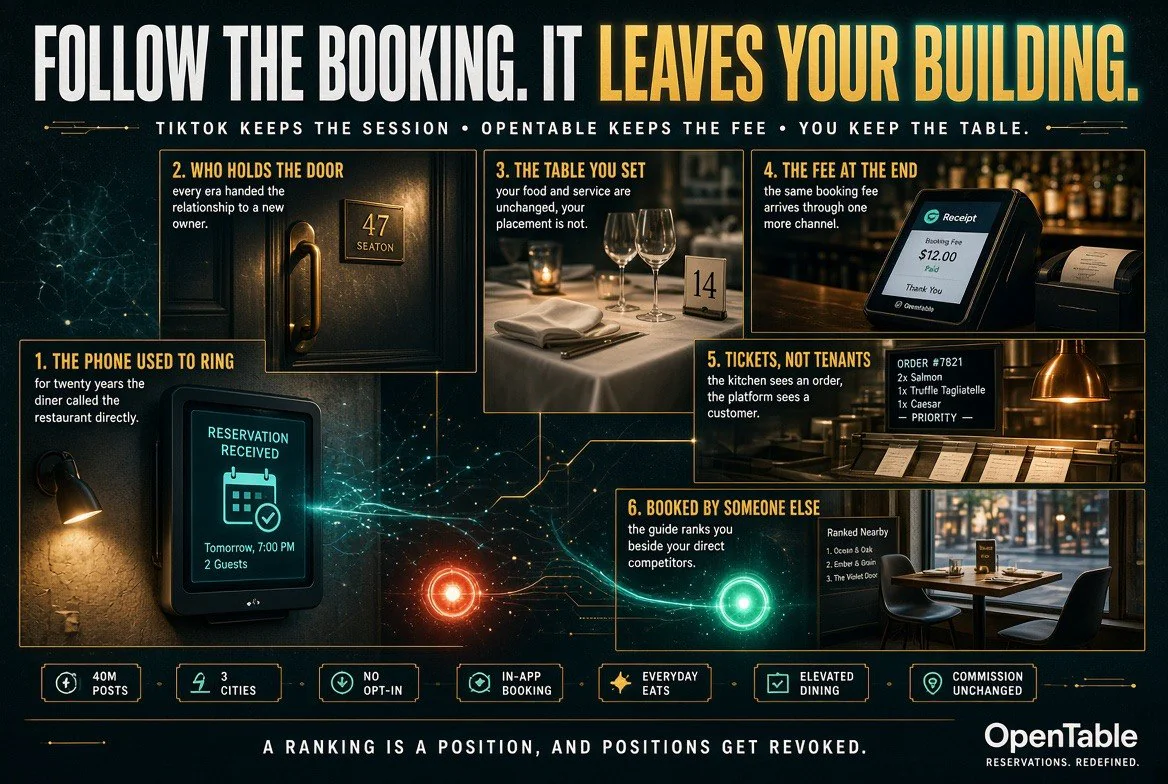
Follow the booking. Must Eat does not run its own reservation system. It integrates with OpenTable, and reservations at selected restaurants flow through it.
So who is having a good Wednesday? TikTok gets the session, the data and the ad surface. OpenTable gets demand arriving from a platform with enormous reach among exactly the demographic that books anniversaries and birthdays. And the restaurant gets a reservation it might well have taken anyway — now taxed at whatever commission sits in its OpenTable agreement, routed through a discovery surface it does not control, with no direct line to the guest.
If you are already paying OpenTable covered-market fees of the kind independents have been complaining about for years, this launch does not change that equation. It deepens it. Your restaurant is now reachable through one more channel that ends in the same booking fee, and the new channel is the one your own customers’ videos built.
The counterargument is real and worth stating plainly: a new discovery surface that puts independent restaurants in front of people who would never have found them is genuinely valuable, and a booked table is a booked table. There is nothing dishonest about taking the reservation. What is dishonest is taking it without knowing the structure of the deal you just joined.
What This Does to the Value of the Reservation
There is a deeper shift happening here, and it applies whether or not Must Eat ever expands past three cities.
For two decades, the restaurant’s asset was the phone number and the walk-in. Then it was the review score. Then it was the email list you actually owned. Each of those was a shift in who held the relationship with the diner, and each shift cost operators margin in ways that were invisible until the invoice arrived.
Discovery-driven booking compresses that further. When the path to a table runs through a guide that ranks you against your direct competitors by an undisclosed process, then your competitive position is partly someone else’s editorial judgment, expressed as placement. Your food has not changed. Your service has not changed. Your ranking can.
That is the part operators underestimate. A viral video is luck. A ranking in a guide is a position — and positions are contested, monetizable, and revocable.
| Who holds the relationship | Typical era | What it cost you | What you still owned |
|---|---|---|---|
| You, via the phone | Pre-2010 | Staff time only | Everything |
| Review platforms | 2010 onward | Ads, reputation management, time | Guest identity, contact list |
| Reservation networks | 2015 onward | Per-cover fees and commissions | Service standards, menu control |
| Social guides and marketplace booking | Now | Commission plus placement opacity | The room, the food, the team |
What an Operator Should Actually Do This Week
Practical, in order, and none of it requires deleting TikTok.
Find out whether you are in it. If you operate in New York, Los Angeles or San Francisco, search your own restaurant in-app and check both categories. Then check your two closest competitors. If you are sitting in Everyday Eats and they are sitting in Elevated Dining, that placement gap is worth more than any ad you are running this month, and you have no documented way to contest it.
Read the commission line in your reservation contract before you assume the integration is neutral. Must Eat routes bookings through OpenTable. If your venue is one of the selected restaurants, new demand arrives on terms you agreed to years ago — or never read closely.
Own one channel outright. A booking platform that owns the diner’s identity can re-market, re-target and re-route that diner. A list you hold yourself cannot be reranked by an algorithm. Send one thing a month to people who already ate at your restaurant and liked it, and you have built the only asset on this list that no guide can rescore.
Do not build your marketing plan on being discovered. Viral discovery is not a strategy, it is a lottery ticket with a nice design. Discovery platforms reward whoever is hot this quarter and reprice everyone else. Consistency of product is the only thing that survives it.
And when Must Eat expands past three cities — which, given the 40 million posts behind it, it almost certainly will — the operators who are ready are the ones who already decided that platforms are distribution, not ownership.
Frequently Asked Questions
What is TikTok Must Eat?
It is a community-driven restaurant discovery guide TikTok launched on 28 October 2026. It compiles restaurant recommendations from more than 40 million posts and comments on the platform and organises them into browsable lists by city, cuisine, price, rating and location.
Where is Must Eat available?
It launched in three US cities: New York City, Los Angeles and San Francisco. Users reach it through TikTok’s search bar, the Local feed, restaurant pages, and location links attached to videos.
Can diners book a table through TikTok?
Yes, at selected restaurants. Must Eat integrates with OpenTable, so reservations can be completed inside the app rather than routing the diner to an external booking site.
What is the difference between Everyday Eats and Elevated Dining?
Everyday Eats covers casual restaurants and neighbourhood favourites. Elevated Dining highlights venues for celebrations, special occasions and nights out. TikTok has not published the criteria that place a restaurant in either category.
Does Must Eat replace Yelp or Google Maps?
Not yet. Its coverage is limited to three US cities, while Yelp and Google Maps are national. The competitive difference is that TikTok ranks on creator and user video content rather than written star reviews.
Did TikTok pay restaurants for the posts in the guide?
No. The guide is built from posts and comments users and creators produced themselves. Restaurants supplied the venue and the dishes that made the content possible, and no compensation structure has been announced.
Should independent restaurants worry about Must Eat?
Worry is the wrong response; awareness is the right one. Check your placement, read the commission terms in your existing reservation contracts, and keep at least one customer channel you own outright so a placement change cannot cut your demand.
Related Reading on AI Table Review
If this argument lands, the rest of the platform problem is worth reading next. Yelp’s AI now calls restaurants for you covers what happens when the platform also takes the phone call. OpenTable’s largest AI feature suite is the reservation-network half of the same squeeze. And the full AI tools archive on AI Table Review tracks which of these vendors actually earn their commission.

About Barak Schurr
Barak Schurr built and exited a major ticketing platform, ran global operations at Eventbrite, and now focuses on one question: which AI tools actually help independent restaurant owners run leaner and grow faster. He writes from the operator’s perspective — no vendor spin, no theory, just what’s real in 2026.
Email: [email protected]
More Resources for Restaurant Operators