Get the AI Restaurant Quick-Start Guide — Free
The 5 AI tools independent US restaurant owners are using right now to cut labor costs and answer every call.
Slang AI Built Its Voice Agent Around Outcomes, Not Seats
⚡ Expert Summary: Slang AI has repositioned its restaurant voice agent as a revenue system instead of a phone system — and it did it on the one metric independents actually feel: missed calls that turn into booked tables. For a single-location operator, the question is no longer whether AI can answer the phone. It is whether the tool you already pay for reports what that call was worth.
What Slang AI Is Actually Selling Now
Slang AI has been running in the restaurant voice space for years, answering phones, taking reservations, and handling the calls that land during a Friday dinner rush when nobody on the floor can pick up. The company markets itself as the AI Superhost for restaurants.
What has changed is the framing. The pitch has moved from call answering to call conversion, and the language across the product now leans on booked reservations, captured orders, and recovered revenue rather than minutes handled.
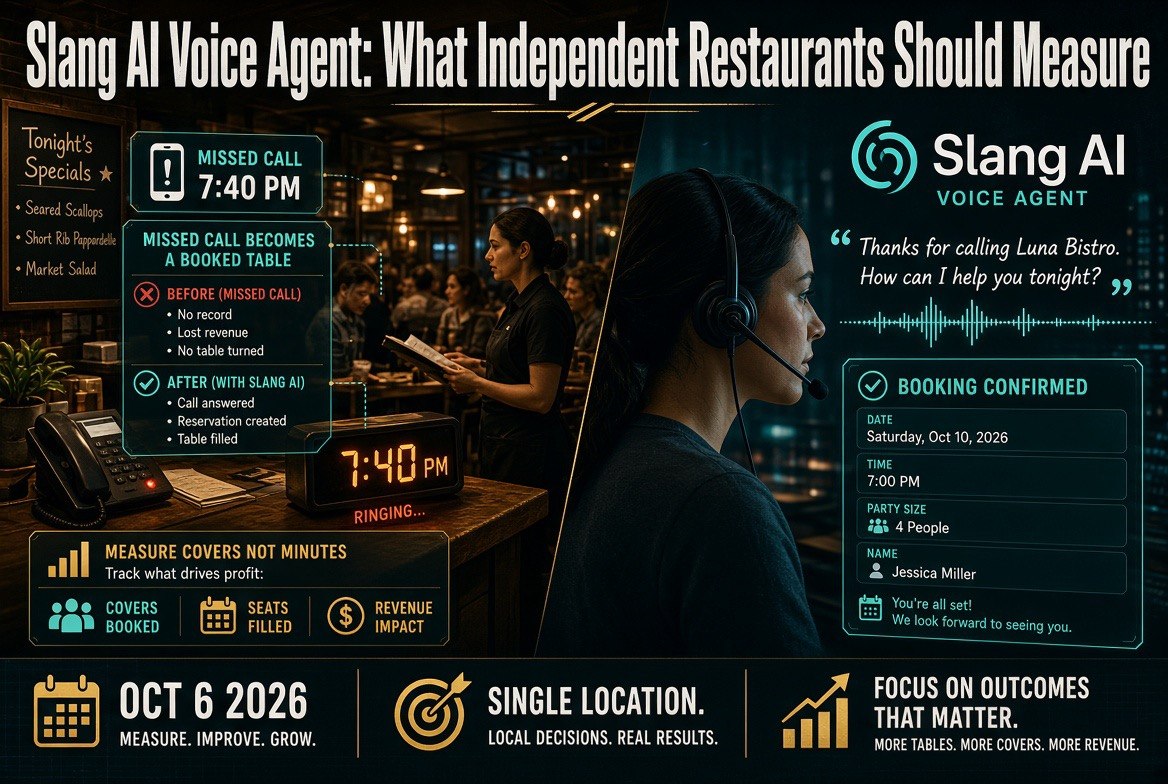
That shift matters more for independents than for chains. A chain can absorb an unanswered call. A single-location restaurant with a two-host stand and a 90-seat room cannot. Every missed reservation at 7:40 on a Saturday is a table that went somewhere else, and the owner usually never learns it happened.
This is the same operator problem we looked at when DoorDash pushed its AI ordering agent into independent restaurants — the tool layer is consolidating around the question of who captures the demand, and voice is the last unclaimed surface.
Why Voice Is the Hardest Channel to Fix
Online reservations are already solved for most independents. OpenTable, Resy, and the native Toast and Square booking stacks all handle the digital path. Voice is different, and it is different for structural reasons.
A phone call is unstructured. The caller does not follow a form. They ask whether you can seat eight at 7:30, whether there is parking, whether the patio is heated, whether the kitchen can do gluten-free for a birthday party, and then they change their mind and want 8:45 instead. A human host handles all of that in forty seconds without thinking about it.
That is why voice AI failed early. The systems could not hold a multi-turn conversation with background noise, a host who is already seating someone else, and a caller who needs a real answer. The current generation is materially better at this, and the gap between a 2023 voice agent and a 2026 one is wider than most owners assume.
What Independents Should Actually Measure
If you are evaluating a voice agent, or already paying for one, the useful question is not “does it answer.” It is “what did it convert.” Here is the comparison that matters, laid out against the phone system most independents already have.
| Factor | Old Phone Line | Slang AI Voice Agent | What the Owner Sees |
|---|---|---|---|
| Calls at peak | Roll to voicemail | Answered, all simultaneous | No missed-table report |
| Reservation capture | Only if a host is free | Booked into your system | Count and covers recovered |
| Opens the store | Owner calls in | Owner calls the agent | Daily summary, not a log |
| Voicemail review | Manual, next morning | Summarised and dated | Names, party, ask |
| Cost model | Included in the line | Monthly subscription | Compare to covers lost |
The third column is the one that separates a useful vendor from an expensive answering machine. If the tool cannot tell you what it converted, you are paying for the appearance of coverage rather than the fact of it.
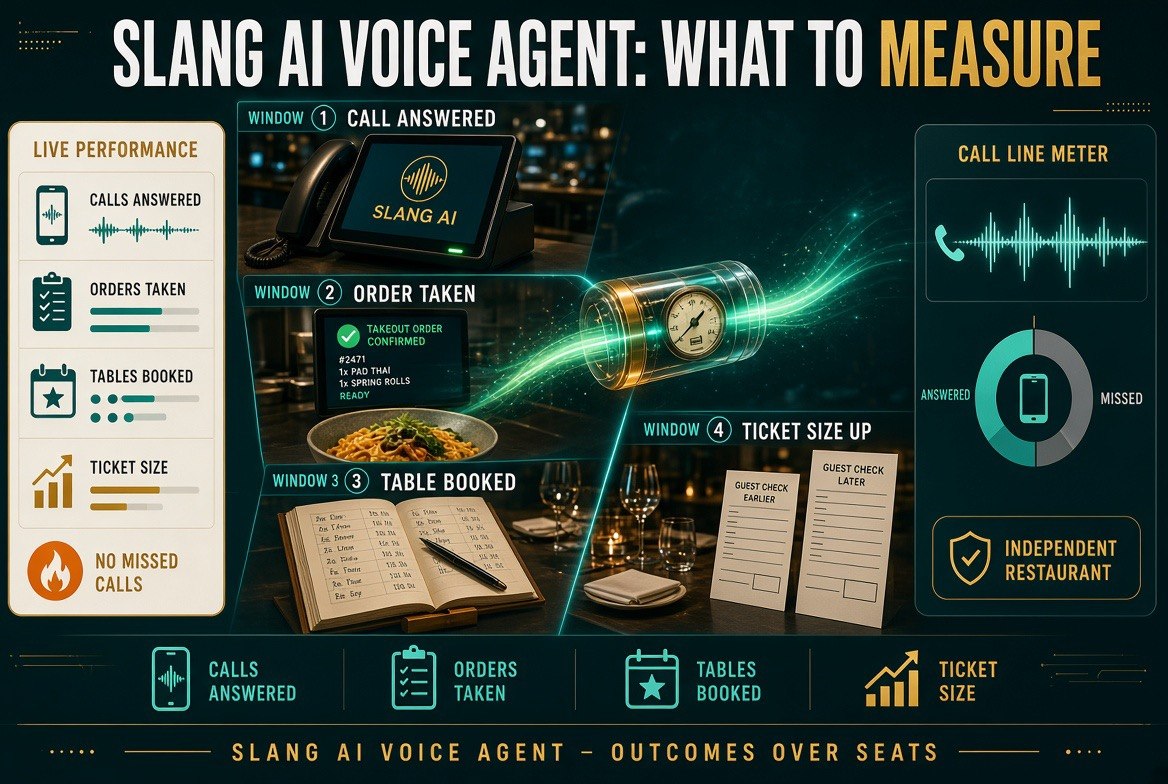
Measure calls answered, orders taken, tables booked and ticket size – not seats.
Why the Voice Layer Is Consolidating Right Now
Restaurant technology has spent a decade moving on-premise work into software. Scheduling, inventory, purchasing, payroll, and reservations all moved to a browser tab. The phone was the exception, and it stayed the exception because voice is genuinely hard to automate.
Two things changed. Speech recognition became accurate enough in a noisy dining room to be usable, and language models became capable of holding a real multi-turn conversation without collapsing into a scripted menu. Those two changes landed at roughly the same time, and the result is a crowded market appearing in a single year.
The consequence for independents is uncomfortable: the vendors are now competing on speed of adoption rather than depth of integration, and the hard sell is arriving before the hard evidence. That is not a reason to ignore it. It is a reason to evaluate on your own numbers rather than theirs.
Where Independents Actually Lose Money on the Phone
Independent Restaurant Association research and operator surveys across 2026 have pointed at the same pattern: the highest-value calls arrive at the worst possible moment. The Friday and Saturday 6-9pm window is when reservation enquiries peak and when every member of staff is committed to the floor.
A missed call in that window is not a neutral event. The guest does not leave a message and wait. They call the next restaurant on the list, and the booking is gone without a trace. The owner sees an empty four-top at 8:15 and assumes a walk-in did not show, when in fact the demand was there and the phone was not.
That invisibility is the real cost. Waste you can see and fix. Lost demand you cannot, because nothing on the P&L records a reservation that was never taken.
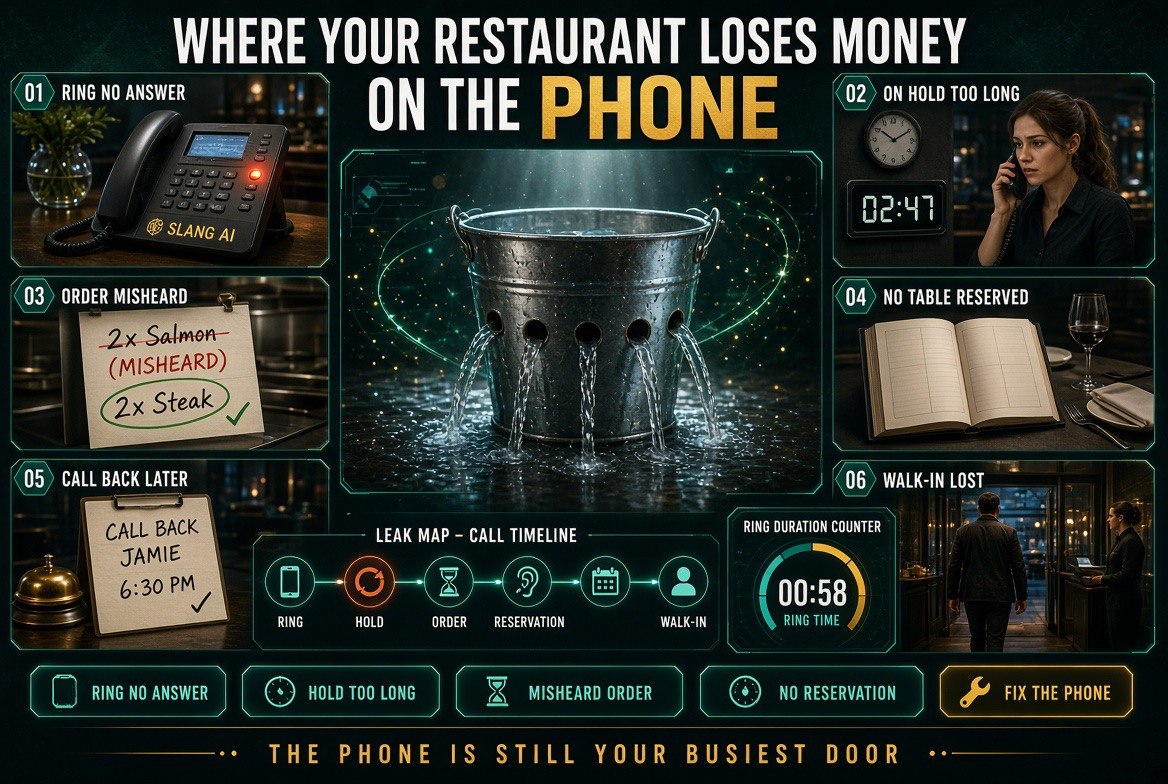
Six ways an independent restaurant quietly loses money at the phone.
The Questions to Ask Before You Sign Anything
The voice agent market is young enough that contract terms matter as much as the product. Before signing, get clear written answers to these.
What happens to my number? Some vendors port your line, some forward, some use a new number you advertise. Porting is cleanest long-term but harder to reverse. Confirm what leaving looks like before you commit.
Who owns the call data? Recordings and transcripts contain guest names, phone numbers, and sometimes payment details. You want that data under your control, with a clear deletion policy and a plain statement of where it is stored.
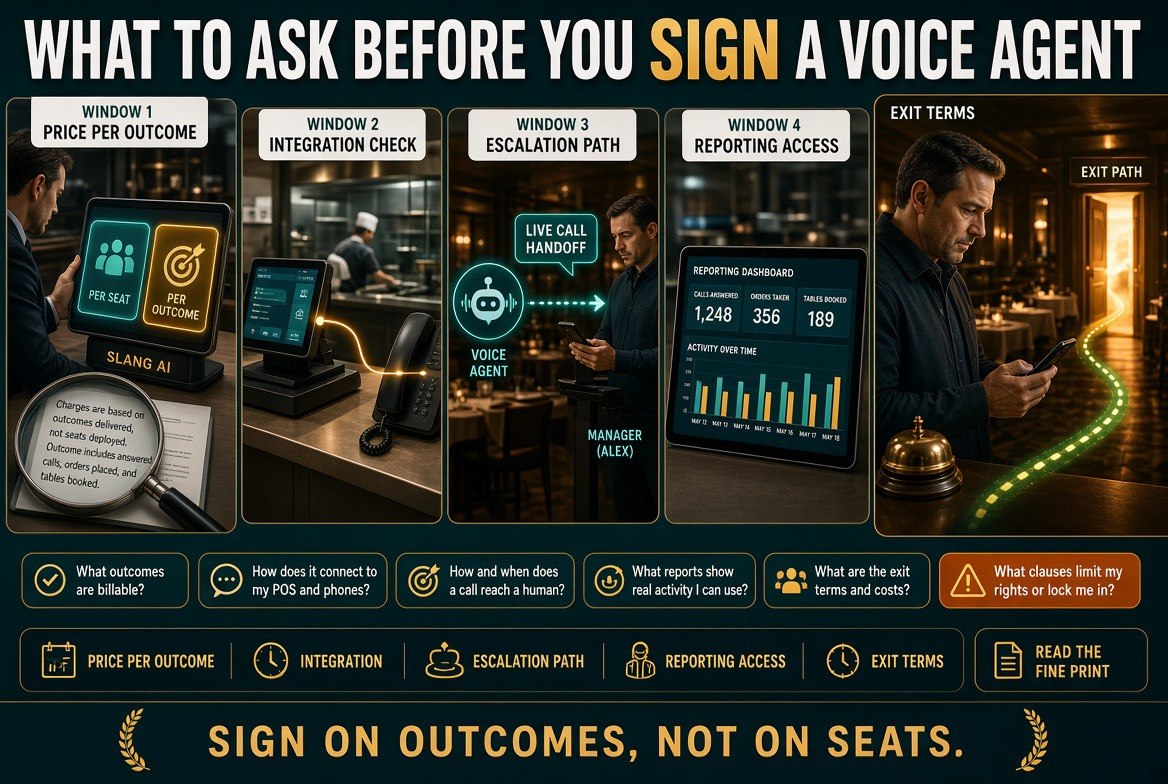
Five questions to ask before signing any voice agent contract.
What is the fallback when the agent fails? Every system fails eventually. The good vendors have a defined path: ring through to a human, take a message, or route to a backup line. Ask for it explicitly and test it during the trial.
Does it handle your accent and your menu? Generic models mispronounce menu items and struggle with strong accents and local dialect. This is the most common disappointment in the first week and the easiest thing to test before purchase.
What is the exit? Month to month versus annual terms, notice periods, and whether the number comes back with you. Read that clause before the pricing page.
The theme across all five is the same one that runs through every AI tool decision an independent faces this year: the answers are boring, and they are the difference between a tool that makes you money and one that quietly costs you.
Where Slang AI Fits Against the Other Voice Players
Voice ordering for restaurants is not one market. It is at least three, and independents are usually shopping in the wrong one. The table below maps the categories, because the vendor you pick should depend on which problem you actually have.
| Category | What It Solves | Wrong Fit When |
|---|---|---|
| Inbound call answering | Missed reservations and questions at peak | Your host stand is already covered |
| Phone order taking | To-go volume that overwhelms the line | You do under 20 takeout calls a night |
| Drive-thru voice | Speed of service on a window | You have no drive-thru |
| Outbound marketing voice | Win-back and event outreach | You have no list to call |
Most independents with a genuine problem are in the first two rows. That is the segment Slang AI is built for, and it is why the outcome framing matters more than the technology framing.
What This Means for Your Restaurant This Week
You do not need to buy anything to act on this. Here is the sequence that produces a real answer in a few days.
1. Count your missed calls for three nights. Pull the phone log from Friday, Saturday, and one midweek service. Count calls that hit voicemail or rang out. Most owners are shocked by the Friday number, and it is the only number that justifies the spend.
2. Convert that to covers. Take the missed count, apply your historical conversion rate for phone enquiries, and multiply by your average check. If the result does not exceed the monthly subscription several times over, you do not have a voice problem.
3. Check what your current system integrates with. A voice agent that books into a system you do not run is worse than voicemail, because it creates double bookings and staff exemptions. Confirm the integration before you sign.
4. Ask the reporting question on the demo. Request the weekly summary an owner actually receives. If the answer is a call log, you are buying coverage. If the answer is covers recovered with a dollar figure, you are buying revenue.
5. Run one service in parallel. Keep a human on the line for one busy night while the agent runs alongside, and compare what each captured. One night tells you more than a month of vendor claims.
Frequently Asked Questions
What does Slang AI do for restaurants?
Slang AI provides an AI voice agent that answers restaurant phone calls, handles reservations and common guest questions, and reports captured bookings back to the operator.
Is a voice agent worth it for a single-location restaurant?
It depends on missed call volume. If you are losing reservations at peak service, the recovered covers usually exceed the subscription quickly. If your phone is quiet, the tool is a cost with no return.
Can an AI voice agent book into my existing reservation system?
Most current agents integrate with major systems. Always confirm the integration with the specific platform you run before signing, because a booking flow that does not sync creates double bookings.
How do I measure whether the AI voice agent is working?
Measure captured reservations and recovered covers with a dollar value, not minutes handled or calls answered. Calls answered is a vanity metric. Covers recovered is the real one.
Does an AI voice agent replace my hosts?
It replaces the missed call, not the host. The agent handles overflow and after-hours volume. The floor still needs people to seat guests, read the room, and handle the situations a phone call cannot.

About Barak Schurr
Barak Schurr built and exited a major ticketing platform, ran global operations at Eventbrite, and now focuses on one question: which AI tools actually help independent restaurant owners run leaner and grow faster. He writes from the operator’s perspective — no vendor spin, no theory, just what’s real in 2026.
Email: [email protected]
More Resources for Restaurant Operators